Archives for June 2009

Temple of Literature, Hanoi, Vietnam

One of the more impressive places to visit in Hanoi is the Temple of Literature. Originally built in 1070 as a Confucian Temple, in 1076, part of the complex became Vietnam’s first university. Its purpose was to educate the ruling class– the bureaucrats and the nobles and other members of the elite.

Temple of Literature, Hanoi

Temple of Literature, Hanoi

During the time it functioned- from 1076 to 1779, many of the students were not successful in passing the final examinations. The names of those who succeeded were engraved in a stone stele and over the entire period, only 2,313 students’ names were recorded.

The temple is constructed with a series of five courtyards and three paths lead through it. In older times, only the king would use the center path. There are a number of attractive buildings, manicured gardens, and ponds on the complex.

Garden view

Garden view

Statue of a phoenix next to offerings in the temple

Statue of a phoenix next to offerings in the temple

The day we visited, we saw many Vietnamese high school students, dressed in their graduation robes, having their pictures taken against the beautiful gardens and buildings.
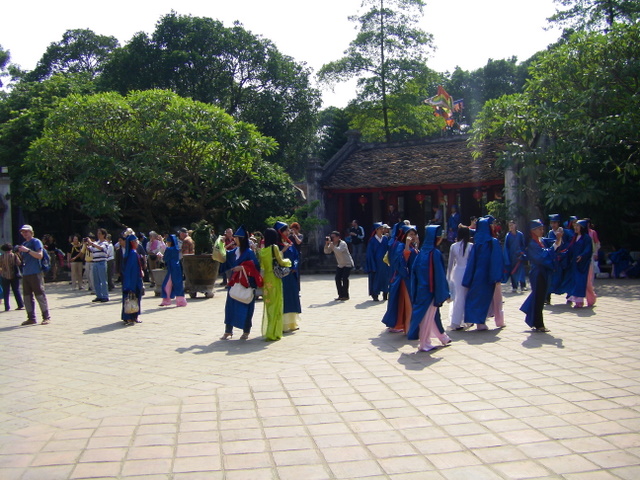
Students in their graduation robes

Students in their graduation robes

We also were treated to a concert of Vietnamese music played on traditional instruments. Altogether delightful!
The Temples of Angkor

I will be posting in the future about the temples of Angkor, probably one at a time, but for now there is a wonderful site put up by National Geographic that shouldn’t be missed. It is here.

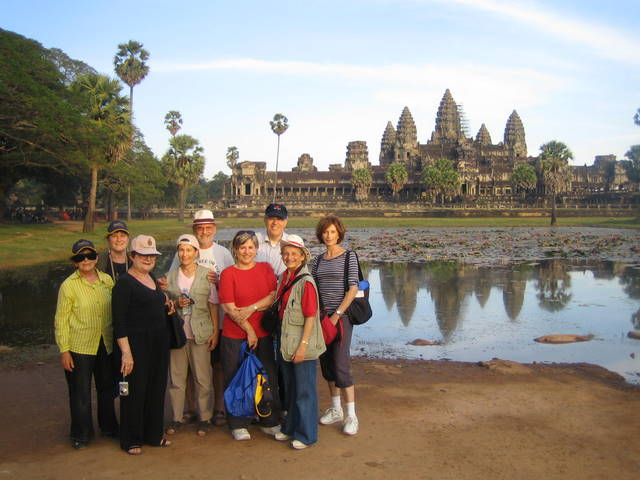
Meanwhile, here is a picture of me with our group from last November in front of Angkor Wat

Group in front of Angkor Wat

Group in front of Angkor Wat

The Summer Palace, Beijing

OK, friends, time to get your suntan lotion, hats, and water bottles. Today we will visit the Summer Palace.

At the Summer Palace

At the Summer Palace

The history of the Summer Palace dates back some 800 years when the first emperor of the Jin Dynasty, Wan Yanliang, moved his capital to the vicinity of Beijing and built his “God Mountain Palace” at the present site of Longevity Hill. From then on, in accordance with Feng Shui, the area was developed by subsequent emperors with the basic elements of the hill and water. Over the years, the structures changed and the names of the hill and the body of water shifted.

By the time of the Yuan Dynasty (1271–1368), there was already an official Forbidden City in the heart of Beijing, and the Summer Palace became the place where the emperor and empress and their entourage would come for relaxation, particularly during the hot days of the summer. There was a lake and trees and as time went on more and more buildings.

Over the years, the Summer Palace has been destroyed twice. The first time, in 1860, Anglo-French forces invaded Beijing and ravaged two of the loveliest areas in the complex, Yuanmingyuan Garden and the Park of Pure Ripples. Because they most of the buildings were made of wood, nearly every building in the park was destroyed by fire. Only the few nonflammable structures such as bronze pavilions and stone pagodas were spared.

In 1888, Empress Dowager Cixi who had a reputation for enjoying luxury, diverted 30 million taels of silver that had been designated for the Chinese navy into reconstructing and enlarging the Summer Palace. She had the southern side of Longevity Hill laid out in imitation of West Lake in Hangzhou and the northern side built in the architectural style of Suzhou, one of the more beautiful cities in China, sometimes termed “Venice of the East.” Cixi gave the park its present name: Yiheyuan (Garden of Good Health and Harmony), known in English as the Summer Palace.

In 1900 when the Eight-Power Allied Forces invaded Beijing, the great temples rebuilt in the 1880s were completely demolished and almost every valuable object in sight stolen by the invading troops. In 1902, when Empress Dowager Cixi returned to Beijing from Xi’ an, she ordered the reconstruction of the park. According to historical records, she “rebuilt the Summer Palace with unbounded extravagance and opulence, spending some 40,000 taels of silver per day. Singing and dancing went on without end.”

After the revolution of 1911 when the emperor was overthrown, the Summer Palace became the private property of the young deposed Emperor Puyi.

Today the Summer Palace is a delight for the senses. Even on the hottest summer days, the breeze from Kunming Lake cools visitors. The willow trees and the parasols carried by visitors give it a look of Oriental elegance. Paddle boats for visitors, both domestic and foreign, make a visit there a pleasant outing. Visitors can imagine the elaborate meals served here, the receptions and the Western musical entertainment that served to amuse both the imperial family and their guests.

Here is Kunming Lake

Kunming Lake, the Summer Palace

Kunming Lake, the Summer Palace

There are a number of noteworthy sights at the Summer Palace. One is the Long Corridor, an outdoor covered corridor that extends 720 meters in length and contains over 8000 hand painted pictures of flowers, birds, and landscapes.

The Long Corridor

The Long Corridor

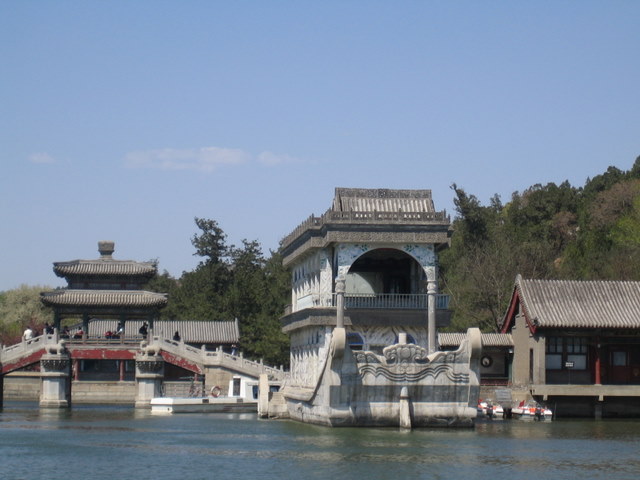
Another is the Marble Boat, a structure built by Cixi to symbolize the stability of the dynasty. Of course, not long after, the dynasty was ousted.

The Marble Boat

The Marble Boat

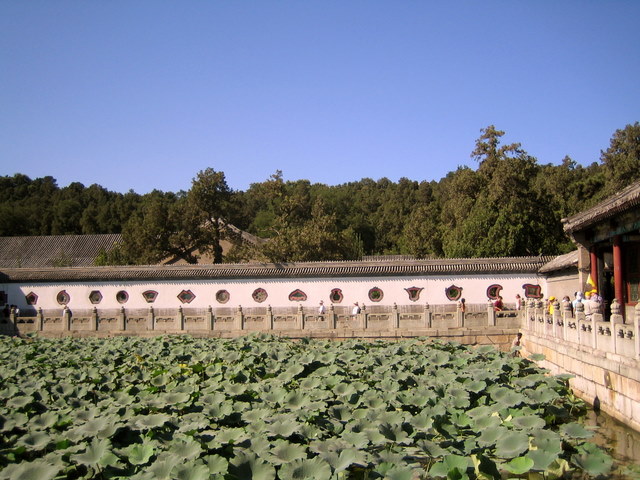
And last, for now, here is a picture of an indoor corridor. Notice that there are no two windows that have the same shape. On each of the windows, there is a picture painted and none of the pictures are the same either. The Chinese love variety.

Corridor behind lotus plants

Corridor behind lotus plants

Take it from me, the Summer Palace is captivating and one trip is not nearly enough.

Cambodia – Tonle Sap

This is an excellent article on Tonle Sap, a real phenomenon. It is a lake that during the rainy season expands enormously. The water current actually changes twice a year. During the dry season, the water flows from it to the Mekong Delta, but in the rainy season, the water backs up causing the lake to swell, carrying with it lots of fish.

Here are a few pictures I took when I visited there…

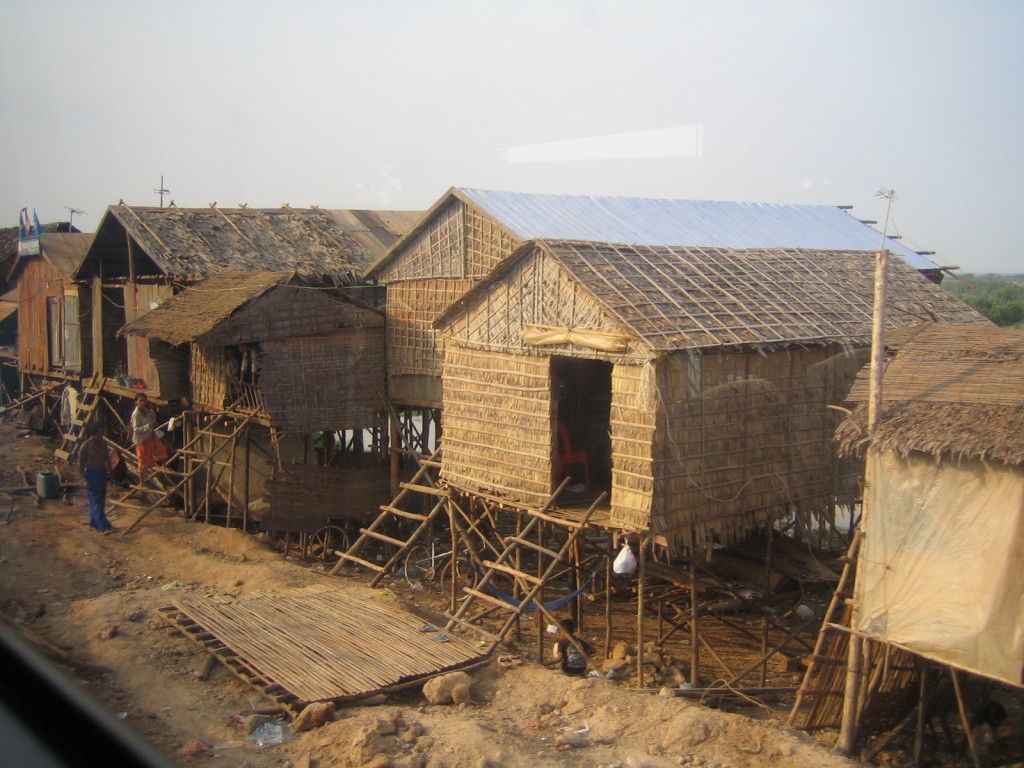
homes along Tonle Sap

homes along Tonle Sap

These homes were usually one room homes and contained places to sleep and usually a TV. They have no indoor plumbing and we could see wells with pumps for fresh water that had been donated by foreigners. All of these homes can be dismantled and trucked to other locations. In fact, I took this picture on my first trip to Cambodia and when I returned a year later, this whole line of homes had been relocated.

Another home next to a water pump

Another home next to a water pump

This, as the other, was photographed through the bus window, hence the glare and reflection. You should be able to see on the right a sign with US and Cambodian flags that marks the donation of the pump by an American donor.

The weather tends to be warm all year long. The two seasons are wet and dry- so it is not unusual to see little children running around without clothes.

Beautiful child

Beautiful child

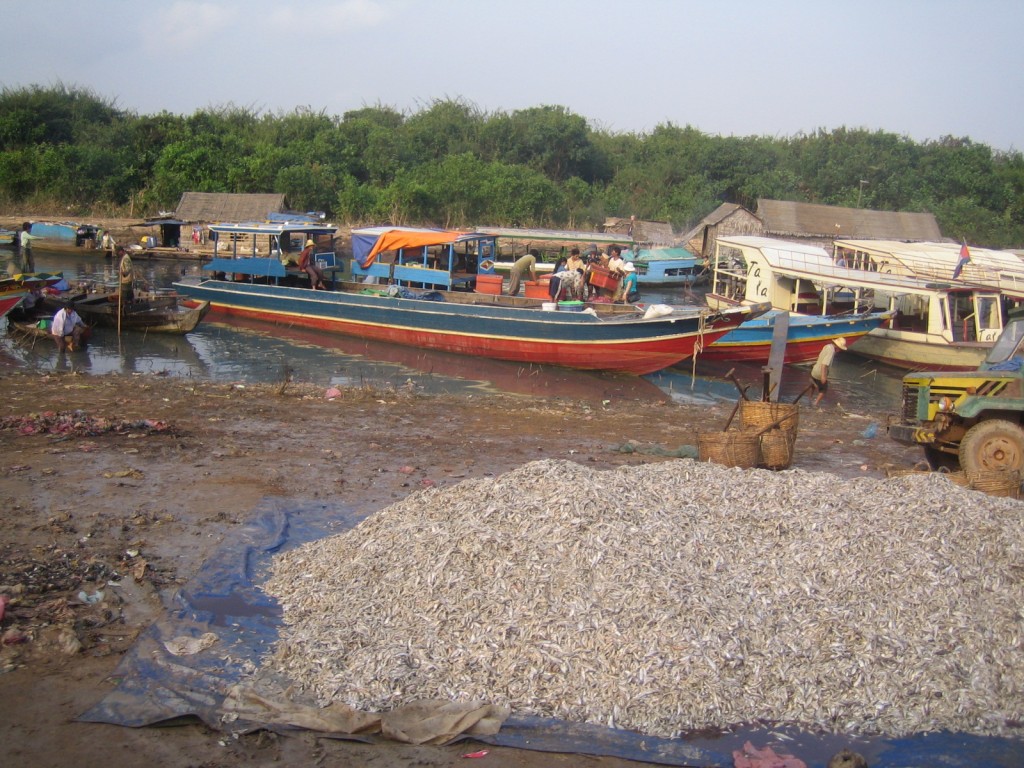
The fishing industry

The fishing industry

Fishing is a very important industry. In the foreground is a pile of dried fish!

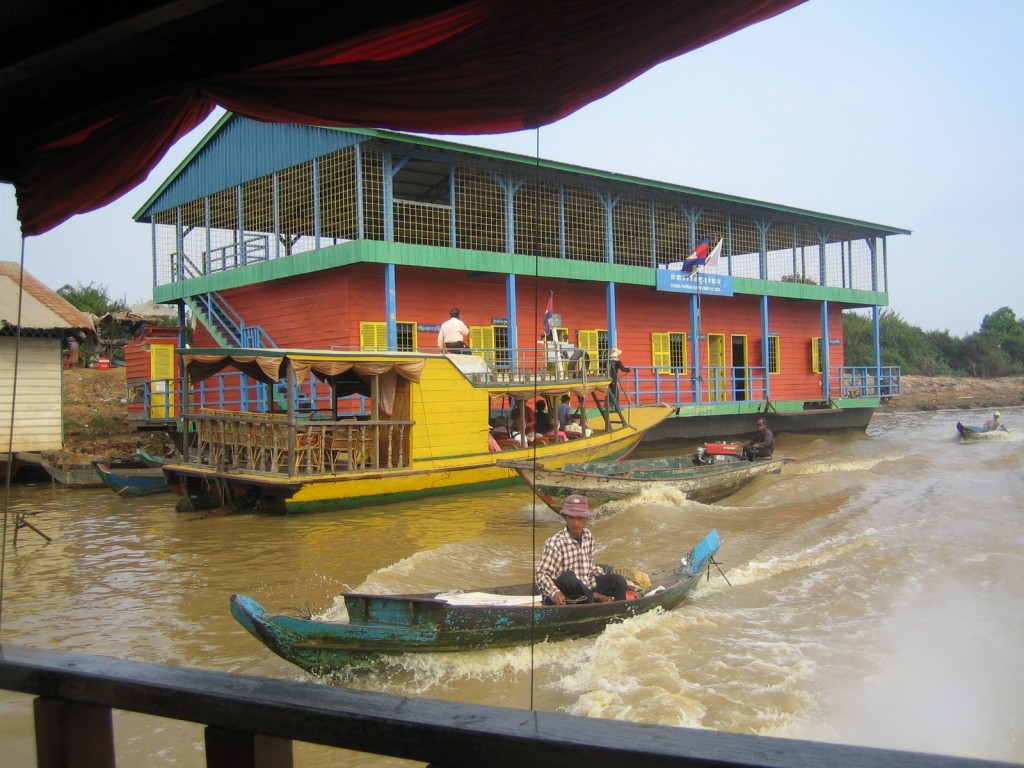
A floating elementary school

A floating elementary school

This school is moored, but is completely transportable. The upstairs area is for recess and play activities. Some schools have basketball courts that are fenced like this one so that out of bounds balls don’t end up in the Mekong Delta!

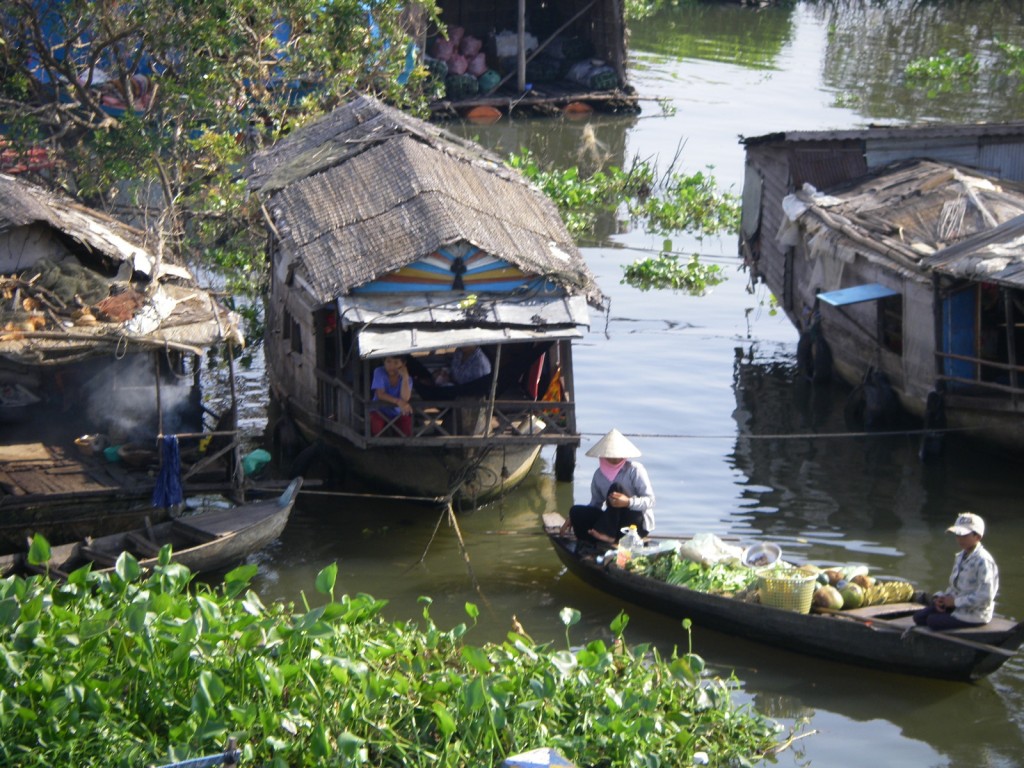
Buying fruits and vegetables

Buying fruits and vegetables

There are many people who live on boats. They can have delivery service to their door (so to speak).

Floating church

Floating church

And yes, a floating church, complete with a Cambodian flag next to the door. Here’s a piece of trivia: Cambodia’s flag is the only country’s flag that features a structure. On its flag is a drawing of Angkor Wat. Someday, we will explore Angkor Wat on this site. Stay tuned.

Pin It on Pinterest