Archives for January 2010

Rona & Aaron’s Excellent Adventure, Part 11

Previously…

After a wonderful day in Halong Bay, we woke up the next morning ready for our next adventure. Our guide, Mrs. Phuong, was originally from Halong Bay and she knew all of the most picturesque places. She took us to a fishing pier that was truly amazing. We saw beautiful displays of vegetables and marveled as fisherman brought in piles and piles of creepy, wiggling fish. There were all sorts of fish, some we’ve seen before and others we hadn’t. There were long silvery fish and short pink ones. And most of them were still moving.

And soon, so were we. We drove back to Hanoi and boarded a plane for Da Nang, the airport located about a 40 minute drive from Hoi An. I have written about Hoi An before here. It is a very beautiful city and it is a wonderful place to relax. There are a number of beautiful resort hotels.

Hoi An has a rich international tradition evidenced by the Chinese and Japanese structures that still grace the city. I was fascinated by the Chinese assembly halls. When the Chinese came to live in Hoi An, they were, in a sense, not unlike my relatives when they arrived in the US as immigrants. My relatives and other Jewish immigrants of that era were able to make it economically with the help of their “landsmen,” people who came from the same area of eastern Europe that they did. Here in Hoi An, people coming from each province of China had their own meeting hall and there they would network, talk of home, and help each other. Here is the Fujian Meeting Hall.

Fujian Meeting Hall

Fujian Meeting Hall

Of course the big attraction in Hoi An is the Japanese Bridge, probably the only bridge that has a temple built into it. It is a footbridge and off to one side in the middle of the bridge is a room where people can pray. Here is the bridge from a distance.

The Japanese Bridge

The Japanese Bridge

Hoi An is the place where many tourists have clothing made to order for themselves. They have exquisite silks that they make into ao dais and other types of clothing, but let’s see what the locals wear in Hoi An.
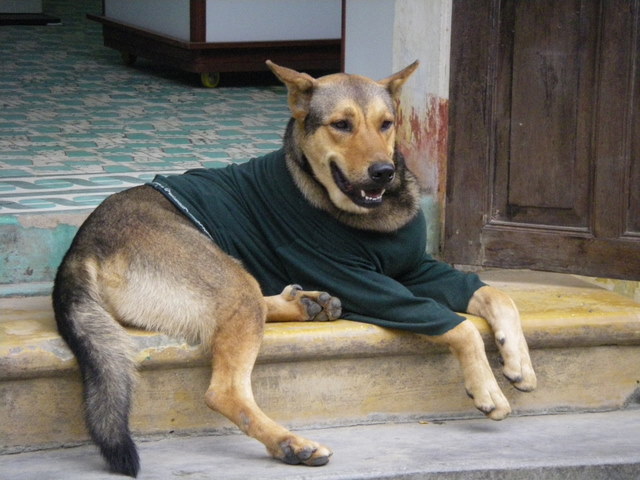
Rodger in a sporty topper
Rodger in a sporty topper

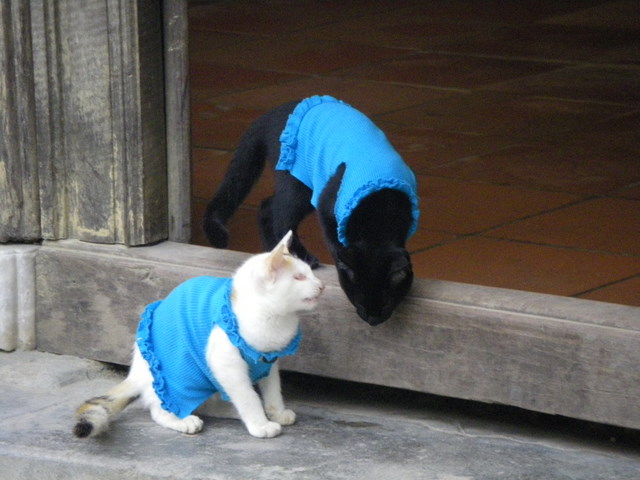
Thelma and Louise like to dress alike, but no one mistakes them for twins

Thelma and Louise like to dress alike, but no one mistakes them for twins

Seriously, even the pets dress to go downtown.

And while in Hoi An, we saw a wonderful folklore show and some of the lovely silk lamps that the city is famous for!
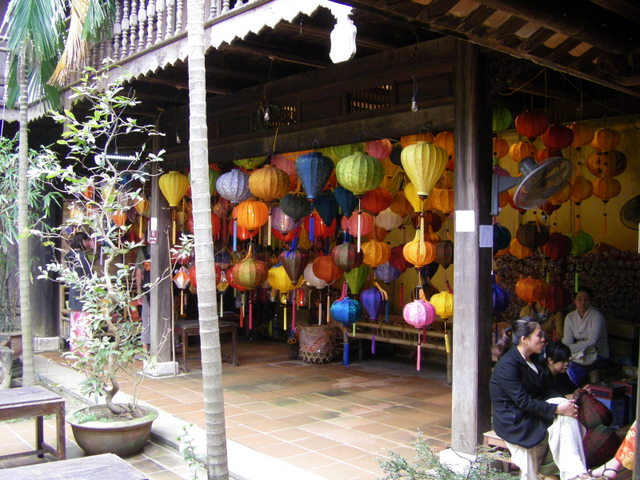
Silk lamps in Hoi An

Silk lamps in Hoi An

But soon, through the rain and the fog we made way
Climbing up Hai Van pass to the city of Hue!

Next: Artistry in food and a wet visit to a Forbidden City

Continue…

Rona & Aaron’s Excellent Adventure, Part 10

To see what preceded this go here

Tired yet?

We arrived in Hanoi on the night train from Lao Cai. It was still dark when we arrived at a mini-hotel where our people fell into bed for a couple of hours of sleep before breakfast and departure from Hanoi. That morning, unlike others, I made the omelets in the kitchen rather than on the portable burners that are all but ubiquitous. I had no idea of how many omelets I had made and so twice, at least, I thought I had finished, but hadn’t. What made this task more arduous than usual was that I was cooking on a stove top that was fairly short. At 5’6″ I am taller than most Vietnamese people, so leaning over to cook wasn’t that much fun, but in addition, there was a huge range hood that started at about the level of my nose. So, each time I found out that I had more omelets to make, it was pretty disappointing.

However, breakfast was good and soon we were on the road to Halong Bay. Along the way we stopped and bought everyone pineapples. Yes, each person got a pineapple, peeled and on a stick and the taste was fabulous. Better than ice cream. From me, that is high praise.

Halong Bay is one of the most beautiful places in the world. It is known for its magnificent rock outcroppings. There are about 1600 huge rocks, some the size of mountains and others only a few meters long and a few meters tall. They are the result of a process that is termed “Karst.” Karst is the name of an area in what is now Slovenia where these types of structures were first identified and explained. They are the result of the receding of the ocean floor and erosion that took place over thousands of years. The limestone has been worn away leaving only the core area resulting in beautiful formations.

Sailing on Halong Bay

Sailing on Halong Bay

Halong Bay has been named as a UNESCO World Heritage Site.

Although most of these rocks are not large enough for people to live on, the bay has a large number of residents who live on floating homes. Their food is delivered to their porches by boat and their children are collected by boat to go to school.

On our tours of Vietnam, one of the loveliest experiences we have is lunch on board a boat as it cruises along Halong Bay. Because our tours are strictly kosher, we bring with us, of course, all of our own kitchen equipment (woks, knives, cutting boards, stirring implements, foil trays, foil for surfaces) and disposable utensils to eat with.

Our boat

Our boat

Here is a picture of the kitchen on the ship set up with our utensils (over to the right, on the towel), our salt and pepper shakers (behind the utensils), the serving plates (their own that they wrapped in aluminum foil), spices (“Shufersol” brand, all of which I brought from Israel) and the fresh vegetables that they would be cutting on our blue vinyl cutting boards with the knives we had brought. The kitchen was immaculate.

Kitchen on the boat

Kitchen on the boat

By the way, we had brought 3 brand new knives from Israel. They are like normal western kitchen knives. Because of our late arrival and our luggage having gotten stuck in Hong Kong, our guide had bought us a new Vietnamese knife which is more like a cleaver. When we unpacked out utensils, the chef immediately chose the Vietnamese knife and began cutting with it. As he was cutting one of the fish, a piece of the knife blade broke off.. an area maybe a half inch long was now missing from knife edge about a quarter of the way from the top of the blade. He continued using that knife anyway because he preferred it. As we continued to travel, every chef chose the broken knife over our new western knives!

On the other side of the kitchen was the cooking area which they also had completely emptied of all of their equipment and had only our pots and wok.

Our pots on the boat

Our pots on the boat

Our pots in the boat's kitchen (and Osem soup mix)

Our pots in the boat's kitchen (and Osem soup mix)

While the men were working in the kitchen, the chef asked me where I was from. I must say
— for all that Israelis think that the world pays attention to news about us, from the reactions I got in Vietnam– not so much. He had no idea. Sometimes people will respond, “Near Egypt?” and that’s not bad. This man waited a couple of minutes and said, “Cities in your country?” I answered “Tel Aviv, Jerusalem…” He stopped and closed his eyes, and put his hands together and said, “Jerusalem, Jerusalem” almost as if he knew the song we sing “Yerushalayim, Yerushalayim.” He had a smile on his face and kept repeating “Jerusalem.” I wish he had been able to tell me his associations with Jerusalem, but his English was fairly rudimentary and my Vietnamese, well, I can say “Pho?”

Preparing the food

Preparing the food

How long to stay on Halong Bay? The answer is: as long as you can. It is simply paradise and as the boat moves, one after another view is even more breathtaking. The best time to arrive is shortly after noon, so you can see it in full sunlight and return as the sun is setting.

Halong Bay

Halong Bay

Next time: Visiting a fishing port in Halong Bay, visiting Japanese and Chinese vestiges in HoiAn and answering the question: what’s in style on the streets of HoiAn?

Continue the adventure here

Rona & Aaron’s Excellent Adventure, Part 9

To learn what came before this, go here

After the market in Bac Ha, we went to a village named Pho. No, not Pho. Pho? What? You’re confused? Welcome to Vietnam.

You see, Chinese (yes, I mean Chinese– bear with me) is a tonal language. People who try to learn it have difficulty with the fact that the same one-syllable word can have 4 completely different meanings depending on the tone used to say it. There is a flat tone, a rising tone, a falling tone, and one that goes up and down. Still with me?

OK, if you think Chinese is difficult, try Vietnamese. They have 6 tones. That same one syllable (the one they always use to illustrate it in both countries is “ma”) means six different things in Vietnamese, depending on the tone. So when we came to the village and I read the sign Pho (foe), our guide said “what?” and I said, “The name of the village.” And she said, “no, the name of THIS village (as if she had no idea of what I was talking about) is Pho (foe?)” And yes, the question mark is the best way to explain how the tone needed to say Pho is pronounced. So if you said, “Can we go to Pho?” she would understand. But if you said, “This is Pho” she would have no idea what you were talking about.

Anyway, this is Pho

Pho

Pho

This was my second time visiting Pho. The first time we were invited to visit the home of the mayor of the town. He was a wiry, happy old man who offered the men liquor and danced around his home with them. This time we went into the home of one of the villagers. To give you an idea of the cooking facilities in Pho, here is a picture from the kitchen.

kitchen in Pho

kitchen in Pho

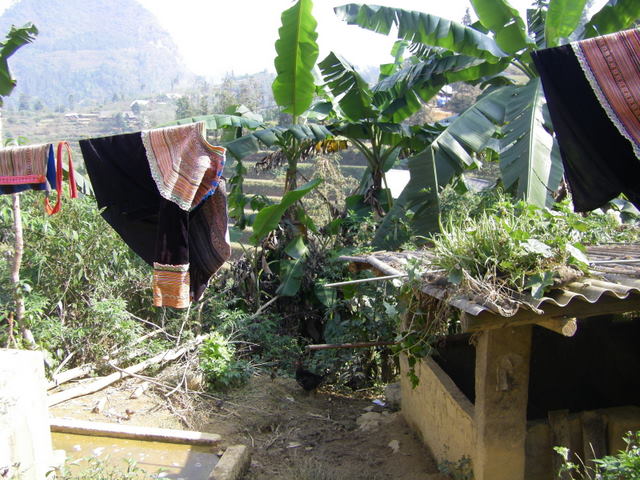
Outside we were able to see the laundry hanging, drying in the clear mountain air.

Drying laundry

Drying laundry

More laundry

More laundry

The scenery around Pho was very beautiful. We saw little black Vietnamese pigs and lots of chickens and ducks. However, most beautiful of all were the people.

Women returning from Market

Women returning from Market

Children in Pho

Children in Pho

With agriculture being the primary source of income, children become very wise in the practical aspects of farming. This little boy, leading his water buffalo who was hauling a large log, gave new meaning to the phrase “…and a little child shall lead them…”

Leading the water buffalo

Leading the water buffalo

Pho was lovely. We enjoyed a wonderful day, returned to Lao Cai for dinner, after a short visit to the Chinese border, and the boarded the overnight train for Hanoi.

Next time we answer these questions: How long should one stay on Halong Bay? How does the cook on the boat respond when I answer his question as to where I am from? and What do Vietnamese think of the knives we use in the the west?

Continue the adventure here

Pin It on Pinterest