Archives for April 2010

The Galapagos Islands, Part 9 of the Ecuador, Galapagos Islands, Peru Tour

Our first outing to an uninhabited area was to Bachas Beach which is located on Santa Cruz Island, but is far away from any human habitation or signs of civilization.

Bachas Beach

Bachas Beach

In the background you can see our ship, but otherwise, it was only we and nature. Bachas Beach got its name from a mispronunciation of the word “barges” as during World War II, US ships docked there in an effort to protect the Panama Canal.

As we walked onto the beach, I was overwhelmed with the peace and the natural beauty of the place, but looking further, it became clear to me that the island was full of life. Do you see it?

Life on the Island?

Life on the Island?

If you look carefully at the two pictures, you may be able to see some very small red/orange objects. They are Sally Lightfoot crabs. These crabs are strikingly beautiful. And they are everywhere. The entire rocky coastline is alive and moving!
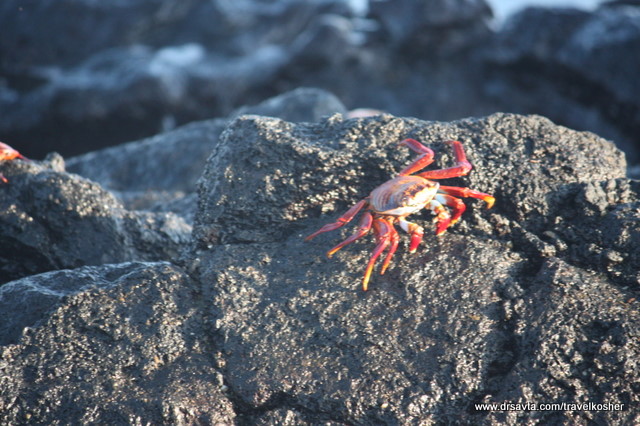
A Sally Lightfoot Crab

A Sally Lightfoot Crab

Taking a walk

Taking a walk

Up close

Up close

Here I was, on the fifth day of creation. I couldn’t believe it. The crabs did not shy away from the camera, nor did the Lava Gulls, who posed for pictures.

Lava Gulls

Lava Gulls

The Galapagos Islands are all about seeing and listening, and not so much about speech. In fact, one of the things I loved the most were the long silences when no one was speaking and when I was alone in this magnificent natural environment.
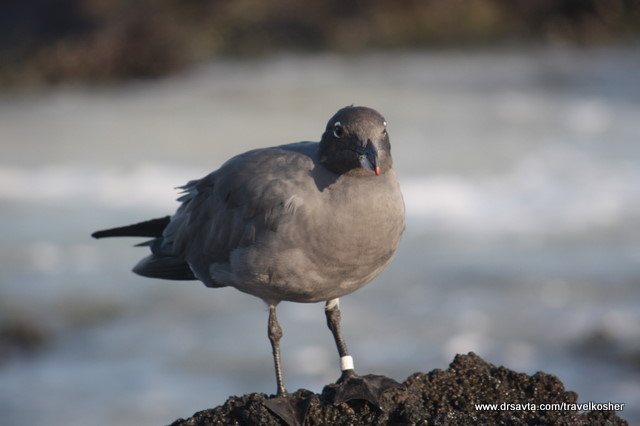
Lava Gull

Lava Gull

We saw some other creatures too. Here are two of them:

Greater Flamingos

Greater Flamingos

At first they were shy, but once they noticed that we were silent, they stopped hiding.
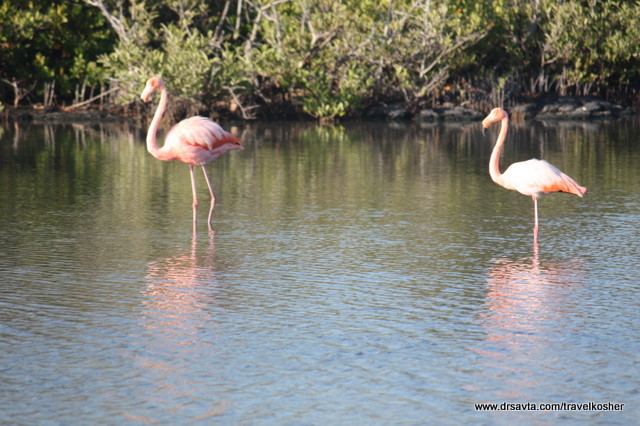
Our Flamingo Friends

Our Flamingo Friends

And who was there to say goodbye once our magnificent visit came to an end?

Sea Lion

Sea Lion

More fabulous creatures to come….
The Galapagos Islands, Part 8 of the Ecuador, Galapagos, Peru Tour

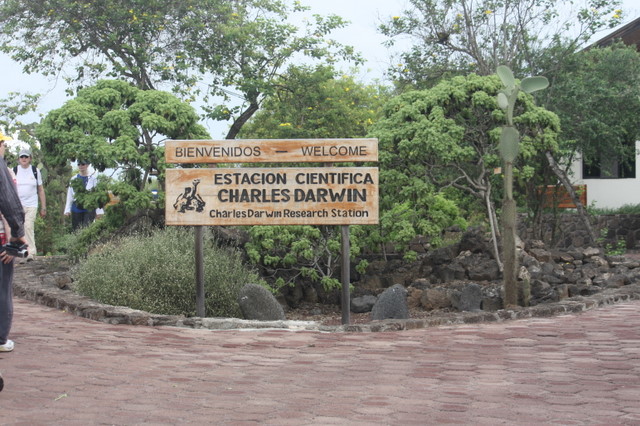
Finally we arrived at the Darwin Research Station outside of Puerto Ayora on Santa Cruz Island.

We have arrived!

We have arrived!

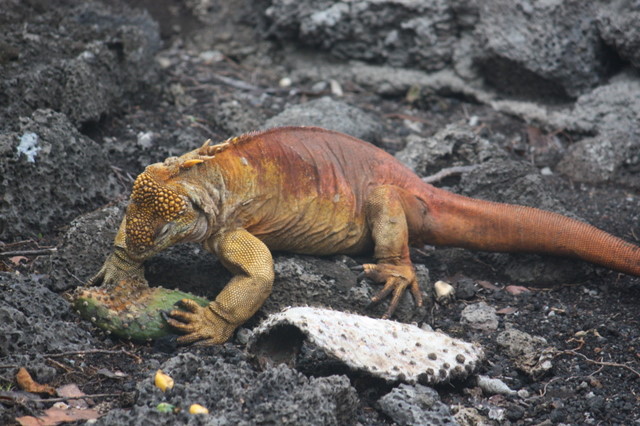
Our visit there was fascinating as we saw species of plants and animals that we had never seen before. One of the animals we came to know and love was the land iguana, a reptile so clever that it has learned how to eat cactus pads and get not only fluids from them in the dry season, but food value from them as well. Land iguanas vary from island to island in the Galapagos. They can grow to be as much as three to five feet long! Here is a land iguana eating a cactus pad.

Land iguana at lunch

Land iguana at lunch

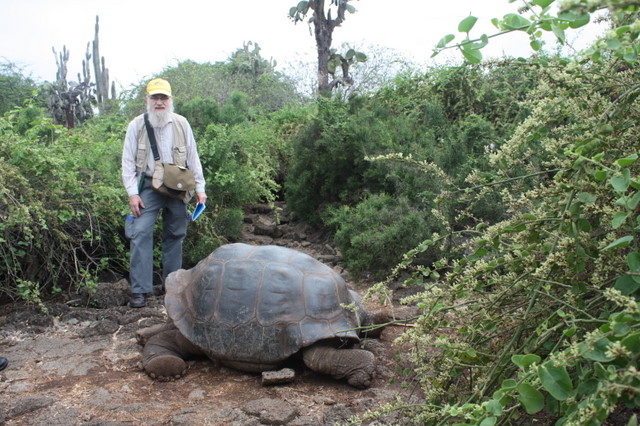
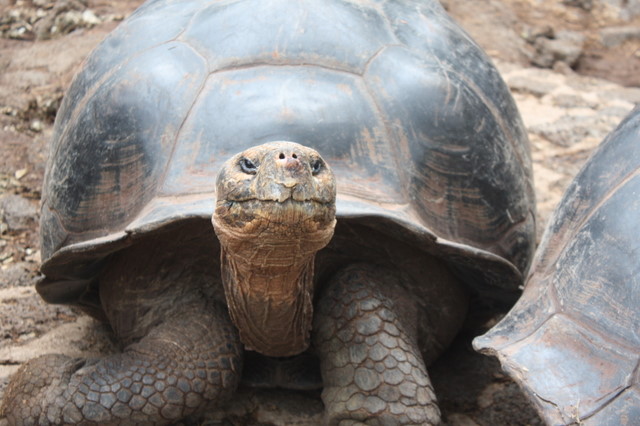
The major concentration at the Darwin station is the giant land tortoises. They too vary from Island to island with different shapes of shells and other remarkable differences. At the Darwin Station, scientists are concerned with preserving all of the existing species. There is, unfortunately one tortoise who is partnerless… Lonesome George is the last known existing tortoise of his kind. He was identified on Pinta Island and was brought to the breeding station in 1972. Since then he has waited in vain for a female Pinta Island tortoise. You can read more about him here.

We enjoyed seeing these enormous tortoises. Unlike what was permitted in the Galapagos Islands years ago, people are not allowed to ride on the tortoises. In fact, we are not permitted to touch them. The government of Ecuador takes very seriously the importance of preserving these islands and their air, land, and sea inhabitants– But we can take pictures!

Wow!

Wow!

My husband and his new pet

My husband and his new pet

and here’s something I thought I would never see:

Up close and personal!

Up close and personal!

When our tour of the station was over, we were satisfied and happy. We got back to the boat for a delicious kosher dinner and a restful night’s sleep, lulled by the gentle waves of the Pacific. What a wonderful day!!

The Galapagos Islands, Part 7 of the Ecuador, Galapagos, Peru Tour

I can’t remember a time when I was more excited about a non-life-changing event than I was on the morning we left for the Galapagos Islands. Births and weddings of course have long lasting implications that change entire futures, but visiting a new place? But it was not just that it was a new place. This was to be the adventure that would be unlike anything that I or anyone I knew had experienced before– something I had only dreamed of.

Our luggage was inspected thoroughly before we got onto the plane. Because the Ecuadorians are concerned that the Galapagos Islands remain a living laboratory, as untainted as possible by civilization, there is always concern that people might be bringing things that will destroy the unique ecology of each of the islands. For that reason, no plants, or seeds can enter the islands. Similarly, when we travel from the Islands to the boat, the bottoms of our shoes are washed off before we enter the boat so that we will not transport seeds from one island to another.

We flew from Quito to Guayaquil, Ecuador’s largest city and then on to the Galapagos Islands. Before we landed, the interior of the plane was sprayed.

The first thing we saw when we landed at the airport in Baltra was this tree.

Galapagos cactus

Galapagos cactus

We thought it looked unique. It seems to grow quite profusely in the Galapagos Islands.

The archipelago consists of 15 main islands, 3 smaller islands and over 100 rocks and outcroppings. Once we had claimed our luggage, we went by bus and ferry and bus to the ship’s landing in Santa Cruz. Santa Cruz is one of the 5 islands that are inhabited by humans.

Santa Cruz

Santa Cruz

From there we walked along the pier. I thought that we would see our ship, a small cruise ship that takes a maximum of 100 passengers.

The pier

The pier

It was raining and happily, it was the only rain we experienced during our visit there.

What I didn’t anticipate was our mode of transportation to the cruise ship and subsequently to each island. The islands are to remain unspoiled and so large ships do not dock near them, but stay removed from them so as not to pollute or to carry anything that might upset the ecology of the islands. So it was like this that we reached our ship.

The dinghies

The dinghies

And here is a picture of the ship

The Galapagos Legend

The Galapagos Legend

Once settled in, all of us were ready for our first big adventure. Late in the afternoon, we set out on our dinghies to visit the Darwin Research Station.

Imagine our surprise when we came upon a whole welcoming committee of marine iguanas who graciously posed for pictures!

Marine iguana

Marine iguana

and friend

and friend

The Marine Iguana is the world’s only sea-going lizard and is found only on the Galapagos Islands. We found them fascinating. We almost forgot that they were not what we were there to see. The Darwin Station is most concerned with the giant tortoises. You’ll see them next time…

Ecuador, Part 6 of the Ecuador, Galapagos Islands, & Peru Tour

After our lovely trip to Otavalo and environs and then back to the middle of the world, we went back to the hotel to prepare for shabbat.

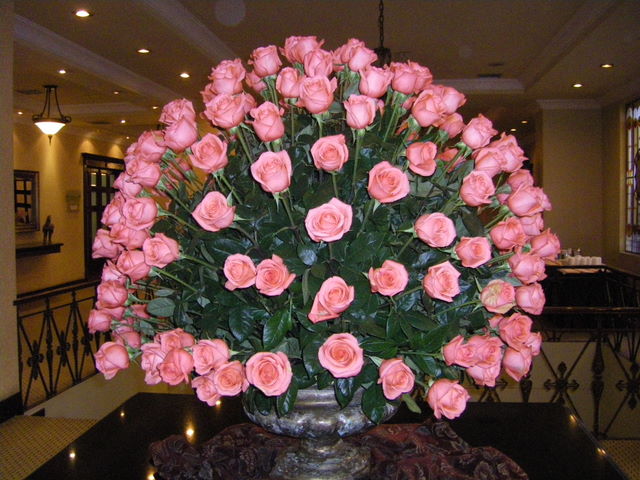
And what a shabbat it was! First of all the flowers that filled the hotel put all of us in a good mood.

Roses

Roses

As shabbat neared, the women went to the dining room to light shabbat candles and shortly afterwards, the services started. The chanting and singing were lovely and in the short time we had been together, we had become a group.

More roses

More roses

After services, at dinner, we began to get acquainted with our guests, members of the Jewish community of Ecuador. Eating with us Friday night were the Israel consul to Ecuador and his wife and children. In addition, there were other Jews who lived in Quito and the vicinity. It was fascinating to hear about them and their backgrounds and why they were living in Quito and a little about life there.

Quito does indeed have a Jewish community. It numbers about 500 people and follows the Conservative stream of Judaism. There are some Orthodox Jews as well, but they comprise only a small fraction of the community. The community is dwindling with young people leaving the country for the US or Israel. There is a community center and a synagogue. There is also a Jewish school, the Albert Einstein school which is known for its excellent education. We were told that a majority of the students are not Jewish and are sent there because of the fine academic reputation the school possesses. The community has a store that sells Judaica, a mikvah, and the availability of kosher food. There is also a mohel (ritual circumcisor).

On Friday night and Saturday we enjoyed talking to the people who came to our hotel to join us for services and meals. We loved seeing the bright-eyed, beautiful children they brought with them– little children learning to speak Hebrew, English, and Spanish. I was not the only one who tried to encourage them to take the aliya plunge! After all, being a Jew in Ecuador is a bit like being a fish out of water. In Israel, they will be swimming along in a current of wonderful, refreshing, fresh water.

We were treated to talks by the Israel Ambassador and the Israel Consul to Ecuador and in addition, we met the local Chabad rabbi.

Yes, more roses

Yes, more roses

On shabbat afternoon we went to see a very beautiful ethnology museum. We enjoyed seeing the dress and artifacts and crafts of some of the peoples who have been living in Ecuador for centuries.

Our walk back to the hotel was pleasant and once shabbat was over, we were treated to a folkdance show put on especially for us in the hotel.

But all of us were very excited because we knew that bright and early on Sunday morning we would be getting up to start the adventure of a lifetime, a trip to the Galapagos!!!

Ecuador – Part 5 of the Ecuador, Galapagos, & Peru Tour

Early in the morning we set out for Peguche Falls, just outside Otavalo. It was a lovely, sunny day and we enjoyed riding through the picturesque countryside. When finally we got to the village adjacent to the falls, we went on foot, through the town, and then along the path to the falls, located in the woods.

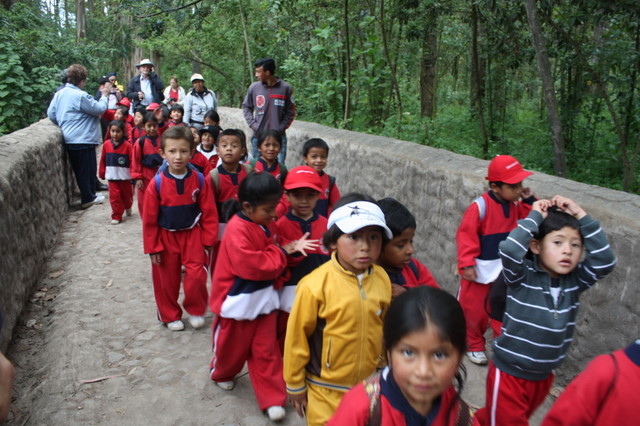
We were walking along, just enjoying nature. The scenery was lovely and the people we were with were delightful. It was very quiet and relaxed when suddenly we noticed that we were not the only people who had the idea of seeing the falls that morning. We turned around and saw this:

School children

School children

Of course, their young legs were faster and more nimble than ours and very soon we were looking at the backs of some of them.

More school children

More school children

Yes, there were hundreds of them!

Yes, there were hundreds of them!

And all of us were treated to this at the end of the path.

Peguche waterfall

Peguche waterfall

It seems that each Friday school children take trips and these falls are a big attraction. In addition to walking to the falls and seeing them, the children played soccer and other games and had bought along picnic lunches. They chattered and laughed and seemed to be enjoying themselves!

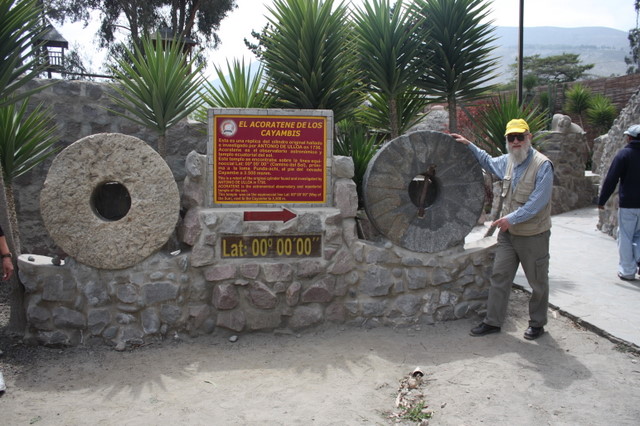
After our visit there, we made our way back in the direction of Quito, but we stopped at a very interesting landmark, one of the places that is located along the equator. This one attempted to instruct us about what it meant being on the equator and they did some experiments that were supposed to convince us that the forces of nature act differently on the equator. We all found it entertaining, even those of us who are natural skeptics.

My husband once again at zero degrees latitude

My husband once again at zero degrees latitude

My turn to straddle the equator

My turn to straddle the equator

And what a surprise to find there a sign that was trying to be in Hebrew. We could make out the last two words: Middle of the world. The rest is still a mystery!

Hebrew?

Hebrew?

We arrived at the hotel happy and ready to prepare for a shabbat together. It was time to relax just a bit before we were out and about once again.

Next time: Shabbat in Quito. Not what you think it would be at all…

update: I received this comment:
Hachtamat Darconim : Hotemet Emza Haolam… I guess the shop was marketing its stamps for being in the Centre of the World. I got a certificate once for reaching the Arctic Circle…. but personally I think Israel is the Centre of the World… Mihal Indyk

She would have won the prize if there were a prize because indeed, inside that building, there was someone who stamped our passports indicating that we had visited the center of the world!

Pin It on Pinterest