Lion Grove Garden, Suzhou, China

A visit to a Chinese garden is an experience everyone should have. Chinese gardens are exciting and lush, while at the same time relaxing and inspiring. They are full of contradictions and full of surprises and mostly, full of beauty.

All traditional Chinese gardens share four elements: buildings, stones, water, and plants. Chinese gardens are a microcosm. The stones, collected for their sizes and shapes, sometimes put in creeks for a period of a year or two or three to refine their shapes, represent mountains. The ponds represent the seas. Unlike the gardens we see in Europe that consist chiefly of plants, these gardens combine the textures of plants and stone and wood and marble and stucco. Unlike the gardens of Europe that feature lots of flowers in brilliant colors, Chinese gardens are shades of green, colored by the leaves of their trees. Unlike European gardens which are manicured and symmetrical, Chinese gardens are wild looking and full of variety.

Today I will show you some pictures of the Lion Grove Garden in Suzhhou, China. Suzhou is known as a garden city or “Venice of the East.” Indeed, Marco Polo reputedly so named it. The city has canals like Venice and being poled through the canals of Suzhou is a uniquely beautiful experience. Suzhou is home to many magnificent gardens. The Lion Grove Garden is only one example. It once belonged to the grandparents of the noted architect, I. M. Pei. A visit there is something that can refresh and renew you for years.

A place of tranquility

A place of tranquility

A walkway in the garden
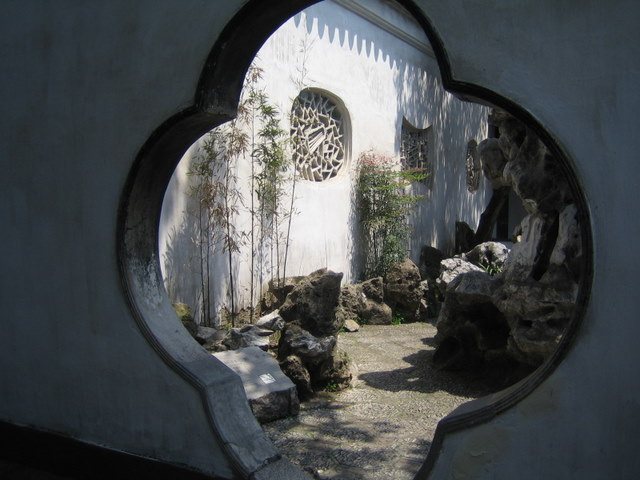
A walkway in the garden

Always new views

Always new views

Looking across the pond

Looking across the pond

A surprise view from a hole in a rock

A surprise view from a hole in a rock

A tranquil view of the pond and the walkway across it

A tranquil view of the pond and the walkway across it

Come join me in China for a tour of some magnificent gardens!
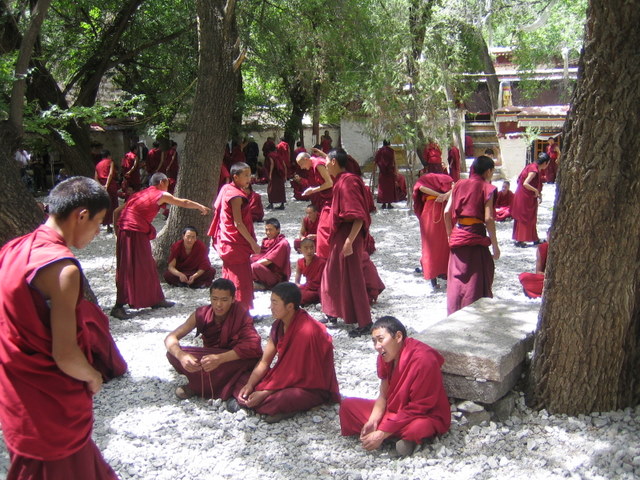
Sera Monastery, Lhasa, Tibet

One of the most fascinating places I have traveled is Tibet. Having gone to cities with progressively higher altitudes in the days before arriving in Tibet, the group was prepared for the rarefied air of Lhasa whose elevation is 3650 meters (11,975 feet) above sea level. Normally visitors are unable to tour on the first day there and must rest, but we “hit the ground running” much to the consternation of the local guide who thought he would have the afternoon and evening off.

I had many adventures in Lhasa and took a large number of photos. One of the most interesting places we visited while there was the Sera monastery. It was founded in 1419, during the Ming Dynasty and the name means “wild rose” in Tibetan. It was named Sera because the hills behind it were filled with wild roses at the time it was being built.

It may be only a coincidence, but the young monks who now study there wear robes that are rose colored. A study session of theirs is fascinating to watch. They gather outside, under the trees in dyads or triads. They refine their knowledge of their faith by asking questions of one another. The questioners stand and the answerers sit. If the answer is deemed good and satisfying based on the traditional sources, the questioners indicate that through a hand gesture signifying approval. If not, they continue to question. Questions are punctuated with slaps on the questioner’s arm. To the observer, it is a somewhat disconcerting sight. Some are standing, some are sitting, there is lots of noise as all of the dyads and triads are constantly speaking, and there is an unpredictable cacophony of slaps.

It is, however, both fascinating and beautiful. Here are a couple of images:

Monks at Sera Monastery, Lhasa, Tibet

Monks at Sera Monastery, Lhasa, Tibet

Monks sharing a moment at Sera Monastery, Lhasa, Tibet

Monks sharing a moment at Sera Monastery, Lhasa, Tibet

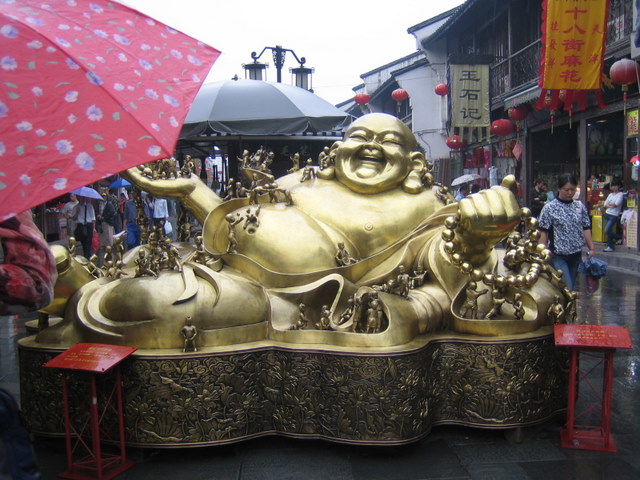
A Buddha in Hangzhou

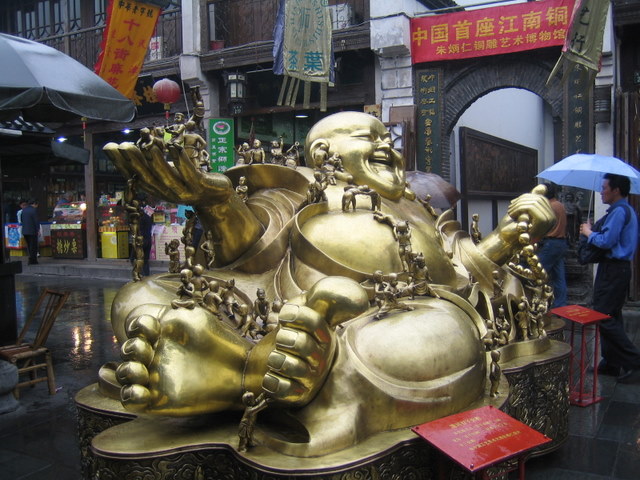
Sometimes a picture is worth a thousand words. In this case, one statue of a buddha is worth a thousand statues of little babies. This one is installed in a walking area in Hangzhou, China. This area contains some very interesting elements including a number of bronze sculptures of people living their daily lives in China. It also contains the oldest Chinese pharmacy still in existence.

Like other places in China, this area in Hangzhou is unique and well worthwhile a stroll, even on a dreary day.

Now here are two pictures of the Buddha

Buddha statue in Hangzhou

Buddha statue in Hangzhou

Buddha statue from another angle

Buddha statue from another angle

What you might not know about China

1. Most people think that because China is a populous country wherever you go there are hundreds of people. In fact, the streets of China are no more crowded than the streets of Jerusalem or Washington or London. In addition, the Chinese people love gardens and so there are vast gardens in the center of cities throughout China including Beijing and Shanghai. They are enjoyed by local residents as well as visitors and always feature a pond or larger body of water.

2. Many people think of China as a harsh place. In fact, the Chinese are friendly, welcoming people. They love visitors from overseas and they enjoy using whatever English they have to make conversation. They are warm and kind people.

3. People worry about anti-Semitism when they travel. They won’t find it in China. Chinese people think of Jews as the other great ancient civilization and they admire Jewish scholarship, ingenuity, and ambition. In fact, Chinese parents are very much like Jewish parents in that they value their children and they value educating their children and will sacrifice everything to give their children an excellent education.

4. People think of Chinese music as discordant. It is not so. Chinese music is many different things. It is Beijing Opera, but it is also the haunting flute melodies that one sometimes hears when walking through gardens. There is no place in my memory that rivals the gentle flute music in the Good Luck Garden in Hangzhou. Walking there was a truly spiritual experience.

The Good Luck Garden

The Good Luck Garden

Also, there are wonderful innovative Chinese artists like this one.

In short, China is better than you can imagine. It is the perfect place to travel. Come along with me!

Fireworks in Hanoi

The last time I visited Hanoi, we had come back from a side trip to Halong Bay, a most magnificent place that I will post about in the future. We spent the day touring the Temple of Literature, the Ho Chi Minh Mausoleum area, seeing the homes he lived in and the One Pillar Pagoda. After a cyclo ride around the old town,

Two cyclos in Hanoi

Two cyclos in Hanoi

we transported our people to a small hotel to have a chance for a shower and change of clothes before dinner and the overnight train to Lao Cai. After everyone was settled in their rooms or decided to take walks, I stayed in the lobby to get the address of the restaurant where we were to eat that night. I was then to take all of our equipment (pots, woks, cooking implements, knives, cutting boards, dishes, silverware, etc.) to the restaurant and work on the cooking of dinner.

As I stood in the lobby, all of a sudden, I saw a flash of sparks. It was already getting dark and it looked like nothing so much as fireworks. I looked to see where it was coming from. It was coming from the top of a utility pole down the block from the hotel. It was sparking like a giant cake decoration sparkler. I turned to the desk clerk and said, “Maybe you ought to call the electric company.” She just stood there. I said to my English speaking Vietnamese guide (we always have a local English speaking guide with us), “Perhaps she didn’t understand; the electric pole is sparking (everyone could see that– people in the street had stopped to watch) and if someone doesn’t come, it could make all of the power in the area go out.” He went to the desk clerk and she again did nothing.

By then, it was time for me to go to the restaurant, about a fifteen minute drive away. My guide stayed to load people onto the bus and bring them later to the restaurant.

The people at the restaurant were lovely and cooperative, something that we found to be true of every place we prepared food in Vietnam and Cambodia. They had the fresh fruits and vegetables waiting for me and the whole fish ready for my inspection. Although it was a busy kitchen, they set aside an adequate area covered with tinfoil for preparation of our food completely separate from the other food that was being prepared that evening.

When our people arrived about an hour later, they came with their story of an adventure: they had just gotten to the lobby and were about to leave when all of the lights went out– in the hotel, in the shops nearby, in the streets. Fortunately, they just proceeded to the bus, but they left the entire neighborhood in the dark.

The Temple of Heaven, Beijing

The Emperor of China was thought to be the son of Heaven. He derived his authority not just by succeeding the Emperor before him from his dynasty, but from his performance as one who could care for his people. Primarily, the Emperor was responsible for feeding the people. A good year with good harvests and plentiful food would be an affirmation of the Emperor’s power. If there were bad years and people starved, the Emperor was seen as not deserving of the blessings of Heaven and his authority was in question. For that reason, the Emperors were highly motivated to pray for rains and good harvests.

Twice a year, from the Forbidden City, the center of Beijing, the crossroads of the world– after all, China calls itself The Middle Kingdom– the Emperor would make his way south with a large entourage of officials in ceremonial dress in a procession that would take three days (although in fact, it was only a couple of miles). During the time the procession was passing, people were to stay inside so as not to see the procession. Those who were by chance outside, had to fall to the ground and lie there with their faces down until the procession passed.

After a southward walk, the procession would turn east and then north again to enter the Temple complex. Once in the compound of the Temple of Heaven, the Emperor would make his way north and would spend three days fasting and praying before putting on special ceremonial garments and praying in the Hall of Prayer for Good Harvests.

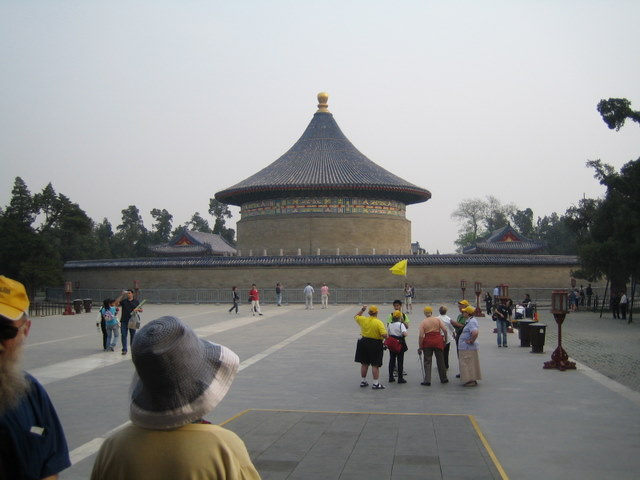
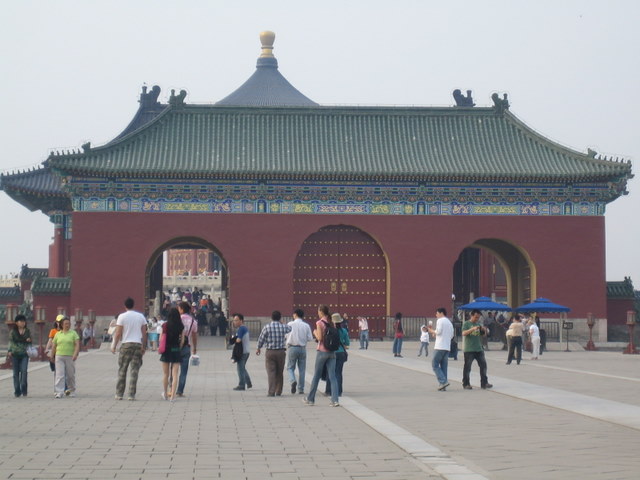
Here are some pictures of the complex:

The Imperial Vault of Heaven

The Imperial Vault of Heaven

Gate between Hall of Prayer for Good Harvests and Imperial Vault of Heaven

The Gate

The Gate

Our group August 2007 in front of the Hall of Prayer for Good Harvests

Our group August 2007 in front of the Hall of Prayer for Good Harvests

Water Puppets!

Vietnam is very much a water culture. That is, the country has a very very long coastline and much of its industry is water based- such as fishing and growing rice. During the rainy season both the Red River and Mekong Deltas fill with water and leave the soil fertile when the waters recede.

One art form that has resulted from this water culture is the water puppet theater.

The puppets are fashioned from wood and the puppeteers stand in water thigh to chest deep behind a screen and manipulate them from behind via the use of bamboo rods under the water. The puppets are fairly primitive looking but the puppeteers are able to make them do amazing things- they dance, they throw and catch, they even have fire-breathing dragons! The stories come from Vietnamese folklore and history. It may not be high art, but it is fascinating and definitely worth seeing.

Here is a wonderful article about the water puppets we see in Hanoi on our Shai Bar Ilan tour to Vietnam/Cambodia!

Here is one outdoor water puppet theater.

IMG_4381

The Temple of Heaven, Beijing

The Temple of Heaven is not only a magnificent series of structures, but it is an amazing place to visit because at its heart is the heart of the Chinese people. In this place you can see and meet people and begin to understand what China is really about. These people are warm, friendly, and full of grace.

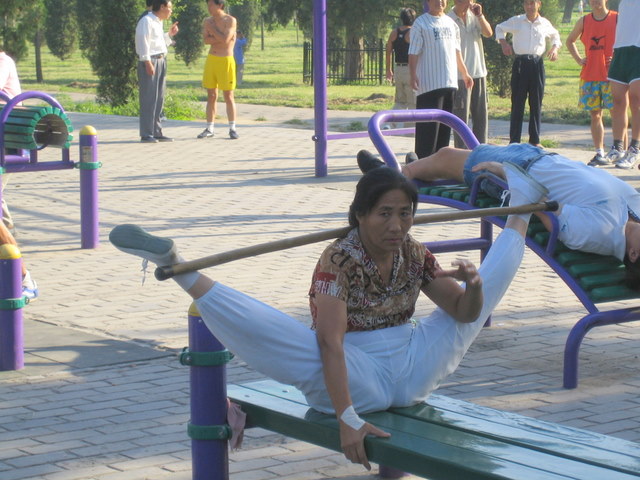
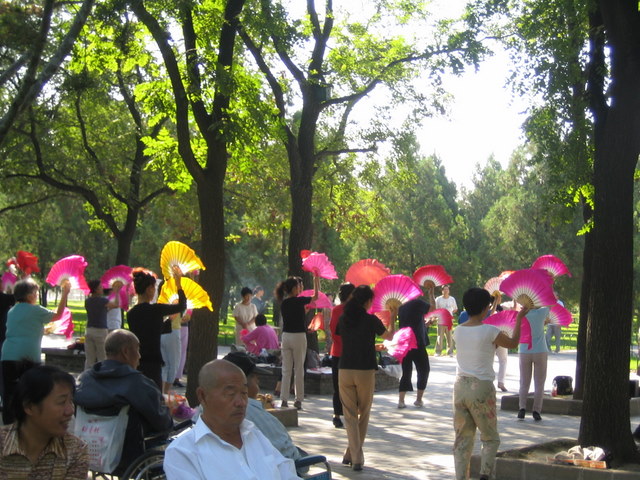
The environs of the Temple of Heaven contain areas where people meet on a daily basis and engage in exercise and games of all sorts. Of course, most of the people who meet and play in this open-air community center are older folks who are no longer working. They pay a minimal yearly fee and then have use of the park every day. Here are some of the sights:

Women exercising

Women exercising

Notice the “play equipment” is adult sized.

Women walking on pebbles

Women walking on pebbles

When we visit China, we make sure to take everyone for a foot massage. These women get their own massage as they walk in their light-soled shoes on pebbles cemented into the ground and protruding exactly enough to provide a therapeutic massage!

Ouch!

Ouch!

This woman made all of us think “ouch!”

Ribbon exercises

Ribbon exercises

This was a particularly lovely sight. Many of the women get their exercise by waving ribbons in beautiful intricate patterns.

Fan dancing in the park

Fan dancing in the park

In addition to Tai Chi, there is fan dancing, sword dancing and lots of other group activities. Western style social dancing is also done with old American tunes being played on large amplifiers. Some people also come here to play cards, chess, and mahjong. Some of the women bring craft projects such as crocheting and knitting. Sometimes they sell their items to tourists.

Of course all should be done accompanied by music!

Musician in the park

Musician in the park


Next time we’ll see some of the buildings in this large complex called “The Temple of Heaven.”

Temple of Literature, Hanoi, Vietnam

One of the more impressive places to visit in Hanoi is the Temple of Literature. Originally built in 1070 as a Confucian Temple, in 1076, part of the complex became Vietnam’s first university. Its purpose was to educate the ruling class– the bureaucrats and the nobles and other members of the elite.

Temple of Literature, Hanoi

Temple of Literature, Hanoi

During the time it functioned- from 1076 to 1779, many of the students were not successful in passing the final examinations. The names of those who succeeded were engraved in a stone stele and over the entire period, only 2,313 students’ names were recorded.

The temple is constructed with a series of five courtyards and three paths lead through it. In older times, only the king would use the center path. There are a number of attractive buildings, manicured gardens, and ponds on the complex.

Garden view

Garden view

Statue of a phoenix next to offerings in the temple

Statue of a phoenix next to offerings in the temple

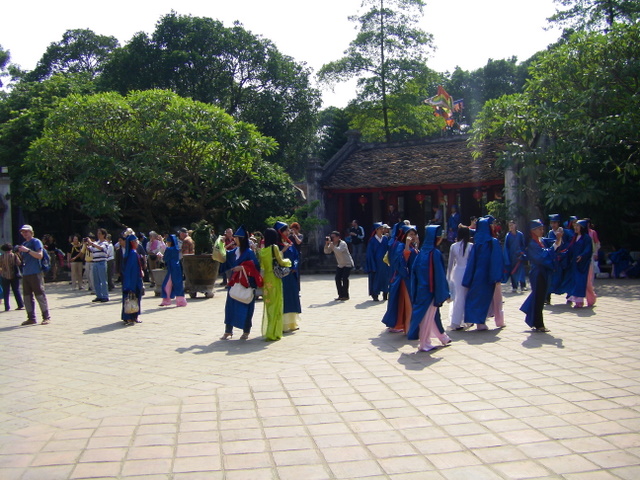
The day we visited, we saw many Vietnamese high school students, dressed in their graduation robes, having their pictures taken against the beautiful gardens and buildings.

Students in their graduation robes

Students in their graduation robes

We also were treated to a concert of Vietnamese music played on traditional instruments. Altogether delightful!

The Temples of Angkor

I will be posting in the future about the temples of Angkor, probably one at a time, but for now there is a wonderful site put up by National Geographic that shouldn’t be missed. It is here.

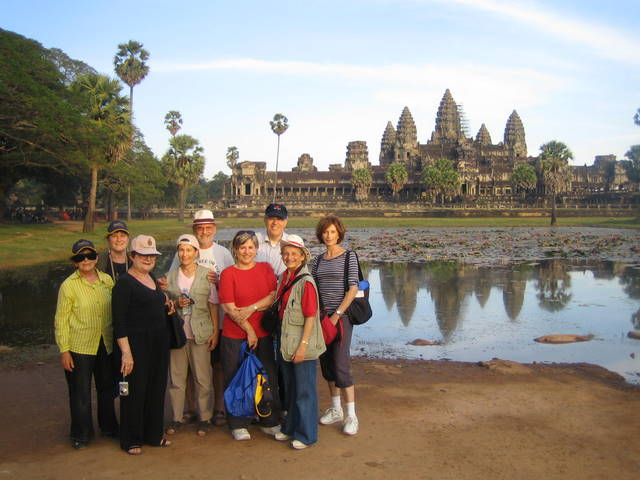
Meanwhile, here is a picture of me with our group from last November in front of Angkor Wat

Group in front of Angkor Wat

Group in front of Angkor Wat

Pin It on Pinterest