Archives for 2010

Rona & Aaron’s Excellent Adventure, Part 14

Previously…

When we returned from the Mekong Delta, we had enough time to get ourselves ready for a relaxing shabbat. What a delight to be wth Rabbi and Mrs. Hartman at Chabad for services and shabbat dinner! It was wonderful seeing that there is a community developing among people who had until recently been isolated. We enjoyed eating and singing and hearing stories about life in Vietnam. Shabbat morning too was enjoyable.

When we returned to the hotel, we put on comfortable shoes and headed out to see some of the sights. First we walked to the post office (fortunately, on a previous tour, we done this excursion during the week, so I have photos)

Post Office, Ho Chi Minh City

Post Office, Ho Chi Minh City

The post office is, of course, from the period that the French were in Vietnam, and so the architecture is European. In fact, the French reproduced the Notre Dame Cathedral just across the street.

Notre Dame, HCMC

Notre Dame, HCMC

We then walked on to the Palace of Reunification. This had been the Presidential Palace of South Vietnam when Vietnam was divided. Inside, now, there are reception rooms and the building is used for ceremonial purposes. However, they have retained the furnishings and equipment that were used in the Palace during the war, including the war maps and communications equipment.

The Palace is very impressive.

The Reunification Palace, Ho Chi Minh City, Vietnam

The Reunification Palace, Ho Chi Minh City, Vietnam

Here is the former presidential office

Former presidential office

Former presidential office

Here are some reception rooms. All are decorated in exquisite taste.
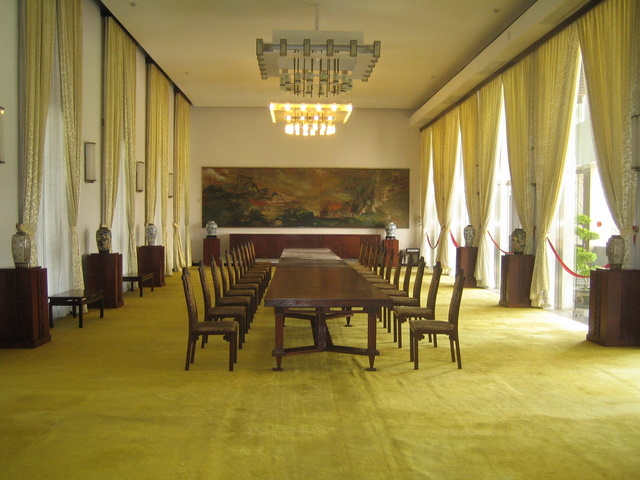
Reception room

Reception room

Reception room

Reception room

After our lovely walk, we returned to the hotel to change (those who wanted to) because it was already time to go back to Chabad for Mincha and Seuda Shlishit!

After a wonderful shabbat, we made havdalah and bade farewell to Chabad and went back to the hotel to get our money because Saturday night was just made for shopping!

Next: Come along with us to the Saigon night market, learn how the Viet Cong defeated the US Army, and see for yourself a most colorful and interesting religious group and their Disneyland-like Temple!

Continuing…

Rona & Aaron’s Excellent Adventure, Part 13

Previously…

After a brief (very brief) stop at one of the tombs of one of the emperors, we got onto a plane and left for Ho Chi Minh City (HCMC). This is the name given to Saigon when the country became one after the US withdrew all of its troops. However, the name never really caught on in the south and people who live in Saigon call it Saigon. Even those in the north and central part of the country are more likely to refer to the city as Saigon. But, officially, it is still called Ho Chi Minh City (HCMC).

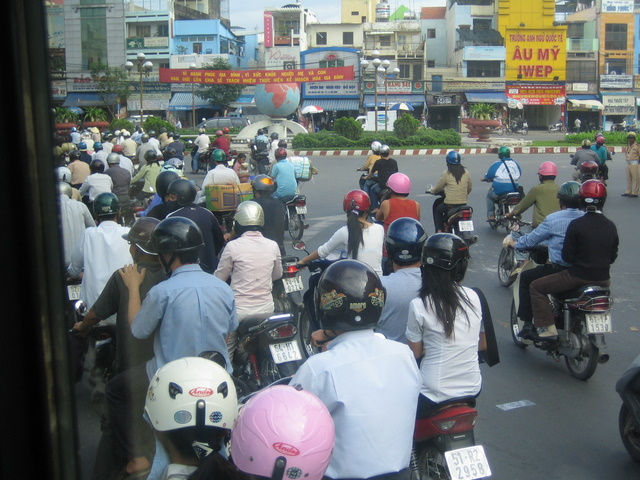
Saigon is a bustling metropolis. It is large, noisy, and full of activity. The streets are full of motorbikes and motorcycles which are the chief method of transportation in the city. And it is lucky that more people can’t afford cars because there would simply not be any room for them. At schools, parents line up outside on their vehicles to pick up their one, two, or three children and transport them home on their motorcycle/motorbike. It is not unusual to see three people on a bike and I have seen up to five.

Crossing the street is an art. One of the most important things that a guide in Vietnam must do is to teach his/her people to cross streets. It is not something for the faint of heart.

Saigon traffic

Saigon traffic

Saigon on wheels

Saigon on wheels

Here’s the trick: You wait until there’s a slight break in the traffic (that’s the best it ever gets) and then you walk into the street and keep walking. Yes, motorcycles and motorbikes are coming at you, but you don’t stop. Ever. You see, they watch you, gauge how fast you are walking and cross either to the front or back of you, but stop and guess what happens? That is why when I take my people across the streets the first couple of times I sound somewhat strange as I repeat the entire time, “Walk, walk, walk, walk, walk, walk, walk, walk, walk, walk!”

So, after arriving in Saigon, we went to our hotel and shortly afterwards, set off for Chabad where we ate dinner. If you want to know about Chabad Vietnam, you can find them here. But only I can tell you how kind and friendly and warm and welcoming the young Rabbi Hartman and his lovely wife, Racheli are. In the short time they have been there, they have accomplished amazing things– building a community where there was nothing– having 50 people (NOT including our group!) for shabbat dinner, and starting a nursery school. Israel TV made a documentary about their arrival in Vietnam which you may be able to see (not always available) at this location.

The next morning we set out for the Mekong Delta. You may have heard of the delta, primarily in regard to the Vietnam War (which they call the “American War”), but the size of the delta is quite amazing. It is 39,000 square kilometers (15,000 sq miles). Compare that to Israel, 20,329 square kilometers (7,849 sq miles)!

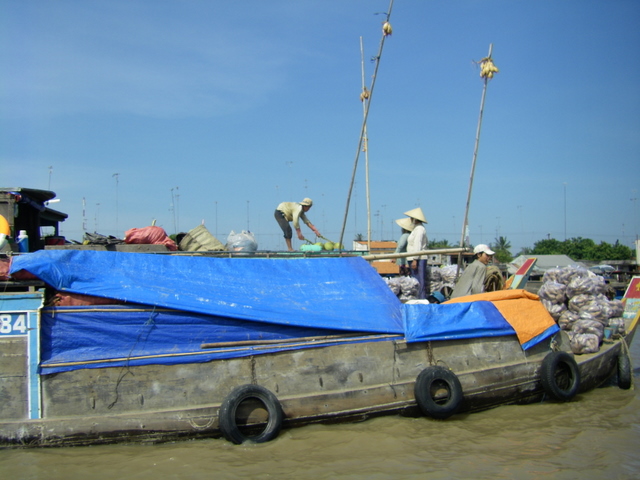
Along the delta, there are floating markets. Here people bring fruit and produce and sell or trade it each morning. They advertise their wares by hanging them from bamboo poles on their boats, much as one would hang a flag.

Selling potatoes

Selling potatoes

Selling rambutans

Selling rambutans

You can read about rambutans here.

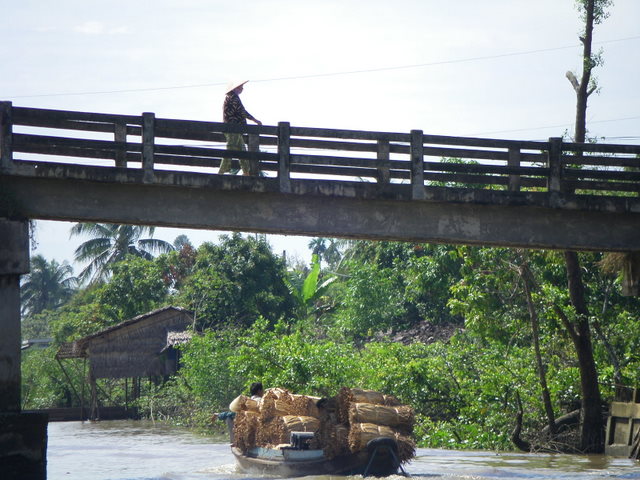
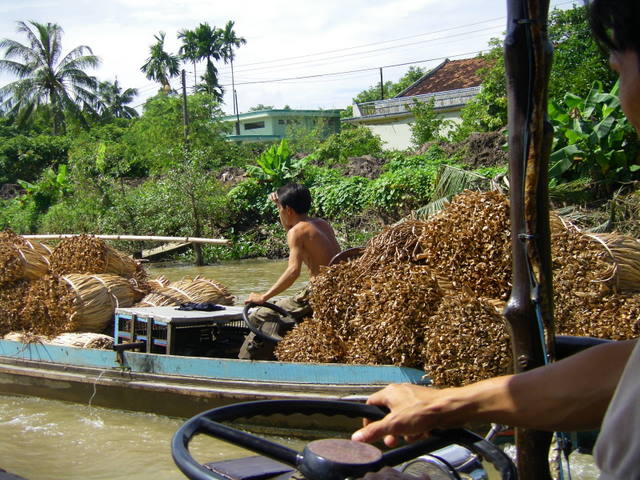
We enjoyed watching the local cottage industries using the available produce and making puffed rice (it’s fabulous to watch), rice bars, rice paper, and coconut candies. It was all fascinating. Then we enjoyed cruising around the byways of the delta.

On the delta

On the delta

On the delta

On the delta

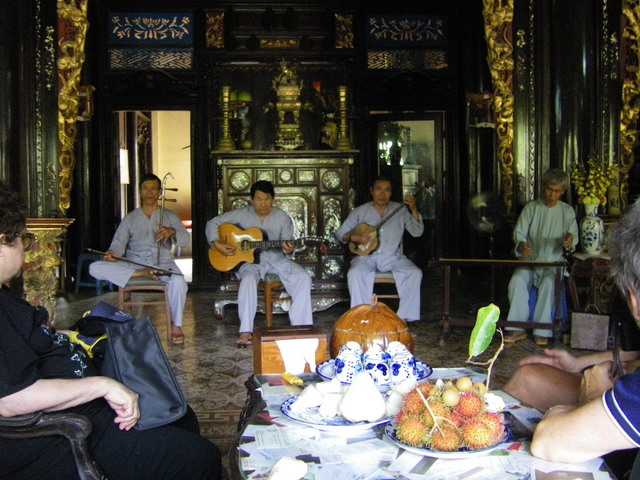
We also enjoyed a private concert of Vietnamese music which we listened to as we sampled new and different fruits.

House concert

House concert

Next time we answer the question: What do a post office, Notre Dame, and the Reunification Palace have in common?

Continuing…

Rona & Aaron’s Excellent Adventure, Part 12

Previously…

Yes, folks, we are back for our next adventure, but first let’s carry on with this one and then I will tell you about the next one.

We drove through the Hai Van Pass, a very impressive ride when the weather is clear. Unfortunately, the weather was rainy and foggy, so all we saw was the condensation on our windows and the fog in front of the bus which made us gasp from time to time.

By the time we got to Hue, it was already time for me to go to the restaurant to supervise dinner. My husband went on with the group to the Perfume River and the Thien Mu Pagoda, both of them very lovely.

The kitchen staff was wonderful, anxious to please. Of course, having no common language offered a bit of a challenge, but how could I become frustrated when they took me to the special room they had set up for us with Israeli flags on the tables?

So, I watched carefully and as usual, checked every item that was used in the preparation of the food. One man sat for over an hour sculpting carrots and this was the result:

Artistry in food

Artistry in food

When served at the table, it looked like this:

Pineapple, carrot, and garlic creation

Pineapple, carrot, and garlic creation

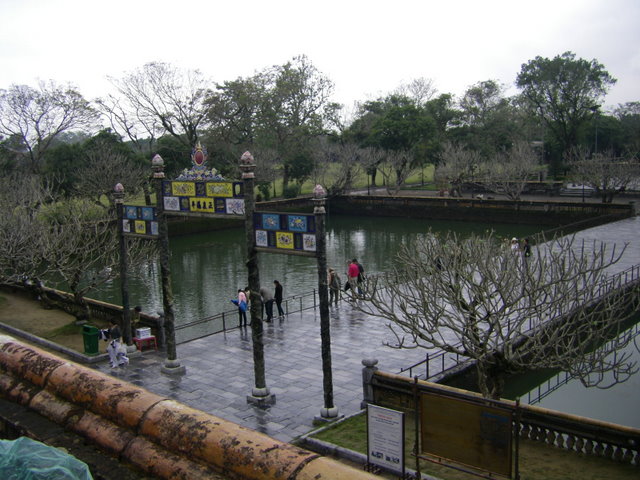
The next morning, the light rain continued and we took a walk through the wet and slippery, but very beautiful Forbidden City in Hue, dated from 1804. The city is reminiscent of the Ming Dynasty Forbidden City in Beijing, China, but the architecture is more delicate and understated. Here is one of the gates:

A gate in the Forbidden City, Hue

A gate in the Forbidden City, Hue

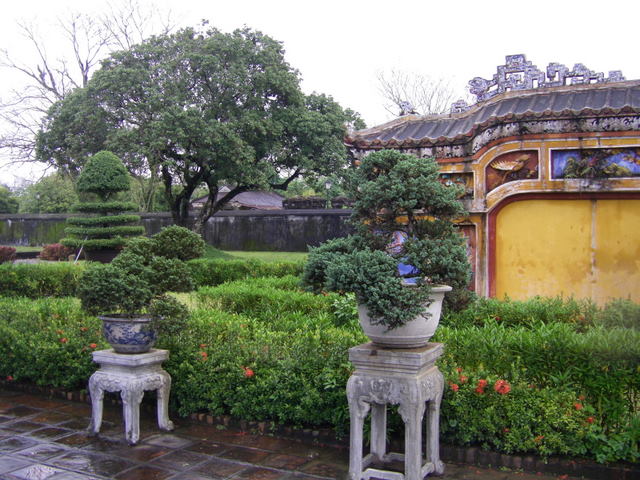
We walked through gardens and saw beautiful buildings.

The Forbidden City, Hue

The Forbidden City, Hue

The Forbidden City, Hue

The Forbidden City, Hue

And then before we knew it, we were on our way to the big, bustling city of Saigon, officially known as Ho Chi Minh City.

Next stop: The Mekong Delta as you never imagined it.

Continuing…

Rona & Aaron’s Excellent Adventure, Part 11

Previously…

After a wonderful day in Halong Bay, we woke up the next morning ready for our next adventure. Our guide, Mrs. Phuong, was originally from Halong Bay and she knew all of the most picturesque places. She took us to a fishing pier that was truly amazing. We saw beautiful displays of vegetables and marveled as fisherman brought in piles and piles of creepy, wiggling fish. There were all sorts of fish, some we’ve seen before and others we hadn’t. There were long silvery fish and short pink ones. And most of them were still moving.

And soon, so were we. We drove back to Hanoi and boarded a plane for Da Nang, the airport located about a 40 minute drive from Hoi An. I have written about Hoi An before here. It is a very beautiful city and it is a wonderful place to relax. There are a number of beautiful resort hotels.

Hoi An has a rich international tradition evidenced by the Chinese and Japanese structures that still grace the city. I was fascinated by the Chinese assembly halls. When the Chinese came to live in Hoi An, they were, in a sense, not unlike my relatives when they arrived in the US as immigrants. My relatives and other Jewish immigrants of that era were able to make it economically with the help of their “landsmen,” people who came from the same area of eastern Europe that they did. Here in Hoi An, people coming from each province of China had their own meeting hall and there they would network, talk of home, and help each other. Here is the Fujian Meeting Hall.

Fujian Meeting Hall

Fujian Meeting Hall

Of course the big attraction in Hoi An is the Japanese Bridge, probably the only bridge that has a temple built into it. It is a footbridge and off to one side in the middle of the bridge is a room where people can pray. Here is the bridge from a distance.

The Japanese Bridge

The Japanese Bridge

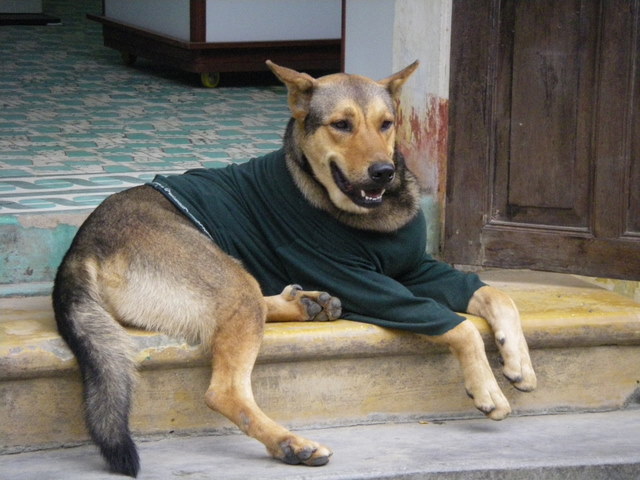
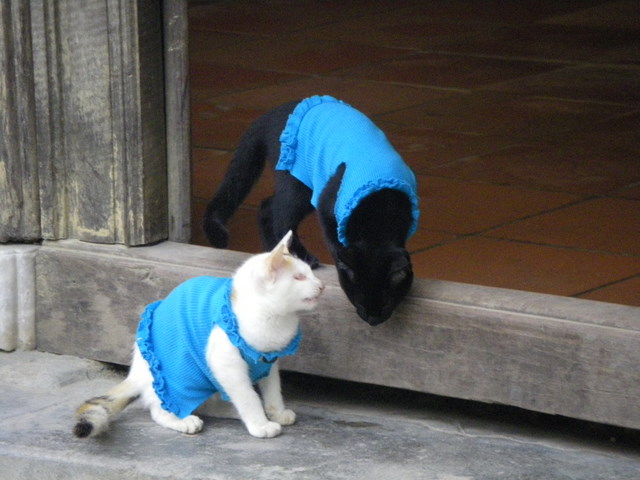
Hoi An is the place where many tourists have clothing made to order for themselves. They have exquisite silks that they make into ao dais and other types of clothing, but let’s see what the locals wear in Hoi An.

Rodger in a sporty topper

Rodger in a sporty topper

Thelma and Louise like to dress alike, but no one mistakes them for twins

Thelma and Louise like to dress alike, but no one mistakes them for twins

Seriously, even the pets dress to go downtown.

And while in Hoi An, we saw a wonderful folklore show and some of the lovely silk lamps that the city is famous for!

Silk lamps in Hoi An

Silk lamps in Hoi An

But soon, through the rain and the fog we made way
Climbing up Hai Van pass to the city of Hue!

Next: Artistry in food and a wet visit to a Forbidden City

Continue…

Rona & Aaron’s Excellent Adventure, Part 10

To see what preceded this go here

Tired yet?

We arrived in Hanoi on the night train from Lao Cai. It was still dark when we arrived at a mini-hotel where our people fell into bed for a couple of hours of sleep before breakfast and departure from Hanoi. That morning, unlike others, I made the omelets in the kitchen rather than on the portable burners that are all but ubiquitous. I had no idea of how many omelets I had made and so twice, at least, I thought I had finished, but hadn’t. What made this task more arduous than usual was that I was cooking on a stove top that was fairly short. At 5’6″ I am taller than most Vietnamese people, so leaning over to cook wasn’t that much fun, but in addition, there was a huge range hood that started at about the level of my nose. So, each time I found out that I had more omelets to make, it was pretty disappointing.

However, breakfast was good and soon we were on the road to Halong Bay. Along the way we stopped and bought everyone pineapples. Yes, each person got a pineapple, peeled and on a stick and the taste was fabulous. Better than ice cream. From me, that is high praise.

Halong Bay is one of the most beautiful places in the world. It is known for its magnificent rock outcroppings. There are about 1600 huge rocks, some the size of mountains and others only a few meters long and a few meters tall. They are the result of a process that is termed “Karst.” Karst is the name of an area in what is now Slovenia where these types of structures were first identified and explained. They are the result of the receding of the ocean floor and erosion that took place over thousands of years. The limestone has been worn away leaving only the core area resulting in beautiful formations.

Sailing on Halong Bay

Sailing on Halong Bay

Halong Bay has been named as a UNESCO World Heritage Site.

Although most of these rocks are not large enough for people to live on, the bay has a large number of residents who live on floating homes. Their food is delivered to their porches by boat and their children are collected by boat to go to school.

On our tours of Vietnam, one of the loveliest experiences we have is lunch on board a boat as it cruises along Halong Bay. Because our tours are strictly kosher, we bring with us, of course, all of our own kitchen equipment (woks, knives, cutting boards, stirring implements, foil trays, foil for surfaces) and disposable utensils to eat with.

Our boat

Our boat

Here is a picture of the kitchen on the ship set up with our utensils (over to the right, on the towel), our salt and pepper shakers (behind the utensils), the serving plates (their own that they wrapped in aluminum foil), spices (“Shufersol” brand, all of which I brought from Israel) and the fresh vegetables that they would be cutting on our blue vinyl cutting boards with the knives we had brought. The kitchen was immaculate.

Kitchen on the boat

Kitchen on the boat

By the way, we had brought 3 brand new knives from Israel. They are like normal western kitchen knives. Because of our late arrival and our luggage having gotten stuck in Hong Kong, our guide had bought us a new Vietnamese knife which is more like a cleaver. When we unpacked out utensils, the chef immediately chose the Vietnamese knife and began cutting with it. As he was cutting one of the fish, a piece of the knife blade broke off.. an area maybe a half inch long was now missing from knife edge about a quarter of the way from the top of the blade. He continued using that knife anyway because he preferred it. As we continued to travel, every chef chose the broken knife over our new western knives!

On the other side of the kitchen was the cooking area which they also had completely emptied of all of their equipment and had only our pots and wok.

Our pots on the boat

Our pots on the boat

Our pots in the boat's kitchen (and Osem soup mix)

Our pots in the boat's kitchen (and Osem soup mix)

While the men were working in the kitchen, the chef asked me where I was from. I must say
— for all that Israelis think that the world pays attention to news about us, from the reactions I got in Vietnam– not so much. He had no idea. Sometimes people will respond, “Near Egypt?” and that’s not bad. This man waited a couple of minutes and said, “Cities in your country?” I answered “Tel Aviv, Jerusalem…” He stopped and closed his eyes, and put his hands together and said, “Jerusalem, Jerusalem” almost as if he knew the song we sing “Yerushalayim, Yerushalayim.” He had a smile on his face and kept repeating “Jerusalem.” I wish he had been able to tell me his associations with Jerusalem, but his English was fairly rudimentary and my Vietnamese, well, I can say “Pho?”

Preparing the food

Preparing the food

How long to stay on Halong Bay? The answer is: as long as you can. It is simply paradise and as the boat moves, one after another view is even more breathtaking. The best time to arrive is shortly after noon, so you can see it in full sunlight and return as the sun is setting.

Halong Bay

Halong Bay

Next time: Visiting a fishing port in Halong Bay, visiting Japanese and Chinese vestiges in HoiAn and answering the question: what’s in style on the streets of HoiAn?

Continue the adventure here

Rona & Aaron’s Excellent Adventure, Part 9

To learn what came before this, go here

After the market in Bac Ha, we went to a village named Pho. No, not Pho. Pho? What? You’re confused? Welcome to Vietnam.

You see, Chinese (yes, I mean Chinese– bear with me) is a tonal language. People who try to learn it have difficulty with the fact that the same one-syllable word can have 4 completely different meanings depending on the tone used to say it. There is a flat tone, a rising tone, a falling tone, and one that goes up and down. Still with me?

OK, if you think Chinese is difficult, try Vietnamese. They have 6 tones. That same one syllable (the one they always use to illustrate it in both countries is “ma”) means six different things in Vietnamese, depending on the tone. So when we came to the village and I read the sign Pho (foe), our guide said “what?” and I said, “The name of the village.” And she said, “no, the name of THIS village (as if she had no idea of what I was talking about) is Pho (foe?)” And yes, the question mark is the best way to explain how the tone needed to say Pho is pronounced. So if you said, “Can we go to Pho?” she would understand. But if you said, “This is Pho” she would have no idea what you were talking about.

Anyway, this is Pho

Pho

Pho

This was my second time visiting Pho. The first time we were invited to visit the home of the mayor of the town. He was a wiry, happy old man who offered the men liquor and danced around his home with them. This time we went into the home of one of the villagers. To give you an idea of the cooking facilities in Pho, here is a picture from the kitchen.

kitchen in Pho

kitchen in Pho

Outside we were able to see the laundry hanging, drying in the clear mountain air.

Drying laundry

Drying laundry

More laundry

More laundry

The scenery around Pho was very beautiful. We saw little black Vietnamese pigs and lots of chickens and ducks. However, most beautiful of all were the people.

Women returning from Market

Women returning from Market

Children in Pho

Children in Pho

With agriculture being the primary source of income, children become very wise in the practical aspects of farming. This little boy, leading his water buffalo who was hauling a large log, gave new meaning to the phrase “…and a little child shall lead them…”

Leading the water buffalo

Leading the water buffalo

Pho was lovely. We enjoyed a wonderful day, returned to Lao Cai for dinner, after a short visit to the Chinese border, and the boarded the overnight train for Hanoi.

Next time we answer these questions: How long should one stay on Halong Bay? How does the cook on the boat respond when I answer his question as to where I am from? and What do Vietnamese think of the knives we use in the the west?

Continue the adventure here

Pin It on Pinterest