Archives for 2010

Ecuador – Part 4 of the Ecuador, Galapagos, & Peru Tour

Today we will visit two lovely places, but first a little background:

Ecuador is not a rich country. Its top source of foreign capital is the export of crude oil. However number two is the income it derives from its expatriates who work in other countries and send money home to their families. According to our local guide, Julio, 4 to 5 million of the population of 14-15 million work outside the country. There are an estimated 700,000 Ecuadorian women working in Spain alone! Ecuador’s third highest source of income is from the magnificent roses grown there. Agriculture is an important industry and fruits and vegetables are exported as well as coffee and cacao.

Our guide, Julio, in the vest and the Panama hat

Our guide, Julio, in the vest and the Panama hat

Julio here was introducing us to some new and exotic fruits.

Oh, and a piece of trivia: Panama hats are Ecuadorian!

In the year 2000, after years of economic crisis, Ecuador adopted the US dollar as its currency. Since then, prices have stabilized. Having the US dollar as currency makes it an attractive tourist destination for those familiar with the dollar! On a recent tour to Vietnam, I misplaced a decimal when converting to the local currency and almost gave our local guide $320 for items she purchased for us when I only owed her $32. She, thankfully, was honest and told me that I had better check my math! In Ecuador, I had no such problems.

Trivia: Remember that song we sang in the US– “Kumbaya”? I never quite knew what to make of it. It turns out that Kumbaya is the name of a town not far from Quito and the song was a song they sang, in a circle, to bring down much needed rain. The people would sing louder and louder again and again to bring the rain.

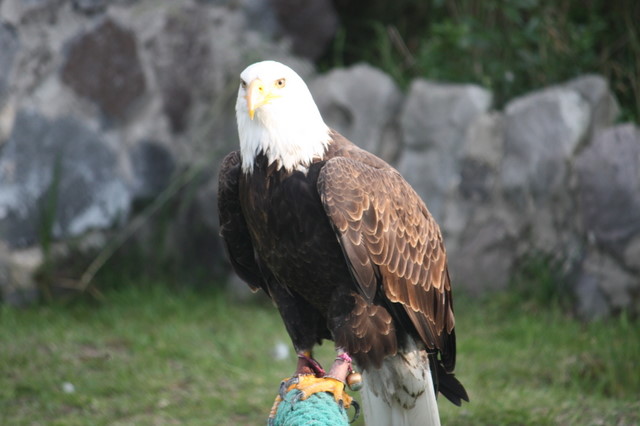
We made our way from the hacienda to Parque Cóndor Otavalo, a refuge for birds that have been injured and need special care. Often these birds are not equipped to survive on their own and spend their lives there. We saw a number of fine looking birds:
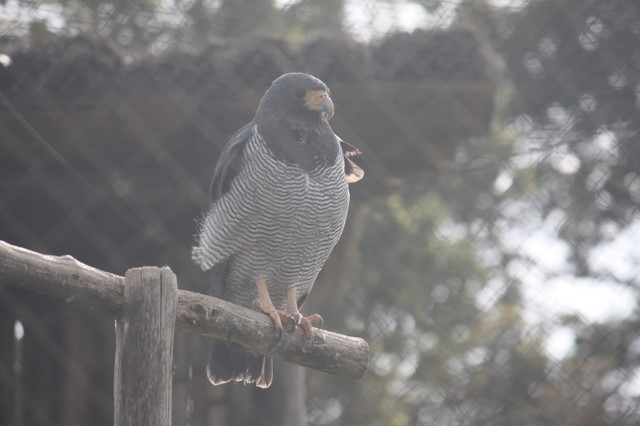
A barred hawk

A barred hawk

A black hawk-eagle

A black hawk-eagle

and our old friend, the bald eagle

and our old friend, the bald eagle

Later we drove to San Pablo Lake. It ‘s a beautiful area at the foot of the Imbabura volcano. The land is rich and the mountain is seen as the sacred protector of the area. We stayed at a beautiful resort with wooden buildings that contained large, lovely guest rooms each with its own fireplace.
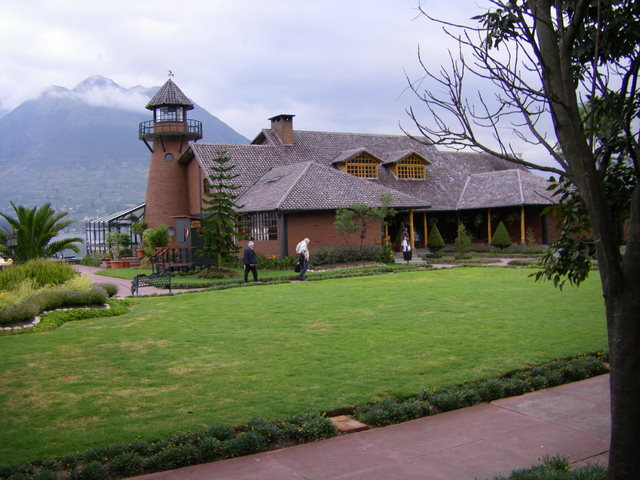
Hosteria Puertolago

Hosteria Puertolago

The inn

The inn

Another view

Another view

After taking our things to the room,we all went out on a boat for a look at the lake and its surroundings. As Israeli groups tend to do, we sang together a good deal of the time. There was lots of laughter and joking and lots and lots of smiles. As it got dark, we noticed that the lights in the homes surrounding the lake had been turned out. We wondered if there was a power failure. We were told that the lights are turned out for an hour or two each evening to save electricity.

What is particularly amazing about this place on earth is that being so near the equator, one is able to see both the constellations of the southern hemisphere and of the northern hemisphere. With the lights out, the view couldn’t have been more perfect– and if I had studied more astronomy, I am certain I would have been even more awestruck. Next time I will be sure to look for the Southern Cross.

When we returned to land, we were greeted by a delicious dinner, sent by our mashgiach in Quito, in the beautiful, elegant dining room with windows out to the lake.

After dinner and some time spent getting to know each other, we all went to our rooms. When we arrived at our door, a young woman was waiting to build us a fire. A lovely end to a perfect day!

Next time: You and me and thirty gazillion school children at a waterfall and a visit to another spot on the equator.
Ecuador – Otavalo, part 3 of the Ecuador, Galapagos, & Peru Tour

We arrived in Otavalo just after noon. It was a beautiful sunny day. Unlike Sundays when the market is bustling with people, the market was almost deserted which made it particularly lovely to experience and photograph.

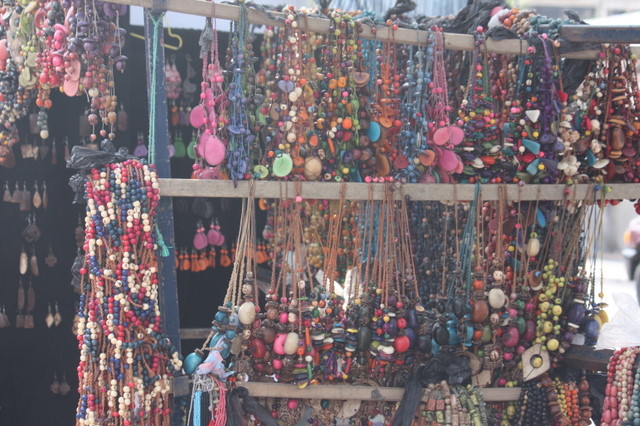
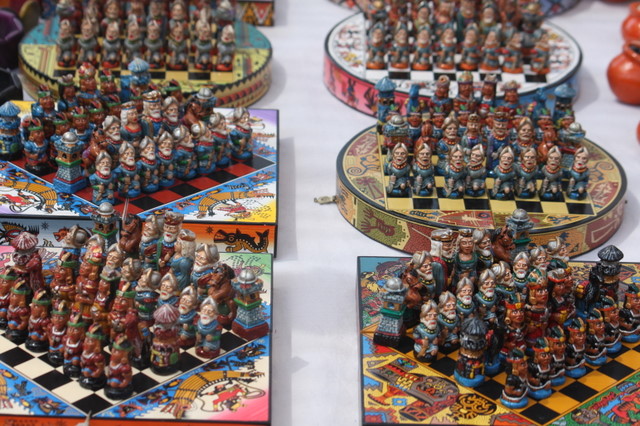
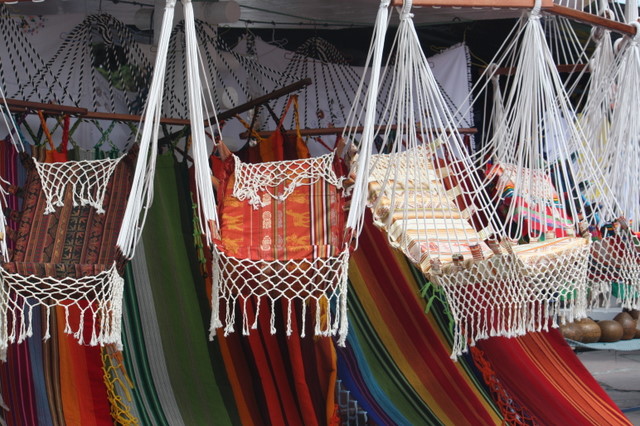
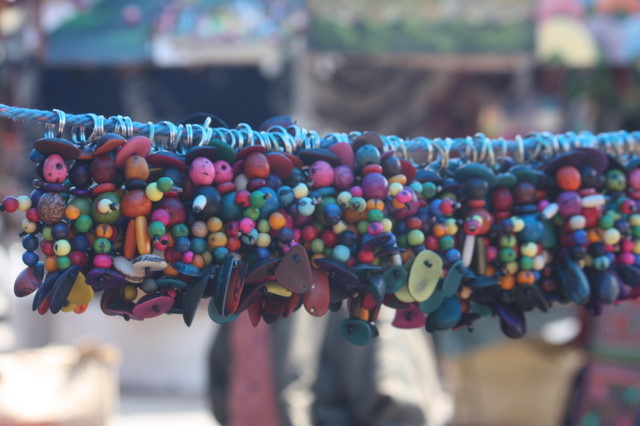
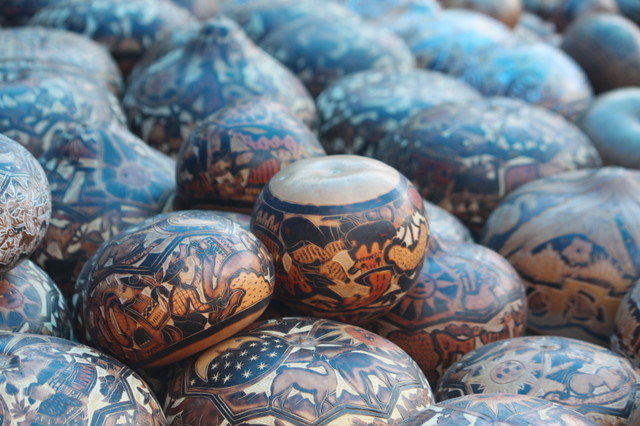
The first thing I noticed about the market is the colors, brilliant colors everywhere. The handwork was delicate and skillful. Here are some of the sights:

Key rings

Key rings

Decorated gourds

Decorated gourds

Necklaces

Necklaces

Flutes

Flutes

Chess sets

Chess sets

Hanging Chairs

Hanging Chairs

They had lovely embroidered blouses and shirt and dresses as well. They had beautiful woven fabrics in a multitude of colors. The vendors were friendly and nice to deal with. There was none of the hard sell that one experiences in other parts of the world.

We took some time to walk into a little shop and order some diet coke and coffee to go with our lunches. The coffee took a really long time to come. Finally, when the next customer came in, we realized why. They were getting the coffee from another restaurant down the block!

After lunch we continued on to see a hacienda. We found it particularly interesting because our local guide had come many summers with his family when he was a boy to spend time there. It was not only a hotel (and quite a lovely one) but also the food, he told us, was excellent and it is surrounded by beautiful gardens. We looked into some of the guest rooms all of which have fireplaces as well as lofts for additional family members.

The Hacienda

The Hacienda

A lovely variety of plants and flowers

A lovely variety of plants and flowers

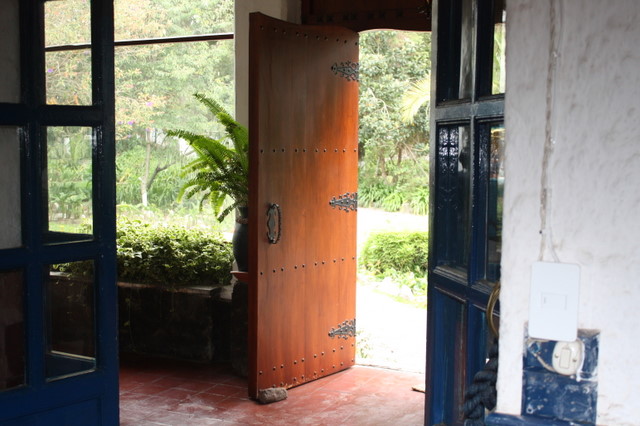
A welcoming entrance

A welcoming entrance

The hallway that runs parallel to the front of the hacienda with our hostess

The hallway that runs parallel to the front of the hacienda with our hostess

But the afternoon was not yet finished. Next time you will meet some of our fine feathered friends and see a most exquisite resort by a lake.

Ecuador

Landing in Ecuador after such a long trip seemed almost like a dream. As we approached the airport, we were flying north, above the valley that Quito occupies. As I looked down at the city, I couldn’t believe how green and lush everything looked. Quito, the capital of Ecuador, is located among volcanic mountains. The city is at an elevation of 2,800 meters (about 9,186 ft) above sea level. The city itself stretches from north to south a distance of 60 kilometers (about 36 miles). Although its main square is 25 km (15 miles) south of the equator and the city itself extends to within about 1 km (0.6 miles) of zero latitude, because of its altitude, it is not hot.

When we finally exited the plane, I felt a resonance in the sight I beheld, for here, inside the airport, were a huge number of people waiting for their relatives and friends. It so much reminded me of Ben Gurion Airport with the crowds waiting to greet visitors.

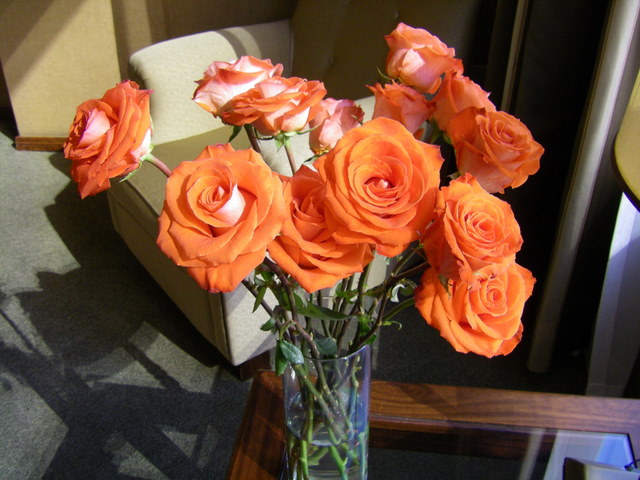
After we had gathered all of our luggage, we set off for the hotel, just a few minutes ride away. Our hotel room had a lovely vase with long stemmed roses. We learned later that Ecuador makes a great deal of money exporting these huge, gorgeous long stemmed roses.

Roses in our hotel room in Quito

Roses in our hotel room in Quito

Imagine our surprise when we walked into our private dining room for dinner and we found the tables set as if for a banquet and we were introduced to the local mashgiach (kosher supervisor) who had supervised the preparation of a delicious meal!

After a much needed night’s sleep, we awoke the next morning and set out to discover Quito and its surroundings.

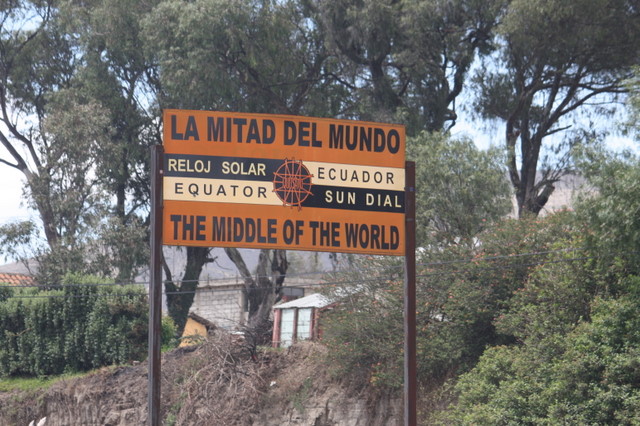
We first came to the Middle of the World Monument.

The Middle of the World

The Middle of the World


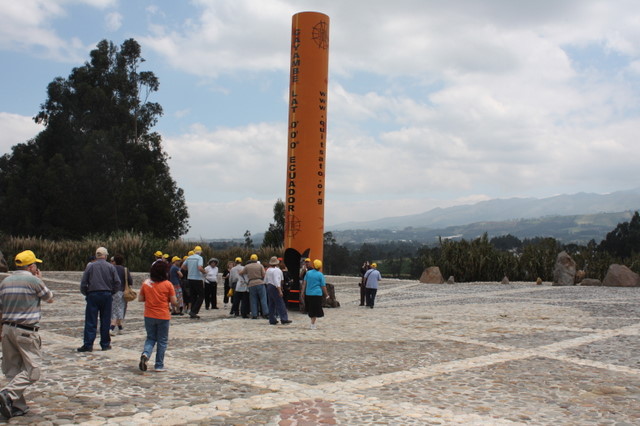
where we heard an amazing explanation of the seasons and how they change and how the sun’s shadow at noon can tell us the month of the year.
Cylindrical post and compass on the ground

Cylindrical post and compass on the ground


Of course everyone had to have their pictures taken straddling the equator, and I was no exception, nor was my husband.
My husband, with one foot in each hemispere.

My husband, with one foot in each hemispere.

But we had much more to do that day and so we got back onto the bus and headed in the direction of Otavalo.

One the way we saw lots of area for raising roses, one of the biggest export crops. Also in the area bananas, coffee and cocoa are raised. Some of the world’s finest chocolate is produced in Ecuador and some of it is produced under kosher supervision.

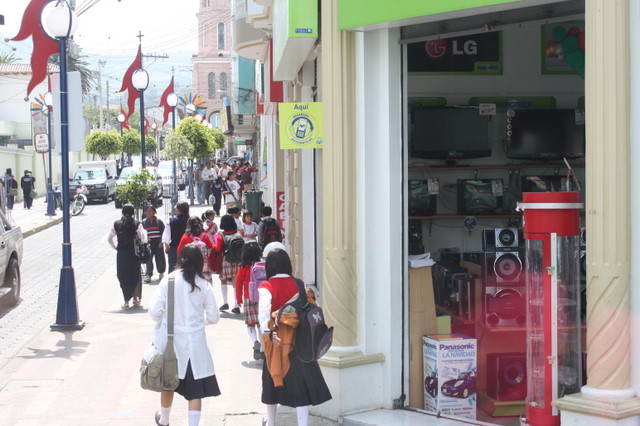
Once near Otavalo, we are able to see the children returning from school. Like children in many other countries, these children have school uniforms and they all looked incredibly adorable

Children coming home from school

Children coming home from school

.

Yes, lovely and sun-filled and happy and content. What a wonderful day. But it was just about to get a lot better when we got to the magnificent market in Otavalo.

But that’s for next time…

Ecuador, the Galapagos Islands, & Peru!

How do I begin? This was a whole new area of the world. I knew nothing about it. I had pictures in my mind of what it would be like, but I never expected what I found there. Come along with me to discover this really special part of the world!

On this trip, we had the unfortunate luck to start out just after a rare snowstorm in Spain. Yes, Spain. What would that have to do with anything? Yes, well, I wish it didn’t. You see, we were flying Iberia Airlines and the snowstorm had caused them to cancel something like 200 flights. Although the snow had been cleared from the runways by the time we were ready to fly, they were way behind and catching up very slowly. As a result, our flight from Tel Aviv took off 8 hours late. Guess what happened? You guessed? When we got to Madrid, our connecting flight to Quito had taken off hours earlier.

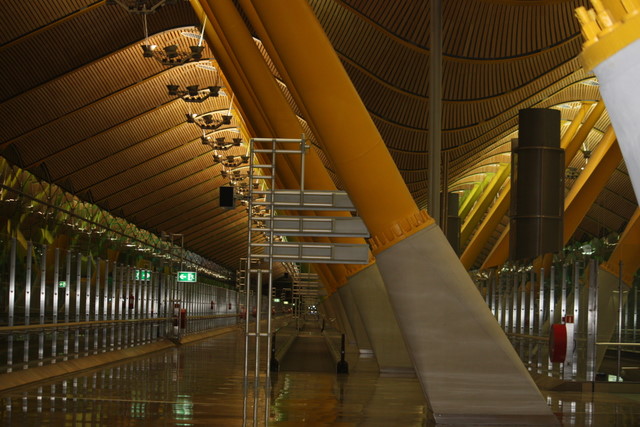
Madrid Airport

Madrid Airport

Unfortunately, they were unable to get us onto a flight that could get us anywhere near Quito or that would connect to one the next day and we had to spend the next day in Madrid… which would have been fun (as it was for our travelers who were treated to a tour of Madrid and a visit to the Prado), but as trainees, our task was to change all of the tickets, make sure all of the kosher meals were properly ordered, and get to the hotel the airline had reserved rooms in for us (and lots and lots of other people) and arrange everything so that our people were able to join us at the hotel, get their room keys, their boarding passes, and their passports and eat a kosher dinner. After a day of cold weather with no outer wear, lots of rain, and a measure of frustration, we all enjoyed sharing a leisurely dinner and had a very good night’s sleep.

The next day, we all happily took off for Ecuador!

Next time: The Middle of the World and the magnificent market in Otavala. Don’t miss them!

Rona & Aaron’s Excellent Adventure, Part 20

Previously…

Our time in Cambodia was magical. There were magnificent edifices, beautiful scenery, and the kindest, most beautiful people to meet. We stayed at a hotel that had a lovely swimming pool, surrounded by tropical plants. Each day we would leave in the morning after breakfast on the terrace beside the pool. we would see magnificent things, and we would return to the hotel for the hottest part of the day. Some of our people swan, some read books, some napped, and some went to the market just next door to the hotel. Later we left for our afternoon excursion and then returned to the hotel for dinner on the terrace.

Two of the evenings we were in Cambodia were particularly memorable. On one evening we ate dinner out of the lawn beyond the swimming pool where there was a stage set up. They brought out two round tables and set them adding flowers and candles and they served our food to us there. As we ate, we were treated to a full performance of lovely Cambodian Dances. Here is a short glimpse at what it was like.

Here is some more dancing by the lovely Cambodian ladies.

The night was truly magical.

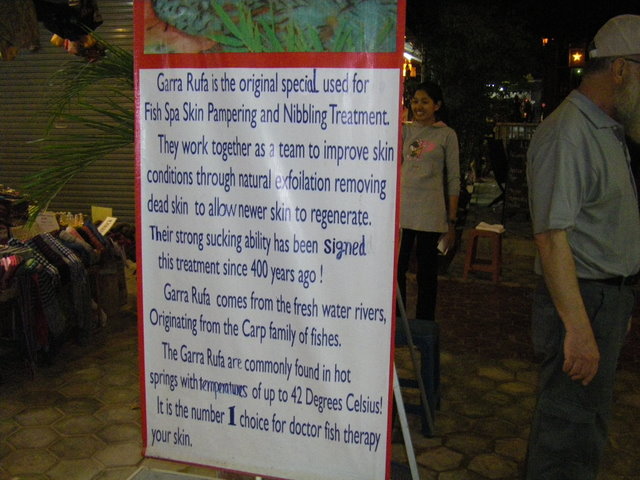
But there was yet another night that had its own magic. Outside our hotel were cyclos — drivers who has motorcycles with a cart attached to the back. We all took cyclos into town to the night market. It’s a beautiful market with lots of wonderful things to buy– jewelry, clothing, and all sorts of objects produced locally. For us, though, the highlight was the massage that our feet got. Here’s the sign:

Doctor Fish

Doctor Fish

The small fish eat the dry skin on one’s feet and the sensation is totally hysterical. Here we are enjoying the experience

In short, our tour, although off to a rough start, turned out to be the tour of a lifetime!

Rona & Aaron’s Excellent Adventure, Part 19

Previously…

One of the last places we visit in Cambodia is one of the most amazing places in the world. We go to Tonle Sap which is the largest lake in Southeast Asia. Tonle Sap flows into the Mekong Delta for part of the year, but when the waters of the Mekong, coming from as far away as Tibet, rise in the spring, the flow of water reverses as the Mekong Delta overflows back north into Tonle Sap. The area of the lake in dry season is 2,700 square kilometers. During the rainy season, from June to October, its area increases and gets up to 16,000 square kilometers! This shifting of currents, bringing fish up from the Mekong Delta to the lake provides enormous numbers of fish and those fish account for 60% of Cambodia’s protein intake.

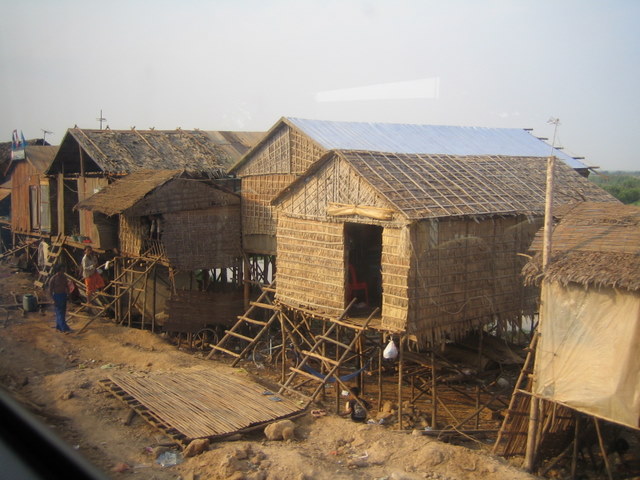
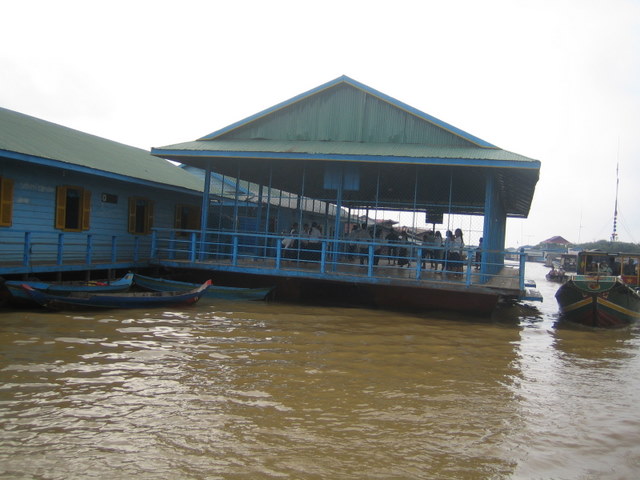
The homes around the lake and on the lake are small and virtually unfurnished. Some are up on stilts to prevent them from being flooded. Other people move their homes on trucks to other areas before the waters rise. This is possible because their construction is light and simple.

Here are a couple of homes:

Home on Tonle Sap

Home on Tonle Sap

Notice contents of home: clothing and a TV

Notice contents of home: clothing and a TV

Of course some people choose to live on the lake in houseboats and the schools too are located on boats.

Children in the basketball court at their school

Children in the basketball court at their school

There are grocery stores that are on boats too.

The neighborhood "makolet"

For those who would prefer home delivery, there are also boats that sell fruits and vegetables.

Service to your door

Service to your door

Life on the lake seems to be pleasant for this child who was just about to go swimming.

Anyone want to join me?

Anyone want to join me?

We travel on the lake in a motorized boat. Of course, on this trip, nothing was predictable, so it almost didn’t surprise us when the engine gave out and we were sitting stuck on the lake. The weather was lovely. The sun was just starting to descend giving a golden glow to the water. There were other boats. No one panicked. Eventually, after trying to start the motor a large number of times, the young boy who was assisting the pilot waved down another boat of the same type, threw a rope to them, and tied us to the other boat. We then were towed most of the way to the dock with the engine finally starting as we arrived there. After all, we had had days with no adventure. It was time.

Our travelers were a wonderful group and we all left the lake having had an enjoyable time. What they didn’t know was what was in store for them in the evening. Next time: two fabulous evenings in Siem Reap. You won’t want to miss them. Once you see them, you will sign up for our next tour!

Continuing…

Rona & Aaron’s Excellent Adventure, Part 18

Previously…

A short digression from our tour…

I am about to show you a place that stands as a metaphor for what happens when we don’t pay attention to the little things. There are all sorts of metaphors that we use. We talk about things that you don’t pay attention to coming around and biting you in the back. We talk about a cancer left unchecked and the destruction it can ravage. Well, here is the standing proof of this idea.

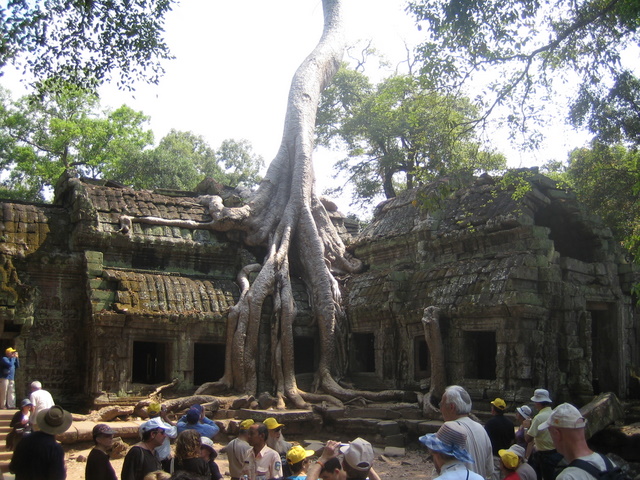
Ta Prohm was allowed to remain as it was found (although there is still some construction going on there.) Take a gander at what nature has done to this temple.

The spong tree that ate Ta Prohm

The spong tree that ate Ta Prohm

Yes, indeed. It’s unbelievable. Small seeds found their way into the roofs of these temple buildings. As time went by, the seeds sprouted roots that sought soil. And yes, they made their way down the building into the ground and at the same time grew high into the sky.

My husband standing near some roots

My husband standing near some roots

Another tree

Another tree

Standing among these trees and looking at what they have done to the temple, one is completely amazed. All of this happened when small trees were allowed to grow from the roofs unchecked. As one looks at the other temples, one can see the beginnings of trees- little branches with leaves protruding from the roofs. Much of the preservation work that is constantly being done at the other temple complexes has to do with removing these small invaders before they cause destruction.

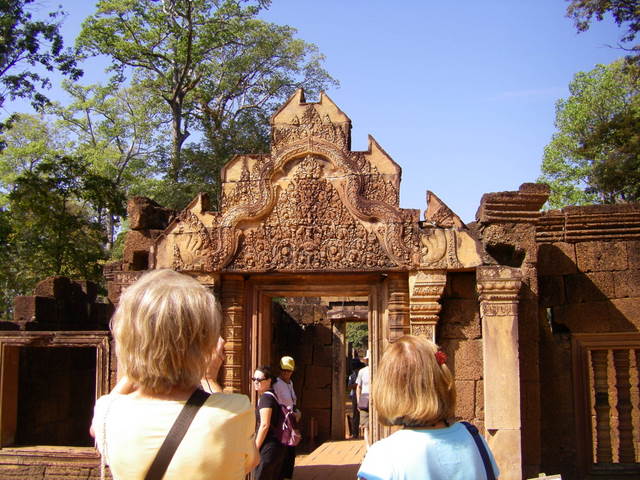
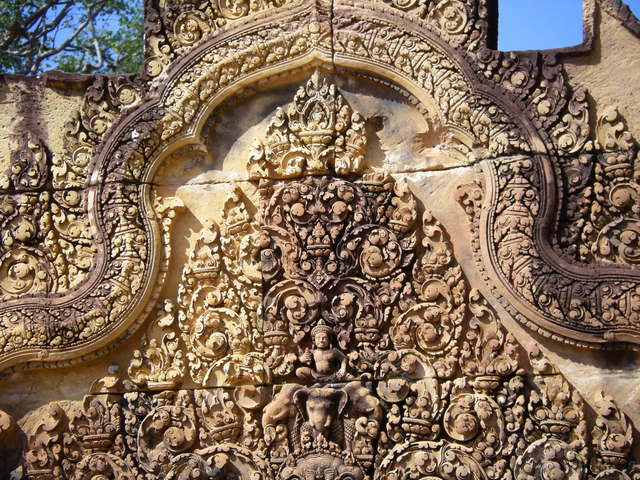
Still stunned by Ta Prohm, we made our way to one of the more beautiful temples, perhaps the most beautiful temple of Angkor, is Banteay Srei, the women’s temple. It’s an almost pink color with exotic carvings. Like most temples, it had a formal entrance and was surrounded by a moat. Most of the temples we visited didn’t have visible moats, but Angkor Wat and Banteay Srei did.

In the moat

In the moat

You can see a very different style in this temple.

Approaching the entrance

Approaching the entrance

Detail of entrance gate

Detail of entrance gate

And here is a little of what one sees inside. This temple is a real favorite and therefore full of visitors. It’s really something very special to see.

Inside of Banteay Srei

Inside of Banteay Srei

Our local guide explained to us the rationale behind the design of this temple. Its components are the same as others including a library and a prayer hall and other chambers. But in this one, the separate buildings represent parts of the body– the trunk, the legs, the arms, and the head. Fascinating!

Next time: some of the people we saw and the largest lake in Southeast Asia and its amazing ability to change fundamentally twice each year.

Continuing…

Rona & Aaron’s Excellent Adventure, Part 17

Previously…

Angkor Thom is a temple complex that dates from the late 12th century. It is nearby Angkor Wat, but of a different vintage and it contains elements that differ greatly from Angkor Wat. Although its architecture is similar, the emphasis is less on Hindu tales and tradition.

The word Angkor is Khmer for “city.” Angkor Thom is thought to have been a city of between 80,000 and 150,000 people. It was built by the Khmer king Angkor Jayavarman VII as his capital city. One inscription found in the city refers to Jayavarman as the groom and the city as his bride.

Angkor Thom is surrounded by walls on all four sides with a total of only five entrances. One of the most visited temples in the complex is the Bayon Temple.

Bayon Temple, Angkor Thom

Bayon Temple, Angkor Thom

As you can see, the restoration of the Bayon Temple is under the auspices of UNESCO and sponsored by Japan. All of the temples are constantly in a state of restoration, a necessity that you will understand better when I show you Ta Prohm. In this case, the temple is being restored because many of its structures have been damaged and they are being rebuilt with original materials that were found at the site. Of course it is a bit like assembling a 100,000 piece jigsaw puzzle with pieces that could either be from it or from other puzzles and so the identification of which stones were from which structures is only the beginning of the job. They are doing a magnificent job as each year I see more and more of the construction.

Here is what Bayon temple looks like as one approaches.

Walking toward Angkor Thom

Walking toward Angkor Thom

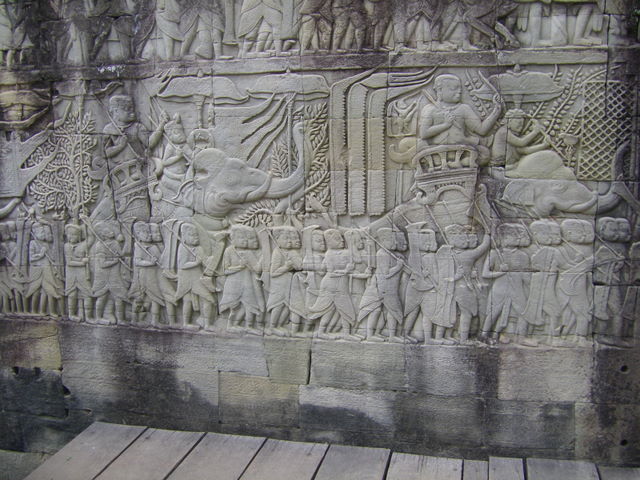
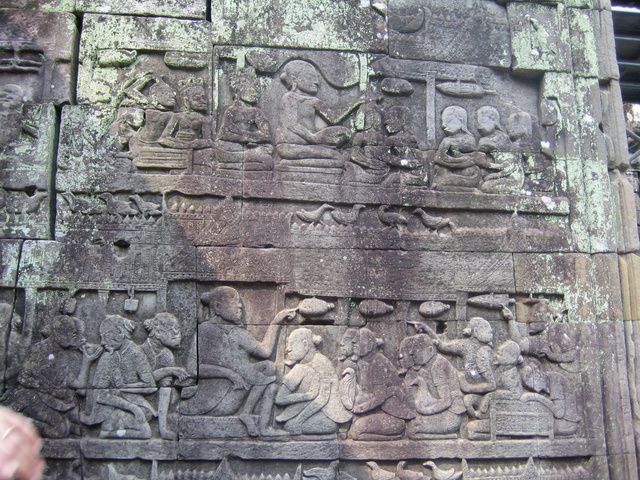
The Bayon Temple, like Angkor Wat, has massive bas reliefs. However, instead of mythical battles, these bas reliefs are taken from the daily life of the people and as one walks around the base of the temple, it feels as if one is peering through windows and watching people go about their daily life.

Bas relief, Bayon Temple

Bas relief, Bayon Temple

Looks like a class to me!

Looks like a class to me!

The most interesting feature of the Bayon Temple is the carvings of faces. There are faces wherever you look.

How many faces do you see?

How many faces do you see?

Of course, one of the things that happens is that people get quite creative with their photography (or if not, they watch others and get ideas) and so here’s a picture of my husband rubbing noses with one of the faces.

Up close and personal

Up close and personal

Climbing up and seeing the temple from all different levels is fun and interesting and every once in a while, there’s a surprise, like these people dressed in traditional Khmer costumes. Our people enjoyed having their picture taken with them.

Happy people!

Happy people!

Visiting Angkor Thom was a lot of fun and we enjoyed seeing many of the temples and structures in its complex. However, nothing we saw prepared us for Ta Prohm! Next time…

Continuing…

Rona & Aaron’s Excellent Adventure, Part 16

Previously…

By now, I am sure that you have forgotten the details of our arrival in Hanoi. To give you just the important facts, I will remind you that we waited for a very long time to receive our visas, even though the group visa application form had been mailed from Israel and it was approved in Hanoi and mailed back to Israel, and even though we all filled out the required forms and attached relevant photos (relevant being the kindest adjective I can think of for passport photos, but I digress.) While all this was happening, I asked if we had to fill out any other forms. I seemed to remember a form that we needed to hand over as we entered the country even though by then we had our visas. At first I was told yes, we must fill it out and so I asked for the appropriate number of forms. Then I was told, no, we really didn’t need it. We all got through passport control and then waited a very long time to have all of the lost baggage forms filled out. Only after that did we leave the airport.

“Well, what’s the relevance?” you might ask. As well you should.

At the time we were leaving Vietnam via the airport at Ho Chi Minh City (HCMC)/ Saigon, we checked in at the desk, got our boarding passes and proceeded to security and passport control. About half the group had gone through and I purposely waited to be the last in case there was any problem. It was a good thing. For first one and then another of the people in our group had been stopped and asked for the form that we had never filled out which should have been stamped at entry. Of course the fact that half the group had gotten through without it made me certain that this was not an insurmountable difficulty. One of the passengers was very concerned. “Suppose they never let me out of Vietnam…” Um, right. I said, “Don’t worry; I’ll take care of it.”

I may have mentioned that my Vietnamese consists of thank you and Pho? (and Pho doesn’t come in handy all that much.) But still I realized that anything is possible if one believes it is. (Well, not anything but this should be). I told all of the people who were not allowed out to come to my line and I picked the kindest looking clerk. I pointed to my yellow hat and said, “I am the leader. We entered Vietnam without filling out any forms, but we all have visas. We have no forms to give you.” I am pretty certain that he didn’t understand one word of what I was saying, but he smiled and nodded his head and he allowed everyone through.

And so finally we were on our way to Cambodia.

Cambodia is an amazing country. If China farms out its work to Vietnam where workers are paid less, then Vietnam farms out its work to Cambodia where there is real poverty. Vietnam is a country on the move. The educational system is constantly improving and children are encouraged to study and achieve. Cambodia is not there yet.

Of course Cambodia is still reeling from its years under the Khmer Rouge when an estimated 1.7 million Cambodians were killed or died as a result of the cruelty of their own people. This was at a time when the entire population of Cambodia was only about 7 million. The country suffered such trauma that it is only this past year that the first trial of a Khmer Rouge officer commenced. There was debate as to whether the trial should be held because of the issues of retraumatizing the population.

But arriving in Cambodia, one sees green fields and blue skies and people with sweet demeanor and once there, one falls in love with the country.

We stayed at the Apsara Hotel, on the main road from the airport to the city, not far from the temples of Angkor. After a lovely dinner in the garden overlooking the pool, we all went to sleep and bright and early the next morning, we headed out to Angkor Wat.

Angkor Wat means the temple of Angkor. It is only one of many temples built from the ninth to the thirteenth centuries. It is perhaps the largest and certainly the most well known. In fact, it is the only building that appears on its nation’s flag.

To say that it is impressive is an understatement.

My husband in front of Angkor Wat

My husband in front of Angkor Wat

Another view, this time with all five towers showing

Another view with all five towers showing

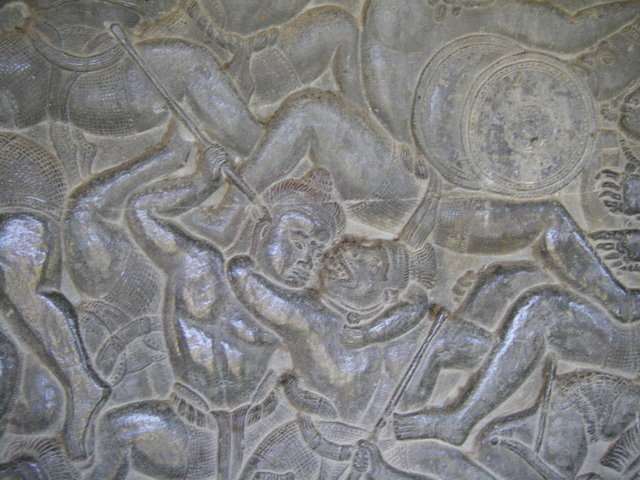
We had a very nice local guide, but he didn’t seem to understand that hearing the story of the Battle of Lanka in excruciating detail was not necessarily our cup of tea. It did, however, provide excellent background for understanding the multitude of bas reliefs that decorated the temple. If the construction of the temple itself had not been impressive, and believe me, it is astounding, the bas reliefs alone would have made the visit mid-boggling. They are intricate and they go on forever.

One detail of the devil fighting the monkey

One detail of the devil fighting the monkey

a larger section

a larger section

And here is a look at the intricacy of the construction

In the interior of Angkor Wat

In the interior of Angkor Wat

Detail of one of the towers

Detail of one of the towers

It took 37 years to build Angkor Wat– which is an amazingly short time considering its size and intricacy. However, there are some who estimate that about 300,000 workmen were engaged in building it! More info is available here.

Sorry I didn’t get around to Angkor Thom, but that’s for the next time. OK?

Continuing…

Rona & Aaron’s Excellent Adventure, Part 15

Continuing…

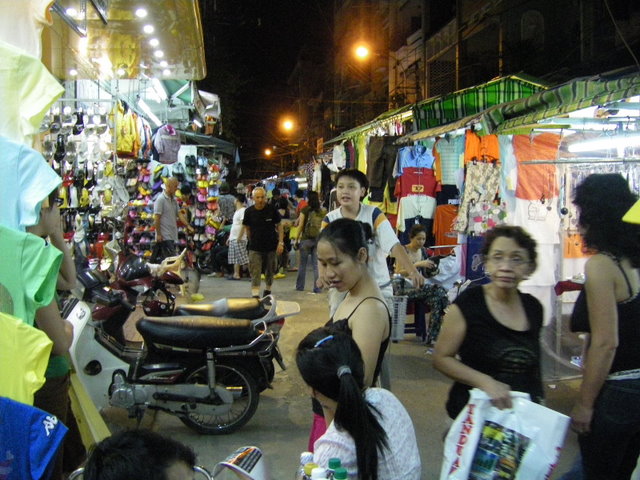
After a wonderful shabbat, our group was ready to discover the wonders of the Saigon night market. Now I am sure that in a city the size of Saigon, there are probably tens of markets, but this one just happened to be about 3 blocks from our hotel, across Le Loi Street from Chabad, a very convenient location. It consisted mostly of clothing, shoes, luggage, handbags, and jewelry. The prices were very good.

The night market

The night market

After buying a sufficient number of items, we had to buy a suitcase to put them in… Actually, that really isn’t the truth. We had bought a very cheap suitcase a couple of years ago and by this point on the trip the luggage handlers had pretty much destroyed it, so it was time to get a new suitcase and the one we found was large and not so heavy and seemed practical. However, it does seem to me that you can’t really leave this market without buying a serious amount of stuff, if only T-shirts for souvenirs.

In the morning, after a good night’s sleep and breakfast in the roof garden, bright and early, we made our way through the traffic and the rubber plantations to Cu Chi. Cu Chi is where the Viet Cong had constructed an entire city under the ground. They were able to live there undetected by constructing a series of tunnels at three levels, by directing their cooking smoke through enough conduits that by the time it emerged, it was barely detectable, and by constructing entrances that were invisible to all but those who had placed them there. They had entrances from under the river and through tiny holes in the ground that were completely covered up most of the time.

The opening, in time of war completely covered by leaves

The opening, in time of war completely covered by leaves

The soldier emerges

The soldier emerges

We were treated to a tour of the Viet Cong’s instruments of torture and death. They certainly were innovative. There were any number of traps where if a soldier was caught, he would pray for death. It did eventually come because they made sure that the stinging edges of their spikes were also able to infect or poison the soldiers. Of course, when asked, the Vietnamese will all tell you that the war is over and this is another time and there is no reason for any bad feelings.

What was a bit disconcerting was that from time to time we would hear shots fired. There is a rifle range adjoining the area we were touring. It made for some not so pleasant authenticity.

We made our way from Cu Chi to an amazing place. How can I describe it? Well, perhaps only through pictures. In the 1920s a new relgion was founded called Cao Dai. Here is some information about it. Their main temple in Tay Ninh is quite impressive both outside and inside.

Cao Dai Temple, Tay Ninh, Vietnam

Cao Dai Temple, Tay Ninh, Vietnam

The religion attempts to unite all religions and to emphasize kindness toward people and toward the world. High priests are strict vegetarians, and all adherents must follow a moral code.

Inside the temple

Inside the temple

During the service which includes chanting, playing of bells and gongs and the people prostrating themselves, visitors are asked to watch from the balcony. Wearing shoes in the temple is forbidden and so a large pile of sport shoes and crocs waited for us after the service.

During the service

During the service

Since Cao Dai incorporates several religions, there are priests representing each of the three major contributing religions, they are dressed in red- for Christianity, blue- for Taoism, and yellow- for Buddhism.

Here is another photo of the worship at the Cao Dai Temple.

Worshipers at the Cao Dai Temple

Worshipers at the Cao Dai Temple

Next: What is Angkor Wat? and why is it special? and what is Angkor Thom? and aren’t all Cambodian temples alike? Find out the surprising answers next time…

Continuing…

Pin It on Pinterest