Rona & Aaron’s Excellent Adventure, Part 17

Previously…

Angkor Thom is a temple complex that dates from the late 12th century. It is nearby Angkor Wat, but of a different vintage and it contains elements that differ greatly from Angkor Wat. Although its architecture is similar, the emphasis is less on Hindu tales and tradition.

The word Angkor is Khmer for “city.” Angkor Thom is thought to have been a city of between 80,000 and 150,000 people. It was built by the Khmer king Angkor Jayavarman VII as his capital city. One inscription found in the city refers to Jayavarman as the groom and the city as his bride.

Angkor Thom is surrounded by walls on all four sides with a total of only five entrances. One of the most visited temples in the complex is the Bayon Temple.

Bayon Temple, Angkor Thom

Bayon Temple, Angkor Thom

As you can see, the restoration of the Bayon Temple is under the auspices of UNESCO and sponsored by Japan. All of the temples are constantly in a state of restoration, a necessity that you will understand better when I show you Ta Prohm. In this case, the temple is being restored because many of its structures have been damaged and they are being rebuilt with original materials that were found at the site. Of course it is a bit like assembling a 100,000 piece jigsaw puzzle with pieces that could either be from it or from other puzzles and so the identification of which stones were from which structures is only the beginning of the job. They are doing a magnificent job as each year I see more and more of the construction.

Here is what Bayon temple looks like as one approaches.

Walking toward Angkor Thom

Walking toward Angkor Thom

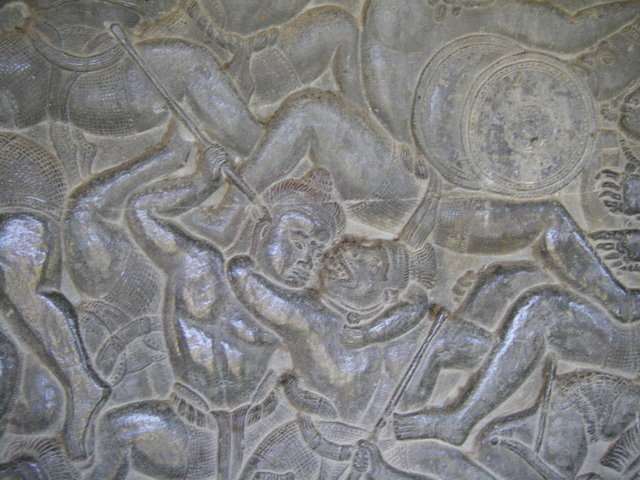
The Bayon Temple, like Angkor Wat, has massive bas reliefs. However, instead of mythical battles, these bas reliefs are taken from the daily life of the people and as one walks around the base of the temple, it feels as if one is peering through windows and watching people go about their daily life.
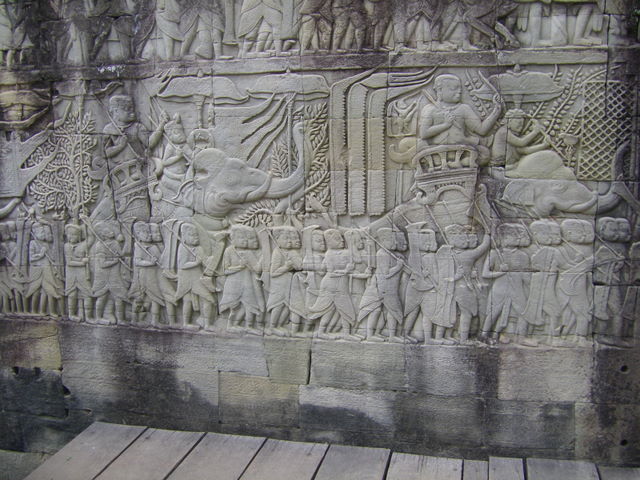
Bas relief, Bayon Temple
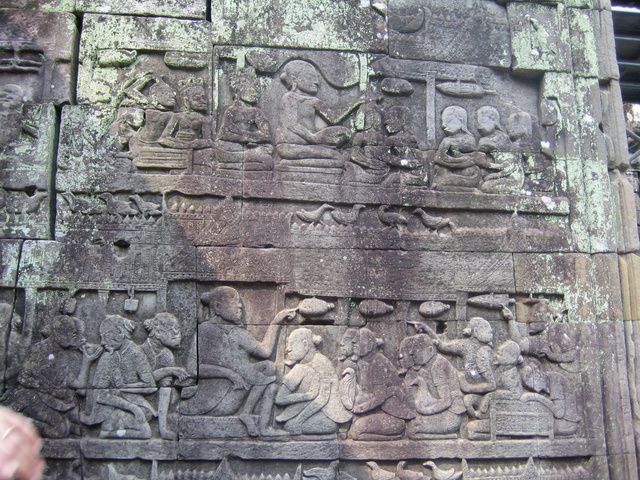
Bas relief, Bayon Temple

Looks like a class to me!

Looks like a class to me!

The most interesting feature of the Bayon Temple is the carvings of faces. There are faces wherever you look.

How many faces do you see?

How many faces do you see?

Of course, one of the things that happens is that people get quite creative with their photography (or if not, they watch others and get ideas) and so here’s a picture of my husband rubbing noses with one of the faces.

Up close and personal

Up close and personal

Climbing up and seeing the temple from all different levels is fun and interesting and every once in a while, there’s a surprise, like these people dressed in traditional Khmer costumes. Our people enjoyed having their picture taken with them.

Happy people!

Happy people!

Visiting Angkor Thom was a lot of fun and we enjoyed seeing many of the temples and structures in its complex. However, nothing we saw prepared us for Ta Prohm! Next time…

Continuing…

Rona & Aaron’s Excellent Adventure, Part 16

Previously…

By now, I am sure that you have forgotten the details of our arrival in Hanoi. To give you just the important facts, I will remind you that we waited for a very long time to receive our visas, even though the group visa application form had been mailed from Israel and it was approved in Hanoi and mailed back to Israel, and even though we all filled out the required forms and attached relevant photos (relevant being the kindest adjective I can think of for passport photos, but I digress.) While all this was happening, I asked if we had to fill out any other forms. I seemed to remember a form that we needed to hand over as we entered the country even though by then we had our visas. At first I was told yes, we must fill it out and so I asked for the appropriate number of forms. Then I was told, no, we really didn’t need it. We all got through passport control and then waited a very long time to have all of the lost baggage forms filled out. Only after that did we leave the airport.

“Well, what’s the relevance?” you might ask. As well you should.

At the time we were leaving Vietnam via the airport at Ho Chi Minh City (HCMC)/ Saigon, we checked in at the desk, got our boarding passes and proceeded to security and passport control. About half the group had gone through and I purposely waited to be the last in case there was any problem. It was a good thing. For first one and then another of the people in our group had been stopped and asked for the form that we had never filled out which should have been stamped at entry. Of course the fact that half the group had gotten through without it made me certain that this was not an insurmountable difficulty. One of the passengers was very concerned. “Suppose they never let me out of Vietnam…” Um, right. I said, “Don’t worry; I’ll take care of it.”

I may have mentioned that my Vietnamese consists of thank you and Pho? (and Pho doesn’t come in handy all that much.) But still I realized that anything is possible if one believes it is. (Well, not anything but this should be). I told all of the people who were not allowed out to come to my line and I picked the kindest looking clerk. I pointed to my yellow hat and said, “I am the leader. We entered Vietnam without filling out any forms, but we all have visas. We have no forms to give you.” I am pretty certain that he didn’t understand one word of what I was saying, but he smiled and nodded his head and he allowed everyone through.

And so finally we were on our way to Cambodia.

Cambodia is an amazing country. If China farms out its work to Vietnam where workers are paid less, then Vietnam farms out its work to Cambodia where there is real poverty. Vietnam is a country on the move. The educational system is constantly improving and children are encouraged to study and achieve. Cambodia is not there yet.

Of course Cambodia is still reeling from its years under the Khmer Rouge when an estimated 1.7 million Cambodians were killed or died as a result of the cruelty of their own people. This was at a time when the entire population of Cambodia was only about 7 million. The country suffered such trauma that it is only this past year that the first trial of a Khmer Rouge officer commenced. There was debate as to whether the trial should be held because of the issues of retraumatizing the population.

But arriving in Cambodia, one sees green fields and blue skies and people with sweet demeanor and once there, one falls in love with the country.

We stayed at the Apsara Hotel, on the main road from the airport to the city, not far from the temples of Angkor. After a lovely dinner in the garden overlooking the pool, we all went to sleep and bright and early the next morning, we headed out to Angkor Wat.

Angkor Wat means the temple of Angkor. It is only one of many temples built from the ninth to the thirteenth centuries. It is perhaps the largest and certainly the most well known. In fact, it is the only building that appears on its nation’s flag.

To say that it is impressive is an understatement.

My husband in front of Angkor Wat

My husband in front of Angkor Wat

Another view, this time with all five towers showing

Another view with all five towers showing

We had a very nice local guide, but he didn’t seem to understand that hearing the story of the Battle of Lanka in excruciating detail was not necessarily our cup of tea. It did, however, provide excellent background for understanding the multitude of bas reliefs that decorated the temple. If the construction of the temple itself had not been impressive, and believe me, it is astounding, the bas reliefs alone would have made the visit mid-boggling. They are intricate and they go on forever.

One detail of the devil fighting the monkey

One detail of the devil fighting the monkey

a larger section

a larger section

And here is a look at the intricacy of the construction

In the interior of Angkor Wat

In the interior of Angkor Wat

Detail of one of the towers

Detail of one of the towers

It took 37 years to build Angkor Wat– which is an amazingly short time considering its size and intricacy. However, there are some who estimate that about 300,000 workmen were engaged in building it! More info is available here.

Sorry I didn’t get around to Angkor Thom, but that’s for the next time. OK?

Continuing…

Rona & Aaron’s Excellent Adventure, Part 15

Continuing…

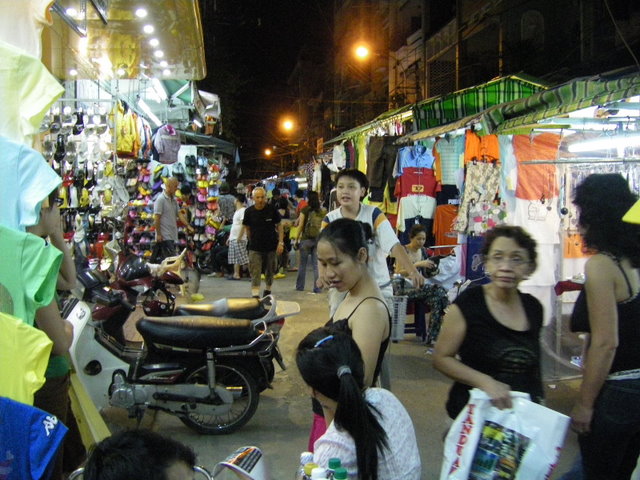
After a wonderful shabbat, our group was ready to discover the wonders of the Saigon night market. Now I am sure that in a city the size of Saigon, there are probably tens of markets, but this one just happened to be about 3 blocks from our hotel, across Le Loi Street from Chabad, a very convenient location. It consisted mostly of clothing, shoes, luggage, handbags, and jewelry. The prices were very good.

The night market

The night market

After buying a sufficient number of items, we had to buy a suitcase to put them in… Actually, that really isn’t the truth. We had bought a very cheap suitcase a couple of years ago and by this point on the trip the luggage handlers had pretty much destroyed it, so it was time to get a new suitcase and the one we found was large and not so heavy and seemed practical. However, it does seem to me that you can’t really leave this market without buying a serious amount of stuff, if only T-shirts for souvenirs.

In the morning, after a good night’s sleep and breakfast in the roof garden, bright and early, we made our way through the traffic and the rubber plantations to Cu Chi. Cu Chi is where the Viet Cong had constructed an entire city under the ground. They were able to live there undetected by constructing a series of tunnels at three levels, by directing their cooking smoke through enough conduits that by the time it emerged, it was barely detectable, and by constructing entrances that were invisible to all but those who had placed them there. They had entrances from under the river and through tiny holes in the ground that were completely covered up most of the time.

The opening, in time of war completely covered by leaves

The opening, in time of war completely covered by leaves

The soldier emerges

The soldier emerges

We were treated to a tour of the Viet Cong’s instruments of torture and death. They certainly were innovative. There were any number of traps where if a soldier was caught, he would pray for death. It did eventually come because they made sure that the stinging edges of their spikes were also able to infect or poison the soldiers. Of course, when asked, the Vietnamese will all tell you that the war is over and this is another time and there is no reason for any bad feelings.

What was a bit disconcerting was that from time to time we would hear shots fired. There is a rifle range adjoining the area we were touring. It made for some not so pleasant authenticity.

We made our way from Cu Chi to an amazing place. How can I describe it? Well, perhaps only through pictures. In the 1920s a new relgion was founded called Cao Dai. Here is some information about it. Their main temple in Tay Ninh is quite impressive both outside and inside.

Cao Dai Temple, Tay Ninh, Vietnam

Cao Dai Temple, Tay Ninh, Vietnam

The religion attempts to unite all religions and to emphasize kindness toward people and toward the world. High priests are strict vegetarians, and all adherents must follow a moral code.

Inside the temple

Inside the temple

During the service which includes chanting, playing of bells and gongs and the people prostrating themselves, visitors are asked to watch from the balcony. Wearing shoes in the temple is forbidden and so a large pile of sport shoes and crocs waited for us after the service.

During the service

During the service

Since Cao Dai incorporates several religions, there are priests representing each of the three major contributing religions, they are dressed in red- for Christianity, blue- for Taoism, and yellow- for Buddhism.

Here is another photo of the worship at the Cao Dai Temple.

Worshipers at the Cao Dai Temple

Worshipers at the Cao Dai Temple

Next: What is Angkor Wat? and why is it special? and what is Angkor Thom? and aren’t all Cambodian temples alike? Find out the surprising answers next time…

Continuing…

Rona & Aaron’s Excellent Adventure, Part 14

Previously…

When we returned from the Mekong Delta, we had enough time to get ourselves ready for a relaxing shabbat. What a delight to be wth Rabbi and Mrs. Hartman at Chabad for services and shabbat dinner! It was wonderful seeing that there is a community developing among people who had until recently been isolated. We enjoyed eating and singing and hearing stories about life in Vietnam. Shabbat morning too was enjoyable.

When we returned to the hotel, we put on comfortable shoes and headed out to see some of the sights. First we walked to the post office (fortunately, on a previous tour, we done this excursion during the week, so I have photos)

Post Office, Ho Chi Minh City

Post Office, Ho Chi Minh City

The post office is, of course, from the period that the French were in Vietnam, and so the architecture is European. In fact, the French reproduced the Notre Dame Cathedral just across the street.

Notre Dame, HCMC

Notre Dame, HCMC

We then walked on to the Palace of Reunification. This had been the Presidential Palace of South Vietnam when Vietnam was divided. Inside, now, there are reception rooms and the building is used for ceremonial purposes. However, they have retained the furnishings and equipment that were used in the Palace during the war, including the war maps and communications equipment.

The Palace is very impressive.

The Reunification Palace, Ho Chi Minh City, Vietnam

The Reunification Palace, Ho Chi Minh City, Vietnam

Here is the former presidential office

Former presidential office

Former presidential office

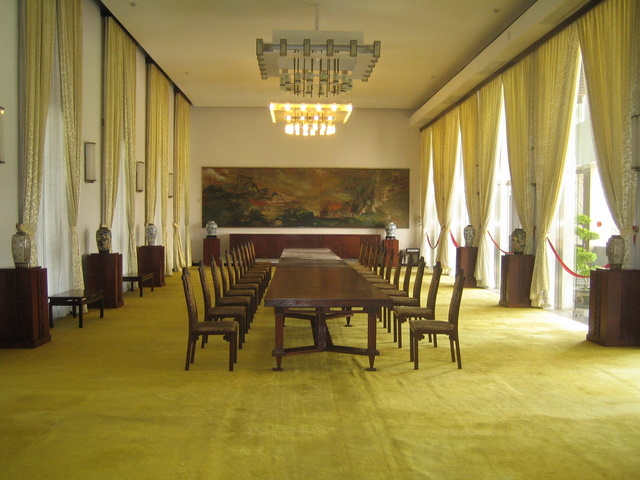
Here are some reception rooms. All are decorated in exquisite taste.

Reception room

Reception room

Reception room

Reception room

After our lovely walk, we returned to the hotel to change (those who wanted to) because it was already time to go back to Chabad for Mincha and Seuda Shlishit!

After a wonderful shabbat, we made havdalah and bade farewell to Chabad and went back to the hotel to get our money because Saturday night was just made for shopping!

Next: Come along with us to the Saigon night market, learn how the Viet Cong defeated the US Army, and see for yourself a most colorful and interesting religious group and their Disneyland-like Temple!

Continuing…

Rona & Aaron’s Excellent Adventure, Part 13

Previously…

After a brief (very brief) stop at one of the tombs of one of the emperors, we got onto a plane and left for Ho Chi Minh City (HCMC). This is the name given to Saigon when the country became one after the US withdrew all of its troops. However, the name never really caught on in the south and people who live in Saigon call it Saigon. Even those in the north and central part of the country are more likely to refer to the city as Saigon. But, officially, it is still called Ho Chi Minh City (HCMC).

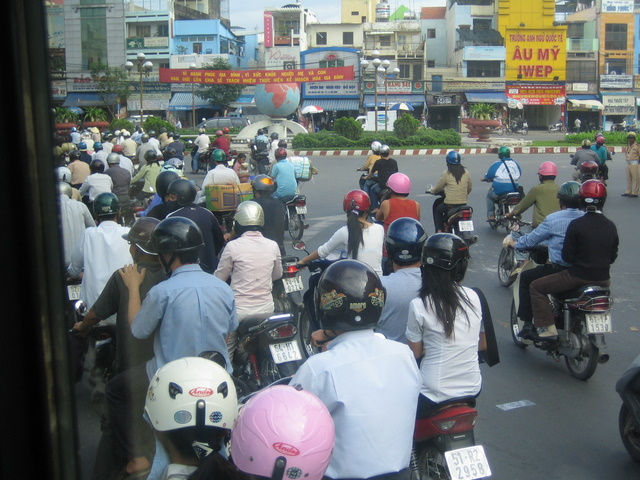
Saigon is a bustling metropolis. It is large, noisy, and full of activity. The streets are full of motorbikes and motorcycles which are the chief method of transportation in the city. And it is lucky that more people can’t afford cars because there would simply not be any room for them. At schools, parents line up outside on their vehicles to pick up their one, two, or three children and transport them home on their motorcycle/motorbike. It is not unusual to see three people on a bike and I have seen up to five.

Crossing the street is an art. One of the most important things that a guide in Vietnam must do is to teach his/her people to cross streets. It is not something for the faint of heart.

Saigon traffic

Saigon traffic

Saigon on wheels

Saigon on wheels

Here’s the trick: You wait until there’s a slight break in the traffic (that’s the best it ever gets) and then you walk into the street and keep walking. Yes, motorcycles and motorbikes are coming at you, but you don’t stop. Ever. You see, they watch you, gauge how fast you are walking and cross either to the front or back of you, but stop and guess what happens? That is why when I take my people across the streets the first couple of times I sound somewhat strange as I repeat the entire time, “Walk, walk, walk, walk, walk, walk, walk, walk, walk, walk!”

So, after arriving in Saigon, we went to our hotel and shortly afterwards, set off for Chabad where we ate dinner. If you want to know about Chabad Vietnam, you can find them here. But only I can tell you how kind and friendly and warm and welcoming the young Rabbi Hartman and his lovely wife, Racheli are. In the short time they have been there, they have accomplished amazing things– building a community where there was nothing– having 50 people (NOT including our group!) for shabbat dinner, and starting a nursery school. Israel TV made a documentary about their arrival in Vietnam which you may be able to see (not always available) at this location.

The next morning we set out for the Mekong Delta. You may have heard of the delta, primarily in regard to the Vietnam War (which they call the “American War”), but the size of the delta is quite amazing. It is 39,000 square kilometers (15,000 sq miles). Compare that to Israel, 20,329 square kilometers (7,849 sq miles)!

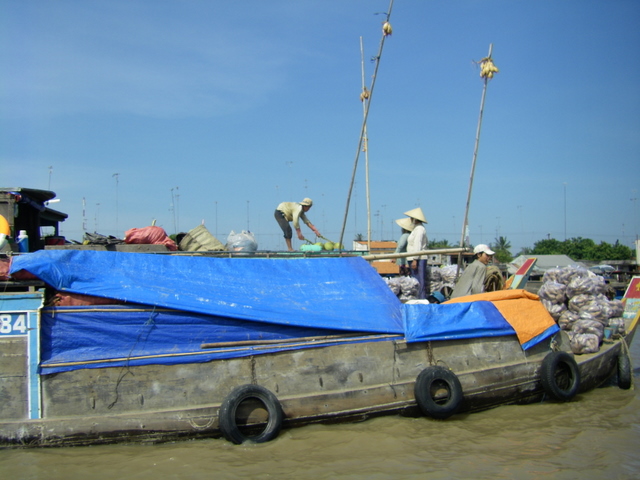
Along the delta, there are floating markets. Here people bring fruit and produce and sell or trade it each morning. They advertise their wares by hanging them from bamboo poles on their boats, much as one would hang a flag.

Selling potatoes

Selling potatoes

Selling rambutans

Selling rambutans

You can read about rambutans here.

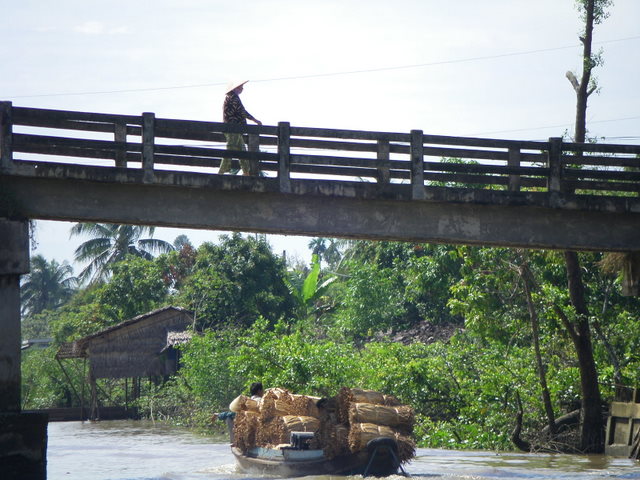
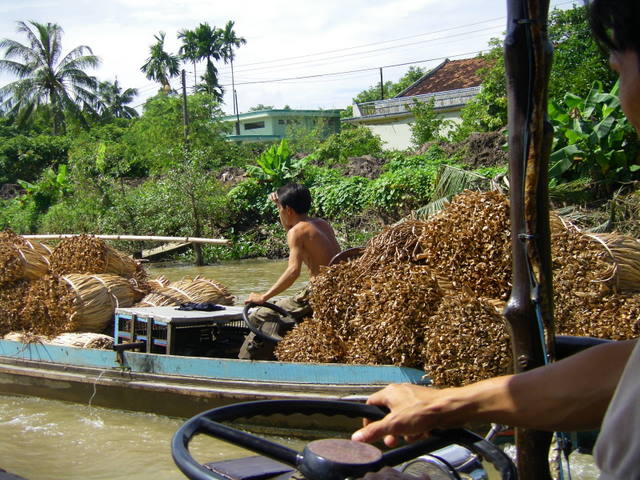
We enjoyed watching the local cottage industries using the available produce and making puffed rice (it’s fabulous to watch), rice bars, rice paper, and coconut candies. It was all fascinating. Then we enjoyed cruising around the byways of the delta.

On the delta

On the delta

On the delta

On the delta

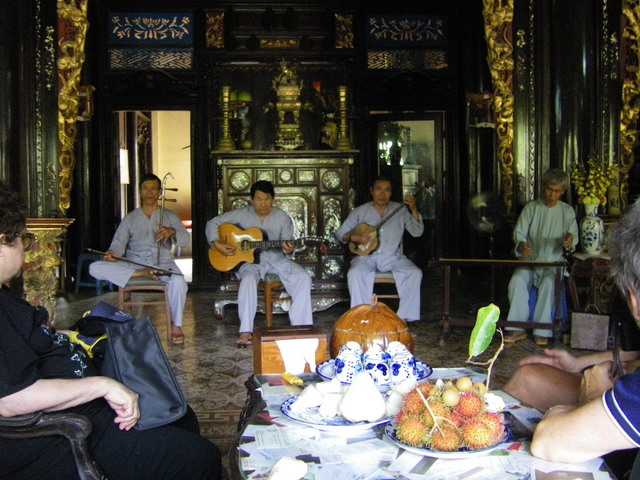
We also enjoyed a private concert of Vietnamese music which we listened to as we sampled new and different fruits.

House concert

House concert

Next time we answer the question: What do a post office, Notre Dame, and the Reunification Palace have in common?

Continuing…

Rona & Aaron’s Excellent Adventure, Part 12

Previously…

Yes, folks, we are back for our next adventure, but first let’s carry on with this one and then I will tell you about the next one.

We drove through the Hai Van Pass, a very impressive ride when the weather is clear. Unfortunately, the weather was rainy and foggy, so all we saw was the condensation on our windows and the fog in front of the bus which made us gasp from time to time.

By the time we got to Hue, it was already time for me to go to the restaurant to supervise dinner. My husband went on with the group to the Perfume River and the Thien Mu Pagoda, both of them very lovely.

The kitchen staff was wonderful, anxious to please. Of course, having no common language offered a bit of a challenge, but how could I become frustrated when they took me to the special room they had set up for us with Israeli flags on the tables?

So, I watched carefully and as usual, checked every item that was used in the preparation of the food. One man sat for over an hour sculpting carrots and this was the result:

Artistry in food

Artistry in food

When served at the table, it looked like this:

Pineapple, carrot, and garlic creation

Pineapple, carrot, and garlic creation

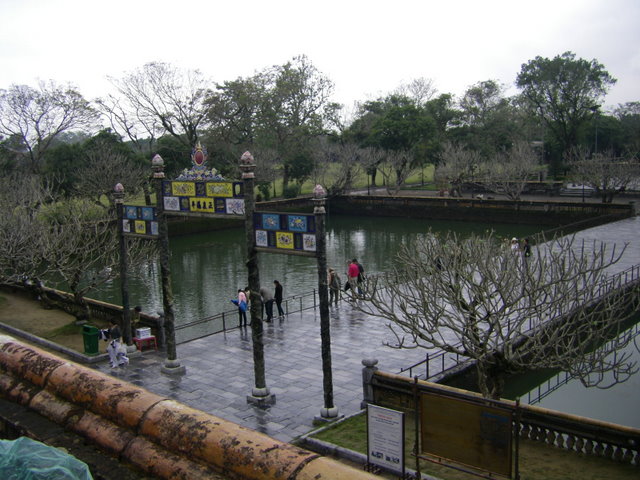
The next morning, the light rain continued and we took a walk through the wet and slippery, but very beautiful Forbidden City in Hue, dated from 1804. The city is reminiscent of the Ming Dynasty Forbidden City in Beijing, China, but the architecture is more delicate and understated. Here is one of the gates:

A gate in the Forbidden City, Hue

A gate in the Forbidden City, Hue

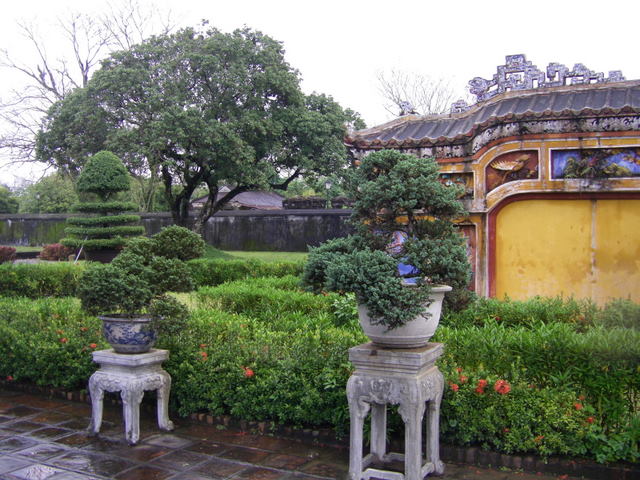
We walked through gardens and saw beautiful buildings.

The Forbidden City, Hue

The Forbidden City, Hue

The Forbidden City, Hue

The Forbidden City, Hue

And then before we knew it, we were on our way to the big, bustling city of Saigon, officially known as Ho Chi Minh City.

Next stop: The Mekong Delta as you never imagined it.

Continuing…

Rona & Aaron’s Excellent Adventure, Part 11

Previously…

After a wonderful day in Halong Bay, we woke up the next morning ready for our next adventure. Our guide, Mrs. Phuong, was originally from Halong Bay and she knew all of the most picturesque places. She took us to a fishing pier that was truly amazing. We saw beautiful displays of vegetables and marveled as fisherman brought in piles and piles of creepy, wiggling fish. There were all sorts of fish, some we’ve seen before and others we hadn’t. There were long silvery fish and short pink ones. And most of them were still moving.

And soon, so were we. We drove back to Hanoi and boarded a plane for Da Nang, the airport located about a 40 minute drive from Hoi An. I have written about Hoi An before here. It is a very beautiful city and it is a wonderful place to relax. There are a number of beautiful resort hotels.

Hoi An has a rich international tradition evidenced by the Chinese and Japanese structures that still grace the city. I was fascinated by the Chinese assembly halls. When the Chinese came to live in Hoi An, they were, in a sense, not unlike my relatives when they arrived in the US as immigrants. My relatives and other Jewish immigrants of that era were able to make it economically with the help of their “landsmen,” people who came from the same area of eastern Europe that they did. Here in Hoi An, people coming from each province of China had their own meeting hall and there they would network, talk of home, and help each other. Here is the Fujian Meeting Hall.

Fujian Meeting Hall

Fujian Meeting Hall

Of course the big attraction in Hoi An is the Japanese Bridge, probably the only bridge that has a temple built into it. It is a footbridge and off to one side in the middle of the bridge is a room where people can pray. Here is the bridge from a distance.

The Japanese Bridge

The Japanese Bridge

Hoi An is the place where many tourists have clothing made to order for themselves. They have exquisite silks that they make into ao dais and other types of clothing, but let’s see what the locals wear in Hoi An.

Rodger in a sporty topper

Rodger in a sporty topper

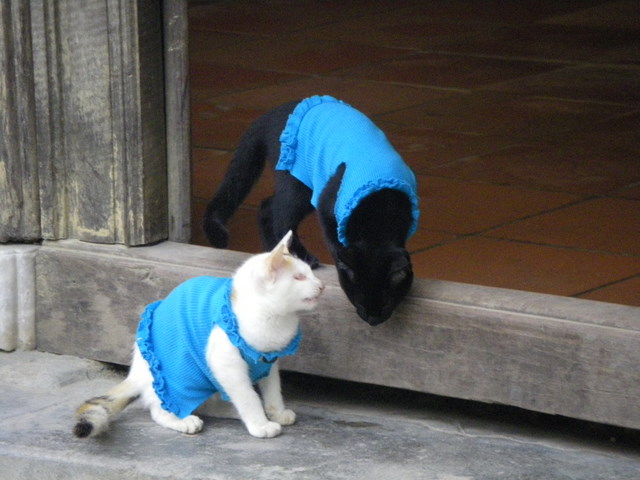
Thelma and Louise like to dress alike, but no one mistakes them for twins

Thelma and Louise like to dress alike, but no one mistakes them for twins

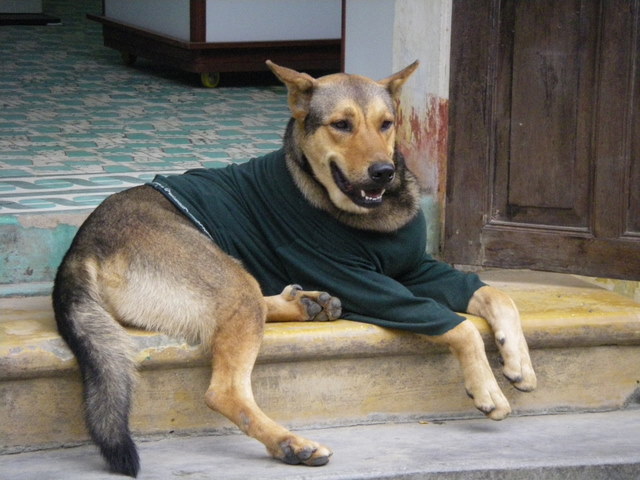
Seriously, even the pets dress to go downtown.

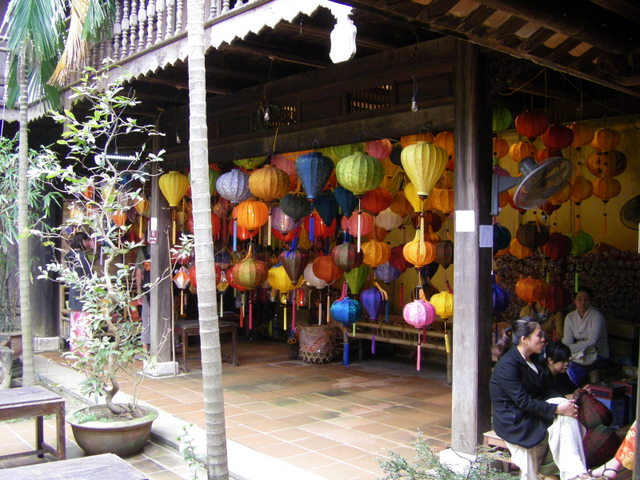
And while in Hoi An, we saw a wonderful folklore show and some of the lovely silk lamps that the city is famous for!

Silk lamps in Hoi An

Silk lamps in Hoi An

But soon, through the rain and the fog we made way
Climbing up Hai Van pass to the city of Hue!

Next: Artistry in food and a wet visit to a Forbidden City

Continue…

Rona & Aaron’s Excellent Adventure, Part 8

For the previous episode look here

Early Sunday morning we packed up and left the hotel. We set out for Bac Ha, about 3 hours away, where the largest market for the ethnic minorities in northern Vietnam is located. We drove along roads that had huts and banana plants and rice terraces and lots of lots of life as people walked and biked along the roads. Children played outside. Older children in their school uniforms walked or rode bikes to school. It is a country on the move.

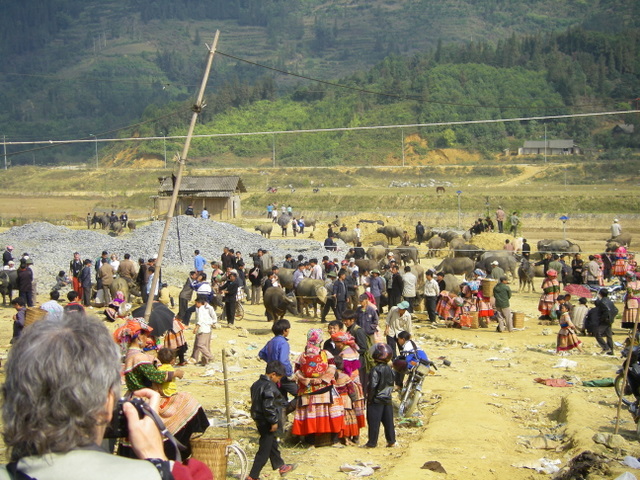
The market at Bac Ha is a place to buy all sorts of things. Local people come there to buy clothing, linens, sewing supplies, hardware, fruits, vegetables, fish (mostly dried), nuts, noodles, and meat– pretty much everything. They socialize and there is a festive atmosphere. They also buy that most famous household pet: the water buffalo.

Buying water buffalo in Bac Ha

Buying water buffalo in Bac Ha

Water buffalo are, of course, very valuable because they are the closest that most people get to mechanized farming equipment in most of Vietnam– actually in most of the far east. The water buffalo are domesticated and very gentle and friendly.

It was interesting to see lots of combinations of traditional and contemporary. We saw girls in native dress checking their mobile phones.

Looking for messages

Looking for messages

We saw people walking around wearing their motorcycle helmets.

Pink helmet-- and Flower Hmong dress

Pink helmet-- and Flower Hmong dress

We looked for interesting things to buy. We found silk sleeping bags– small pouches made of silk with a sheet inside that one could crawl into with an attached pillow cover. We found belts with zippers that when zipped up became small purses. We bought them from a little girl who was fascinated with my husband’s beard and with a big smile took out a comb and attempted to comb it!

Combing Aaron's beard

Combing Aaron's beard

As we walked through the market, we saw our travelers walking too, smiling and enjoying the sights and sounds. There are more pictures of this market in this post. It was a feast for the eyes.

After our experience there, we got on the bus and went to a local village. More about that next time when we answer these questions: Why can’t we simply say the name of the village? What does a normal kitchen in the village look like? and most important… what is the special significance in this village of the phrase “and a little child shall lead them”?

To continue the adventure, click here

Rona & Aaron’s Excellent Adventure, Part 7

To see the previous page, go here

Which is, in fact, appropriate, since the seventh part corresponds to our first shabbat away.

The kabbalat shabbat service that began our shabbat together was really very beautiful. All of our travelers were dressed in their nice clothing and the women ranged from lovely to elegant. The table was set with tablecloths and napkins and the tea candles were lit. We all were one family as we said the traditional prayers and sat in a leisurely manner to eat our meal. Having moved so far and so fast, all of us welcomed the sabbath rest.

In the morning, we gathered for services. We had noticed that another Israeli group was staying at our hotel. We had seen these people in Hanoi and would see them again when we got to Cambodia. We hoped that some of the men might join us for services as we had only 7 men. Well, two men did show up, not at the same time, and both of them had the same response when I asked them if they would like me to being them a siddur (prayerbook) “I just came in for a few minutes to feel the shabbat atmosphere.” After services, we had kiddush and ate breakfast. After breakfast, it was time to change clothes and go for our shabbat walk up Ham Rong Mountain.

I would love to post photos of Ham Rong Mountain, but I have only climbed it on shabbat when I am unable to take pictures. The mountain begins its slope in the center of town up a steep flight of steps. We passed by stores and stalls selling herbs and plants that are used medicinally. We passed stalls where they were selling a type of liquor that had coiled snakes at the bottom of the bottle and sometimes scorpion-type creatures. None of us was tempted to buy.

As we ascended the mountain, a nature preserve, we were treated to the most magnificent experience. There was a slight drizzle that covered all of the bushes and trees and grasses with silvery droplets. The rocks and plants and paths and fountains and the areas that were planted with flowers were nothing short of exquisite. There was a freshness to the air and the fragrance of the plants and trees was intoxicating. As we walked, we heard the sound of music and as we approached a house on stilts, our local guide asked if we wanted to go in. We said, “Of course.” We didn’t realize that what was inside was a folklore show with music and dancing. The last number involved the men holding long thick bamboo poles parallel to the floor just above floor level and moving them back and forth as the women dancers avoided stepping on them. Then, both the men and women took up the dance. Finally, they invited us to participate and one of our brave travelers actually went and danced with the troupe! (He was great!!)

After the hike, we had a short time to rest before we got together again for mincha (the afternoon service), dinner (salad, the cholent that had been cooking since Friday afternoon and some delicious fruit salad!) and finally maariv (the evening service) and havdalah (the service that ends shabbat.)

What a wonderful, beautiful shabbat– and what a pleasure to finally have nothing go wrong for a change!

Next time we answer these important questions: Where can one buy a water buffalo, what do you do if you’re in traditional dress and want to ride on a motor scooter, and most important– what is that little girl doing to my husband’s beard?

For more of the adventure go here

Rona & Aaron’s Excellent Adventure, Part 5

For what happened previously go here

It is Thursday night. Hanoi. A porter laden with suitcases and boxes arrives at the door of the train and as my travelers settle into their cabins, two at a time, he delivers three large and two small suitcases to my cabin. In addition, there is my coat, my backpack, and a couple of plastic bags that somehow accumulated in my hands. It took some time to put everything either up on the bed opposite me, on either side of the table between the beds, or under the bed opposite mine.

Once people were settled in and the train began to move, I am able to heave a huge sigh of relief, knowing that I am off duty until about 4:30 a.m. at which time I am to wake people in anticipation of our arrival in Lao Cai.

The train was clean and attractive and the train ride lulled me to sleep. Although I had set my alarm, one of the workers on the train came by to wake us before the alarm went off.

In a few minutes, everyone was up and moving.

The train stopped and I was the last off of our car with all of the suitcases etc. We walked along the length of the train, looking into the cars as we passed. Some had flower arrangements on the tables between the beds. One had lotus-shaped lamps. Some had six beds per cabin and not four. We finally emerged from the station to a dark parking lot in which were two mini-buses that had come for us and our luggage. My husband went with about half the travelers and our local guide who had come with us from Hanoi and held our train tickets in one of them and I got into the other with the rest of the travelers. As we began to pull out of the parking lot, one of the travelers said, “Where is my money belt?” In a second or two it became clear that it was not on the bus with us. I called to the bus driver to stop the bus, which he did. He and the others remained on the bus and I went with the traveler back to the station.

Lao Cai, 5 a.m.

Lao Cai, 5 a.m.

The station was dark. I did not have the tickets, hence no proof we had been on the train nor proof as to which cars we had occupied. In addition, I do not speak Vietnamese. At all. Fortunately, Lao Cai is the last stop of the train, so it was still in the station.

We walked past an office where there were several uniformed men. In one of my winning charades gestures, I gestured that the man’s money (rub finger tips with thumb) belt (point around waist) was on the train (point to the train.)

Apparently they understood me and a couple of the men walked with us to the train. We started down the length of it. It must have had twenty cars or more. We started at car number twenty and walked looking into the now darkened train. Fortunately, I had a sense of the variations in the cars and when I saw the car with the lotus-shaped lamps, I knew we were not too far. We finally reached two cars that were identical just as ours were, cars 5 and 6. I hadn’t realized that one of the men had a cell phone with him. To make sure, I gave him the number of our local guide’s cell phone. He called her and I asked her what number cars we had been in. She told us and we were right. Only one problem— the train was locked.

I think that Vietnamese people are truly kind because they did not want to give up. Apparently the same person who built the mini-hotel with only one key per room and no pass key had designed the train system in such a way that when all of the cars are locked, no one at the station has a key. Our heroes did what was necessary.

No, they did not saw through the wall of the train. They stood at the side of the door and put all of their weight on it and pushed and pushed, each time getting the door wider and wider open. It must have opened by just a couple of degrees and then one of the men was able to slip in. He went to the cabin that had been occupied by my traveler and he brought the money belt to the door. Aha, but he couldn’t get out. He had squeezed into something that was angled in, but getting out, he was confronting the edge of the door. Another, slimmer man then squeezed himself in. He then pushed the first man out and then he himself came out. My traveler was thrilled to receive the money belt. The Vietnamese were very happy to point from one to the other as to who deserved the reward money. In all, I think around $60 were distributed and all of us left the train very happy.

Those waiting on the bus were also happy and we quickly proceeded onward to SaPa.

The weather in the north of Vietnam, just at the China border, is cold in the winter and although the heat was on in the bus, the driver’s open window was blowing an unpleasant breeze into the bus. After a while I asked him to roll up the window. Once again, my ignorance of Vietnamese was all too frustrating. He thought I asked him to stop the bus.

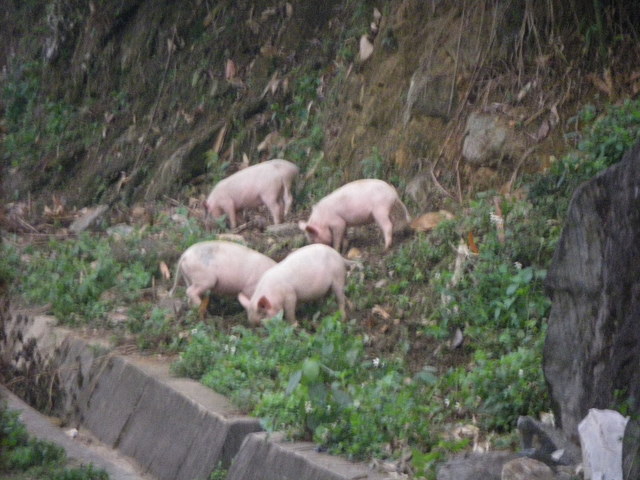
As I looked outside at the landscape just a short time after dawn, I saw about 5 little pigs by the side of the road. I asked “would anyone want to photograph piglets?” A few people got out of the bus, took some photos and then returned to the bus. He started the bus and off we went.

Piglets along the road

Piglets along the road

But it was still cold.

This time I put held my hands on the opposite upper arms and made a shivering motion. He closed his window. We were warming up and on our way to SaPa. The rain began to fall.

Uh Oh… Our itinerary called for us to walk through one of the local minority villages this morning. They get awfully muddy. But there was still check-in and breakfast and cholent to get started. My worries about that could wait for an hour or two.

At last we arrived at the hotel.

Chau Long Hotel, SaPa

Chau Long Hotel, SaPa

Next time: What we did about the new hotel rules on using our plata (hotplate) and how “Slip sliding away” is a great song, but not the way one would want to describe a walk through a village.

To continue the adventure go here

Pin It on Pinterest