Rona & Aaron’s Excellent Adventure, Part 4

For what happened previously go here

Having been sufficiently stunned by news of impending doom (i.e., our suitcases could be confiscated along with all we’d packed for shabbat and for other important parts of the tour), I entered the Temple of Literature compound and tried to relax. I thought of all sorts of alternatives to what we had planned and I knew that no matter what, our people were going to be well taken care of. We could bake bread, if necessary. I was pretty sure that beans and barley were available in Vietnam. We might have to buy large amounts of canned tuna to use for lunches to make up for the cheese and the peanut butter that would be confiscated, but we would be all right and our travelers would not even notice the problem.

As I walked through the gardens, relaxing became easy. It was beautiful, calm, tranquil — perfect. When I caught up with the group, they had just spied what was to be their first bride of the day.

Apparently, Vietnamese brides and grooms take full advantage of the period preceding the wedding and they go from place to place with a bevy of professional photographers being photographed in the outfits they have selected for that day. Like Chinese brides, Vietnamese brides often have more than one wedding gown– the traditional one (in China- red, in Vietnam, an Ao Dai in any color) and a white bridal gown such as those worn by brides in the West.

Here is the bride we saw at the Temple of Literature

Bride in Ao Dai

Bride in Ao Dai

We enjoyed a brief concert of Vietnamese music on traditional Vietnamese instruments and then set off for the Museum of Ethnology. There, inside the museum we saw colorful exhibits of ethnic minority customs, traditions, and dress and outside we saw models of homes and buildings of many of the ethnic minorities.

As the day wore on, the sun came out and Hanoi became very beautiful. And what did we see but more brides! Everywhere! And some of them were pretty adventurous!

After a visit to Maison Centrale, known to most Americans as “The Hanoi Hilton,” the place where captured US pilots, among them John McCain, were held, we went to Hoan Kiem Lake, a lake in the center of the city and were treated to a cyclo ride through the old city. The old city has 36 streets that were named for the crafts and trades that were located there. Although some of the streets still have some of those specialties, one cannot easily discern which street was for which trade or craft. One can, however, get the feeling of what it is like to travel at motorcycle/motorbike level in this busy city. You can see it here.

With the day quickly waning, I was getting more and more nervous about the suitcases. Even if I had figured out the solutions to my immediate problem, I really hoped that our people would have their belongings so that they could change their clothes and feel comfortable over the weekend. Since we were leaving at nine p.m. for an eight hour trip on a night train where we would sleep, our deadline for luggage delivery was all too critical.

My husband went to the restaurant to prepare dinner for the group while I went with them to the mini-hotel.

It is apparently called a mini-hotel not just because there are a small number of rooms and only one elevator, but also, I am guessing, because people use it only for a short amount of time. In fact, there were some lovely and wholesome looking young women dressed alike (black shorts, white blouses) waiting at ground level who one might imagine were in some way connected with the hotel. But I digress…

The purpose of going to the mini-hotel was to give people a chance to shower, change, and redistribute their clothing and personal items and pack only their small carry-on for our trip up north for the weekend. Taking the large suitcases onto the train was not a good idea. However, until the suitcases finally arrived, people didn’t want to shower, fearful they’d only have to put on the same clothing they’d been wearing for two days.

Our train was leaving at nine. The suitcases were not delivered until shortly after seven. Of course between suitcase delivery and the train there was distributing them to each room with only one small elevator and five stories of building and then collecting them again and then driving to the restaurant and having dinner. We were rushed.

The good news: ALL of the suitcases made it. The bad news: They had fastened a heavy plastic strip that held our largest suitcase closed and I had no implement to open it. There was no time. I decided to take all three of the large suitcases and our two small ones with us onto the train.

Our people were wonderful. Everyone was ready on time for the bus. They had left their suitcases outside their doors to be collected by the porters. We were out of the woods.

Or so we thought.

One couple said they weren’t sure where to leave their suitcase and they left it inside the room. When the time came to turn in the keys, they realized that they had locked the room with the key inside. I thought that would not be a problem, I went to the desk and asked for a duplicate key. The clerk didn’t understand me. I showed her a key and asked for another one and wrote the room number. She nodded no. I said “when you clean the room…” Of course, it was only later that I realized that most people staying there, maybe all of them, don’t leave the room and then come back. I had her call Mrs. Mai. I explained to her what had happened. Now I had two Vietnamese women who didn’t understand what I was saying, I believe. However, after the conversation, the desk clerk called someone and said, “wait one moment.” I am certain that when Vietnamese people learn English they are told that “wait one moment” means “this could take hours.”

I decided that my people needed to go and eat. I sent them on the bus to the restaurant. I assured the couple that I would not leave the hotel until their suitcase was liberated.

Finally a young man showed up on a motorbike. I assumed he had the key. I said to him, “You have the key?” and shook my head hopefully. He said, “yes, yes.” I’m guessing that when Vietnamese people learn the phrase “yes, yes” they are told it means, “I think you are a nice person and I would like you to be happy.”

The room was at the end of the corridor on the fifth floor. It was on the left. He walked down the corridor and opened the last door on the right. I said, “No, it’s this one.” He said, “yes, yes.” He went into the room and closed the door behind him. I thought, “Great! there’s an adjoining bath between them!”

He walked out of the room and said, “wait one moment.” He returned a few minutes later with an assistant and a tool box. They went into the room on the right. Then I heard loud banging– as if they were trying to break down the wall. It continued for a very long time. I waited. I sweated. I looked at my watch. I knew I had missed dinner, but how long could I stay without missing the train?

The banging continued. I sweated some more. It was 8:30. The train was at 9. I had no idea how far it was to the train station nor did I have any idea how much traffic there would be. I was cutting it very close. I called Mrs. Mai. I told her that the men were trying to break down a wall to get the suitcase, but so far, no luck. She told me that when the suitcase was finally liberated, she would have it picked up and brought to our other suitcases and that the couple would have it on Monday morning when everyone else got theirs. She called me a taxi and told him to take me to the train station.

I got into the taxi and I wanted him to know that I was in a hurry and so I wrote 9:00 on a piece of paper and apparently that was all it took to get him into Hollywood-car-chase mode. Ohmigosh! He flashed his lights, honked his horn, and drove on the wrong side of the street. As we reached the train station, I began to fear that maybe there was more than one station in Hanoi and I hoped we were at the right one. At that very moment, our big red bus pulled up and beside it I found my husband and all of our travelers.

Stay tuned to find out what happened to the suitcase, why I once again had to break down a Vietnamese door, and other exciting slip and slide adventures next time..

Continue the adventure here
Rona & Aaron’s Excellent Adventure, Part 3

For what happened before, look here

Although I was of college age when the Vietnam War was taking place and people were demonstrating, some of them obsessing about every day’s battles, I was oblivious. I remained oblivious even when I got married and moved to Fort Knox, Kentucky, where my husband was serving as a chaplain in the US Army. Sure, I knew that we had guys being shipped out to ‘Nam, but I didn’t really pay much attention to the news, being somewhat self-absorbed. So, all I knew of Hanoi was that it was where the bad guys were and there was a woman who they called, “Hanoi Hannah” broadcasting nasty, morale-breaking things to our guys

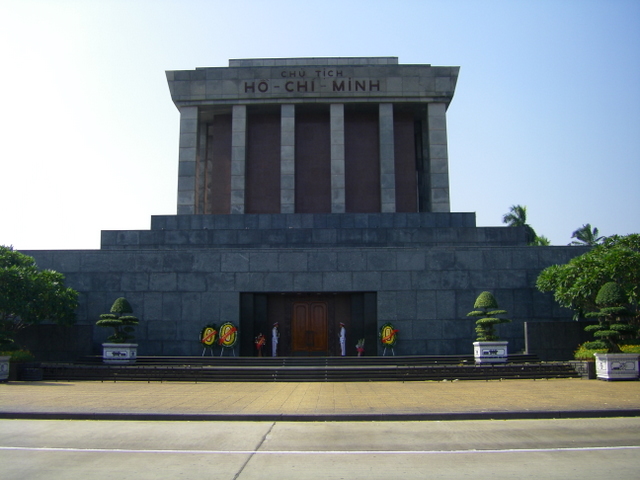
Well, the Hanoi that I have come to know and, yes, love over the last couple of years is a bustling, busy city filled with interesting sights and sounds. During our day there we went to visit the mausoleum of Ho Chi Minh. It is a tasteful building into which people enter after passing through full security and leaving their cameras checked. People file in a single line, taking off their hats, walking silently into the building , ascending the stairs to the left, turning right and then right again and filing past Ho Chi Minh who is lit dimly and appears to still be alive. We walked the length of the coffin, then turning left, across the front and then turning left once again along the other side, filing out of the room, making two rights, and then going down the stairs. Something about the silence and the dim lighting with the soldiers standing at attention made the experience feel very dignified. Although he was a formidable foe, in the way he is revered in his own country, there is a sense of honor. Always depicted in photos and statuary as being with the children, he is seen as “Uncle Ho” who loved the children.

Ho Chi Minh's Tomb

Ho Chi Minh's Tomb

His tastes were simple. When he gained power, he was entitled to use the magnificent palatial edifice erected by the French when they were the colonial power. Instead, he lived in three sparse rooms for a period of several years until those around him explained to him that it was not an honor to the country for their leader to be so humbly housed. Then they built him a house on stilts, characteristic of Vietnamese architecture in the countryside. It also was quite humble, with just two rooms upstairs– an office and a bedroom– and eating and reception space exposed to the elements beneath it. It was fashioned of fine wood and is very attractive, but not at all the type of home one would expect for the head of a large country. Vietnam is now, by some estimates, a country of 87 million people!

On the grounds of the complex that housed his two homes and the palace, there was a pond where carp were raised. He would clap his hands and the carp would come to the surface to eat. There were also trees that bore fruit and the people of Hanoi were permitted to come and pick fruit.

Adjacent to Ho Chi Minh’s home is the One Pillar Pagoda, an interesting structure with a similarly interesting story. Around the entire area are beautifully landscaped gardens.

After leaving the Ho Chi Minh complex, we went to the Temple of Literature. It was there in the early 11th Century that Vietnam’s first university was founded. You can read more about it here. As our group walked through the front gate, Mrs. Mai, the woman who heads up our operations in Vietnam and Cambodia arrived to talk to me.

Entrance Gate, Temple of Literature

Entrance Gate, Temple of Literature

The group proceeded with the local guide and my husband. I stayed behind to talk to Mrs. Mai and to try and work out our plans. She had to have me sign permission for her people to pick up the luggage when it arrived from Hong Kong. It was due to arrive on the same flight as we had arrived on the day before. That meant that it would likely not be ready for pick up until at least 5 p.m. and with traffic, getting it in time for our people to be able to repack — getting out their winter clothing and putting it in their small luggage– in anticipation of our weekend train trip up north was problematic. I also was worried by the fact that she told me they only had paperwork on 11 of the 14 suitcases because I had not given them my baggage stickers until after they had done the paperwork– so although they had stickers for 14 suitcases, they only had paperwork for 11! I told her that it was really important to get specifically those bags because we had packed a substantial amount of food in them including our challot for shabbat and other essential food supplies that we needed to take with us up north. She said, “If there is food in your suitcase you will not get it.” I said, “I won’t get the food?” She said, “You won’t get the suitcase; they will just not send anything.”

She left with the papers. I left with the worry. But would they find the food? If so, would they send the suitcase? and also, why was it that on that Thursday, everywhere we went we saw brides? The answers to these questions (well, to a couple of them) and some pictures of the brides in the next exciting episode.

To continue, go here

Rona & Aaron’s Excellent Adventure, Part 2

…to see what happened earlier, go here

So we were airborne. Of course the luggage could not have made the flight. We had run over, under, around, and through and the baggage simply could not have been identified and transported that fast. It was all right. There would be another flight that night? the next morning? We’d be fine.

And after about two hours, we landed in Hanoi. We walked to the waiting area where we were met by our local guide. I gave the guide all of our passports, the visa application forms with photos attached, and the visa approval form we had received from the government of Vietnam. And then we waited. And waited. And waited. We could see the office where the visas were being given, see passports opened and visas affixed, but our guide was elusive. So we waited. Did I mention we waited?

After about an hour, she finally came back and we distributed the passports into which had been pasted the visas. Then everyone went through passport control and we met on the other side.

Our guide said we had to go to the lost luggage desk. Reminding her that our luggage was not lost, but tardy, she explained that unless we filed a claim for lost luggage, the luggage would not be transferred to Hanoi. I was to gather up all of the baggage claim checks which they then pasted onto a sheet of paper. Some of my people were hesitant to give up their only proof of every having had a bag, but were reassured when they were told that I would get a copy of the baggage tag page. We were missing 14 pieces of luggage. We had found only 11 baggage claim checks. No one would own up as to having additional ones. They filled out the paperwork only identifying 11 pieces of luggage. As they handed me the paperwork, I opened my ticket holder and found that I was the hold-out. There were the three baggage claim tags. I gave them to the people behind the counter and they copied the sheet for me.

Now about two hours later than we had anticipated, it was time for dinner and everyone was hungry and tired and so we decided to go directly to the restaurant where we would eat rather than to the hotel. We called and made sure that the four Swiss travelers and the one British traveler were brought to the restaurant to meet us.

Finally on the bus, we made our acquaintance with the Hanoi traffic jam– the type that puts everything at a standstill. The major bridge across the Red River was being repaired and construction materials and dug up road surface narrowed it to one lane. But we told people about Vietnam and about Hanoi and most of them were just happy to be finally out of the airport and on our way.

We arrived at the restaurant. It is the “forest” restaurant and it is beautifully decorated with objects that represent the history and folklore of Vietnam. Set in a garden, the wooden building was adorned with cloth and metal and wood wall hangings. The wait staff was dressed in native garb of one of Vietnam’s 54 ethnic minorities. It was beautiful.

Rung Restaurant, Hanoi

Rung Restaurant, Hanoi

What was not beautiful was the fact that our knives, cutting boards, and cooking utensils were in our baggage which was currently homeless in Hong Kong. So there we were with our Hanoi equipment (dishes, silverware, one large pot, and a wooden spatula) unable to prepare dinner.

We sent the local guide out to buy a knife. She had to take a motorcycle ride to get it and meanwhile, the chef was bristling as he wanted to kill the fish already so that he could cook them. Yes, you see when we cook in Vietnam, we need to see the fish whole and intact. So, often the fish are still alive when we meet them. These fish had something of a reprieve as we waited for the knife to appear.

In the end, we ate dinner, enjoyed getting to know each other, and although our luggage was still not with us, we all settled into our hotel that night for some much needed sleep.

Tomorrow: Hanoi as most people never imagined it and what ever happened to the luggage…

The adventure continues here

Rona & Aaron’s Excellent Adventure, Part 1

This is cross-posted from www.drsavta.com

We begin our adventure at Ben Gurion Airport. Our travelers arrived so promptly that by 5 minutes after the announced gathering time having received their tickets and bags and hats and information packets, all were in line to get their boarding passes This was surely a portent of a flawless trip!

Several of the travelers asked that I show the people at the ticketing counter the letter of visa approval we had gotten from the government of Vietnam because apparently without it we could not board our flight. One woman had renewed her passport after the visa was applied for and since her passport number didn’t match the one on our approval form, there was a question as to whether she would be able to enter the country. I reassured the El Al personnel that there would not be a problem.

OK, one minor glitch… I called our office and they conveyed the new number to our representative in Hanoi.

We boarded the plane ready for our 11 hour flight to Hong Kong. Our flight to Hanoi had been scheduled for only one hour from our landing time in Hong Kong. I had asked the operations person at our office if that wasn’t much too short a time to get from one plane to another in Hong Kong. He told me that it was a code share and as such, the second flight would wait for us and the two gates would be adjacent. What he didn’t tell me was that he was leaving the company and that he wasn’t really concerned with any fallout if things didn’t go as planned. He was already gone from the company before we left for Vietnam.

As we sat down, we noticed that the TV monitors in front of our seats were registering error messages. As the doors of the plane remained open and we stayed on the ground, we began to realize that they were trying to get the system fixed before we took off. In fact, the system did get fixed and we left not more than about 25 minutes late.

Of course, we likely had lost our place in line to take off and so by the time we were in the air, we were about 40 minutes late.

Realizing this, I began to be very concerned. It was not just that there was not another Vietnam Airlines flight to Hanoi that night, it was the fact that at the same time as we were in transit, so were four people from Switzerland and one from England, all of whom were to arrive in Hanoi about an hour before we were due. They were being met at the airport and taken to the hotel, but if we did not make it to Hanoi that night, they would be left with nothing to eat until we arrived as they all kept kosher and there is no kosher food available in Hanoi. The only Chabad in Vietnam is in Ho Chi Minh City — Saigon.

I began fairly early in the flight speaking with some of the flight personnel. Some said, “Oh no; you’ll never make it.” Others said, “You’ll be fine.” Still another said that when we get close to Hong Kong, they will call Vietnam Airlines to see if they would wait for us.

And so passed the night.

About two hours from Hong Kong, our projected arrival was 10 minutes before the connecting flight’s takeoff. I was never told they would wait for us. I was, however, still under the impression that the gates were adjacent and if we could only get our people out of the plane first, we might have a chance. When I asked if they could just ask the other people on the flight to remain seated and to let us get off the plane first, I didn’t get an answer.

About 10 minutes before landing, long after the seat belt lights had been lit and the tray tables returned to the backs of the seats and all of the seats in an upright position, I was told to gather my people quickly and bring them up to the first class section. Amazingly, my people were incredibly responsive and in seconds they had gathered their carry-ons from their overhead compartments and joined me in the first class section. (Parenthetically: it’s definitely the way to fly).

When we landed, we got out first. Waiting for us was a lovely lady from Vietnam Airlines with a big sign with our names and she ran ahead of us, leading us to the check-in counter where we quickly received our boarding passes.

Then the fun began.

The Hong Kong Airport is more a city than an airport. It is huge. It is the third largest airport in the world after Dubai and Beijing with a terminal area of 570,000 square meters. Our gates were not adjacent.

Three Vietnam Airlines workers ran with us across aisles, down escalators, onto a train, up elevators, across more halls and aisles, through concourses, and finally to the gate. As we didn’t all fit on the same elevator, my husband and I ended up running separately from the other travelers. Apparently our person was a faster runner than theirs because when we got onto the plane, we realized that none of our people had made it yet. The plane was already 10 to 15 minutes beyond takeoff time. I didn’t want to sit down because I was worried our people would not make it onto the flight in time and the plane would take off without them. In a short time, however, the first of them showed up and after a few minutes we were missing only three. As I begin to make my way up the aisle, the last three boarded. In a few minutes, the captain apologized for the delay and we were airborne.

Freed from the earth, but not out of the woods…

For more of the story, go to this post

Home again

My recent inactivity on the computer is inversely related to my frenetic activity traveling. In the next day or two I will begin telling you of some of my adventures in Vietnam and Cambodia, but in the meantime, I will share one picture I took.

Outside of Banteay Srei Temple, Cambodia

Outside of Banteay Srei Temple, Cambodia

Where in the world is Rona Michelson?

Well, at the moment (9:18 p.m. Israel time November 15, 2009), I am in my home in the beautiful new city of Modi’in- about a half hour from Tel Aviv and a half hour from Jerusalem.

But on Tuesday the 17th, I leave and on Thursday the 19th I will be here:

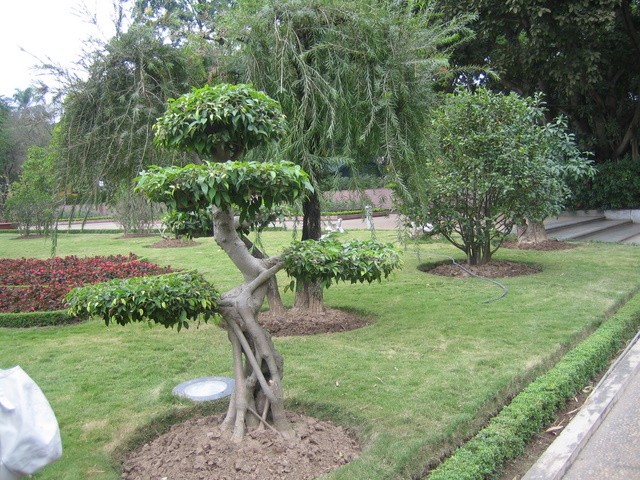
Manicured garden

Manicured garden

Seeing these people:

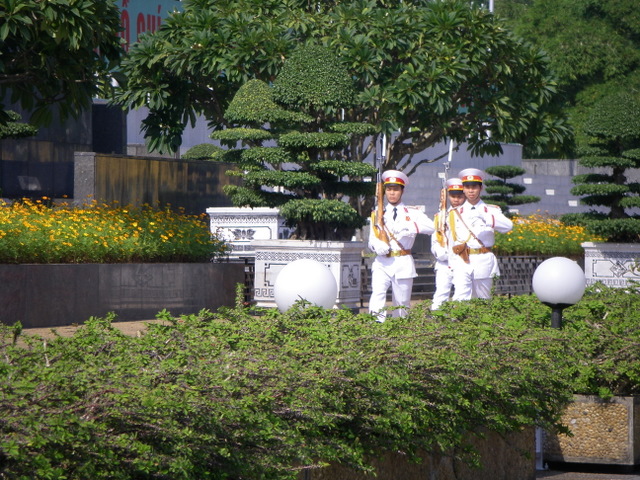
Honor Guards

Honor Guards

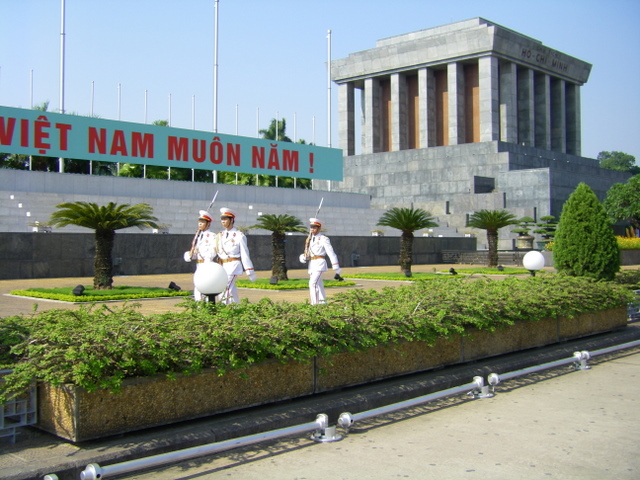
Guarding this:

Can you guess where I am?

I’ll be back in about 3 weeks to tell you all about it.

Dali, Yunnan Province, China

Many of the books I read that deal with China emphasize how polluted the air is– that the skies are not blue. Actually, that has not been my experience. The most maligned city in China, Beijing, has, during the 6 times I have visited, had two or three smoggy days, but aside from them, the skies have been clear and blue.

However, everyone agrees that the western part of China, Yunnan Province, has beautiful crystal clear skies and is a most magnificent place to visit.

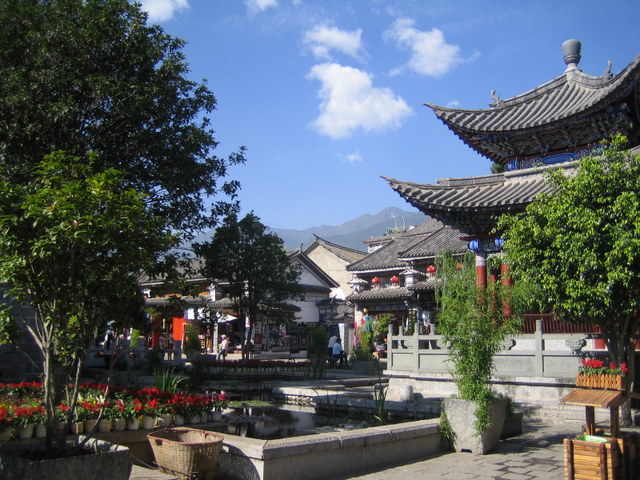
One exquisite city in Yunnan is Dali, home to two of China’s ethnic minorities, the Yi and the Bai. Bai means white and their native dress is beautifully embroidered white clothing which both the men and women wear. Dali is surrounded by mountains and is the recipient of the vast water flow that comes from the mountains. Freshly flowing water streams through conduits in the streets and between the water, the mountains, the blue sky and the meticulous cleanliness of the city, one can’t help thinking that this is one of the most idyllic places on earth.

A street in the walking area of downtown Dali

A street in the walking area of downtown Dali

Everywhere one looks there is something beautiful to see– or at least something interesting.

A town square, Dali

A town square, Dali

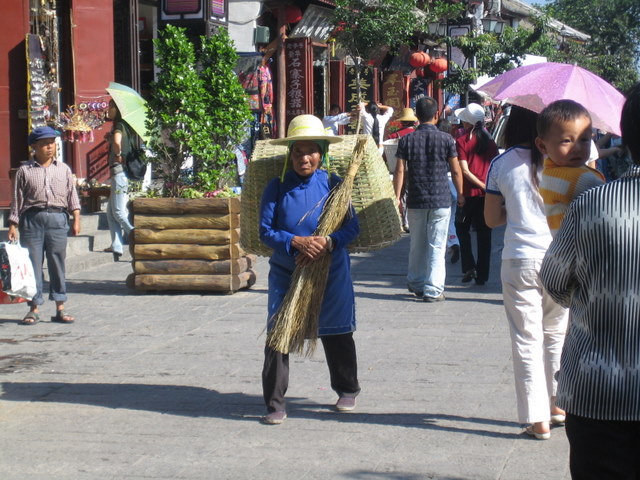
One of the things one notices when in the far east is how hard the women work. While women in the US were asking for the right to go out and work, women in the far east were doing more than their share in planting, harvesting, and even carrying heavy loads. With small families, older people work to support themselves as long as they can.

Street scene, Dali

Street scene, Dali

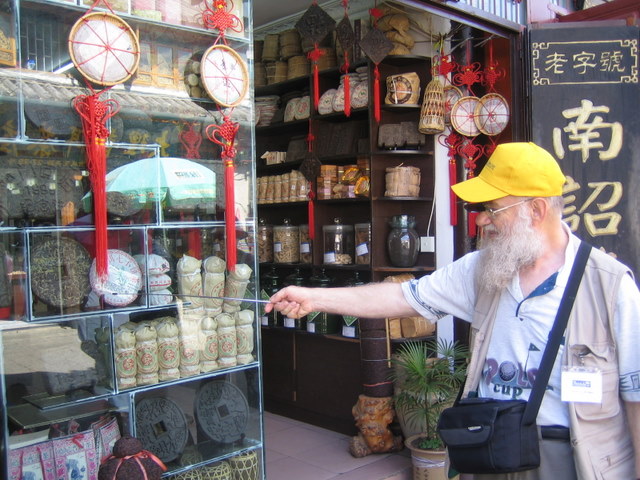
Remember that expression “for all the tea in China?” Well, that is not a small quantity. All over China tea is sold– in tins and packed into different shapes. It’s quite a culture there. No tea bags. And the teas all have special healing qualities. It’s not unusual to see a tea store such as this.

Teas in China

Teas in China

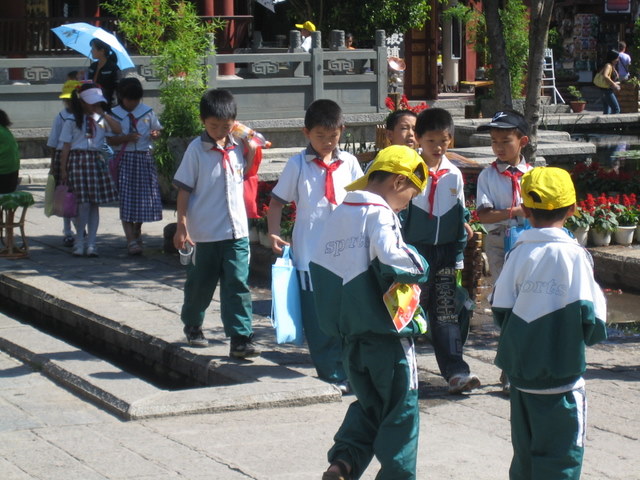
One of the very special treats of a trip to China is seeing the children. I don’t know if it is objectively true, but I think that every one of them is beautiful. Most of them are from single child families and are doted upon and it shows. The seem self confident and mature This day I caught some children returning from school. They were walking through the market, laughing and joking good naturedly. Notice how lovely they look in their school uniforms.

The boys

The boys

and the girls

and the girls

rubytuesday

Kunming, China

While most people can name a couple of cities they know in China– usually Beijing, Shanghai, Nanking, and Harbin, China has hundreds of large cities that most people in the West have never heard of. One such city is Kunming. With a population of approximately 6.2 million, it is a substantial city with a great deal of industry and some major significance. It is the capital of Yunnan Province and is the gateway to come of the most picturesque places in China. It has a population of about 20% ethnic minorities. China has 55 ethnic minority groups. Some of them have a large number of smaller groups within them, some of which feel that they have been miscategorized. In all, these groups make for a fascinating and colorful experience as they have their own dress, customs, languages, religions, and histories as well as a claim on specific areas of land.

Kunming is called the “Spring City” or the “City of Eternal Spring” because of its wonderful mild weather. Foreign students flock here to study Chinese language and traditional Chinese medicine.

Here is a view of part of the city center.

Gate, City Center, Kunming, China

Gate, City Center, Kunming, China

Although most Chinese people are not devoutly religious, they do have beliefs in higher powers and many think of themselves as Buddhist or Taoist. Many also have adopted the Confucian philosophy. Many Chinese see no contradiction among these three and are adherents to all three. Here is a very beautiful Buddhist Temple. It differs from most because one actually enters and then descends toward the main complex. The picture was taken looking back toward the entrance gate.

Gate,  Yuantong Temple, Kunming, China

Gate, Yuantong Temple, Kunming, China

The temple was built late in the 8th century, but, of course, preserved through the years. Here is some detail of one of the buildings as it was being refurbished recently. It is made of wood with lacquered paint to decorate it. All of the painting is hand done.

Detail of building in Yuantong Temple, Kunming, China

Detail of building in Yuantong Temple, Kunming, China

What could be more relaxing after a day of looking at all of this beauty than sitting with a cup of tea. We were treated to both the tea and an explanation of the significance of this particular type, Puer tea, which is formed into large wheels of tea (about the size of a frisbee) and sold to parents when their daughter is a baby and preserved until she is betrothed as a gift for her husband. Puer tea can heal just about everything and we were told that if we were to have a steady diet of it, our skin would look as young as that of this lovely lady who served us tea in her ethnic dress.

Tea tasting, Kunming, China

Tea tasting, Kunming, China

rubytuesday

Hoi An, Vietnam

One of the loveliest places we visit in Vietnam is Hoi An. Hoi An is a UNESCO World Heritage Site. From the 16th to the 19th century, Hoi An was a major port for international trade. About 45 minutes’ drive from DaNang, Hoi An today is a great destination because although it is tourist friendly, it is not overrun with tourists and the city retains its natural charm.

Because of trade ties, a large number of Chinese and Japanese people settled in Hoi An and there are remnants of both. One of the attractions in town is the Japanese bridge which is a covered bridge guarded on one side by a statue of a dog and on the other by a statue of a monkey. On the bridge itself, there is a side room that was used for prayer!

A view from the Japanese bridge, Hoi An

A view from the Japanese bridge, Hoi An

There are beautiful Chinese assembly halls in the city. This one, Quang Dong, has elaborate mosaic covered sculptures. This is the entrance gate.

Entrance gate, Chinese temple, Hoi An, Vietnam

Entrance gate, Chinese temple, Hoi An, Vietnam

Like China, Vietnam has had a silk trade for many years. Hoi An is famous for its hand tailored, custom made silk dresses and suits. After several days in Vietnam, one comes to regard the Ao Dai, the traditional Vietnamese dress, as very beautiful and graceful as well as modest. They can be made to order from a large variety of colors and patterns. Amazingly, one can be fitted in the evening and have a dress ready to wear by morning.

Hoi An is also noteworthy because of the beautiful silk lanterns that are made and sold there. Each lunar month, on the 14th night of the month, the night before the full moon, the lights in the downtown area are switched off and the town is lit by only silk lanterns. Of course, silk lanterns/lampshades are available for purchase as well. Here are some.

Silk lanterns for sale in Hoi An, Vietnam

Silk lanterns for sale in Hoi An, Vietnam

Come see Hoi An with me!
rubytuesday

Moscow, Russia

Moscow was one of the places I visited that surprised me the most. I thought of it as a dark dour place and it was anything but that. I was amazed by the creativity and the art and here I will show you just a couple of examples.

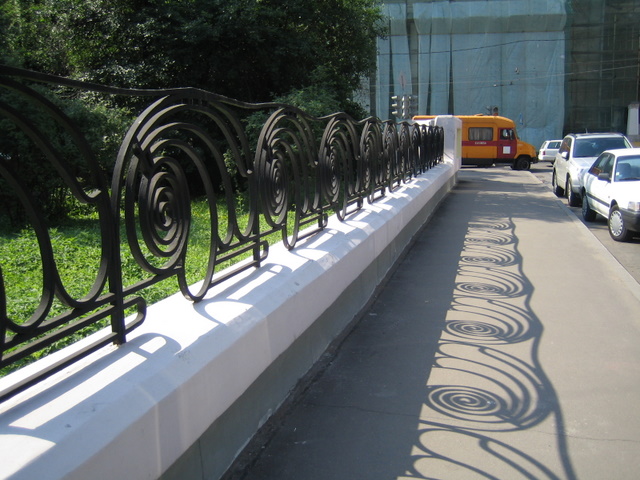
We went to a number of synagogues while in Moscow and one of them was a Chabad Lubavitch synagogue. We passed this fence while walking toward the synagogue.

Fence in Moscow

For those coming from Shadow Shot Sunday, please consider taking my challenge Round the World with Rona

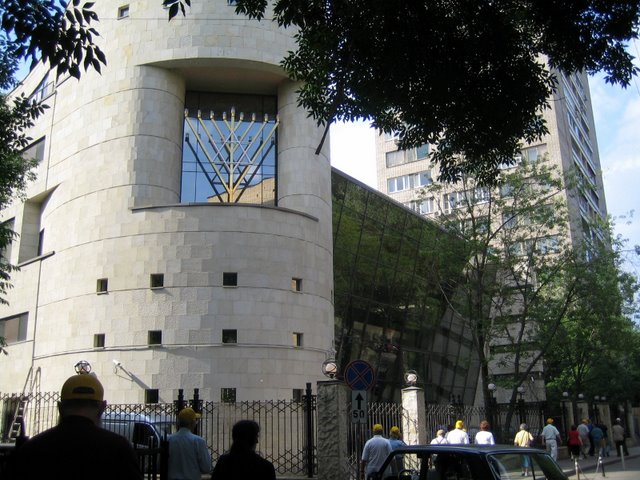
So what do people do with an old synagogue which was probably not used for more than 70 years until after the fall of the Soviet Union? Well, it could be refurbished, which this one was, both inside and outside, but suppose one wanted to update it, expand it, and yet preserve the facade? Well, here is the result:

Chabad Synagogue, Moscow

Chabad Synagogue, Moscow

As one walks toward the synagogue, this is what one views, a modern looking, concrete and glass structure. As one nears the entrance, this is what one sees.

Synagogue, Moscow

Yes, it is a glass wall that is in front of the old facade of the building. It provides additional space and insulation as well as an updated look.

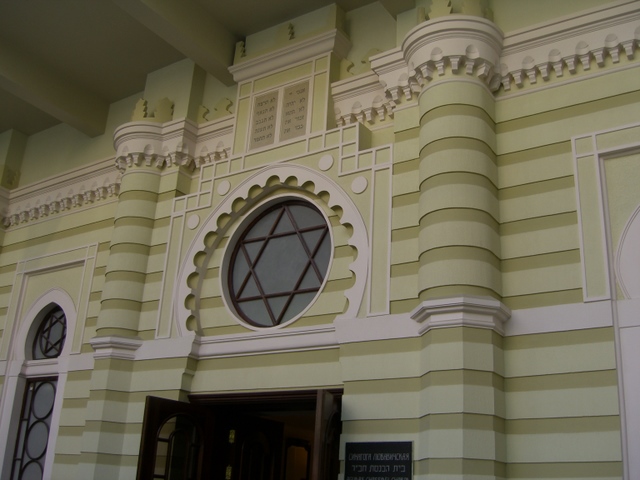
And here is the original facade

Chabad synagogue, Moscow

Fortunately the synagogue is not only beautiful to visit, but it is thriving. While we visited there were groups of people praying in the main synagogue and the large, beautifully decorated chapel, and upstairs there is a snack bar and a roof garden and other recreational facilities. After years of suppression of religious worship, it is amazing to see what has happened. This is not the Russia I thought I would be seeing. It was a pleasant surprise!

Pin It on Pinterest