The Summer Palace, Beijing

OK, friends, time to get your suntan lotion, hats, and water bottles. Today we will visit the Summer Palace.

At the Summer Palace

At the Summer Palace

The history of the Summer Palace dates back some 800 years when the first emperor of the Jin Dynasty, Wan Yanliang, moved his capital to the vicinity of Beijing and built his “God Mountain Palace” at the present site of Longevity Hill. From then on, in accordance with Feng Shui, the area was developed by subsequent emperors with the basic elements of the hill and water. Over the years, the structures changed and the names of the hill and the body of water shifted.

By the time of the Yuan Dynasty (1271–1368), there was already an official Forbidden City in the heart of Beijing, and the Summer Palace became the place where the emperor and empress and their entourage would come for relaxation, particularly during the hot days of the summer. There was a lake and trees and as time went on more and more buildings.

Over the years, the Summer Palace has been destroyed twice. The first time, in 1860, Anglo-French forces invaded Beijing and ravaged two of the loveliest areas in the complex, Yuanmingyuan Garden and the Park of Pure Ripples. Because they most of the buildings were made of wood, nearly every building in the park was destroyed by fire. Only the few nonflammable structures such as bronze pavilions and stone pagodas were spared.

In 1888, Empress Dowager Cixi who had a reputation for enjoying luxury, diverted 30 million taels of silver that had been designated for the Chinese navy into reconstructing and enlarging the Summer Palace. She had the southern side of Longevity Hill laid out in imitation of West Lake in Hangzhou and the northern side built in the architectural style of Suzhou, one of the more beautiful cities in China, sometimes termed “Venice of the East.” Cixi gave the park its present name: Yiheyuan (Garden of Good Health and Harmony), known in English as the Summer Palace.

In 1900 when the Eight-Power Allied Forces invaded Beijing, the great temples rebuilt in the 1880s were completely demolished and almost every valuable object in sight stolen by the invading troops. In 1902, when Empress Dowager Cixi returned to Beijing from Xi’ an, she ordered the reconstruction of the park. According to historical records, she “rebuilt the Summer Palace with unbounded extravagance and opulence, spending some 40,000 taels of silver per day. Singing and dancing went on without end.”

After the revolution of 1911 when the emperor was overthrown, the Summer Palace became the private property of the young deposed Emperor Puyi.

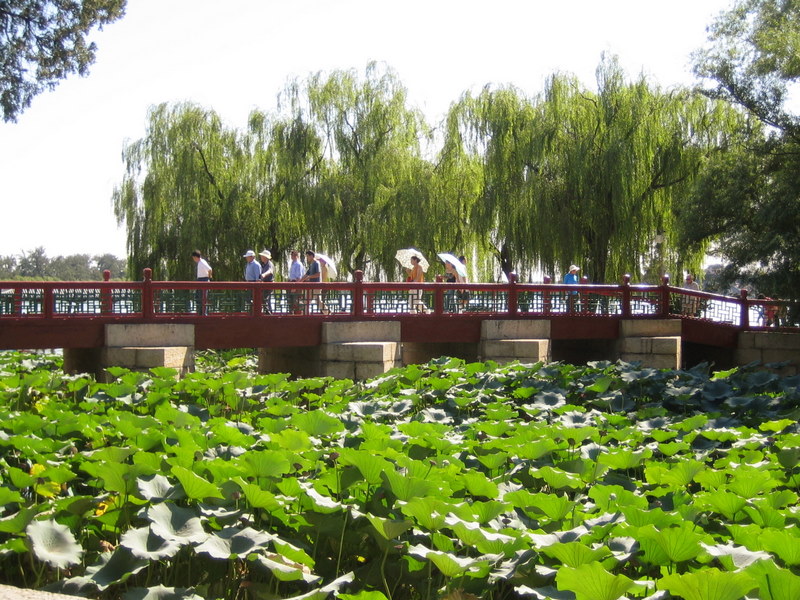
Today the Summer Palace is a delight for the senses. Even on the hottest summer days, the breeze from Kunming Lake cools visitors. The willow trees and the parasols carried by visitors give it a look of Oriental elegance. Paddle boats for visitors, both domestic and foreign, make a visit there a pleasant outing. Visitors can imagine the elaborate meals served here, the receptions and the Western musical entertainment that served to amuse both the imperial family and their guests.

Here is Kunming Lake

Kunming Lake, the Summer Palace

Kunming Lake, the Summer Palace

There are a number of noteworthy sights at the Summer Palace. One is the Long Corridor, an outdoor covered corridor that extends 720 meters in length and contains over 8000 hand painted pictures of flowers, birds, and landscapes.

The Long Corridor

The Long Corridor

Another is the Marble Boat, a structure built by Cixi to symbolize the stability of the dynasty. Of course, not long after, the dynasty was ousted.
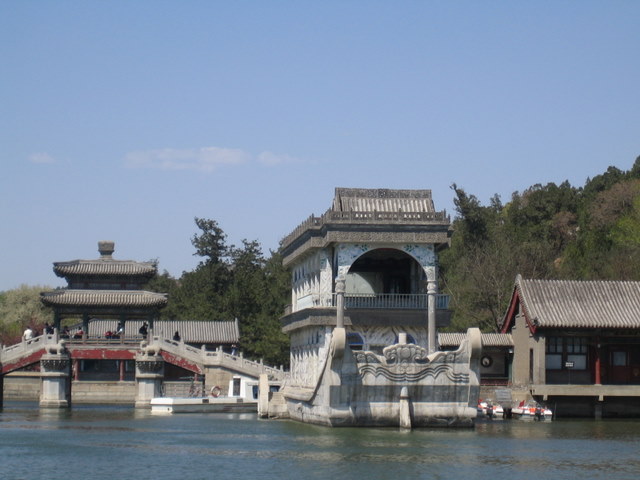
The Marble Boat

The Marble Boat

And last, for now, here is a picture of an indoor corridor. Notice that there are no two windows that have the same shape. On each of the windows, there is a picture painted and none of the pictures are the same either. The Chinese love variety.
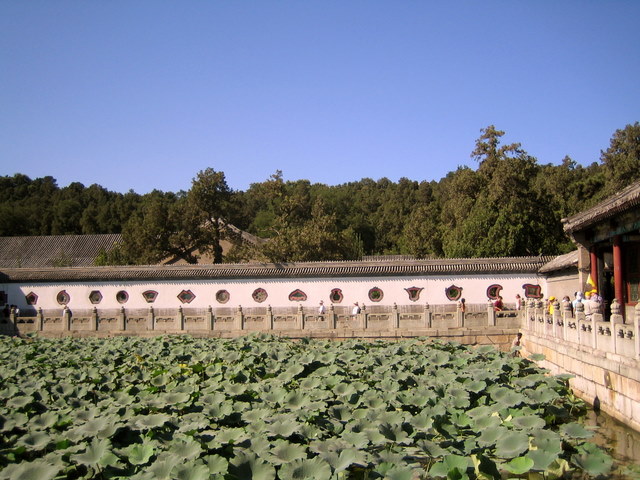
Corridor behind lotus plants

Corridor behind lotus plants

Take it from me, the Summer Palace is captivating and one trip is not nearly enough.

The Private Area of the Forbidden City

The area behind the ceremonial part of the Forbidden City is where the emperor and his family and concubines and the eunuchs and servants lived. Unlike the official area where guests were greeted, ceremonies performed, examinations given, laws pronounced– where the terrain consisted of building after building with no greenery, the family area had greenery and at the very back, a lovely garden.

After passing the giant stone carving, to the north- in the direction we have been walking, there is a plaza and the entrance to the private area.

img_1359

This is simply a wall we walk by, but it stands out against all of the other walls we have seen in the Forbidden City which are “purple.” Now what the Chinese call purple, we might term terracotta, but the Chinese name for the Forbidden City is actually “the purple Forbidden City.”

img_1358

Even walking through the private area, it feels different– smaller in scale, quieter, calmer. It’s easy to understand why the emperor would want such a division between the official area and the private area.

img_1362

This is one of the bedchambers. It was probably used by one of the concubines. The emperor and the empress had their own buildings where they lived and the concubines lived in the equivalent of elegant dorms.

aug2007-126

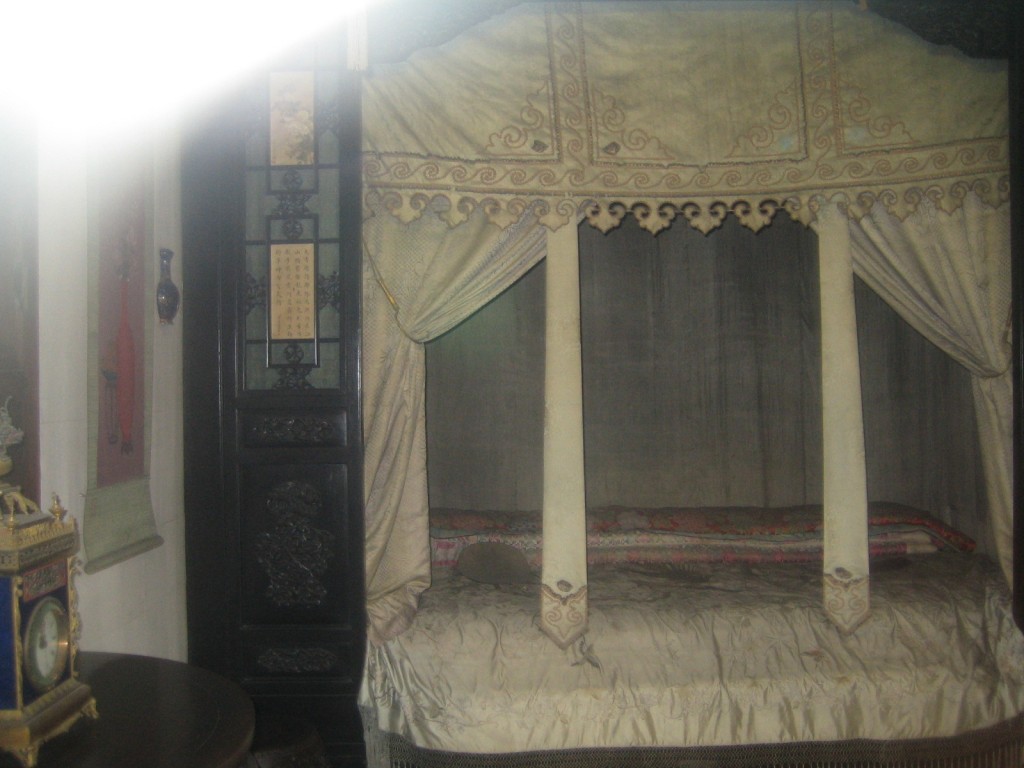
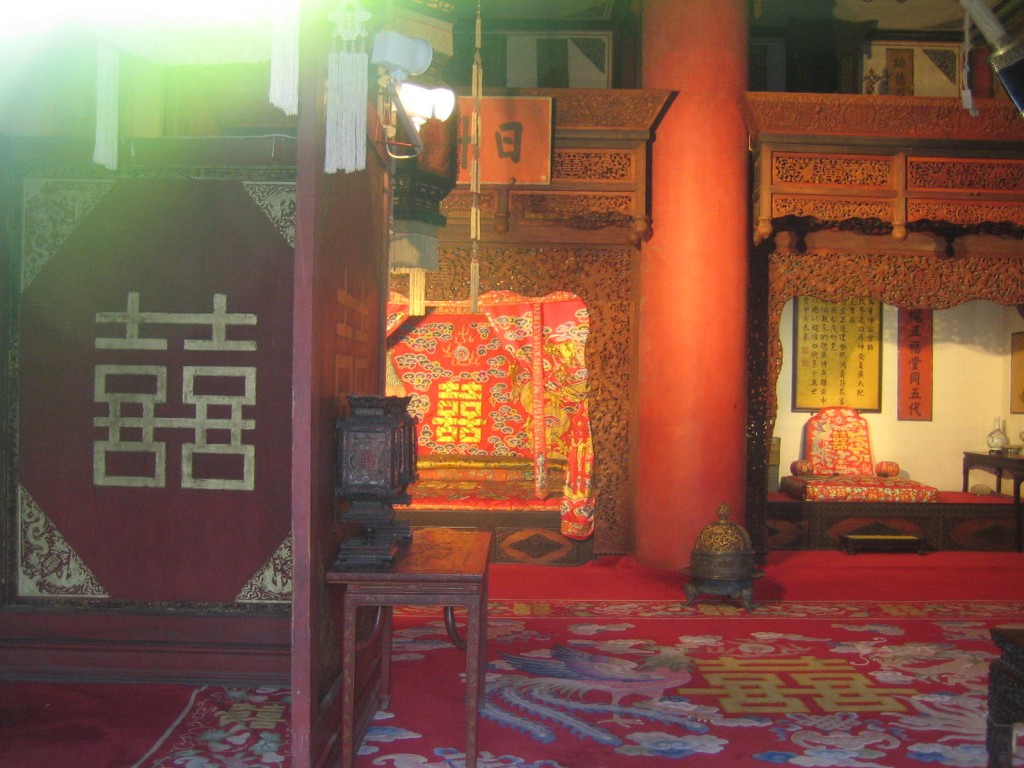
This is the bridal chamber, the place where the emperor and empress would spend their first night together. Traditional Chinese beds are like elaborate boxes that have one side cut out. They have walls on three sides and a ceiling. It is possible to see it in both pictures above. In the bridal chamber, the bed is just to the left of the red column.

img_2675

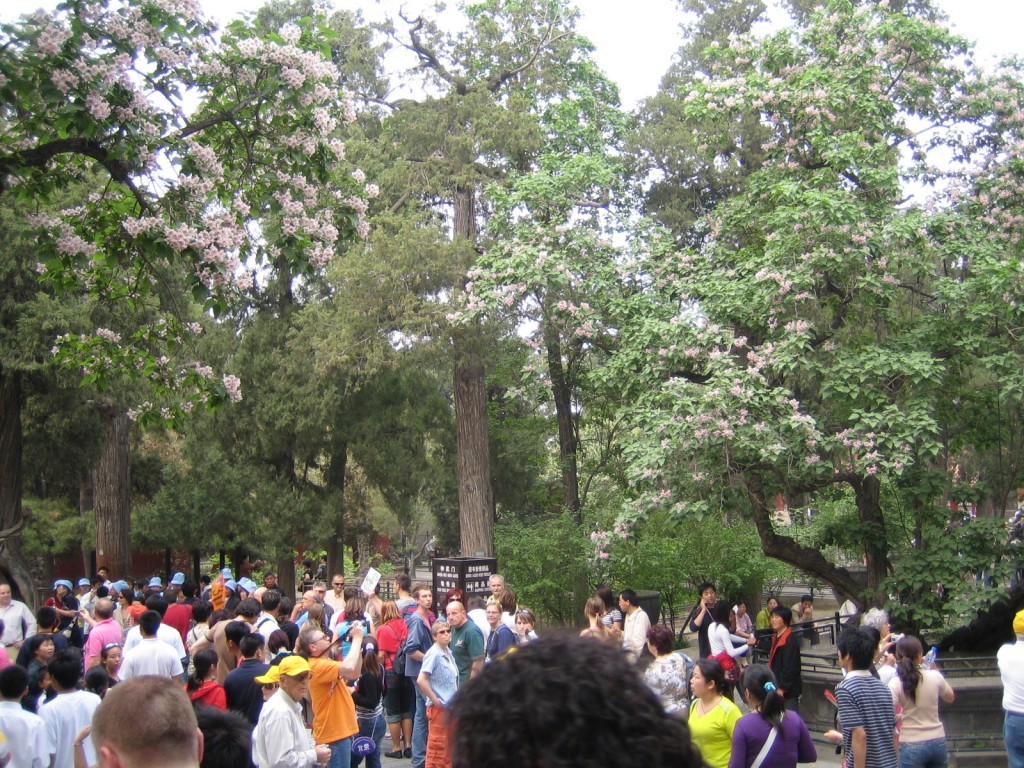
Even in the picture, you can feel the release of tension as you see the softness of the flowers and trees in the imperial garden . The garden has a path running through it that is a kilometer long and it is made of mosaics that contain 720 pictures and patterns. Among the pictures are historical stories, people, and animals. The garden dates from 1417.

img_2676

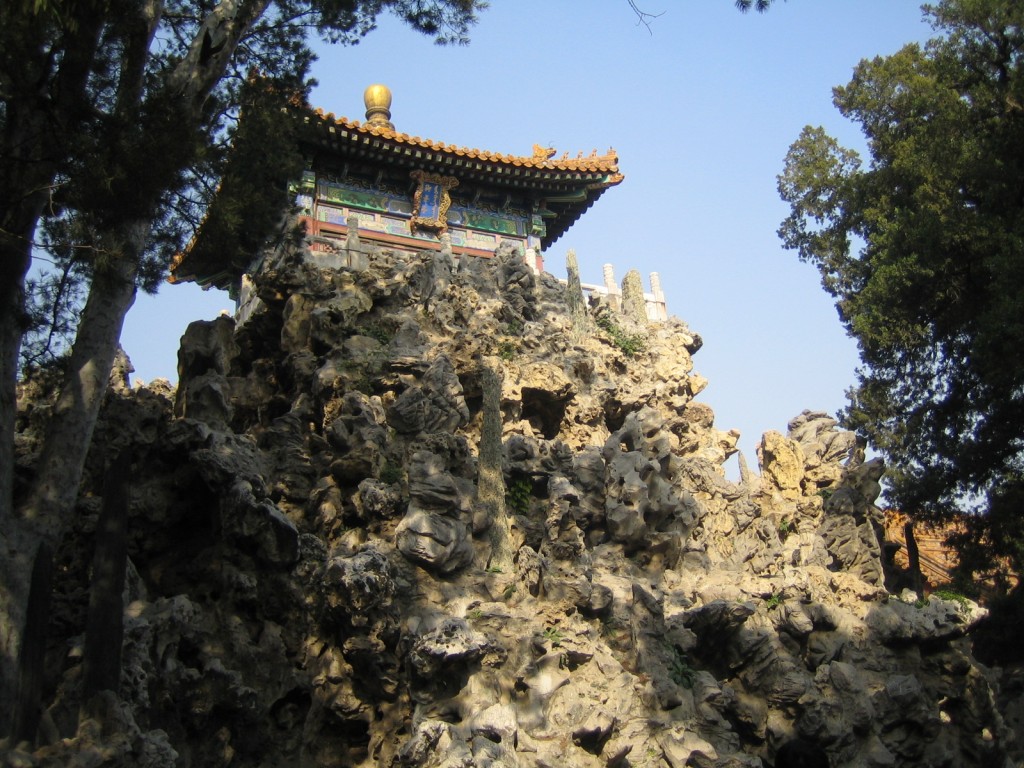
This garden, like other formal Chinese gardens, contains the four essential garden elements: Buildings, water, greenery, and stones. Chinese people have always loved stones. They think of a garden as representing the world and the stones are the mountains. They also like to choose stones that have shapes reminiscent of animals. In this garden, they have taken stones from other places in China and piled them one on top of the other to form “the Hill of Accumulated Elegance.”

img_1372

A beautiful and fascinating place to visit– and I only have scratched the surface.

Into the Forbidden City, Beijing, China

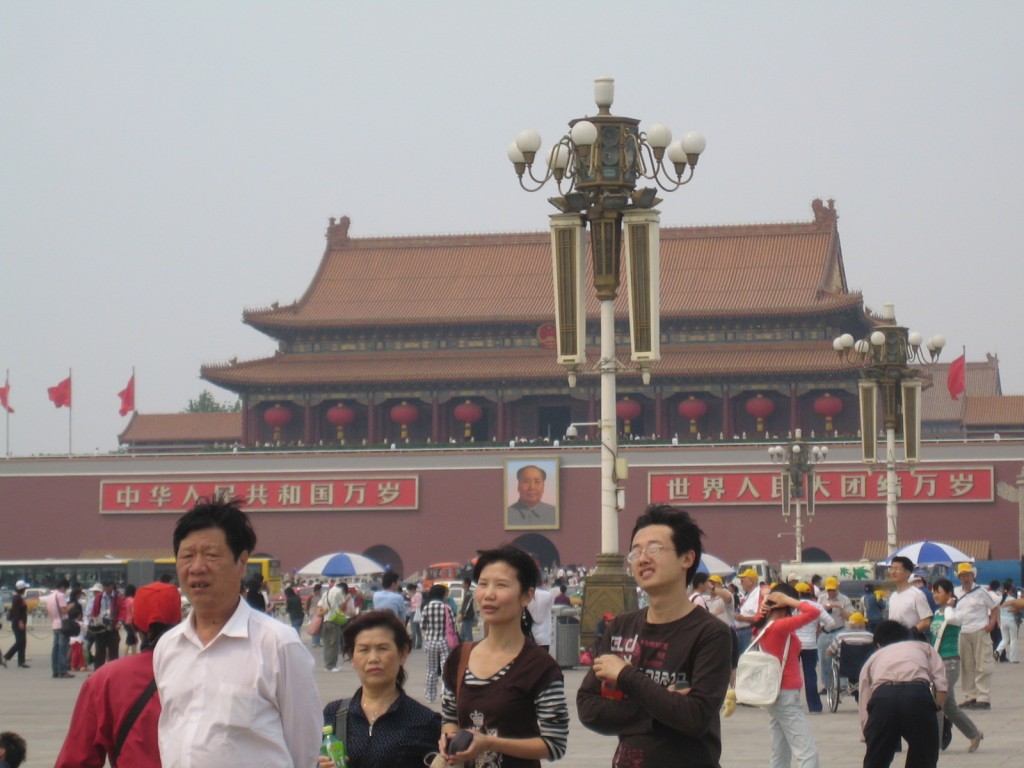
Finally we approach the entrance to the Forbidden City with its picture of Chairman Mao. Every time I have been there, crowds of people are entering. Most of the tourism in China is Chinese. When you think about it, it makes sense. It is a country of about 1.3 billion people. If only 1% of them travel, that’s 13 million people! And with the Forbidden City being the heart of China, it is understandable that it would always have a large number of visitors. Thankfully, the area it occupies is very large. It is about 750 meters (820 yards) across and about a kilometer (1093.6 yards) long. We have entered at the south end through the Tiananmen Gate.

Once inside, we are in a public area of the Forbidden City. In this area there are shops and souvenir stands and until recently, there was even a Starbucks. It offended the sensibilities of some of the Chinese and it eventually closed. Somehow, I agree with them. The beauty of the Forbidden City and other Chinese sites is their uniqueness and their strong ties to Chinese culture and history. In this area there are trees and plants. There are no trees and plants in the official area of the Forbidden City.

Behind us, Tiananmen Gate; ahead of us, Meridian Gate

Behind us, Tiananmen Gate; ahead of us, Meridian Gate


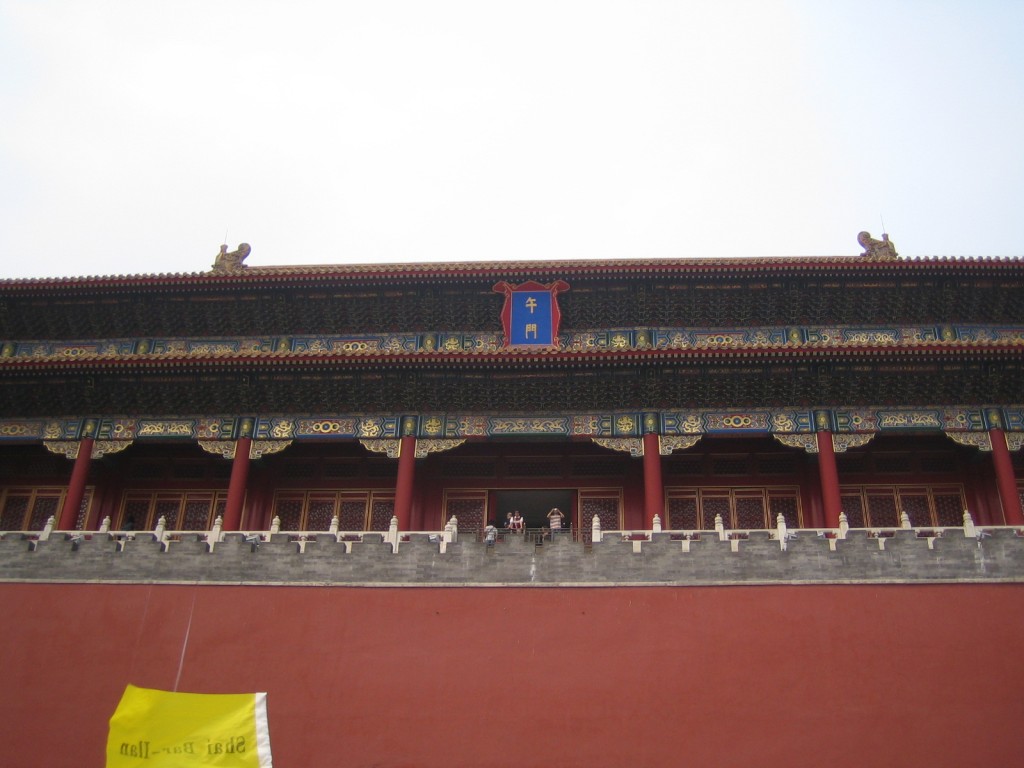
This area has almost a fair-like quality. People walk slowly, sit on benches, and children play. Once we pass through Meridian Gate, everything changes. That is the entrance to the official part of the Forbidden City- a place where one only could enter with an invitation. Those with requests of the emperor often waited from four or five o’clock in the morning with a letter of reference, many of them only to be turned away hours later. It was there the condemned criminals’ sentences were announced and there the results of the examinations for mandarin service were reported.

Looking up at Meridian Gate

Looking up at Meridian Gate

Back of Meridian Gate

Back of Meridian Gate

Inside we find the Hall of Supreme Harmony which was where the emperor used to greet dignitaries.
The emperor had many many concubines and a staff of hundreds of eunuchs. In fact, they were the only men aside from the emperor who were permitted to remain in the Forbidden City overnight.

The number 9 is very important in Chinese folklore. It is considered the luckiest number and is the Imperial number. The Forbidden City is rumored to have 999 buildings. Some say it has 999 rooms. I never counted, but there are an enormous number of buildings, all of them impressive. Here’s just one view of an area that was recently restored.

Inside the Forbidden City

Inside the Forbidden City

And here we are walking through another gate to yet another area. The enormity of this complex, built between 1406 to 1420 is breathtaking!

A gate in the Forbidden City

A gate in the Forbidden City

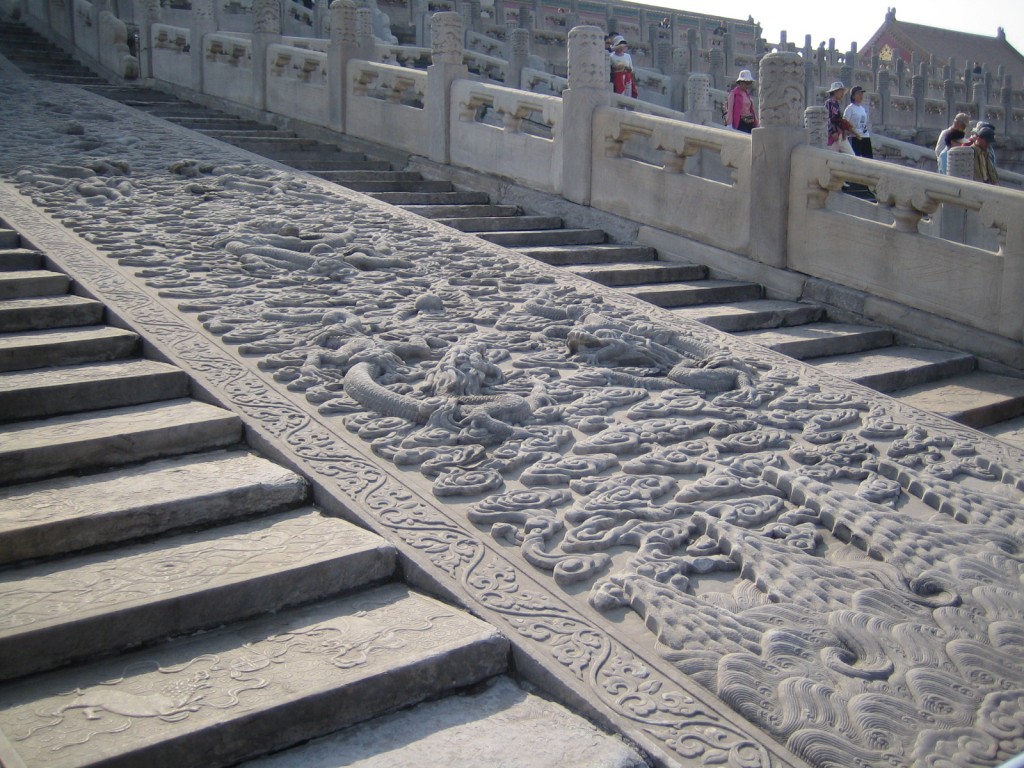
One of the more amazing things in the Forbidden City is this piece of carved stone. It is over 16 meters long and 3 meters wide and 1.7 meters thick. It weighs more than 200 tons! The stone dates from the Ming Dynasty (1368-1644) and was quarried in the western suburbs of Beijing. It was brought to the Forbidden City by sprinkling water on the way in order to make and iced road and pulled along the iced road. It was re-carved in 1761.

Large stone carving

Large stone carving

We have been walking through the official area of the Forbidden City- the place where the emperor carried out his official duties. There are, in this area, several museums including a museum of clocks. The Chinese imperial family loved western culture. Among their treasures are clocks made in Germany and France.

Below is the entrance to the private area where the emperor, the empress, the emperor’s concubines, his children, and the eunuchs lived.

Entrance to private family area of Forbidden City

Entrance to private family area of Forbidden City

Next time I will show you some of the private area of the Forbidden City, but, of course, to really experience it, you must visit it in person.

The Forbidden City- Beijing, China

Before we actually enter the Forbidden City, it’s important to know that this is not the first Forbidden City in China. It is one of many that existed over the years in places like Xian (where the first Emperor lived), Kaifeng, and Nanjing. In fact, the name Beijing means “northern capital” – just as Nanjing means “southern capital.” Even in Beijing, this is not the first Forbidden City. The Yuan Dynasty which ruled from 1271 or 1279 (depending on which source you trust) to 1368 which preceded the Ming Dynasty had built their own Forbidden City within the city of Beijing. When the Ming Dynasty came into power, they very much wanted to negate the former dynasty in large part because they were not of Chinese origin, but Mongol. The Emperor and others in the Ming Dynasty not only decided to build their own Forbidden City, but they arranged to eclipse the former Forbidden City by constructing a hill in front of it, destroying its Feng Shui and forever remaining ascendant. The name of this hill and the park now surrounding it is Jing Shan and the view from there, looking north, of the former Yuan Forbidden City is most fascinating.

Looking toward the Yuan Dynasty Forbidden City

Looking toward the Yuan Dynasty Forbidden City

However, it is also possible, from this hill, to view the Ming Dynasty-built Forbidden City. This is the one that served as home to 24 Emperors, fourteen of the Ming Dynasty and ten of the Qing Dynasty.

Looking south over the Forbidden City

Looking south over the Forbidden City

This picture, taken in August of 2007 captures the scaffolding around parts of the Forbidden City. The Forbidden City has been undergoing renovations for many years and each year it is more beautiful. Word has it that the reconstruction may take as long or longer than the original construction that took from 1406 to 1420. The silver dome-like object in the upper right is the brand new Beijing opera house.

After the Qing Dynasty was overthrown in 1911 and the young Emperor, PuYi was forced to abdicate in 1912, the Forbidden City became known as “The Palace Museum” and it houses many of the treasures of the Chinese people.

And now, let’s visit the Forbidden City.

We are lucky. The reason the Forbidden City has its name is that quite simply, if you weren’t invited, you didn’t enter it. Fortunately for us, there are no more Emperors to keep us out and we can enjoy strolling through this awe-inspiring structure.

The Forbidden City is in the center of Beijing which is, according to the Chinese, the center of the world. Hence, China is termed “The Middle Kingdom.” It lies at the crossroads of east/west, north/south. South of the Forbidden City is Tiananmen Square, a huge open plaza, the largest of its kind in the world. It was in front of the square, at Tiananmen Gate on October 1, 1949 that Mao ZeDong proclaimed the People’s Republic of China. His picture still appears on the outside wall of the Forbidden City.

Tiananmen Gate

Tiananmen Gate

As with other Chinese structures, the Forbidden City is entered from the south and one proceeds northward through successive gates. Here is another picture of the entrance to the Forbidden City.

Entrance to the Forbidden City

Entrance to the Forbidden City

OK, we’re at the threshhold, but you must have patience. Next time, we enter the Forbidden City!

The Great Wall of China

The Great Wall of China began as a series of fortifications to ward off invaders from the north. The first parts of the wall date back to the 7th century before the Common Era. These walls, built by a number of small kingdoms, were finally joined by China’s first emperor, Qin Shi Huangdi whose Qin Dynasty dates from 221 BCE. Qin unified China and instituted standards for road width, for currency, and for language, uniting the disparate kingdoms.

Over the centuries, portions of these walls have fallen into disrepair and much of the wall that remains was constructed during the time of the Ming Dynasty (1368-1644). Recent investigation has shown that the wall is actually 1,586 miles longer than previously thought. It is 8,850km (5,500 miles) long.

A visit to the Great Wall, of course, only provides the experience of a small part of it. One of the sections that is visited by tourists is just outside of Beijing.

The Great Wall of China

The Great Wall of China

Even when first viewed, it is an amazing structure. It became all the more amazing as we came to know it at closer range. The section of the wall that we arrived at was even with the parking lot. However, to the second tower, there were approximately 1200 steps. Even for those who are fit, the combination of the heat in the summer and the very steep uneven steps presents a challenge for someone who wants to climb to the top tower.

Look at these steps!

The height of one step

The height of one step

My husband has one foot on one step and the other on the next one! At this section of the wall, one is literally crawling up the steps! This section is across a bridge from where most of the tourists walk. Aside from the problem with the height of the steps, they are not uniform in height, so if you aren’t careful, it’s easy to fall. Just look at the view downward on the tourist area of this section.

View looking down the steps!

View looking down the steps!

But look at the view one gets when climbing!

View from the Great Wall

View from the Great Wall

In the summer of 2007, I was lucky enough to be able to take my granddaughter, Hadas, to Beijing with me. One of the more memorable days was the day we went to the Great Wall.

Hadas at the Great Wall

Hadas at the Great Wall

Hadas made it to the top of the 1200 steps. You can see her peeking out from the roof.

Hadas at the top!

Hadas at the top!

She did a lot better than I did! On that trip, for some reason, I was huffing and puffing my way up the steps, but felt fine coming down– until I heard someone ask me “Do you know what your name is?” I didn’t get why someone was asking me this, but only later realized I had probably hyperventilated and was actually starting to pass out! In a couple of minutes I was fine, but I am certain that Hadas remembers the day with just a little bit of fear mixed in.

Recommendation: Don’t rush up the Great Wall. It’s been there for thousands of years. It will still be there ten minutes later.

A “Jewish” mosque in Xian

One of the cities I love to visit in China is the city of Xian. It was one of the capitals of China and it is the place where Qin Shi Huangdi, the first emperor had his Forbidden City. It is just outside of Xian that his tomb is located and one day soon, I will talk about it and about how it is one of the wonders of the world.

But today, I want to talk about the mosque. You see, in China, beginning with the spice and silk traders, there arose a community of Jews. This community was documented to exist in the 12th century, but probably was much older. It consisted of Jewish traders and often the local Chinese women they married. As did every other Jewish community, they built a synagogue. The synagogue was built in the style of important Chinese buildings, incorporating the elements of feng shui. It was largely a rectangular garden whose sides were longer and whose front and back were shorter– with a series of gates beginning at the front that led through three courtyards, all beautifully planted, toward the back with small structures in the center that one could walk through. Along both long sides, there were buildings in which there were places for caretakers of the synagogue to live, places to wash ones hands (and probably mikvaot), and places for receptions. At the back, there was a large building which was the place where the services were held. Unfortunately, the synagogue was located not far from a river that would overflow from time to time and several times during its history, the synagogue was destroyed.

There were, however, sketches of the synagogue done by a Jesuit Priest, Father Matteo Ricci who met the head of the community when he, Ai Tian, went to Beijing, hearing that there were other people who read the Bible and worshiped one G-d. There was some misunderstanding as Ai Tian believed that Father Ricci was Jewish and he even went so far as to ask Father Ricci to become their Rabbi! Father Ricci traveled to Kaifeng to visit the synagogue and ultimately made the world aware of the community.

By the mid 19th century, the synagogue fell into disrepair and by then there was no rabbi serving the community. No one but the rabbi knew how to read the torah. The community sold their sifrei torah which can now be found in many places throughout the world.

So what does this have to do with a mosque in Xian? The mosque was built as a near replica of the Kaifeng synagogue.

For this reason, a visit to the mosque is a “must” if one wants to understand the experience of the Jews who once lived in China. Here are some pictures of the mosque in Xian that was built in a similar manner to the synagogue in Kaifeng.


The first picture is of the entrance gate to the mosque/synagogue. The second picture is of one of the gates to an internal courtyard. The third picture is of the plaza outside of the main building where wedding ceremonies were held, where sukkot were built, and which was decorated with flowers on Shavuot!

There is much more to learn about this community and about Jews in China through the ages. One place to get a taste of it is here.

Hello world!

Welcome to a blog that will be taking you to China, Vietnam, and Cambodia. Not only will I be talking about the rich cultures of these three magnificent countries, but I will be talking about the wonderful warm people, the beautiful sights, and the very special experiences of traveling there– and remaining able to eat freshly prepared, healthy kosher food! You can find a list of our tours here

The Summer Palace, Beijing

The Summer Palace, Beijing

Come back and see me and join in the adventure!

Pin It on Pinterest