Water Puppets!

Vietnam is very much a water culture. That is, the country has a very very long coastline and much of its industry is water based- such as fishing and growing rice. During the rainy season both the Red River and Mekong Deltas fill with water and leave the soil fertile when the waters recede.

One art form that has resulted from this water culture is the water puppet theater.

The puppets are fashioned from wood and the puppeteers stand in water thigh to chest deep behind a screen and manipulate them from behind via the use of bamboo rods under the water. The puppets are fairly primitive looking but the puppeteers are able to make them do amazing things- they dance, they throw and catch, they even have fire-breathing dragons! The stories come from Vietnamese folklore and history. It may not be high art, but it is fascinating and definitely worth seeing.

Here is a wonderful article about the water puppets we see in Hanoi on our Shai Bar Ilan tour to Vietnam/Cambodia!

Here is one outdoor water puppet theater.

IMG_4381

The Temple of Heaven, Beijing

The Temple of Heaven is not only a magnificent series of structures, but it is an amazing place to visit because at its heart is the heart of the Chinese people. In this place you can see and meet people and begin to understand what China is really about. These people are warm, friendly, and full of grace.

The environs of the Temple of Heaven contain areas where people meet on a daily basis and engage in exercise and games of all sorts. Of course, most of the people who meet and play in this open-air community center are older folks who are no longer working. They pay a minimal yearly fee and then have use of the park every day. Here are some of the sights:

Women exercising

Women exercising

Notice the “play equipment” is adult sized.

Women walking on pebbles

Women walking on pebbles

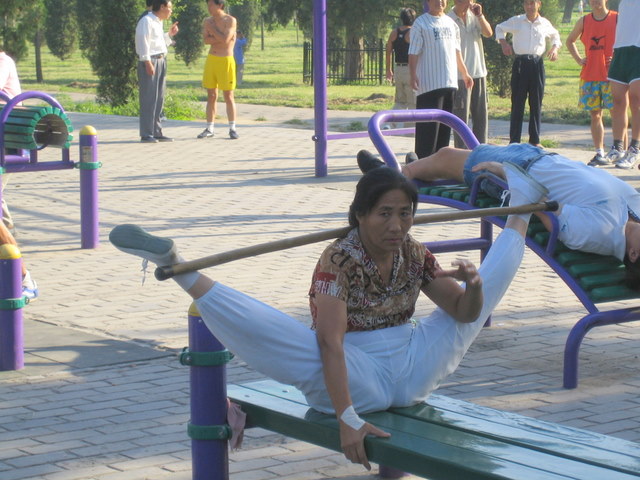
When we visit China, we make sure to take everyone for a foot massage. These women get their own massage as they walk in their light-soled shoes on pebbles cemented into the ground and protruding exactly enough to provide a therapeutic massage!

Ouch!

Ouch!

This woman made all of us think “ouch!”

Ribbon exercises

Ribbon exercises

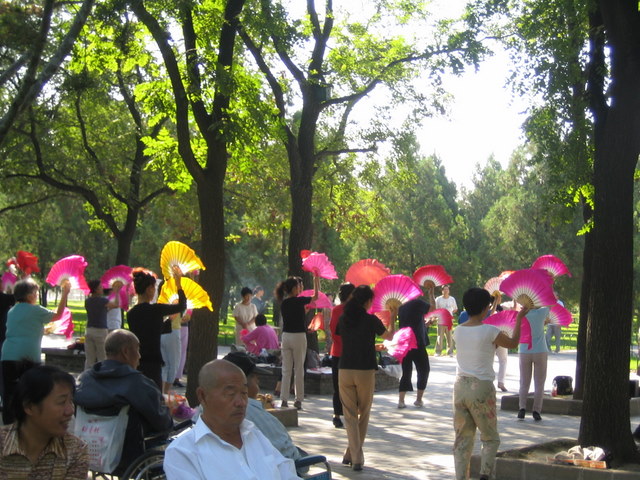
This was a particularly lovely sight. Many of the women get their exercise by waving ribbons in beautiful intricate patterns.

Fan dancing in the park

Fan dancing in the park

In addition to Tai Chi, there is fan dancing, sword dancing and lots of other group activities. Western style social dancing is also done with old American tunes being played on large amplifiers. Some people also come here to play cards, chess, and mahjong. Some of the women bring craft projects such as crocheting and knitting. Sometimes they sell their items to tourists.

Of course all should be done accompanied by music!

Musician in the park

Musician in the park


Next time we’ll see some of the buildings in this large complex called “The Temple of Heaven.”

Cambodia – Tonle Sap

This is an excellent article on Tonle Sap, a real phenomenon. It is a lake that during the rainy season expands enormously. The water current actually changes twice a year. During the dry season, the water flows from it to the Mekong Delta, but in the rainy season, the water backs up causing the lake to swell, carrying with it lots of fish.

Here are a few pictures I took when I visited there…

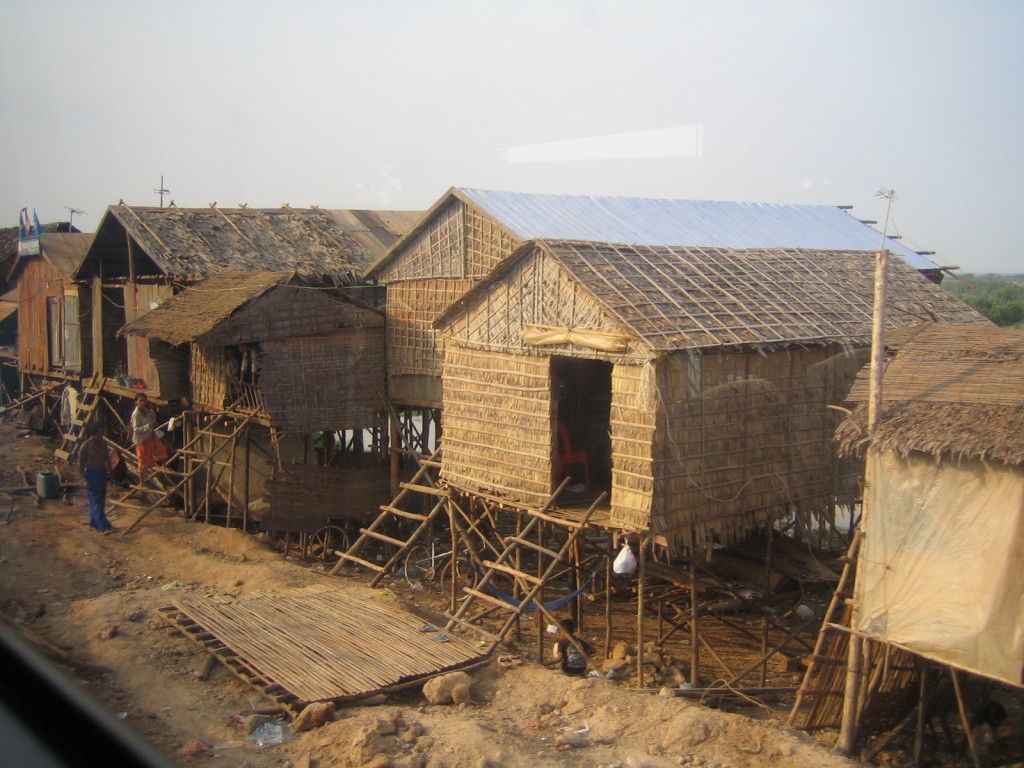
homes along Tonle Sap

homes along Tonle Sap

These homes were usually one room homes and contained places to sleep and usually a TV. They have no indoor plumbing and we could see wells with pumps for fresh water that had been donated by foreigners. All of these homes can be dismantled and trucked to other locations. In fact, I took this picture on my first trip to Cambodia and when I returned a year later, this whole line of homes had been relocated.

Another home next to a water pump

Another home next to a water pump

This, as the other, was photographed through the bus window, hence the glare and reflection. You should be able to see on the right a sign with US and Cambodian flags that marks the donation of the pump by an American donor.

The weather tends to be warm all year long. The two seasons are wet and dry- so it is not unusual to see little children running around without clothes.

Beautiful child

Beautiful child

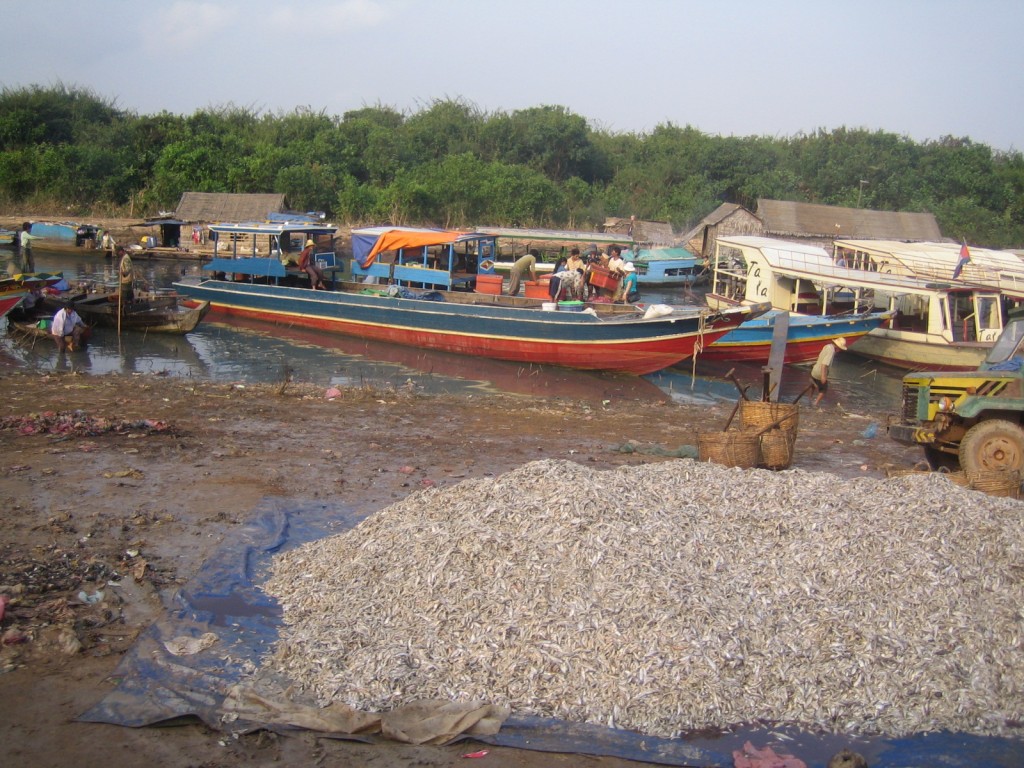
The fishing industry

The fishing industry

Fishing is a very important industry. In the foreground is a pile of dried fish!

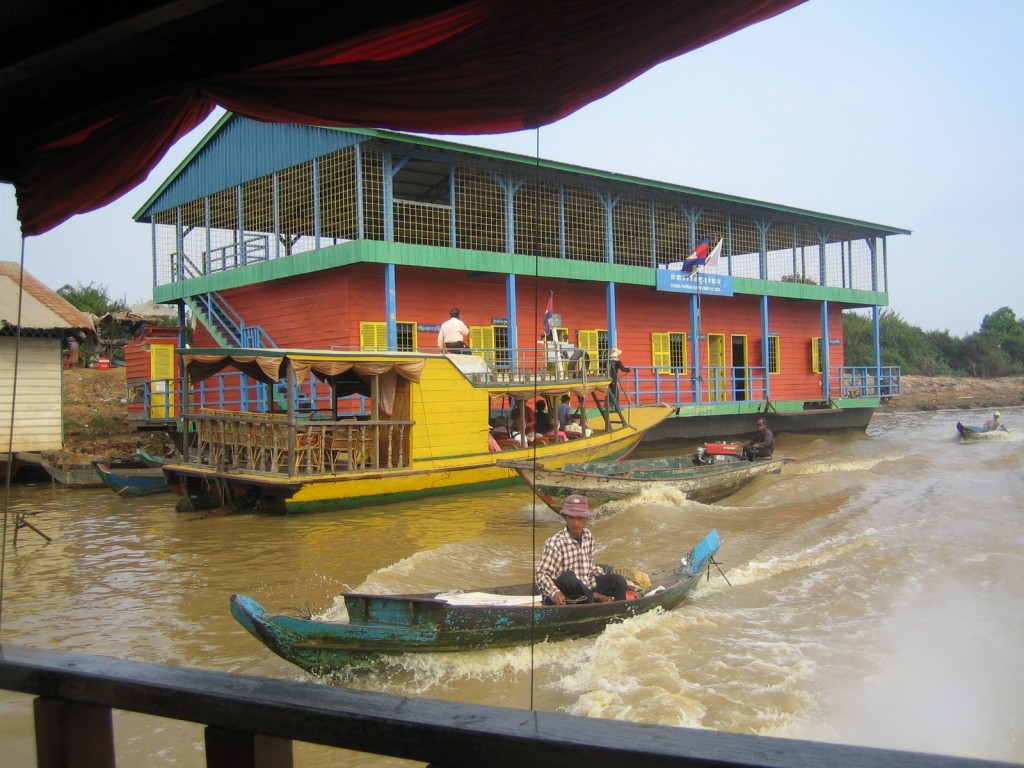
A floating elementary school

A floating elementary school

This school is moored, but is completely transportable. The upstairs area is for recess and play activities. Some schools have basketball courts that are fenced like this one so that out of bounds balls don’t end up in the Mekong Delta!

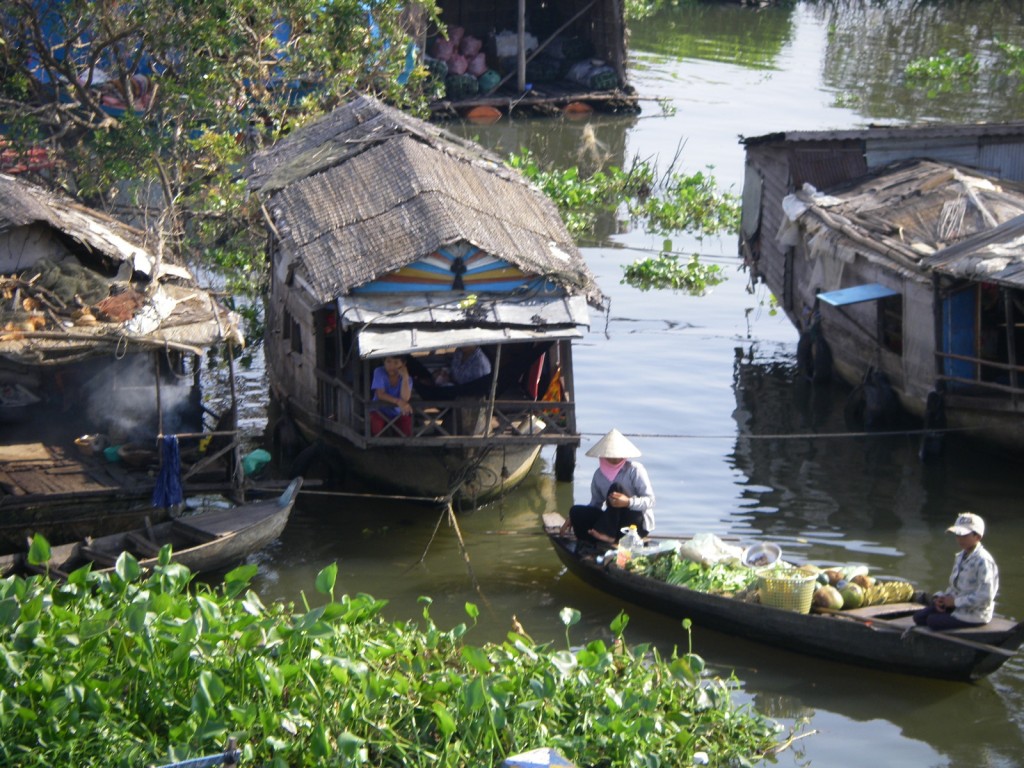
Buying fruits and vegetables

Buying fruits and vegetables

There are many people who live on boats. They can have delivery service to their door (so to speak).

Floating church

Floating church

And yes, a floating church, complete with a Cambodian flag next to the door. Here’s a piece of trivia: Cambodia’s flag is the only country’s flag that features a structure. On its flag is a drawing of Angkor Wat. Someday, we will explore Angkor Wat on this site. Stay tuned.

Hanoi

There is a lot to say about Hanoi. Coming of age in the era of the Vietnam War, I thought of it as a dark forbidding place and never in my wildest dreams did I think I would ever visit. NowI not only visit, but I am getting to know it like a friend.

There are many notable sights to see in Hanoi. There is the complex that surrounds Ho Chi Minh’s mausoleum. It contains the Presidential Palace built by the French, Ho Chi Minh’s two unassuming residences, a museum dedicated to him, and the One Pillar Pagoda. Further off in the city are several lakes, the Temple of Literature, the Old City, and one of the famous Vietnamese water puppet theaters. Of course, there is also Maison Centrale, the old French prison that used to house political opponents of the French, but during the Vietnam War era, housed US POWs including John McCain.

But today, I want to show you the character of the city. It is perhaps enhanced in these pictures by the gentle rain that was falling as I took them.

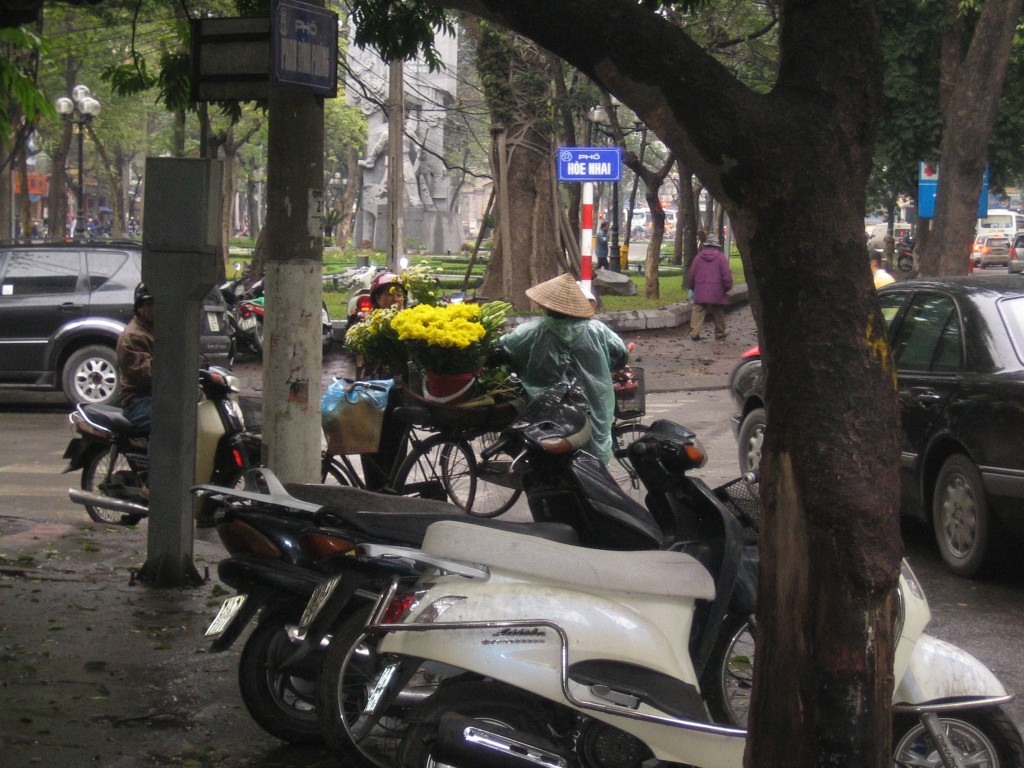
Early in the morning in Hanoi

Early in the morning in Hanoi

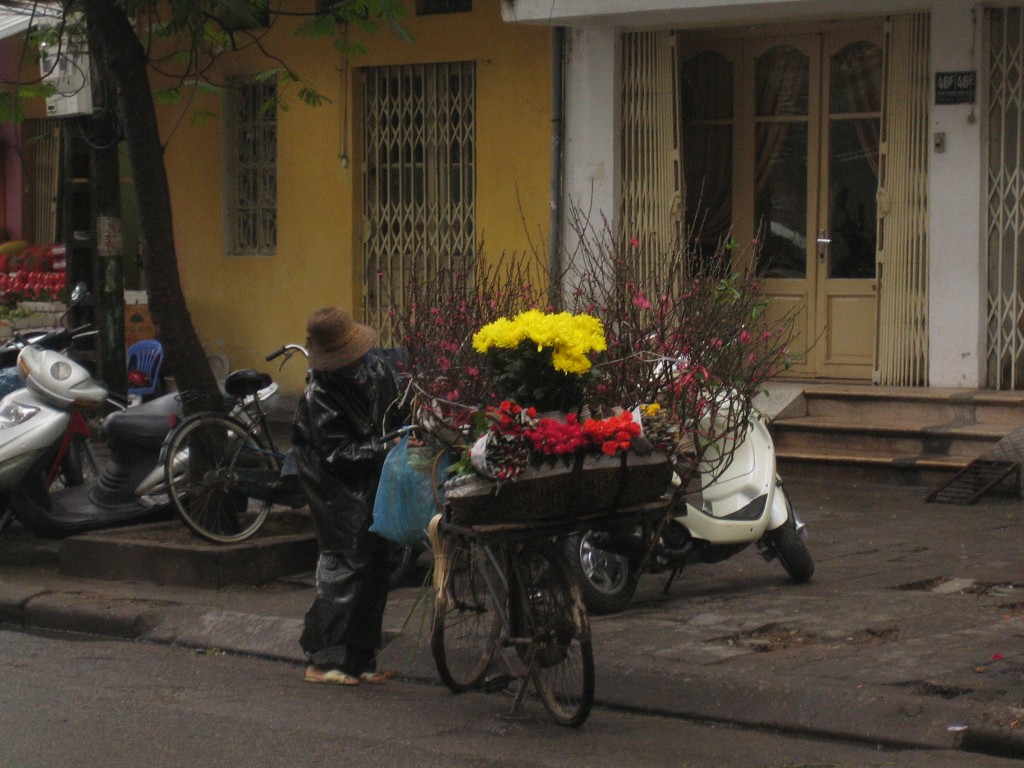
This woman is readying her flower cart. There are hundreds of flower carts in Hanoi and in the days before the celebration of Tet, many of them are festooned with flowering branches, many times of peach blossoms, without which, the holiday is not complete.

Flower vendor with blossoming peach branches

Flower vendor with blossoming peach branches

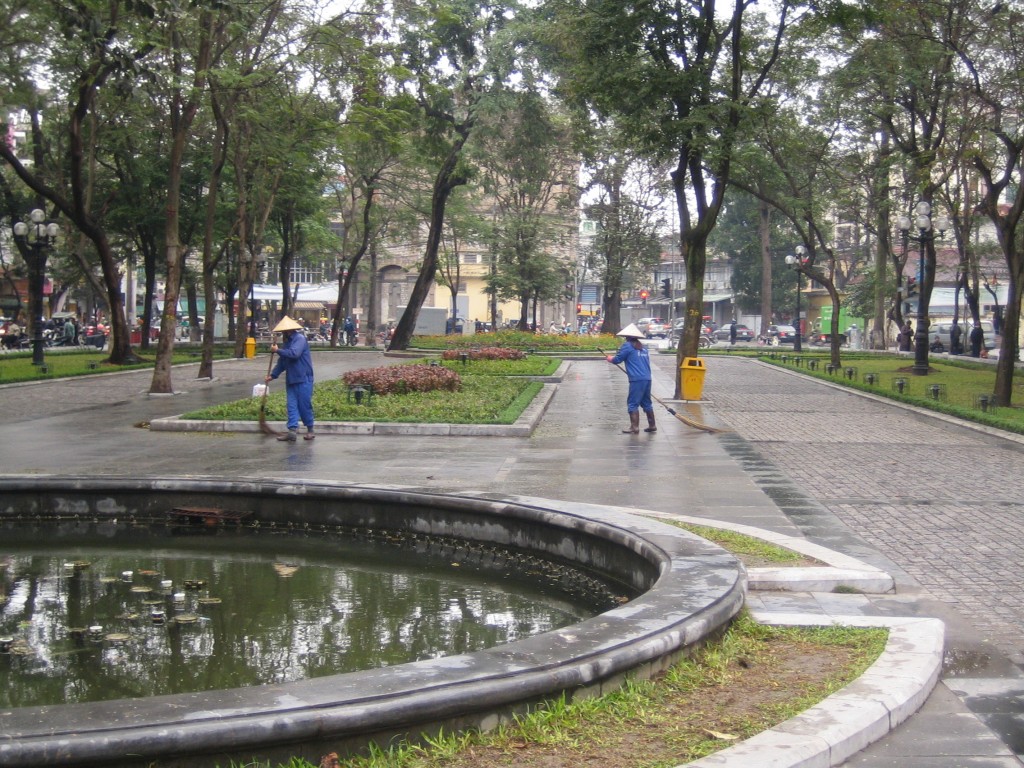
Park in downtown Hanoi

Park in downtown Hanoi

This park has a large memorial to the fighters of Vietnam. Here, the women are cleaning the park, sweeping it in the early morning hours. The hats they are wearing are worn throughout the country. They provide shade from the sun while allowing circulation of air.

Luscious flowers in Hanoi

Luscious flowers in Hanoi

Tet is a holiday that is celebrated with great joy. There are dozens of customs that accompany the holiday. One of them is decorating the home. These decorations are very similar (perhaps identical) to those of the Chinese New Year which comes out at just about the same time, in the mid-winter.

Tet decorations

Tet decorations

And lest you think that Hanoi is a frightening or dangerous place to be, rest assured that you have nothing to fear. The watchful eyes of the FBI are guarding you.

FBI Agent

FBI Agent

Into the Forbidden City, Beijing, China

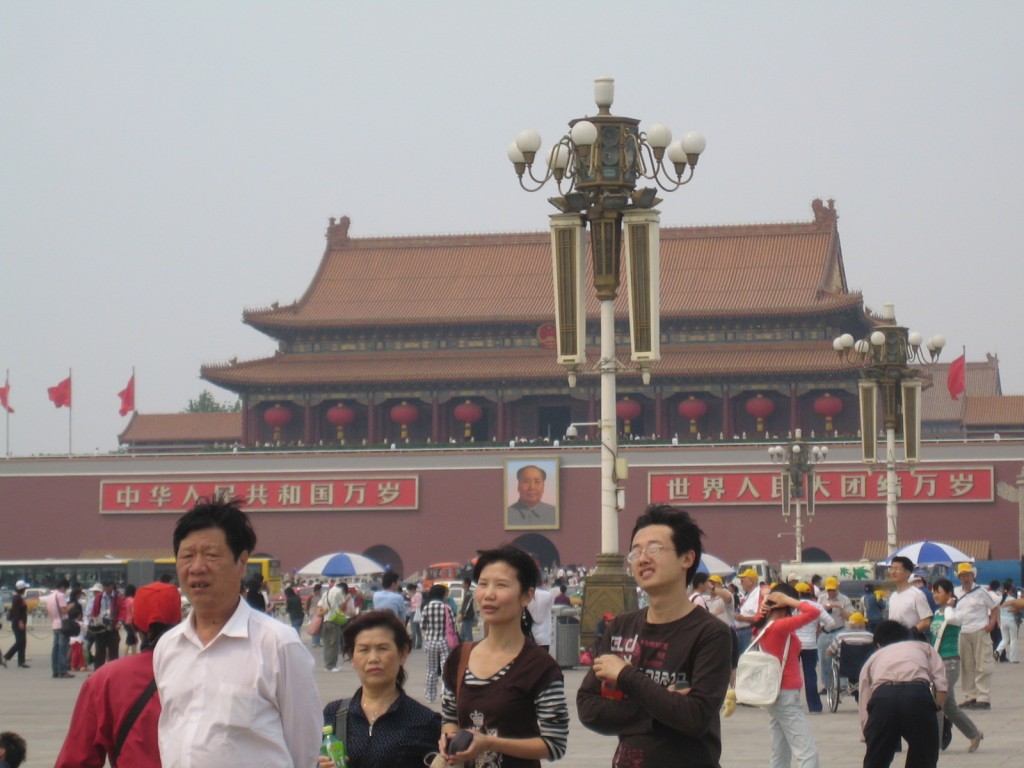
Finally we approach the entrance to the Forbidden City with its picture of Chairman Mao. Every time I have been there, crowds of people are entering. Most of the tourism in China is Chinese. When you think about it, it makes sense. It is a country of about 1.3 billion people. If only 1% of them travel, that’s 13 million people! And with the Forbidden City being the heart of China, it is understandable that it would always have a large number of visitors. Thankfully, the area it occupies is very large. It is about 750 meters (820 yards) across and about a kilometer (1093.6 yards) long. We have entered at the south end through the Tiananmen Gate.

Once inside, we are in a public area of the Forbidden City. In this area there are shops and souvenir stands and until recently, there was even a Starbucks. It offended the sensibilities of some of the Chinese and it eventually closed. Somehow, I agree with them. The beauty of the Forbidden City and other Chinese sites is their uniqueness and their strong ties to Chinese culture and history. In this area there are trees and plants. There are no trees and plants in the official area of the Forbidden City.

Behind us, Tiananmen Gate; ahead of us, Meridian Gate

Behind us, Tiananmen Gate; ahead of us, Meridian Gate


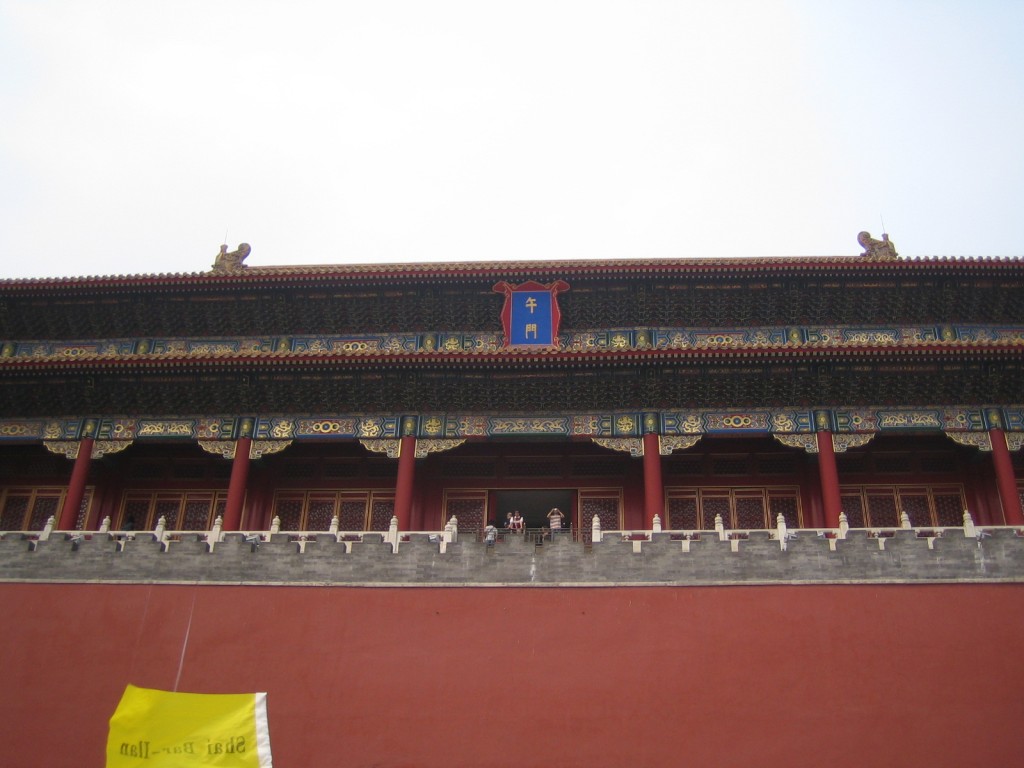
This area has almost a fair-like quality. People walk slowly, sit on benches, and children play. Once we pass through Meridian Gate, everything changes. That is the entrance to the official part of the Forbidden City- a place where one only could enter with an invitation. Those with requests of the emperor often waited from four or five o’clock in the morning with a letter of reference, many of them only to be turned away hours later. It was there the condemned criminals’ sentences were announced and there the results of the examinations for mandarin service were reported.

Looking up at Meridian Gate

Looking up at Meridian Gate

Back of Meridian Gate

Back of Meridian Gate

Inside we find the Hall of Supreme Harmony which was where the emperor used to greet dignitaries.
The emperor had many many concubines and a staff of hundreds of eunuchs. In fact, they were the only men aside from the emperor who were permitted to remain in the Forbidden City overnight.

The number 9 is very important in Chinese folklore. It is considered the luckiest number and is the Imperial number. The Forbidden City is rumored to have 999 buildings. Some say it has 999 rooms. I never counted, but there are an enormous number of buildings, all of them impressive. Here’s just one view of an area that was recently restored.

Inside the Forbidden City

Inside the Forbidden City

And here we are walking through another gate to yet another area. The enormity of this complex, built between 1406 to 1420 is breathtaking!

A gate in the Forbidden City

A gate in the Forbidden City

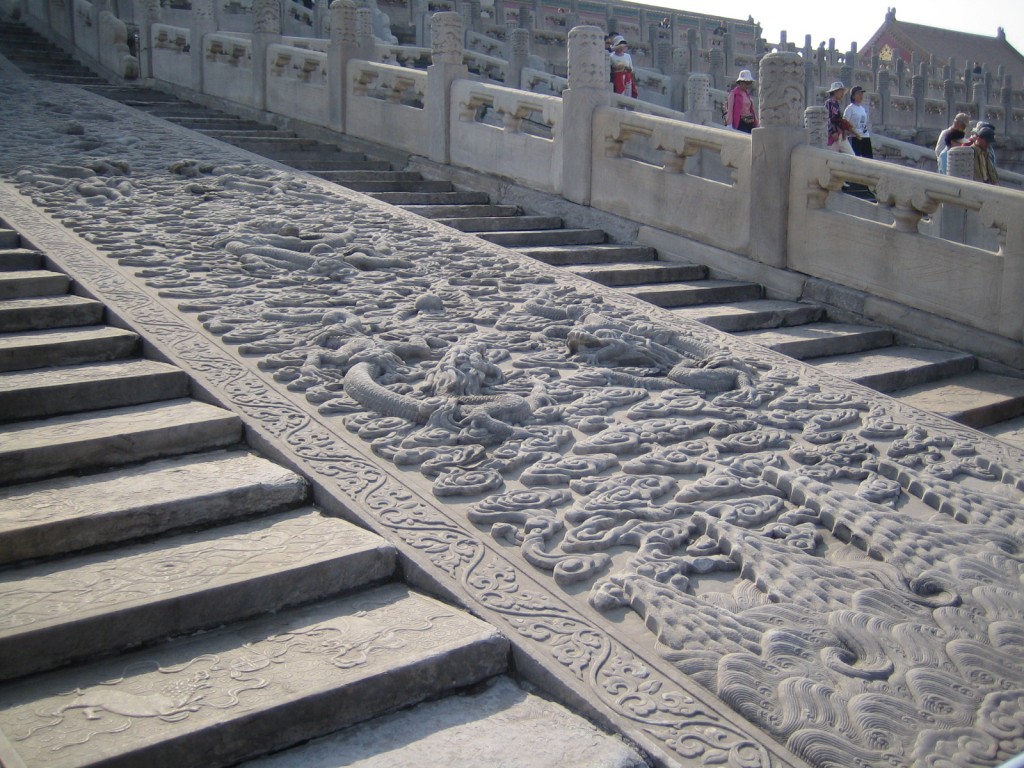
One of the more amazing things in the Forbidden City is this piece of carved stone. It is over 16 meters long and 3 meters wide and 1.7 meters thick. It weighs more than 200 tons! The stone dates from the Ming Dynasty (1368-1644) and was quarried in the western suburbs of Beijing. It was brought to the Forbidden City by sprinkling water on the way in order to make and iced road and pulled along the iced road. It was re-carved in 1761.

Large stone carving

Large stone carving

We have been walking through the official area of the Forbidden City- the place where the emperor carried out his official duties. There are, in this area, several museums including a museum of clocks. The Chinese imperial family loved western culture. Among their treasures are clocks made in Germany and France.

Below is the entrance to the private area where the emperor, the empress, the emperor’s concubines, his children, and the eunuchs lived.

Entrance to private family area of Forbidden City

Entrance to private family area of Forbidden City

Next time I will show you some of the private area of the Forbidden City, but, of course, to really experience it, you must visit it in person.

The Forbidden City- Beijing, China

Before we actually enter the Forbidden City, it’s important to know that this is not the first Forbidden City in China. It is one of many that existed over the years in places like Xian (where the first Emperor lived), Kaifeng, and Nanjing. In fact, the name Beijing means “northern capital” – just as Nanjing means “southern capital.” Even in Beijing, this is not the first Forbidden City. The Yuan Dynasty which ruled from 1271 or 1279 (depending on which source you trust) to 1368 which preceded the Ming Dynasty had built their own Forbidden City within the city of Beijing. When the Ming Dynasty came into power, they very much wanted to negate the former dynasty in large part because they were not of Chinese origin, but Mongol. The Emperor and others in the Ming Dynasty not only decided to build their own Forbidden City, but they arranged to eclipse the former Forbidden City by constructing a hill in front of it, destroying its Feng Shui and forever remaining ascendant. The name of this hill and the park now surrounding it is Jing Shan and the view from there, looking north, of the former Yuan Forbidden City is most fascinating.

Looking toward the Yuan Dynasty Forbidden City

Looking toward the Yuan Dynasty Forbidden City

However, it is also possible, from this hill, to view the Ming Dynasty-built Forbidden City. This is the one that served as home to 24 Emperors, fourteen of the Ming Dynasty and ten of the Qing Dynasty.

Looking south over the Forbidden City

Looking south over the Forbidden City

This picture, taken in August of 2007 captures the scaffolding around parts of the Forbidden City. The Forbidden City has been undergoing renovations for many years and each year it is more beautiful. Word has it that the reconstruction may take as long or longer than the original construction that took from 1406 to 1420. The silver dome-like object in the upper right is the brand new Beijing opera house.

After the Qing Dynasty was overthrown in 1911 and the young Emperor, PuYi was forced to abdicate in 1912, the Forbidden City became known as “The Palace Museum” and it houses many of the treasures of the Chinese people.

And now, let’s visit the Forbidden City.

We are lucky. The reason the Forbidden City has its name is that quite simply, if you weren’t invited, you didn’t enter it. Fortunately for us, there are no more Emperors to keep us out and we can enjoy strolling through this awe-inspiring structure.

The Forbidden City is in the center of Beijing which is, according to the Chinese, the center of the world. Hence, China is termed “The Middle Kingdom.” It lies at the crossroads of east/west, north/south. South of the Forbidden City is Tiananmen Square, a huge open plaza, the largest of its kind in the world. It was in front of the square, at Tiananmen Gate on October 1, 1949 that Mao ZeDong proclaimed the People’s Republic of China. His picture still appears on the outside wall of the Forbidden City.

Tiananmen Gate

Tiananmen Gate

As with other Chinese structures, the Forbidden City is entered from the south and one proceeds northward through successive gates. Here is another picture of the entrance to the Forbidden City.

Entrance to the Forbidden City

Entrance to the Forbidden City

OK, we’re at the threshhold, but you must have patience. Next time, we enter the Forbidden City!

Hello world!

Welcome to a blog that will be taking you to China, Vietnam, and Cambodia. Not only will I be talking about the rich cultures of these three magnificent countries, but I will be talking about the wonderful warm people, the beautiful sights, and the very special experiences of traveling there– and remaining able to eat freshly prepared, healthy kosher food! You can find a list of our tours here

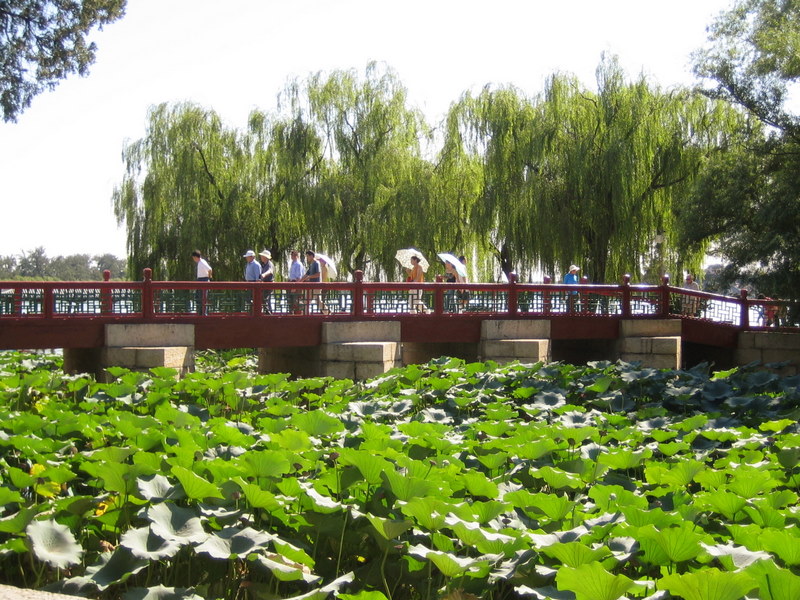
The Summer Palace, Beijing

The Summer Palace, Beijing

Come back and see me and join in the adventure!

Pin It on Pinterest