Chengdu, China — Pandas!

China has a myriad of sights to see. One of my favorite places in China is Chengdu. It’s a large city in Sichuan Province and is best known to westerners for being the prime breeding center for pandas.
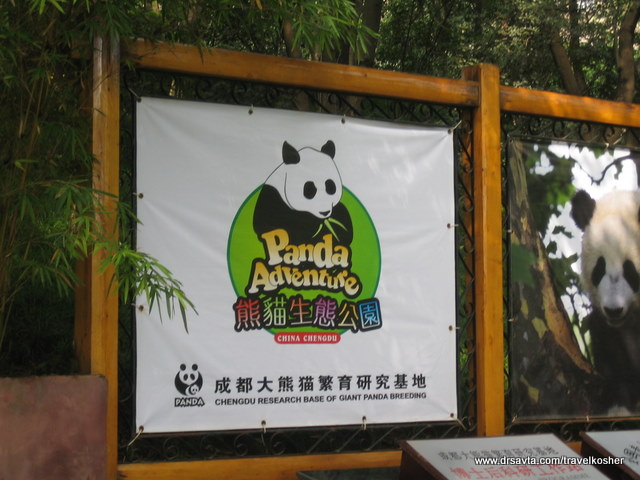
Welcome to the Panda Breeding Base
Pandas!
Pandas had become endangered, and for good reason. Female pandas are fertile for one to two days a YEAR! Add to that the fact that pandas often expend more energy eating than the caloric content provides, and you have tired male pandas who really can’t be bothered.
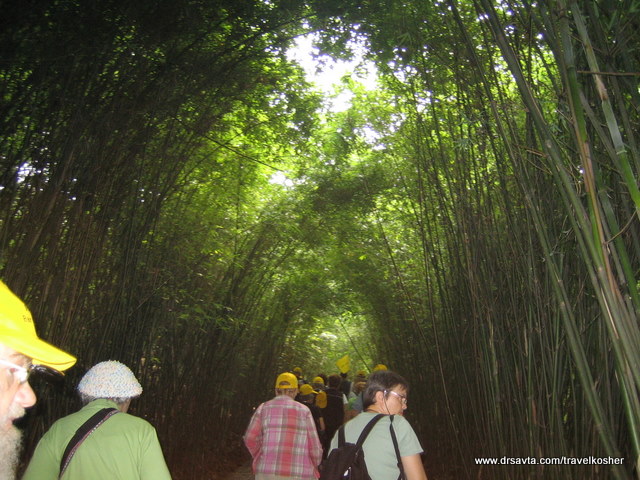
Bamboo
Pandas chiefly eat bamboo, but because the energy required to chew and digest the bamboo is roughly equal to the energy they get from it, they are not lively. At the breeding center, the pandas have been acclimated to a more varied diet that provides them with more energy. In addition, the Chinese have actually developed “panda porn.” They actually screen suggestive movies so their pandas will become inspired.

At the Chengdu panda breeding ground, many of the female pandas are artificially inseminated and all of the pandas are monitored carefully and cared for so that their offspring are healthy. Most often, the panda has one cub, but there are also frequent occurrences of twins.

The breeding program has been enormously successful and pandas soon will not be an endangered species.
Mother and baby panda on closed circuit TV
Above, the mother panda is seen from above with a little fishlike thing on her chest. That is the baby panda. They are tiny when born, but they grow very rapidly. Visitors are not allowed to approach the rooms where the mother panda and her newborn offspring are. Instead, visitors can view them on these TV monitors. To see the cubs when they are somewhere between six months and two years old, one must put on paper booties over one’s shoes and walk by the nursery cages silently so as not to disturb the pandas.

Walking through the large panda base, one could spy pandas resting (of course).
Catching some rays
This panda was one that was somewhat domesticated. For $50, one could have a picture taken with him. We graciously declined.

Pandas are also a business for the Chinese. For a million dollars a year, a foreign zoo can rent a panda for 10 years. Of course, the zoo must meet certain criteria for how they will house and care for the panda. In addition, the zoos must work toward mating the male and female pandas, usually through artificial insemination, and the panda cubs also become the property of the Chinese government. So why would a zoo do it? Pandas are a huge draw for zoos. People are fascinated by the big furry animals. Add a baby panda, and the zoo attendance soars for the first two years. It pays.

In the US, one can see pandas in the zoos in Washington DC, San Diego, Memphis, and Atlanta.

And last but not least, the pandas have friends who live with them, red pandas, also known as firefoxes. They are not of a related species, but their distinctive markings remind people of pandas. Firefoxes are able to be domesticated and are both beautiful and entertaining. I seriously wanted to bring one home!
Red Panda / Firefox

Potala Palace, Lhasa, Tibet

On our trip to western China and the province of Yunnan, we also visited Lhasa, Tibet. Lhasa, at that time (2006), was not a place that people visited so often because it is very far from other places in China, special visas are required, and the roads to Lhasa are less than perfect. [In a future post, I will talk about the roads in Yunnan Province.]

We arrived on a flight from Kunming. Lhasa is located at a very high altitude, 3650 meters or 11,975 feet above sea level. That makes it even higher than Cusco, Peru which is 3400 meters or 11,200 feet above sea level. People who visit often take close to a day to adjust to the altitude. Many people feel short of breath the whole time they are at altitudes they are not used to. We had been traveling from one place to another, each of which was at a higher altitude, so that by the time we came to Lhasa, we had very little difficulty adjusting to the altitude, although climbing steps was a lot harder because of the scarcity of oxygen in the air.

Now, for people who would like a real adventure traveling to Lhasa, there is a train that one can take from Qinghai to Lhasa. It is a very special train, built over frozen tundra at high altitude, in a way that enables the local wildlife to cross beneath its tracks and continue life as it was before the railroad.

Some of the facts about the railroad can be found here :

The train is equipped with 2 oxygen sources, 1) released throughout the cabins when reaching Golmund and heading into Tibet and 2) Personal Oxygen Canisters in case you feel light headed and only available from Tibet to Golmund or from Golmund to Tibet.

Between Xining and Golmud the tracks pass by Qinghai Lake – China’s largest. But it’s the Golmud-to-Lhasa sector which offers the most breath-taking scenery. That segment also offers the record-breakers: the world’s highest passenger railroad (at Tanggula Pass – elevation: 16,640 ft.; 5072m) and the world’s highest railroad tunnel (Fenghuoshan – elevation: 16,093 ft.; 4905m). Over 80% of the journey is at altitudes above 13,000 feet; fully half the track on this sector was laid atop permafrost.

The train ride from Beijing to Lhasa is 48 hours long. For a soft sleeper berth, the price one way is $158.

Since the railway was built, large numbers of Han Chinese have come to settle in Lhasa because now they are able to visit their families back in the center of the country more easily.

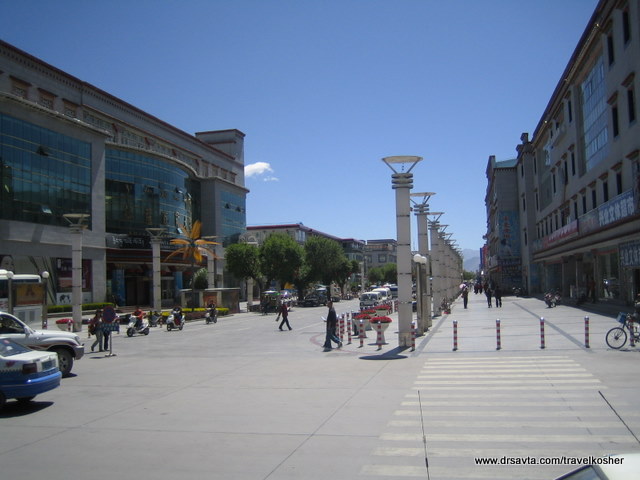
Although one may picture Lhasa as a primitive place or a place burning with tension, we found just the opposite. It was a modern, laid-back place with lots of charm and a lot of interesting places to discover.
Street in Lhasa
Business street in Lhasa
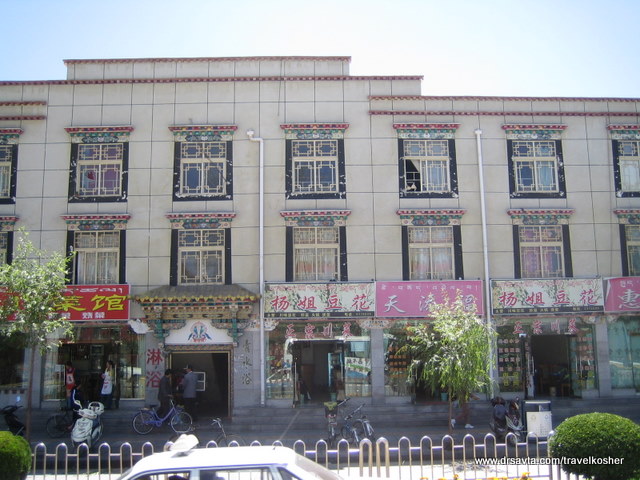
Shops in Lhasa
Shops in Lhasa

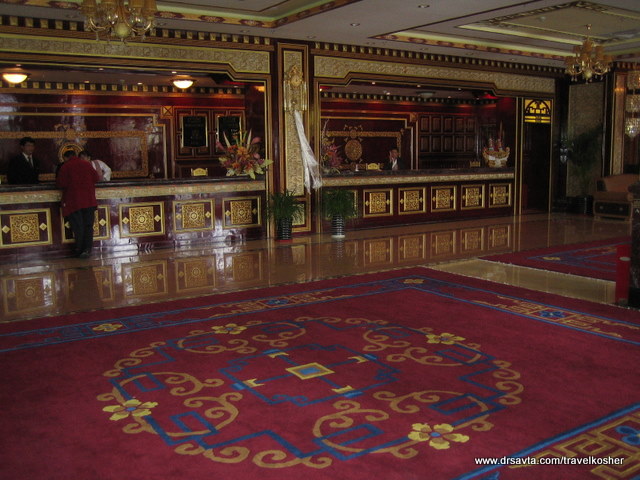
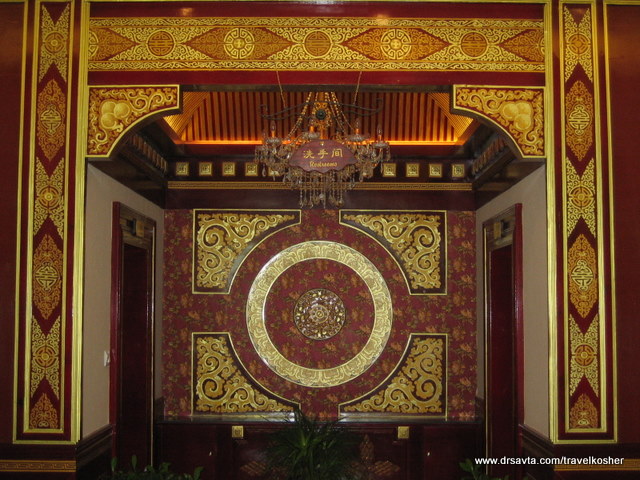
Hotel lobby
This was the lobby of the elegant hotel where we stayed

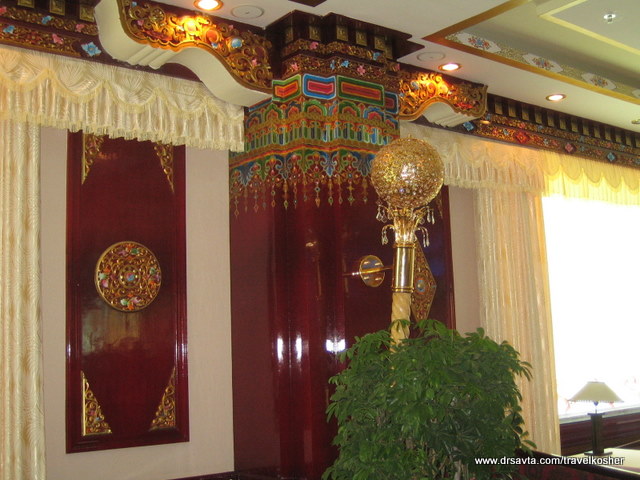
Interior of hotel
Here is some detail of the decoration
The alcove of the restrooms

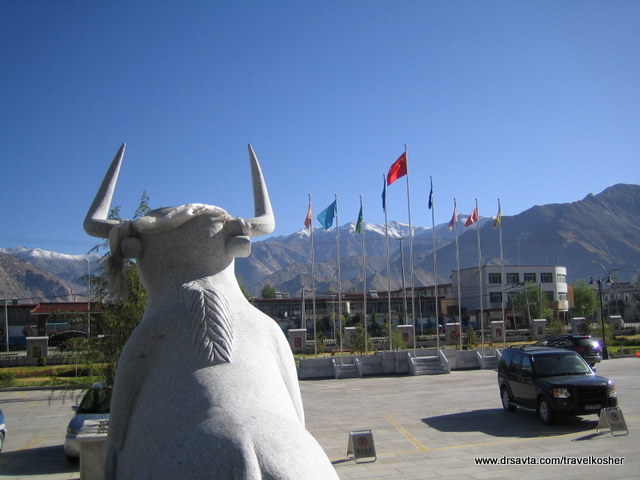
Outside the hotel, although it was already June, the first day or two we were able to see the snow-capped mountains. By the time we left, a couple of days later, all of the snow had melted.
Outside the hotel

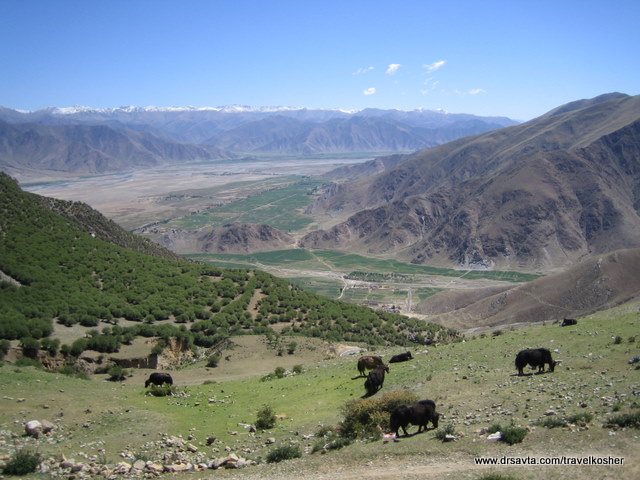
We took a ride to see a monastery on the side of a mountain and saw lovely scenery with lots of grazing yaks.

Yaks in Tibet

On our way back to Lhasa, we saw two carts.
Carts
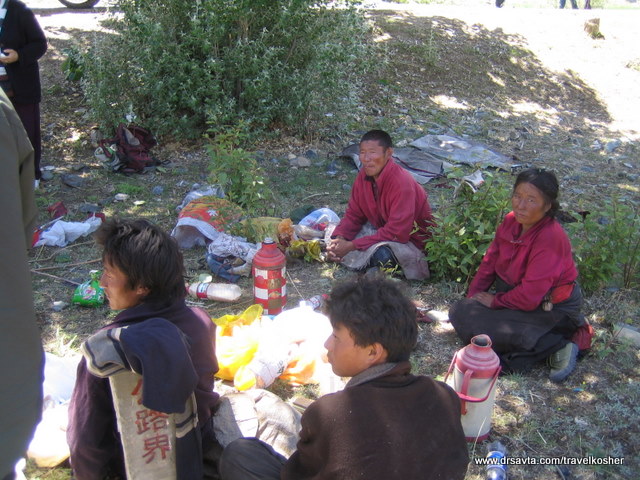
They belonged to a family of pilgrims who had been traveling on foot for almost a year from their home in Chengdu, a distance of 2415 kilometers or 1500 miles. They were nearing Lhasa and the temple they were seeking to visit. They believe that as devout Buddhists they must make this journey at least once in their lives. The father of the family had already been to Lhasa, but now he was bringing the rest of the family. Here they are:
Pilgrims

Pilgrims arriving in Lhasa will walk three steps, prostrate themselves on the ground and then get up and walk three more steps, until they reach the Jokhang temple. Then they circumambulate the temple and then finally enter.

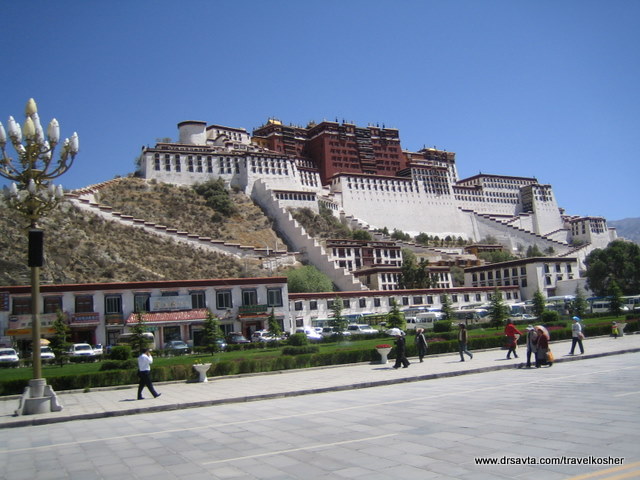
Not far from the temple is the Potala Palace, the former residence of the Dalai Lamas. It served both as a spiritual headquarters and the seat of the government. Today no business is carried out there and it is visited by tourists who must make reservations in advance, come early to go through a rigorous security check, and then climb many flights of steps to see it. It is not for the faint of heart.
The Potala Palace

We were accompanied by someone who took pictures the way a tourist would and watched our group closely. Although the palace has no real artifacts and most of the rooms we saw were empty of furnishings, it is a sensitive location for the Chinese and so they are very vigilant about who the visitors are and what they are doing while they are there.
The palace up close
This is close-up picture of the palace windows.

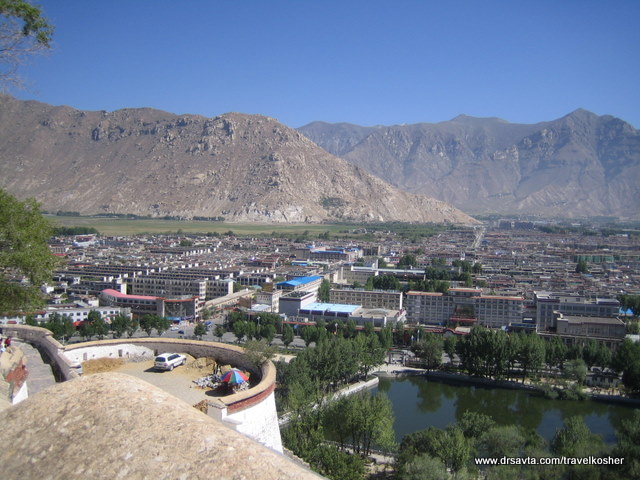
This is a view from the palace of the city of Lhasa
View of Lhasa from Potala Palace
Potala Palace

We loved our trip to Tibet. In another post, I will show you some pictures from the museum and also the summer palace of the Dalai Lama.

Details of the synagogue in Rhodes

Over the door of the synagogue in Rhodes is a large plaque that contains verses, all of which contain the word “shalom” which is the name of the synagogue. Shalom, of course, means peace.
The "Shalom" Plaque
Unfortunately the synagogue knew war and destruction. Years ago we visited the synagogue. I remember the interior looking very different. When I looked a bit closer this time, I saw that the interior had been repainted but they had left some of the original art that had been painted on the walls.

The interior showing some of the art work

The interior showing some of the art work


To the right of the chandelier on the right and on the left wall, you can see some of the wall painting that was preserved when the synagogue was repainted.
One of the details on the wall

One of the details on the wall


Unfortunately, this one was impossible for me to read. The letters were not clear.
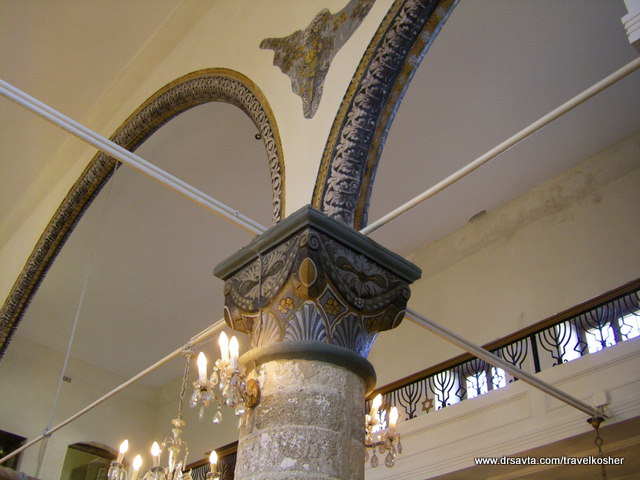
Detail on one of the columns and a remnant of earlier painting

Detail on one of the columns and a remnant of earlier painting


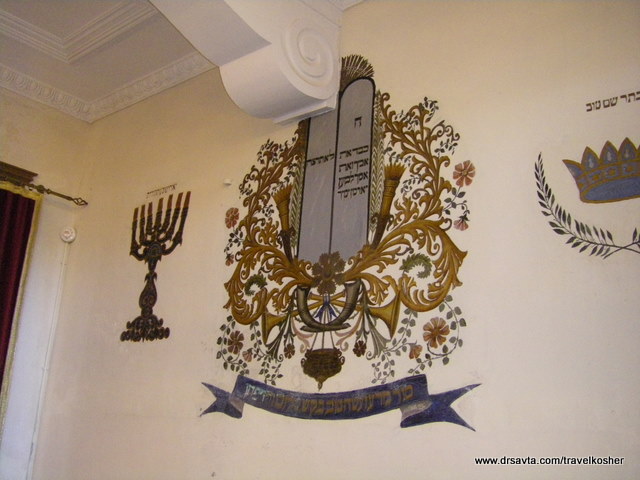
Another wall detail

Another wall detail


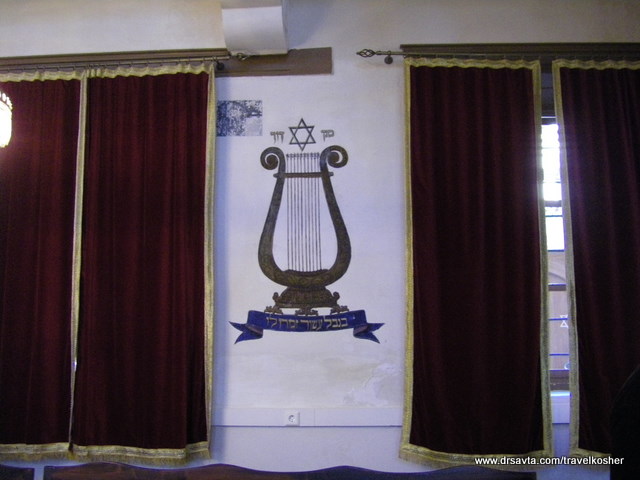
The picture above is an artistic rendition of the tablets of the ten commandments. Interestingly, only two of the ten remain on them. It looks as if they were restored. I am puzzled as to why the rest of them are not there as the text is readily available. The two commandments on the wall are “Honor you father and your mother” and “Don’t murder.”
David's Harp

David's Harp


Above and to the left, you can see another patch of the remaining wall painting.

Visiting the synagogue was a moving experience. I looked at the few remaining illustrations and thought about how the once vibrant community was destroyed. Now only about 30 Jews live in Rhodes and the future of the community is by no means assured as their children have left to marry and settle elsewhere.

It’s worth our support and definitely worth a visit next time you’re in Rhodes.

Lindos

One of the towns on the island of Rhodes is Lindos. Lindos is a white city– all of the houses are white. It sits on the eastern coast of Rhodes. Aside from its proximity to beautiful white beaches, it is known for its acropolis. Acropolis means high city. Many places in Greece have an acropolis. Each one is known as the acropolis of the city or town it is located in. Only the Acropolis in Athens is known as “The Acropolis.” The acropolis was used both for defensive purposes in case of war, since all of the people of the city could be relocated to the high ground behind walls and for religious purposes. At this acropolis, there was the Temple of Athena. Other matters of the day also took place at the acropolis. Legal matters were discussed and adjudicated there as well. The acropolis of Lindos dates possibly as far back as 600 BCE.

A view of Lindos

A view of Lindos


Lindos as seen from the parking lot

Our bus parked at an upper parking lot and we walked perhaps 15 minutes to the lower parking lot. Beyond it, there was no vehicular traffic. In the tourist season (April through October) there are donkeys that will transport you to the top of the acropolis. In the winter, they rest. We caught one relaxing. Note he seems not to display the least bit of guilt.

Donkey at leisure

First I found a local Greek man who was kind enough to pose for a picture. The Greeks are very friendly to tourists.

Then we walked to the top of the acropolis, winding our way through the narrow alleyways. They contained lots of tourist shops but, you guessed it, they all were closed.

Bustling downtown Lindos

Bustling downtown Lindos

We walked up perhaps 100 steps and arrived at an area were there were explanations of what we were to see. In addition, there was a most unusual carving on the wall. It seems that the soil being what it was, the land in the area was not fertile farmland, and so the inhabitants turned to fishing. The carving is the only evidence as to what their fishing ships looked like. It is interesting to note that by about 2000 years BCE, there already were ships that sailed between Egypt and Greece!
The ship
The Stoa

This was the area where all could enter and this is where much of the news of the day and legal issues were discussed.
The Temple of Athena

As you can see, this was reconstructed in recent times. It sits at the top of the mountain and overlooks a magnificent landscape.
The Mediterranean Sea

The white city of Lindos

The white city of Lindos

We went to Rhodes one winter and it was closed

Rhodes is a Greek Island, largest of the Dodecanese, a group of twelve islands very close to Turkey. Rhodes’ largest source of income by far is tourism. In fact, 45% of the population profits directly from tourism and 85% in total profit at least indirectly. Tourists mostly come in the summer time. Rhodes has beaches both on the Aegean Sea and on the Mediterranean. It also has beautiful walking areas, mountain views, and quaint shops. Cruise ships stop there and a visit even of several hours in the Old Town can be a delightful experience.

Most of the tourists come in the warm seasons, from April through October. In the winter, shops in the Old Town generally open only when a cruise ship arrives– and they don’t come often in the winter. We arrived on the 9th of January and the next one is arriving on the 18th. So, when we were there, things were very very quiet– which we didn’t mind since we had been there in the summer several times and knew what the Old Town looked like when it was buzzing with people. Since we had gone just as a getaway, for a break in routine and to have some quiet, it was perfect. The town was ours.

The main street in the Old Town

We wandered through lovely streets and alleys.

On our previous visits to Rhodes we had not had the opportunity to see the inside of the Grand Masters Palace. This time, we not only saw it, but we were its only visitors.

The palace was originally built in the 14th century, but an ammunition explosion destroyed it in 1856. It was rebuilt in the early 20th century by the Italians who then ruled Rhodes. It was rebuilt according to the external plans of the palace. The interior is not the same as the destroyed palace.

This is the street that leads to the palace. On either side are offices of the bureau of antiquities or foreign consuls.

Here is the staircase

Once upstairs, we walked from room to room in this rectangular building with a courtyard.

The scale of the rooms is enormous. Unlike the palaces we have seen elsewhere in Europe, there is no wallpaper or stuffed furniture, in fact, no color at all.

We liked this hallway. There were no explanations of anything, but we like to think that these were the rooms where the knights lived.

I like the stone design around these doors

In the palace, there are mosaics that were taken from the Greek island of Kos. They date from the Roman and Byzantine periods. Here are the Nine Muses.

The Nine Muses

And finally, we walked into a room where there was a delightful young woman, an archaeology student, the only other person we saw in the palace. She was sitting on a modern chair. We spoke to her and she told us that her job is watching the vase in the room. It stands about 6 feet tall and it was a gift of Hirohito to Mussolini. Of course, if someone wanted to harm it, I doubt whether her presence would really make a difference. Physically, it was separated from us only by a rope. So here is the famous vase.

How the Sifrei Torah in Rhodes were saved

I promised an interesting story about the sifrei torah in Rhodes. This is a story we discovered at the brand new Jewish museum in Rhodes.

The source of this article comes from an article written in 2004 by Aron Hasson in the “Ke Haber?” newsletter. Aron Hasson is the founder of the Jewish Museum of Rhodes. I highly recommend visiting there as it is a gem!

In 1943, the German military took control of Rhodes. Early in 1944, British bombs resulted in the deaths of thirty-four Jews. Realizing that the situation in Rhodes was not secure, the community decided to find a way to safeguard their sifrei torah, among them one that was about 800 years old.

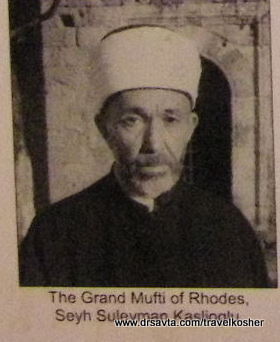
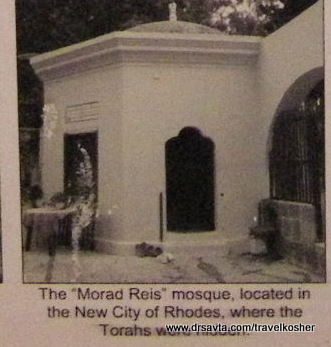
In secret, they turned over the sifrei torah to the Turkish religious leader, the Grand Mufti of Rhodes, Seyh Suleyman Kaslioglu, who hid them in the pulpit of a mosque that was located in the new city of Rhodes, far from the old town which was the target of the bombings.

In July 1944, the Jews of Rhodes were deported by the Germans, most of them to Auschwitz. Of the 1,676 Jews deported, only about 151 survived the war. At the end of the war, all of the sifrei torah were returned to the survivors and to this day are preserved in the synagogue in Rhodes.

In a conversation in 1971 with a Jewish friend of his, the Grand Mufti confided, “One of the greatest moments of my life was when I was able to embrace the Torah and carry it and put it in the pulpit of the mosque because we knew that no German would ever think that the Torahs were preserved in the pulpit of the mosque.”

In a later interview with the daughter of the Grand Mufti, in 2004, she revealed that she “had Jewish blood.” Further investigation showed that the Grand Mufti’s father-in-law was Jewish and that through the years, the Grand Mufti had meetings with the Grand Rabbi of Rhodes and other Jewish leaders.
The Grand Mufti

Mosque

Mosque pulpit

All roams lead to Rhodes

My husband and I were sitting around wondering where to go this winter where we wouldn’t freeze. My husband didn’t feel like going far, so it limited our choices. But we had been to Rhodes several times for a few hours at a time on cruises and always enjoyed visiting and always wanted to visit the museum in the Place of the Grand Master and never got there. Somehow, the ship always left Haifa late and our time in Rhodes was shortened. Rhodes has a fascinating history, having been conquered again and again by different countries and only returning to Greece in 1949.

We took off yesterday and in a mere one hour and fifteen minutes, we were here. The hotel is lovely, situated along the coast. The weather has been ideal.

Today, because it is Monday, all of the museums and archaeological sites are closed. In addition, because Rhodes is a very popular tourist destination in the summer, but not so much in the winter, most of the stores in the old town were closed. There was something quite amazing about visiting a very very beautiful place and having it almost to ourselves. Here are some of the things we saw:
Deer on columns at the port
Street in the Old Town
Courtyard in Old Town

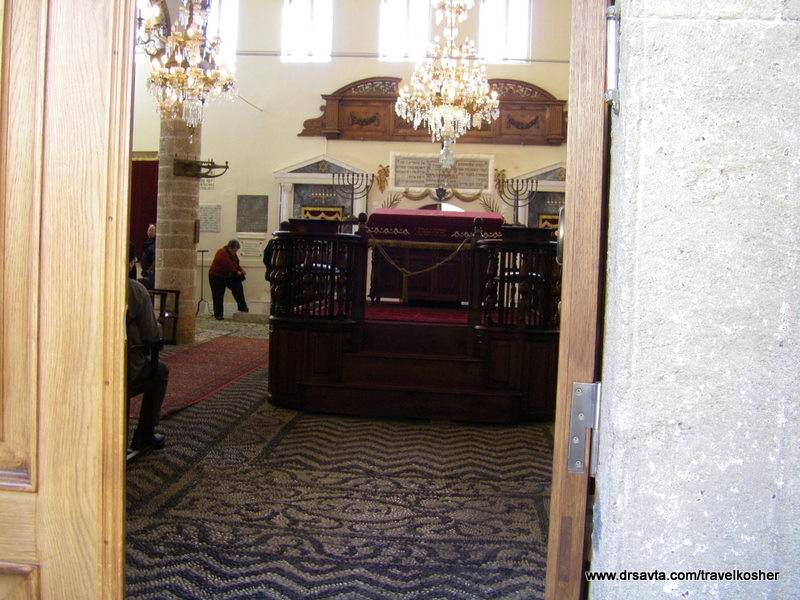
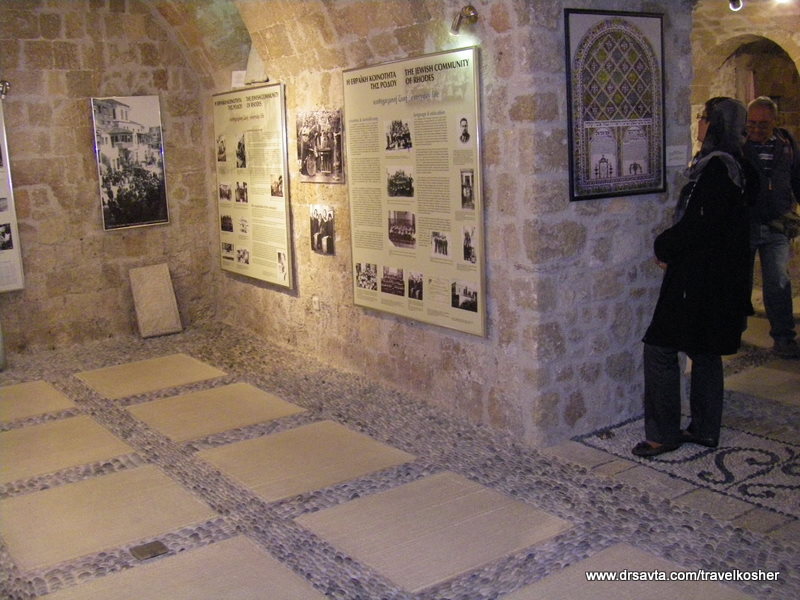
Although we had visited the synagogue before, this visit was very special. The community is very small, number perhaps 30 people. All of the young people have moved away and the community only has a minyan when visitors are present. They have managed, however, to refurbish the synagogue and to convert part of the building complex to an attractive and moving museum of the history of the Jews of Rhodes.
Entrance to the synagogue
The Bima
The twin arks
Inside the museum

The rest of our walk was lovely too.

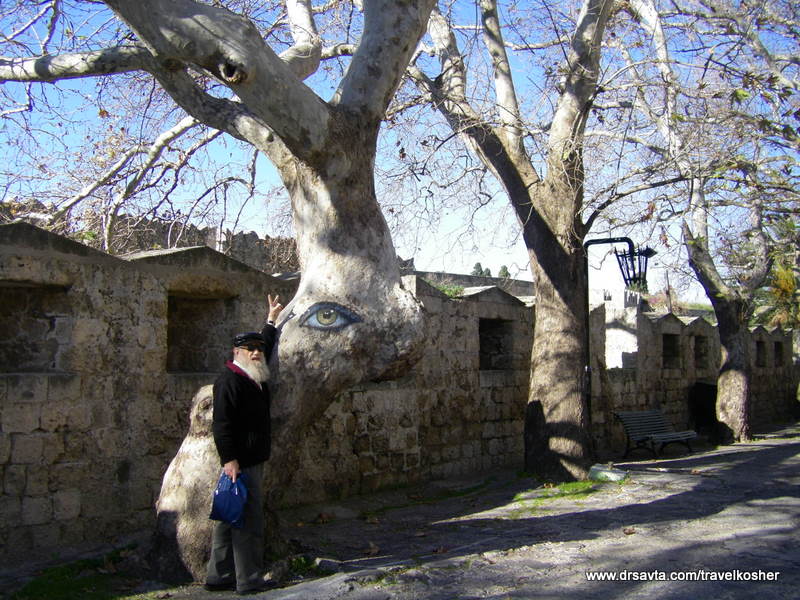
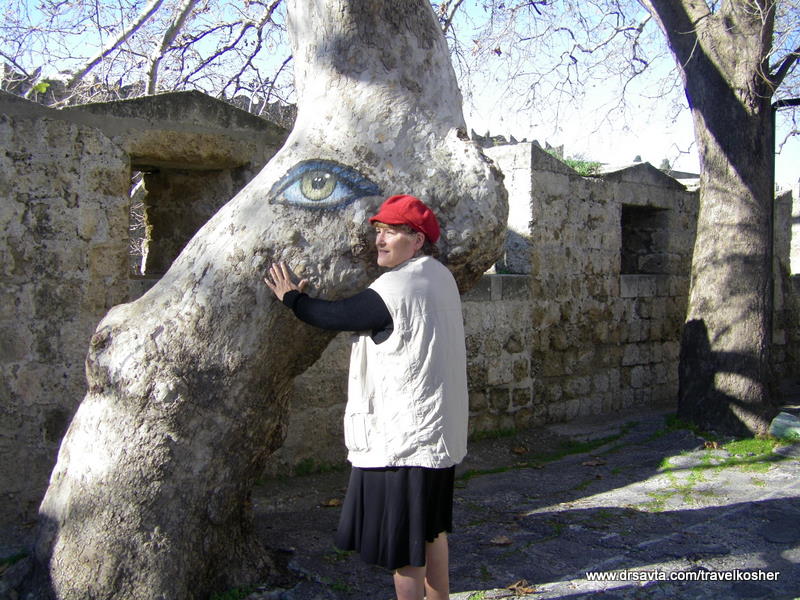
We did come upon a rabbit
The rabbit
or was it a horse?
A horse

And of course, here is a peek at the Grand Masters Palace…
Palace of the Grand Masters

More about the trip and especially an interesting story about the Sifrei Torah from the Rhodes synagogue and how they were saved during World War II… next time…

Where do *you* go?

Many years ago, in faraway lands (the US and Germany), I taught childbirth preparation classes. They consisted of anatomy and physiology and the basics of the birth process and becoming new parents. Most of the time was spent on giving my students techniques for reducing the pain of labor. I was eclectic in my approach and took techniques from several different theories as well as devising some of my own.

One aspect of pain reduction is relaxation and I copied from a book, perhaps Husband Coached Childbirth, an exercise that I read to the couples (yes, I had the husbands relaxing too) while they relaxed on the mats on the floor. It contained images that would help a person focus on another place and experience to distract them from some of the tension in their body.

I am long past the childbirth stage. I have, however, used many of the techniques over the years for uncomfortable medical and dental procedures. Sometimes, I use the images to simply reduce tension. Sometimes I use them just to make me happy.

So here are just some of the places I go– in no particular order:

1. A Chinese garden. Once of my favorites is the “Good Luck” Garden in Hangzhou, China. Not only is it lush and green and with some of the trees decorated with red ribbons, but it contains lovely sculptures and has beautiful Chinese music playing in the background. It’s a first class stress-reliever.

Good Luck Garden

Good Luck Garden

Liu Hai and the Golden Toad

Looking through a doorway

2. Bamboo raft ride on the Martha Brae in Jamaica. Sorry, this was in the days before digital photography! You’ll have to picture nearly still water with trees of all sorts on both banks of the river forming almost a canopy over us and lush vegetation everywhere. Except for the sounds of the birds, and the gentle poling of the gentleman taking us on this ride, there was silence. A fine mist contributed to making the experience magical.

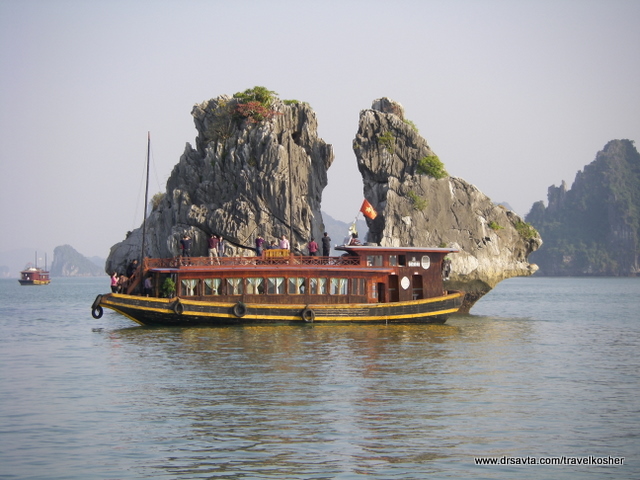
3. Halong Bay in Vietnam. It is beautiful– breathtaking, actually.

Halong Bay, Vietnam

4. The Rice Terraces at YuanYang, China. They are majestic. There’s something very clean and pure about the fresh stalks of rice, planted in rows, sculptured into the landscape.

Rice Terraces

Rice Terraces

5. Austria, just south of Salzburg. It’s just beautiful. I love the snow-capped mountains and this really isn’t a painting. It’s a picture I took myself in the month of May.

So tell me, where do you go??

Li River, China

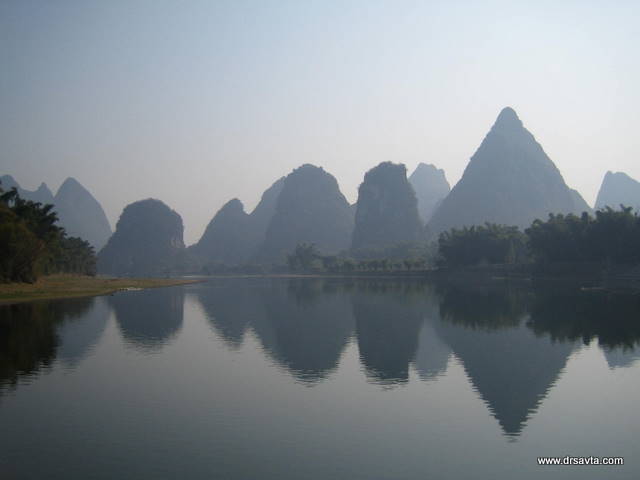
If you are a person who likes art, you probably have seen Chinese landscape paintings that portray very tall, pointed mountains. If you are like me, you probably have thought that it must be a stylized version of the Chinese landscape that the artist was portraying. Well, in fact, the Chinese landscape does have tall, sharp-peaked mountains. They account for some of the world’s most magnificent scenery.

The same Karst process that formed the peaks in Halong Bay, Vietnam, formed the mountains in and around Guilin, China.

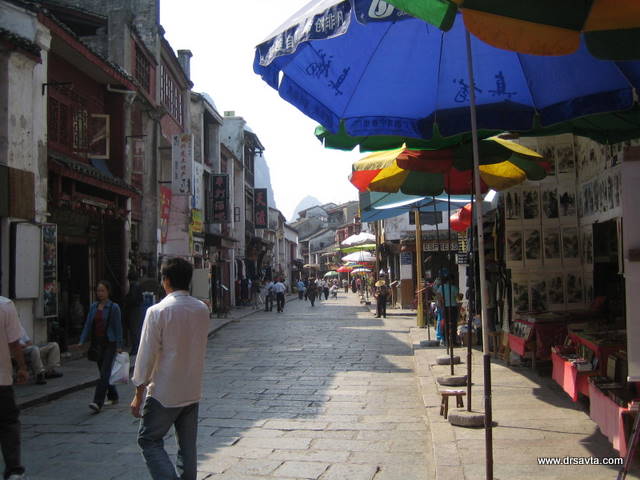
About an hour and a half from Guilin is the small city of YangShuo which also lies amid these magnificent mountains and along the Li River. Some of the best shopping in China can be done in the clean, attractive market at YangShuo that runs perpendicular to the river.

Market in YangShuo

Market in YangShuo

Once on the river, it is almost impossible not to gasp at the beauty of the landscape. Everywhere one looks there are magnificent landscapes.

Li River

Li River


Li River

Li River

While cruising down the Li River, one can see a viewing stand.

Viewing stand

Viewing stand

The viewing stand was built for viewing a production unlike anything I had ever seen before.

The Chinese director, Zhang Yimou known for films such as Raise the Red Lantern and To Live and Curse of the Golden Flower and also for his directing of the opening and closing of the Beijing Olympics, has produced a show on the river. The show is presented each night, often twice a night, and although it is not in a Chinese population center, the seats are always filled. The stand holds about five thousand!

Zhang Yimou, when asked to produce a show immediately decided that the best theater of all was the river itself and the ten mountains that surrounded the small inlet where it is staged. When the mountains were lit at the beginning of the show, it was a breathtaking experience!

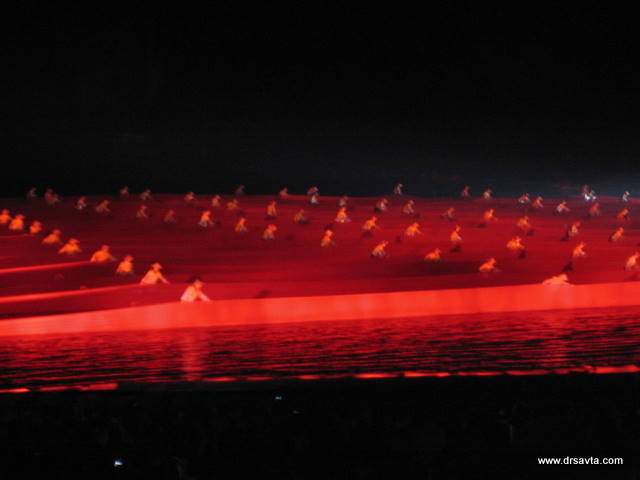
The show depicts the life of the local people in their villages. It shows farming, fishing, and local customs.

Fishermen on the water

Fishermen on the water

The fishermen, on their rafts, move from side to side and raise and lower the red fabric making a beautiful impression.

The women (below), walking on catwalks on the water are wearing dresses that light up. They switch on and off the dresses in amazing patterns.

Women lighting up the night

Women lighting up the night

It all is accompanied by beautiful music. Aside from the magnificent spectacle the show is, the wonderful part is that almost all of the 600 or so performers are local people who had lived a rather impoverished existence and who now earn a significant amount of their livelihood performing in this show. What a wonderful project! And wow! It will take your breath away.

It’s a small, small world

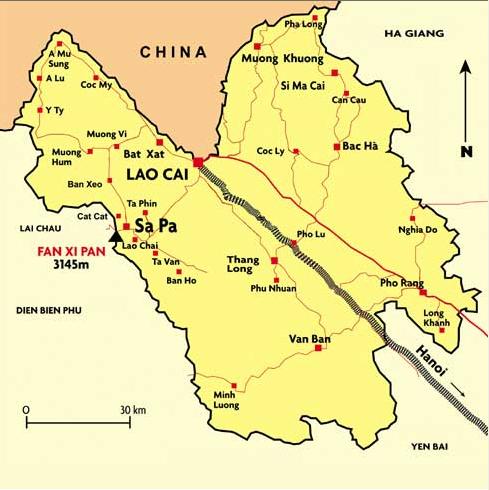
In April of 2009 I published a blog entry about TaVan, Vietnam. The blog entry is located here. You can find TaVan on this map

SaPa map

SaPa map


You can see the railroad tracks that come from Hanoi to Lao Cai, then you can follow the road southwest to SaPa. South of SaPa is the village of TaVan.
In the blog post, I wrote about a young girl who I had met in the village who surprisingly greeted me in Hebrew! Living as far away as she does, in a small village in the mountains of north Vietnam, I imagined that she would always be nameless to me.

Well, last night I received an email from someone in SaPa who gave me her name and email! Looking at the village, one might be surprised that anyone there has email. But actually, it shouldn’t have surprised me because the children of TaVan were very impressive and it was clear that the adults charged with educating them were doing an excellent job.

So hello to Tu and to her classmates and friends and warm wishes to all of them!

Pin It on Pinterest