As easy as yi, er, san

The first day I was in China on my last trip (October 5), I had a couple of things I wanted to do before my people arrived. The first was to purchase a Chinese sim card for my telephone. I had my own cell phone (unlocked and able to receive foreign sim cards) and a loaner (that I placed my Israeli sim into). That way I would have one Israeli phone and one Chinese phone to cover pretty much any situation.

On previous trips, attractive young ladies had been set up at counters at the airport to sell sim cards as people arrived. This time, there were none. I assumed it was because I arrived at 4 a.m.

So, after getting into my room, showering and changing my clothes, and checking my email, I went to the desk and asked where I could buy a sim card. I had noticed that there was a Carrefour department store adjacent to the hotel. I asked if they had them. I was told that the sim card policy in China has changed and that now there is much more regulation on them and therefore one can only purchase one at a store licensed to sell them and after filling out many forms. Fortunately, there was a China Telecom shop only a couple of blocks away.

It was a bright sunny day and everything felt wonderful. There were beautiful people, tall majestic trees with rustling leaves, and colorful shops. As I walked, I almost felt like singing. I love visiting China so much. It was like coming home to an old friend.

When finally I arrived at the telephone store I am not sure who was more perplexed– the salesgirl or me. You see, this store was not in a tourist area. It was frequented by Chinese people who unlike me, speak Chinese. How was I going to accomplish this?

I held up my phone and said “sim” hoping the word was an international one. I opened it up and showed her that one was missing. I could see a flicker of recognition. She called someone on the telephone, I assume to check how she should proceed. The person spoke to me in English. I said I wanted a sim card. I handed the phone back to the sales person. She tried to warn me, I assume because she might have assumed my phone was locked, but I pointed to it and said “OK.” “Hao, Hao.” (Hao is one of the words I know in Chinese. It means “good,”) So far, so good. She took me to another sales person, seated behind a desk. I sat down.

The new lady handed me an envelope on which were written four 8 or 9 digit numbers. She pointed to them. I remembered that in China people are very interested in the significance of numbers and they actually choose the license numbers of their cars– bidding high to get the most fortuitous ones, as for example, the number 8 being a fortuitous number, therefore, when appearing in a license, commanding a higher payment than the unlucky number 4. I chose one of the numbers at random. It was to be my telephone number.

At some point, the woman behind the desk called an English speaking colleague and after that she would hand me the telephone whenever she had a question. They asked for identification and so I handed them my passport. I had to show them which letters spelled out my name and where my birth date was. It was strange, having to stop every few seconds for questions to be asked in Chinese of the person on the phone and then the voice on the other end of the line asking them of me in English. All of us laughed at the awkwardness of the situation.

They filled out many different forms and then finally asked for a local address. Of course my local address was the hotel where I was staying as of that morning. In my jet lagged fatigue, I had forgotten the name of the hotel, but I did have the plastic card that was the room key with me. It was in a folder given to me by the hotel and had all of the relevant information.

And then, after a payment of about $20, I left with many smiles, many giggles, and my Chinese telephone.

Now wasn’t that simple? As easy as yi, er, san!*

*One, two, three

What happened next

So there we were, 6 a.m. taking off from Beijing. It’s always sad to leave China. If you haven’t been there, you have no idea of why. If you have been there, you are probably nodding your head and thinking about when you can return. China is a beautiful country filled with friendly, beautiful people. Chinese people work hard, but with a smile on their face, and greet tourists with smiles and friendship.

For example, while walking through my favorite market, one of the salespeople said to me, “I remember you!” I said, “You do? From when?” and she answered, “From now and from here.” We both smiled.

But I digress…

We were leaving China on an Aerosvit flight via Kiev, Ukraine. We had gotten to the ticket counter early, and so we were able to get bulkhead seats with lots of leg room. The flight, although 9 hours long with no films or other entertainment, was pleasant. People were quiet and I was able to sleep for a good period of time.

It still was good to land in Kiev, despite the fact that there was no time to leave the airport.

Landing in Kiev

Landing in Kiev

After proceeding through security, we were among the first to get our boarding passes for the follow-on flight to Tel Aviv. That meant that once again, we were able to get seats with decent leg room which was nice.

We had about 3 hours to wait for our next flight. The airport waiting hall is one huge room with poor acoustics and hard chairs. There were large numbers of people and since I had my suitcase and my back pack, I decided not to wander into any of the shops. I just sat and tried to read and listen to my iPod.

However, at a certain point, I started to hear the crying of a little girl. She was about 5 years old and very very cute. Her distress was over the fact that her parents would not buy her a stuffed toy dog. She was crying incessantly. Her parents came and sat down a seat or two away from me. The little girl continued crying insisting that her parents buy her the stuffed toy dog. Finally, her father began to reason with her. He said, “Look, here in your back pack are the 7 new stuffed dogs that we bought you.” He took them out one by one. Yes, there were 7 brand new, tags still affixed, stuffed toy dogs. This did not placate her. She still needed the one she had seen in the store. Her father said, “I promise you I will buy you another dog when we get back to New York.” I just listened.

The father took the girl for a walk. She thought he was going to get her another dog. I wondered whether I should talk to the mom.

She was a very pretty young woman. She was tall and slender and well dressed. I began to speak with her. She was Ukrainian and married to an American, living in New York. They had come, for the first time in three years, to visit her parents. They had visited for three weeks. Since the mother had always spoken to her daughter in Ukrainian, the child was fully able to communicate with her grandparents. They were thrilled to see her and there was nothing she wanted that they did not give her. Now, the child was leaving Ukraine, not sure when she would see her grandparents again. The mother explained that usually her daughter was easier to deal with, but they were at a loss as to what to do now.

I told her that I was a marriage and family therapist and that I understood that at times of transition, people don’t act the way they normally do and that helping their daughter to deal with leaving her grandparents and returning to her old life was a good thing to do. The mother knew that the additional stuffed dog was not going to make the child happy, but she didn’t know what to do to get her out of her ongoing demands for it.

When the father and child returned, I tried to think of something that I had that would interest the child. Fortunately, in my magic vest (the one I wear when I am traveling) I had a small laser pointer. I showed the child how to push the button to make a red dot on the floor. She was fascinated. She made the red dot travel the floor. Then it landed on her mother’s shoes. Mother played along, trying to brush it off her shoes. Then it landed on her father’s shoes. He tried to shake it off. Then it landed on my shoes, Crocs, a perfect target. With all of the holes in the top, she was able to aim the red dot at each of the holes and skip from one to the other. Soon she was giggling and happy and starting to examine her father’s throat.

While this was going on, the mother asked me what to do about a child who is stubborn. I told her that stubbornness is what enables people to study hard, work hard, and achieve. I told her she was lucky to have a child who knows what she wants and works hard to pursue it.

Soon they called my flight. I asked the child for my pointer. Unprompted, she handed it to me with a smile and said, “Thank you.”

And then I headed in the direction of home.

Home

Home

The End

Usually I like to talk about a trip starting at the beginning, but this last trip clearly had the most dramatic end (at least in the way that I experienced it…)

Our tour consisted mostly of people who flew to China from the US. Only one other person flew from Israel and we traveled together. On the night we left China, a driver from our local tour company came to the lobby of the hotel to pick us up at 3 a.m. It worried me a bit that when I came downstairs, he was sleeping. I had hoped that he would be sufficiently awake to transport us safely. However, he woke up as soon as I got within about 6 feet of him, so maybe he really wasn’t asleep, but just resting his eyes.*

Aside from the take-off motion he made with his hands when he saw me and my nod in the affirmative, we did not really communicate (his English was not as good as my Chinese– and I know fewer than 15 words).

The other traveler joined me and we went out to the car while the driver piled our luggage into the car. He got into the car and started driving toward the airport.

Our local guide, whose English was very good, had told me that we were leaving from another terminal, not the main one which was recently opened and is very beautiful, but I didn’t remember the number he told me. When we got to the terminal, it was not at all reassuring that the building was dimly lit and the sign outside it said “Domestic departures.”

I was traveling with a large suitcase (in the trunk of the car), a small carry on (on the front seat of the car) and my backpack (that contained, among other essentials, my notebook computer.)

When we got to the terminal, I said to the other traveler, “I’m not sure we’re at the right place and I don’t want to be stranded at 3:30 a.m. in a place where no one speaks English. Please wait with the driver and I will go in and see if we are in the right place.” It took me a few minutes to ascertain that we were in the right place. I walked back out to the car. Meanwhile, the driver had called our local guide and was reassured that we were in the right place and the driver and the other traveler had gotten our bags out of the car. I tipped the driver and he left.

And then, about 3 seconds later, I realized that my backpack was not on me and not with the suitcases and that the driver had left with it. I could still see the lights of the car leaving the airport.

I was certain that there was no chance I could get the backpack back. Oh no. It was gone. Forever.

But then I remembered that our guide had given me the driver’s telephone number and I even remembered where I had written it down. With my Chinese cell phone I called the number. He answered, in Chinese, of course. I said, “I left a bag.” He answered. I, of course, had no idea what he was saying, but it sounded like he didn’t understand. “My bag is with you.” Still, no sense that he had understood. “Bag in car!” Still nothing. “Come back!” Finally, it seemed as if he understood, because he seemed to had an “aha” response and then hung up. But I was not certain. I called our local guide and apologized for waking him a second time. He was very kind and said he would call the driver.

We waited. And waited. Like most modern airports, it can take several minutes to return to the drop off point at the Beijing airport as a network of roads swirls around the airport. We saw one car after another approach. Then, finally, there was the car that had brought us.

The driver stopped the car. He brought me my backpack and apologized for leaving with it. Of course, I was feeling guilty for not checking before he left, so I gave him a second tip and off we went to check in at Aerosvit for our journey home (via Kiev.)

The end.

(OK– except for my adventures in the airport in Kiev)

*My father didn’t suffer from jet lag. When we would find him sleeping, he insisted he was just resting his eyes.

China, October 2010

The words will come later. Right now, enjoy the sights with me.

Note: This was NOT produced by my daughter who does this professionally and could have done a great job. This is my first attempt to make a movie.

“>

1000 words about why I love to travel

Well, only in the metaphoric sense, that is.

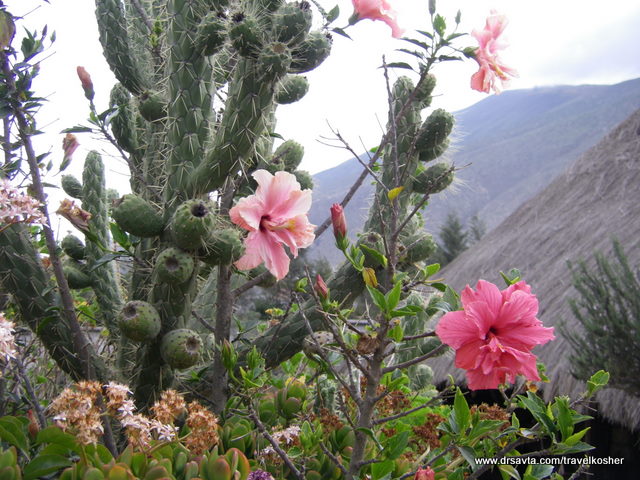
I love to travel for many many reasons. I love seeing new people and places. I love learning about other cultures and countries. I enjoy learning their history and seeing their customs and their handicrafts. I love learning their legends and folktales. Perhaps, most of all, I enjoy the magnificent sights I see. And so, here in a picture is a thousand words about why I love to travel.

Beauty at the middle of the world

Beauty at the middle of the world

The Jews of Quito

One of the joys of visiting and revisiting places is that I get to see the same people time after time. I will be talking about the people I met in Quito, but to preserve their privacy, I won’t identify any of them.

The Quito Jewish Community has two major elements:

1. The large indigenous community that has a beautiful community center and a synagogue and lovely grounds. People in the community are of European origin, most of their families arriving before or during the Second World War. They number around 500 and have a community school of high academic quality that has a non-Jewish majority and afternoon religious school for other children in the Jewish community. The community is a Conservative community and so people who live throughout the Quito area can belong and attend services there. We were lucky enough to visit their complex and to see their synagogue.

After entering the complex, one sees two buildings with a patio area between them. To the left is the huge auditorium/banquet hall, said to the be second largest banquet hall in Quito. On the lower floor is a room that we used for lunch. It was also large and because the building was built on the side of a hill, it had large windows and an outdoor area as well. Further to the left outside is the swimming pool.

On the right is the synagogue building itself. Although the congregation president did speak with us about the community, we were not able to take a full tour of the facilities since we still had a lot to do and wanted to get back to the hotel well before shabbat so that people would have time to prepare.

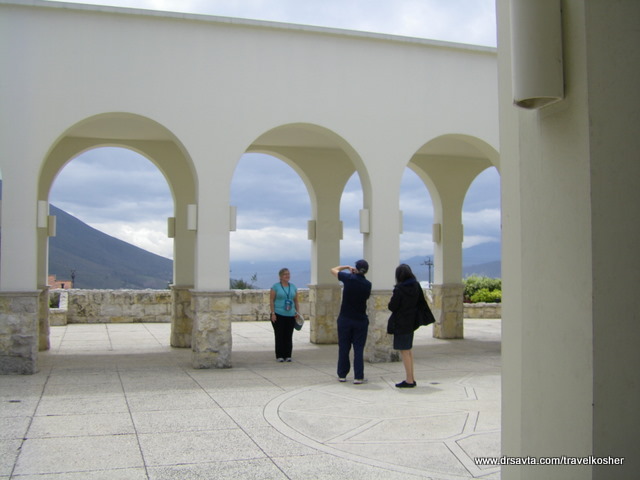
The synagogue grounds

The synagogue grounds


The doors and entrance hall

The doors and entrance hall


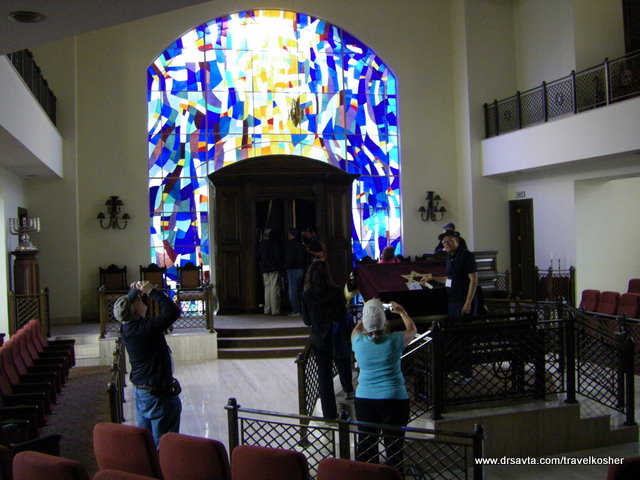
The synagogue interior

The synagogue interior


Synagogue under attack by camera-wielding tourists

Synagogue under attack by camera-wielding tourists


The inside of the domed roof

The inside of the domed roof


2. The Israeli/Orthodox element
The first two times I visited Quito, I became acquainted with these people. They are almost all ex-patriots living in Quito for various reasons. Although it is possible to acquire many kosher products in Quito, the lack of the thriving Orthodox community means that they need to rely on each other to be neighbors, friends, and family. They do not have a synagogue and so they lean on each other when they need strength. Watching them interacting with each other is something special. They have become a family, accepting of each other, caring, and warm. They enjoy seeing and playing with each other’s children. When they came to spend shabbat with us, the visiting Israelis/ Australians/ Americans they were open and friendly and simply nice people. They joined in our tfilot (prayers), zmirot (songs), and divrei torah (homilies.) By now, returning to Quito is a bit like visiting family.

Steak for dinner or no dinner at all?

On my recent tour of Ecuador and Peru, our travelers had requested to see a bullfight. Traditional bullfights being rather bloody and gory and altogether inappropriate for a religious group, we chose instead to go to a bloodless bullfight.

We went to a beautiful hacienda not far from Otavalo, Ecuador, and had lunch there, prepared by our own chef, Boaz under the supervision of our mashgiach, Eyal. Lunch was delicious.

After lunch we were invited to the bull ring. We were told that this is a place where aspiring bullfighters are trained and the bull itself is being trained for bullfighting. The bull was kind of small and didn’t have much desire to perform, but he was persuaded by waves of the cape and the footwork of the matador.

After a demonstration, volunteers were solicited. To my dismay, our chef and our mashgiach both volunteered to fight the bull. Someone rightly called out, “anyone but the chef, please!” The chef was a pleasant young man who produced fantastic meals in the most unlikely places. The mashgiach was a delightful young man whose wife is soon expecting their first baby. Neither one was expendable.

But fight they did. Here’s how it started:

And here’s how it ended:

As we say in Hebrew, Kol HaKavod! Way to go, guys!

Who was that masked man?

At about 8:00 p.m. Monday, I left my home for the airport for the trek to South America. I met my colleague who also will be working on the tour with me. After an easy check-in, we boarded the plane close to on time and settled into our seats. The configuration of the plane was 3/3/3. She and I had the two aisle seats on one row in the center section. For a long time it appeared that the middle seat might remain unoccupied. The only tell-tale clue was someone who had walked past us and when asked by the flight attendant where his seat was, he replied, “it’s the jump seat.” Yes, the plane was that packed, and so in a while we greeted the person who was to sit between us on this 15 hour trip.

He was a young man who had come to Israel as a tourist and to visit friends. He is an English teacher in Sao Paulo, and his English was pretty good. Of course, over the duration of the flight, we had some time to talk. When he heard that we had some hours in Sao Paulo, he wrote down for me information about where we should go and how to get there and back.

When finally we reached Sao Paulo and ascertained that our luggage had been checked through, he said that perhaps instead of taking the bus that he had originally recommended, we join him in his taxi that he had ordered. He said that they would be passing through the center of the city and it was not a problem to drop us off.

Of course we agreed. He told us that this taxi driver was wonderful, very reliable- and that’s why he had him pick him up at the airport. As we rode, our friend told us about Sao Paulo—what a huge city it is! He also told us a lot about the Jewish community which has 5 non-ultra-Orthodox day schools! He didn’t know how many ultra-Orthodox day schools there are. One school, established by Safra for his sister’s children, hires teachers who will teach in English so the children become fluent in English and are able to study abroad. Of course the children also learn Hebrew.

He and the taxi driver (who spoke no English) talked about our taking a bus back to the airport and about where we might find the bus. Then the taxi driver suggested that he transport us back to the airport for less than we would have to pay for a bus. Naturally, we agreed. After all, our friend had told us that the driver was reliable.

As we neared the center of the city, the taxi driver suggested that he keep our carry on bags for us. The truth was that our carry on bags were pretty heavy and we knew that it would make things easier for us. He told us that he would not be transporting anyone with luggage and that our bags would be safe.

We had his business card and we had the recommendation; it sounded good. As we left the taxi, we agreed to meet at the same location at 3 p.m. As we left, the driver gave us an umbrella to use since it was drizzling.

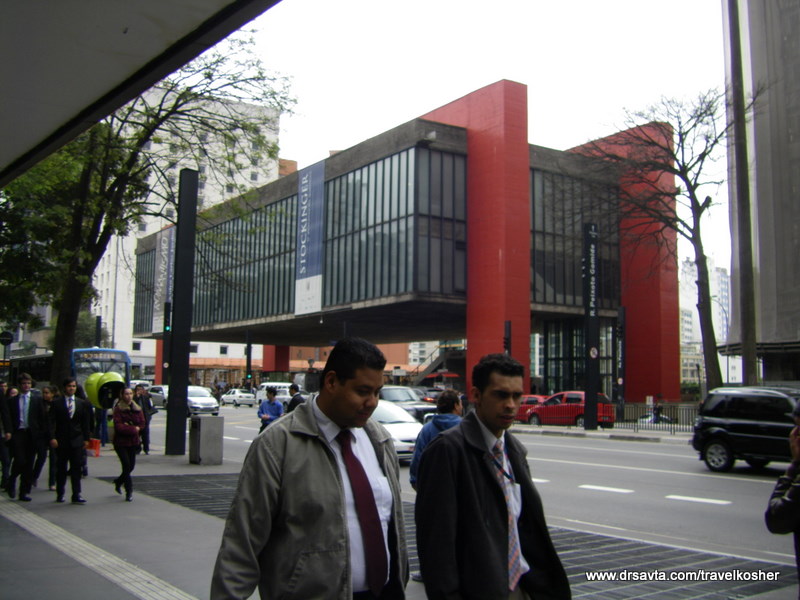
We walked through the park and then saw across the street an amazing building that our friend recommended we visit. It was the Museum of Contemporary Art. Museum of Art, Sao Paulo There was a long line of people waiting to get in. I went to ask how much a ticket was. It turned out that today, entrance to the museum was free.

The exhibit was wonderful. There were both European and South American artists represented and the exhibit was well narrated in English as well as Spanish. There was even a wonderful exhibit and video on the restoration of one of the pieces that was exhibited.

After our museum visit, we just walked and looked at the city. Close to 3 o’clock the two of us started to think about what we had done—leaving our carry-on bags (each containing our notebook computers and all of the information relevant to our tour) in the taxi of a person we didn’t know. Yes, we had his card and I had taken a photo of his license plate (because I wanted a photo of a Brazilian license plate), but how much good would that do us if we wanted to be on a plane in 2 hours…

We waited from about 10 minutes to the hour. We watched taxi after taxi pass. We began to doubt ourselves and then, on the dot of 3 o’clock, the driver pulled up to the curb and took us to the airport. He charged exactly what he said he would charge and our carry-ons were completely intact.

It was perfect.

Our only question… we never got the name of our benefactor from the plane. Who was that masked man?

A digression about Peru

I have been extremely busy for the last 3 weeks, having just returned from South America. Now, 2 surgeries (one mine, one my grandson’s), two sets of guests at my home, one major surprise birthday party (my husband’s) and 9 days of mourning ending on Tisha B’av– later, I am about to leave for my next tour to the same area. So, instead of continuing with the saga, I want to tell you about something that happened during my most recent tour.

Our group was an amazing collection of people. Most were Australians with some Anglo-Israelis, some Americans, and others. They were intelligent and fun-loving and they behaved like one big happy family. Traveling with them was delightful.

One day we went to a town in Peru called Pisac. It is located in the Sacred Valley and it has Incan ruins and a beautiful market. While there, one of the ladies saw a skirt that one of the local ladies was wearing and she really wanted to buy one like it. I assume that she looked for it in the market, but she obviously didn’t find it.

She finally asked our Peruvian guide to help her buy it from the woman who was wearing it. Peruvian women wear straight skirts under their brightly colored, embroidered outer dirndl skirts, so when they reached an agreeable price, the Peruvian woman removed her skirt and gave it to our traveler. When she got on the bus and told us that she had successfully purchased the skirt, everyone laughed and also applauded. Then someone said, “Well, that’s great, but what is she going to say when she gets home and her husband wants to know what happened to her skirt.” Our traveler said, “That’s not a problem; after I bought her skirt, he offered to sell me his pants!”

Women in market at Pisac

Women in market at Pisac

Note the beautiful skirt. Note also that one Peruvian woman was carrying her pet llama and the other has a child who is carrying one. The people posing with the Peruvian women were members of our group, but not the proud owners of a Peruvian skirt.

Galapagos Islands, Part 12 of the Ecuador, Galapagos, Peru Tour

The islands are alive. One feels there like a visitor and often like an interloper. On Espanola Island, we encountered a greeting party. Of course we saw the sea lions who as always were playful and fun. They always are either playing or lazing around in the sun. Maybe that’s why I find them so amusing. They live a life most humans would envy. These guys were taking it easy.

Seal lions on a break

Sea lions on a break

We also were greeted by marine iguanas

Marine iguanas

Marine iguanas

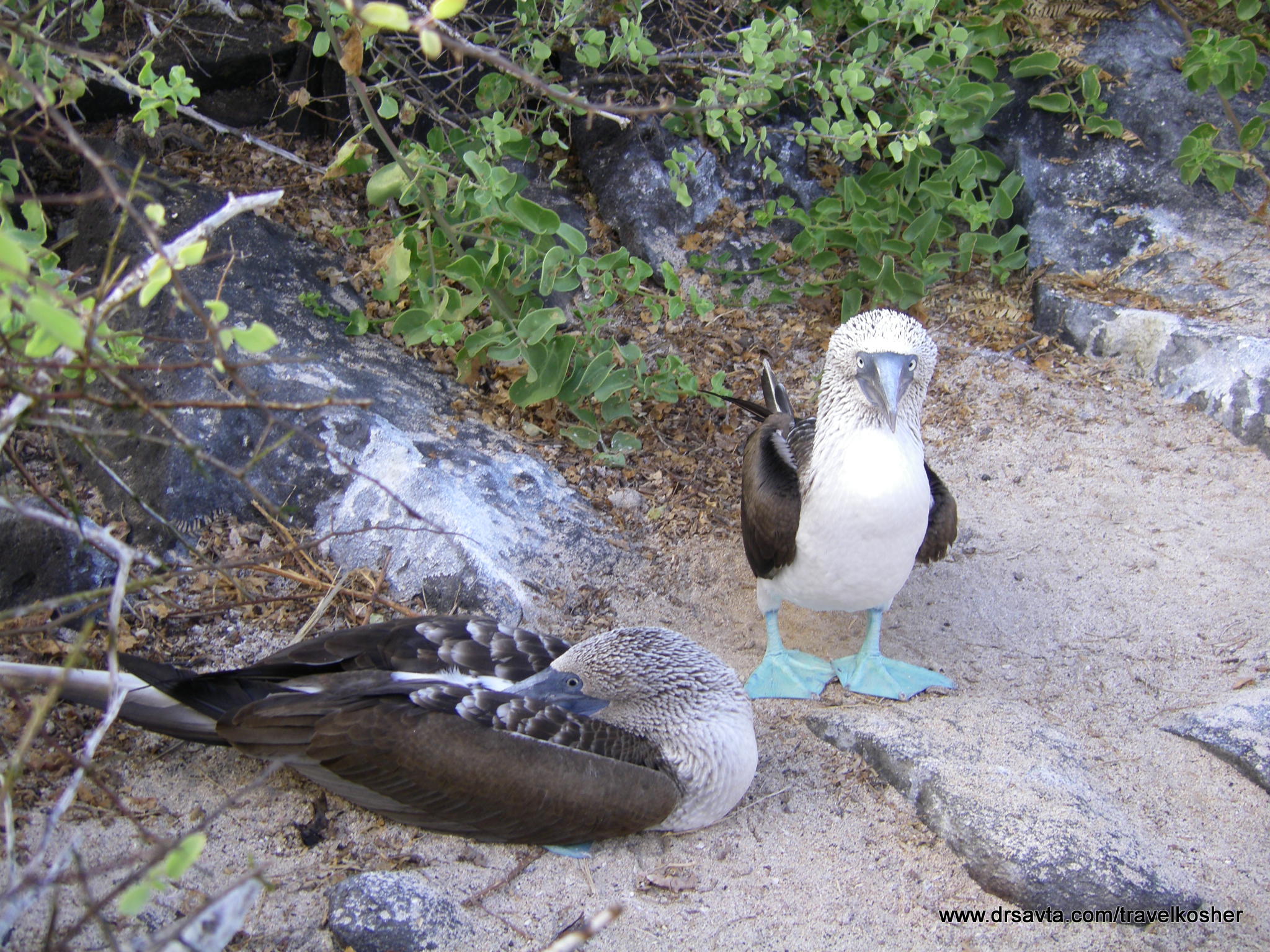
But most surprising was the blue footed booby welcoming committee. About every 10 feet, there was a couple of blue footed boobies standing along the trail. It was as if someone had placed them at their posts. Here they are:

Blue footed booby welcoming committee

Blue footed booby welcoming committee

Another couple

Another couple

And another

And another

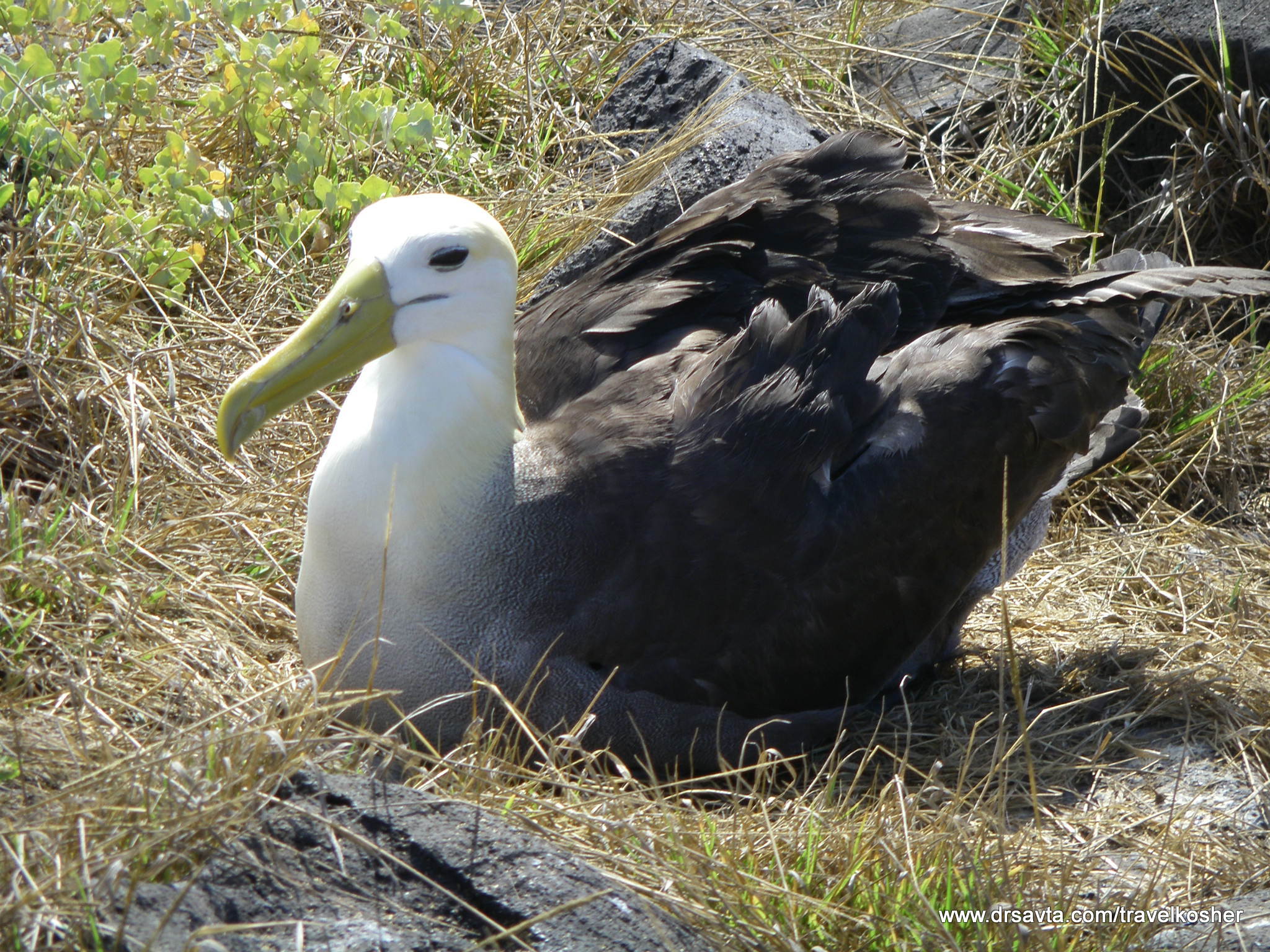
The big treat, though, was to see the albatrosses. In June, they were everywhere. In January, there had been only one or two sighted. So here is one, up close and personal:

An Albatross

An Albatross

Even closer

Even closer

Of course, once again we saw the Nazca boobies, really beautiful white birds.

Nazca boobies

Nazca boobies

Unfortunately, our visit to the Galapagos had to come to an end, but next is a glimpse at Lima, Peru!

Pin It on Pinterest