Home again

My recent inactivity on the computer is inversely related to my frenetic activity traveling. In the next day or two I will begin telling you of some of my adventures in Vietnam and Cambodia, but in the meantime, I will share one picture I took.
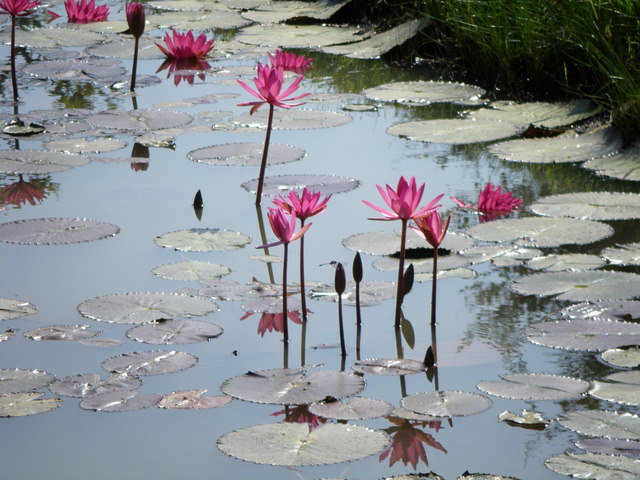
Outside of Banteay Srei Temple, Cambodia
Outside of Banteay Srei Temple, Cambodia
Where in the world is Rona Michelson?

Well, at the moment (9:18 p.m. Israel time November 15, 2009), I am in my home in the beautiful new city of Modi’in- about a half hour from Tel Aviv and a half hour from Jerusalem.

But on Tuesday the 17th, I leave and on Thursday the 19th I will be here:

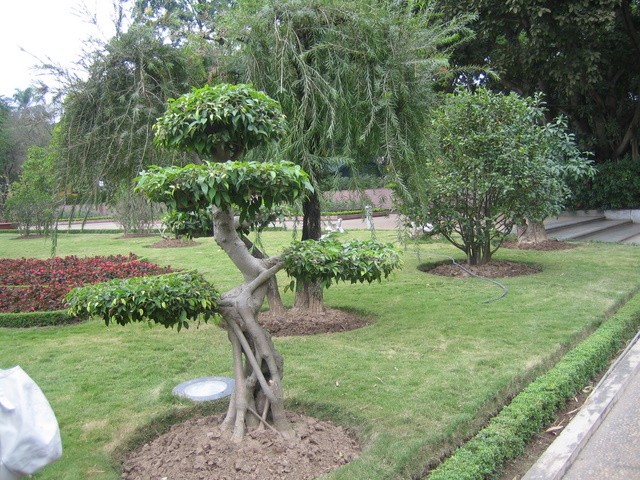
Manicured garden

Manicured garden

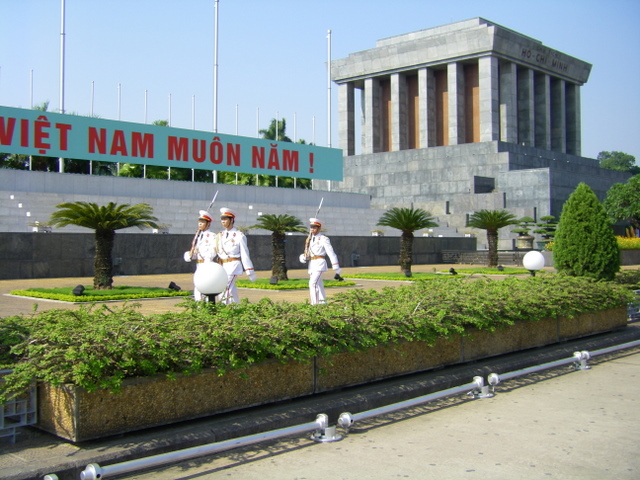
Seeing these people:

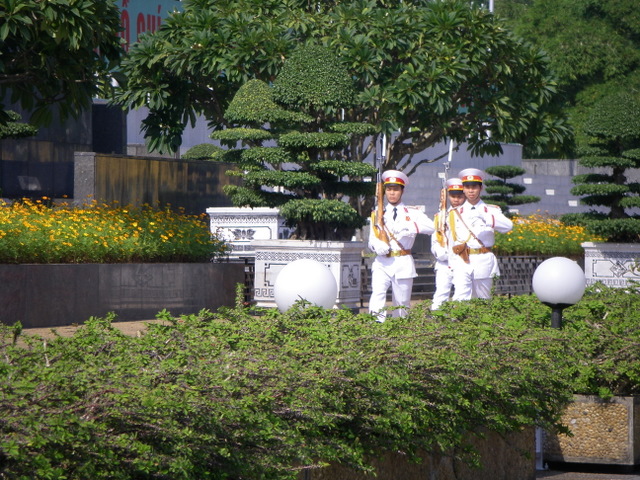
Honor Guards

Honor Guards

Guarding this:

Can you guess where I am?

I’ll be back in about 3 weeks to tell you all about it.

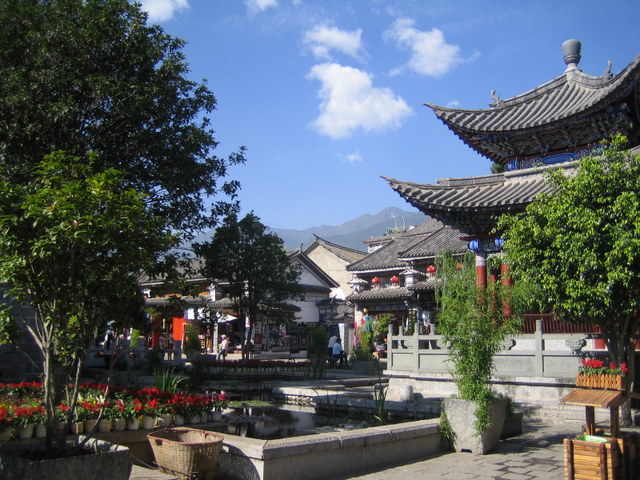
Dali, Yunnan Province, China

Many of the books I read that deal with China emphasize how polluted the air is– that the skies are not blue. Actually, that has not been my experience. The most maligned city in China, Beijing, has, during the 6 times I have visited, had two or three smoggy days, but aside from them, the skies have been clear and blue.

However, everyone agrees that the western part of China, Yunnan Province, has beautiful crystal clear skies and is a most magnificent place to visit.

One exquisite city in Yunnan is Dali, home to two of China’s ethnic minorities, the Yi and the Bai. Bai means white and their native dress is beautifully embroidered white clothing which both the men and women wear. Dali is surrounded by mountains and is the recipient of the vast water flow that comes from the mountains. Freshly flowing water streams through conduits in the streets and between the water, the mountains, the blue sky and the meticulous cleanliness of the city, one can’t help thinking that this is one of the most idyllic places on earth.

A street in the walking area of downtown Dali

A street in the walking area of downtown Dali

Everywhere one looks there is something beautiful to see– or at least something interesting.

A town square, Dali

A town square, Dali

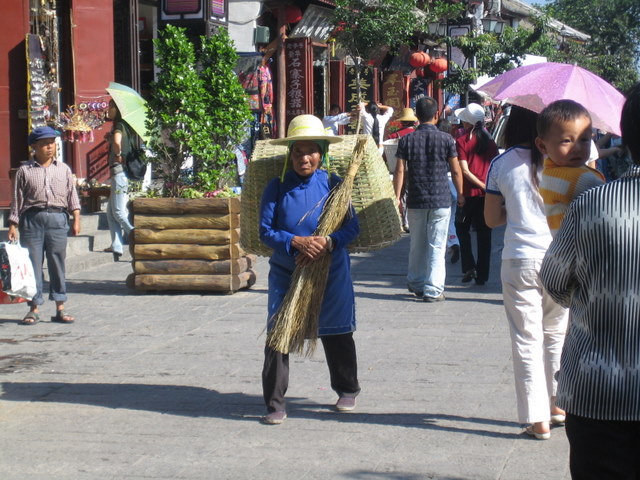
One of the things one notices when in the far east is how hard the women work. While women in the US were asking for the right to go out and work, women in the far east were doing more than their share in planting, harvesting, and even carrying heavy loads. With small families, older people work to support themselves as long as they can.

Street scene, Dali

Street scene, Dali

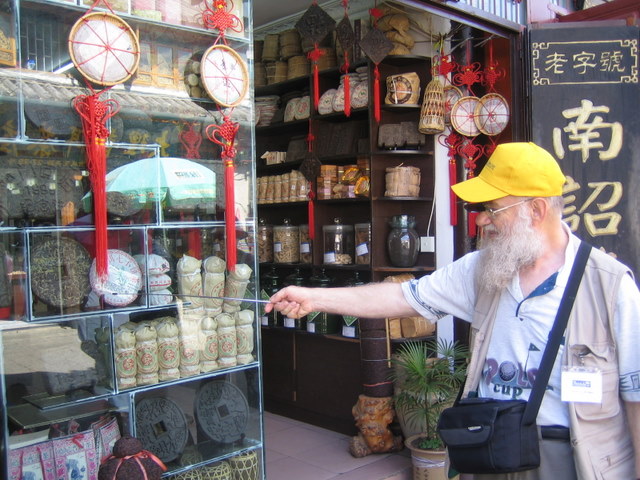
Remember that expression “for all the tea in China?” Well, that is not a small quantity. All over China tea is sold– in tins and packed into different shapes. It’s quite a culture there. No tea bags. And the teas all have special healing qualities. It’s not unusual to see a tea store such as this.

Teas in China

Teas in China

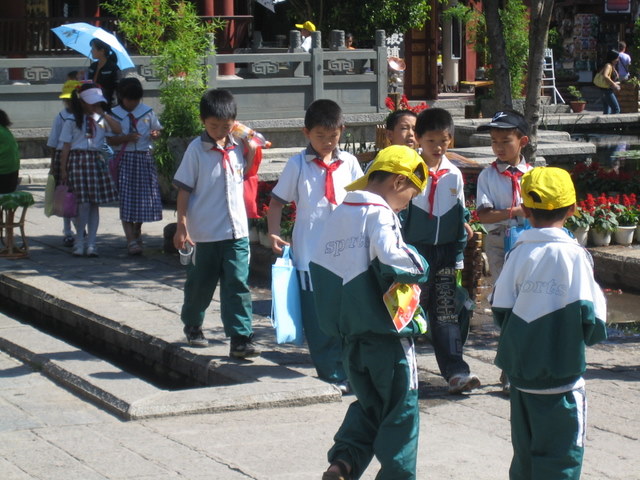
One of the very special treats of a trip to China is seeing the children. I don’t know if it is objectively true, but I think that every one of them is beautiful. Most of them are from single child families and are doted upon and it shows. The seem self confident and mature This day I caught some children returning from school. They were walking through the market, laughing and joking good naturedly. Notice how lovely they look in their school uniforms.

The boys

The boys

and the girls

and the girls

rubytuesday

Kunming, China

While most people can name a couple of cities they know in China– usually Beijing, Shanghai, Nanking, and Harbin, China has hundreds of large cities that most people in the West have never heard of. One such city is Kunming. With a population of approximately 6.2 million, it is a substantial city with a great deal of industry and some major significance. It is the capital of Yunnan Province and is the gateway to come of the most picturesque places in China. It has a population of about 20% ethnic minorities. China has 55 ethnic minority groups. Some of them have a large number of smaller groups within them, some of which feel that they have been miscategorized. In all, these groups make for a fascinating and colorful experience as they have their own dress, customs, languages, religions, and histories as well as a claim on specific areas of land.

Kunming is called the “Spring City” or the “City of Eternal Spring” because of its wonderful mild weather. Foreign students flock here to study Chinese language and traditional Chinese medicine.

Here is a view of part of the city center.

Gate, City Center, Kunming, China

Gate, City Center, Kunming, China

Although most Chinese people are not devoutly religious, they do have beliefs in higher powers and many think of themselves as Buddhist or Taoist. Many also have adopted the Confucian philosophy. Many Chinese see no contradiction among these three and are adherents to all three. Here is a very beautiful Buddhist Temple. It differs from most because one actually enters and then descends toward the main complex. The picture was taken looking back toward the entrance gate.

Gate,  Yuantong Temple, Kunming, China

Gate, Yuantong Temple, Kunming, China

The temple was built late in the 8th century, but, of course, preserved through the years. Here is some detail of one of the buildings as it was being refurbished recently. It is made of wood with lacquered paint to decorate it. All of the painting is hand done.

Detail of building in Yuantong Temple, Kunming, China

Detail of building in Yuantong Temple, Kunming, China

What could be more relaxing after a day of looking at all of this beauty than sitting with a cup of tea. We were treated to both the tea and an explanation of the significance of this particular type, Puer tea, which is formed into large wheels of tea (about the size of a frisbee) and sold to parents when their daughter is a baby and preserved until she is betrothed as a gift for her husband. Puer tea can heal just about everything and we were told that if we were to have a steady diet of it, our skin would look as young as that of this lovely lady who served us tea in her ethnic dress.

Tea tasting, Kunming, China

Tea tasting, Kunming, China

rubytuesday

Hoi An, Vietnam

One of the loveliest places we visit in Vietnam is Hoi An. Hoi An is a UNESCO World Heritage Site. From the 16th to the 19th century, Hoi An was a major port for international trade. About 45 minutes’ drive from DaNang, Hoi An today is a great destination because although it is tourist friendly, it is not overrun with tourists and the city retains its natural charm.

Because of trade ties, a large number of Chinese and Japanese people settled in Hoi An and there are remnants of both. One of the attractions in town is the Japanese bridge which is a covered bridge guarded on one side by a statue of a dog and on the other by a statue of a monkey. On the bridge itself, there is a side room that was used for prayer!

A view from the Japanese bridge, Hoi An

A view from the Japanese bridge, Hoi An

There are beautiful Chinese assembly halls in the city. This one, Quang Dong, has elaborate mosaic covered sculptures. This is the entrance gate.

Entrance gate, Chinese temple, Hoi An, Vietnam

Entrance gate, Chinese temple, Hoi An, Vietnam

Like China, Vietnam has had a silk trade for many years. Hoi An is famous for its hand tailored, custom made silk dresses and suits. After several days in Vietnam, one comes to regard the Ao Dai, the traditional Vietnamese dress, as very beautiful and graceful as well as modest. They can be made to order from a large variety of colors and patterns. Amazingly, one can be fitted in the evening and have a dress ready to wear by morning.

Hoi An is also noteworthy because of the beautiful silk lanterns that are made and sold there. Each lunar month, on the 14th night of the month, the night before the full moon, the lights in the downtown area are switched off and the town is lit by only silk lanterns. Of course, silk lanterns/lampshades are available for purchase as well. Here are some.

Silk lanterns for sale in Hoi An, Vietnam

Silk lanterns for sale in Hoi An, Vietnam

Come see Hoi An with me!
rubytuesday

Moscow, Russia – Red Square
When I think of the color red, one of the travel destinations I think of first is Red Square. Russia, for many years a place that was off limits to travel for fear of the anti-Western political regime that held sway over its people, finally is accessible and turns out to be a very interesting place to visit.

If there were one word I would use to describe Moscow, it would opulent. Never have I seen as much gold as I saw there- and it was everywhere, most notably on the onion-domed churches which dot the landscape.

But today, we are going to Red Square. Here is what one sees walking toward the entrance:

Approaching Red Square

Everything is on a grand scale. No expense has been spared.

Entrance, between the two towers

The actual entrance to Red Square is through the arches under those two towers. Military equipment and large numbers of troops would file through those arches for shows of military might on May Day. Inside Red Square, there is a very very large area that is open for assembly and military exhibitions and there is also a building that houses Lenin’s tomb. People line up and file through the mausoleum to view Lenin.

At the opposite end of the square is the incredibly magnificent St. Basil’s Church. Here it is from afar.

St. Basil's, Red Square, Russia

The church was commissioned by Ivan the Terrible in the 16th century and presumably, after completion, he had the architect blinded so that he could never create anything more beautiful. I am not certain that beautiful would be the word I would use to describe it, but it certainly is noteworthy and unique.

Here is a picture of some detail:

Close up of St. Basil's Moscow

OF course nothing compares to Red Square at sunset, especially when sunset is after 10 p.m. in early summer

Red Square at night (10 p.m. in July)

I found both Moscow and St. Petersburg to be a delight to the senses. More about both of them in the days and weeks to come.

rubytuesday

Moscow, Russia

Moscow was one of the places I visited that surprised me the most. I thought of it as a dark dour place and it was anything but that. I was amazed by the creativity and the art and here I will show you just a couple of examples.

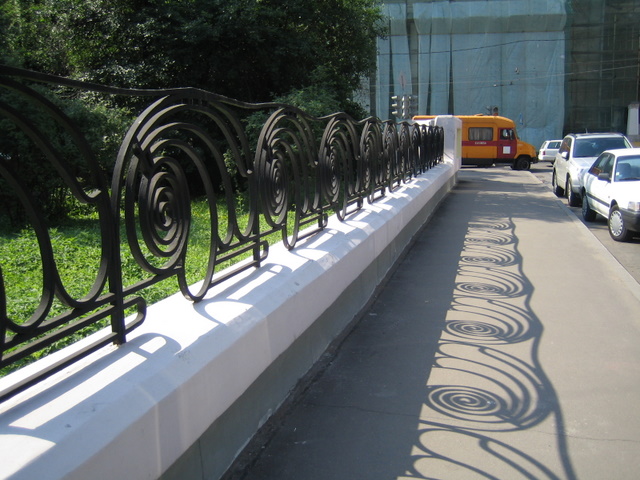
We went to a number of synagogues while in Moscow and one of them was a Chabad Lubavitch synagogue. We passed this fence while walking toward the synagogue.

Fence in Moscow

For those coming from Shadow Shot Sunday, please consider taking my challenge Round the World with Rona

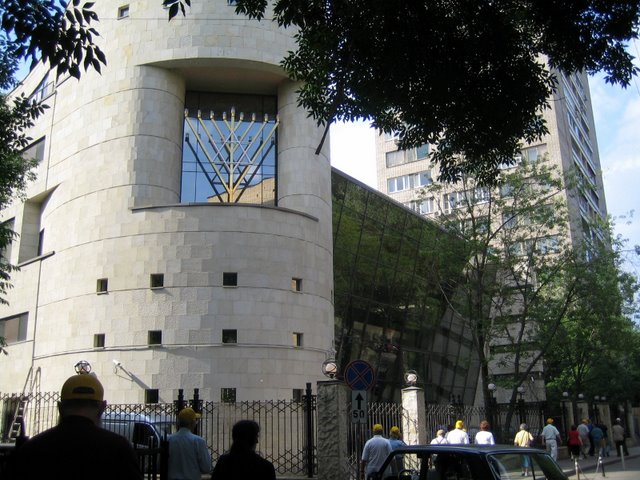
So what do people do with an old synagogue which was probably not used for more than 70 years until after the fall of the Soviet Union? Well, it could be refurbished, which this one was, both inside and outside, but suppose one wanted to update it, expand it, and yet preserve the facade? Well, here is the result:

Chabad Synagogue, Moscow

Chabad Synagogue, Moscow

As one walks toward the synagogue, this is what one views, a modern looking, concrete and glass structure. As one nears the entrance, this is what one sees.

Synagogue, Moscow

Yes, it is a glass wall that is in front of the old facade of the building. It provides additional space and insulation as well as an updated look.

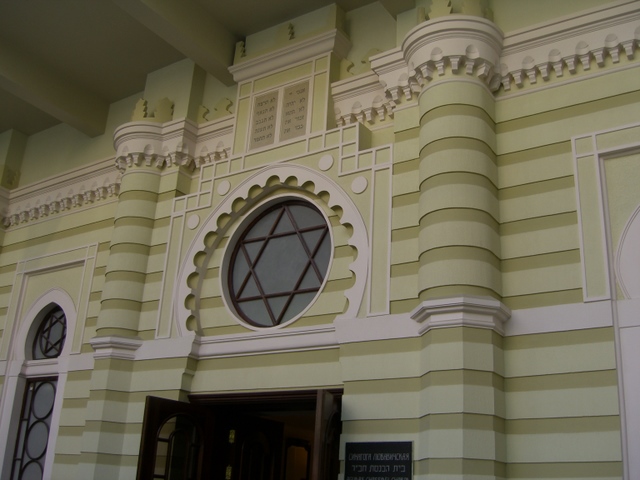
And here is the original facade

Chabad synagogue, Moscow

Fortunately the synagogue is not only beautiful to visit, but it is thriving. While we visited there were groups of people praying in the main synagogue and the large, beautifully decorated chapel, and upstairs there is a snack bar and a roof garden and other recreational facilities. After years of suppression of religious worship, it is amazing to see what has happened. This is not the Russia I thought I would be seeing. It was a pleasant surprise!

Halong Bay, Vietnam

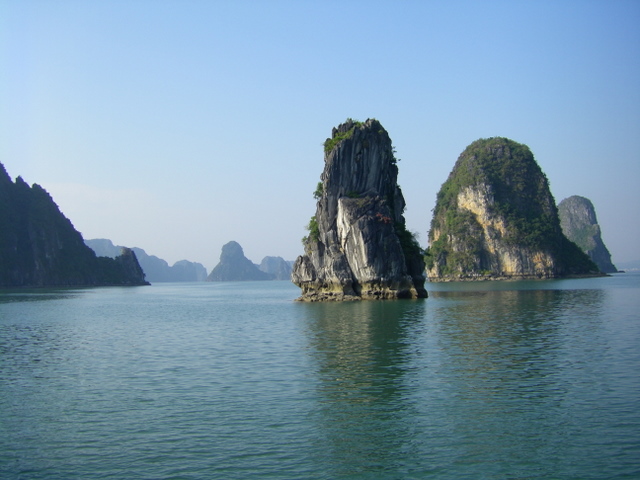
One of the most beautiful places in the world is Halong Bay, east of Hanoi. Halong Bay, in the Gulf of Tonkin, is known for its magnificent rock outcroppings. There are about 1600 huge rocks, some the size of mountains and others only a few meters long and a few meters tall. They are the result of a process that is termed “Karst.” Karst is the name of an area in what is now Slovenia where these types of structures were first identified and explained. They are the result of the receding of the ocean floor and erosion that took place over thousands of years. The limestone has been worn away leaving only the core area resulting in beautiful formations.

Halong Bay, Vietnam

Halong Bay, Vietnam

Halong Bay has been named as a UNESCO World Heritage Site.

Although most of these rocks are not large enough for people to live on, the bay has a large number of residents who live on floating homes. Their food is delivered to their porches by boat and their children are collected by boat to go to school.

Floating homes, Halong Bay

Floating homes, Halong Bay

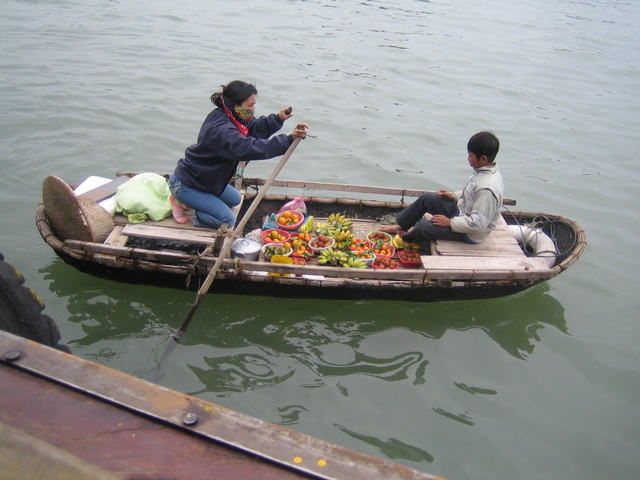
Selling fruit on Halong Bay

Selling fruit on Halong Bay

On our tours of Vietnam, one of the loveliest experiences we have is lunch on board a boat as it cruises along Halong Bay. Because our tours are strictly kosher, we bring with us, of course, all of our own kitchen equipment (woks, knives, cutting boards, stirring implements, foil trays, foil for surfaces) and disposable utensils to eat with. On Halong Bay we enjoy very fresh fish. Below are our people watching as our boat stopped to be supplied with the freshest fish we ever ate!

Sailing on Halong Bay

Sailing on Halong Bay

Come with me! We leave on November 16!

Thien Mu Pagoda, Hue, Vietnam

There are many magnificent things to see in Hue, Vietnam’s former capital. Like China, Vietnam too had a Forbidden City for its rulers. Built in its own Vietnamese style, it is quite impressive and certainly the highlight of a trip to Hue. Parts of it are now undergoing reconstruction and restoration.

But no trip to Hue is complete without a cruise on the Perfume River. It is so named because of the fragrances of the plants and trees that line its banks. Here two views of the Perfume River, a place of enchantment.

Looking at the Perfume River, Hue, Vietnam

Looking at the Perfume River, Hue, Vietnam

A dreamscape

A dreamscape

The treat that comes at the end of the cruise, as if the calm waters and entertaining hostesses on the boat, selling silk pajamas, silk blouses, embroidered wall hangings, and carved wooden items weren’t enough– is the Thien Mu Pagoda.

Built in 1601 and then renovated in 1844, it is part of a Buddhist Temple complex that includes a huge 2000 kilogram bell. Legend has it that people used to see an old lady sitting on the hill where the pagoda now stands. She presumably said that a great leader will someday build a pagoda on this spot that would bring peace to the country. She then disappeared into a cloud. The pagoda’s name translates as “Heavenly Lady Pagoda.” The complex now houses young men who are learning to become Buddhist monks. The setting is calm and beautiful.

Approaching the pagoda

Approaching the pagoda

The pagoda actually is not straight, but leans back. So far, no one is talking about reinforcing it and the angle is barely noticeable.

Thien Mu Pagoda

Thien Mu Pagoda

A walk on the grounds is a reminder of the peace and calm that the monastic life has to offer. Join me on my next trip!

Photobucket

Sera Monastery, Lhasa, Tibet

One of the most fascinating places I have traveled is Tibet. Having gone to cities with progressively higher altitudes in the days before arriving in Tibet, the group was prepared for the rarefied air of Lhasa whose elevation is 3650 meters (11,975 feet) above sea level. Normally visitors are unable to tour on the first day there and must rest, but we “hit the ground running” much to the consternation of the local guide who thought he would have the afternoon and evening off.

I had many adventures in Lhasa and took a large number of photos. One of the most interesting places we visited while there was the Sera monastery. It was founded in 1419, during the Ming Dynasty and the name means “wild rose” in Tibetan. It was named Sera because the hills behind it were filled with wild roses at the time it was being built.

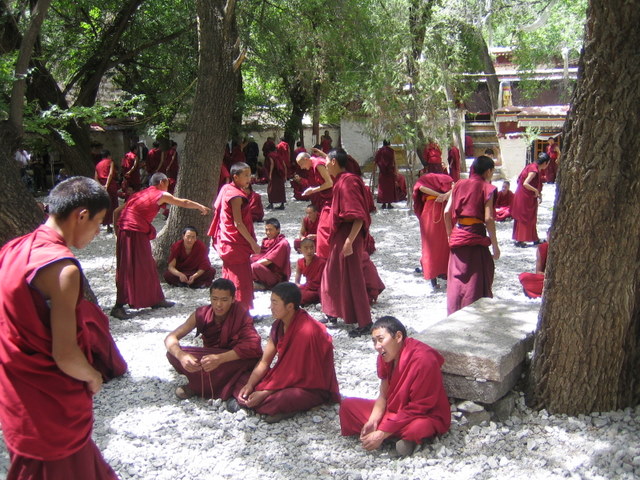
It may be only a coincidence, but the young monks who now study there wear robes that are rose colored. A study session of theirs is fascinating to watch. They gather outside, under the trees in dyads or triads. They refine their knowledge of their faith by asking questions of one another. The questioners stand and the answerers sit. If the answer is deemed good and satisfying based on the traditional sources, the questioners indicate that through a hand gesture signifying approval. If not, they continue to question. Questions are punctuated with slaps on the questioner’s arm. To the observer, it is a somewhat disconcerting sight. Some are standing, some are sitting, there is lots of noise as all of the dyads and triads are constantly speaking, and there is an unpredictable cacophony of slaps.

It is, however, both fascinating and beautiful. Here are a couple of images:

Monks at Sera Monastery, Lhasa, Tibet

Monks at Sera Monastery, Lhasa, Tibet

Monks sharing a moment at Sera Monastery, Lhasa, Tibet

Monks sharing a moment at Sera Monastery, Lhasa, Tibet

Pin It on Pinterest