Chengdu, China — Pandas!

China has a myriad of sights to see. One of my favorite places in China is Chengdu. It’s a large city in Sichuan Province and is best known to westerners for being the prime breeding center for pandas.
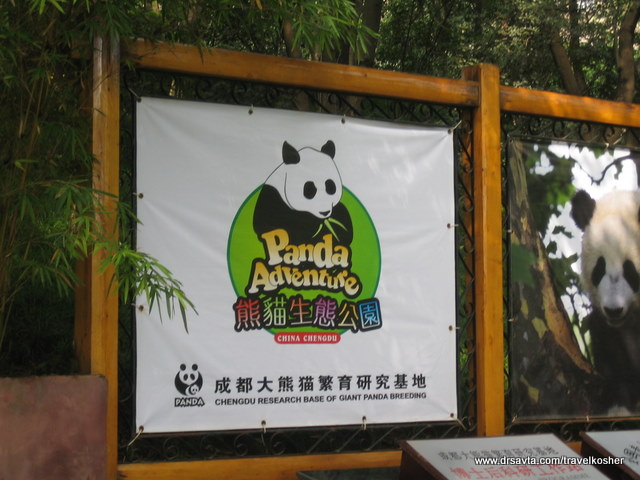
Welcome to the Panda Breeding Base
Pandas!
Pandas had become endangered, and for good reason. Female pandas are fertile for one to two days a YEAR! Add to that the fact that pandas often expend more energy eating than the caloric content provides, and you have tired male pandas who really can’t be bothered.
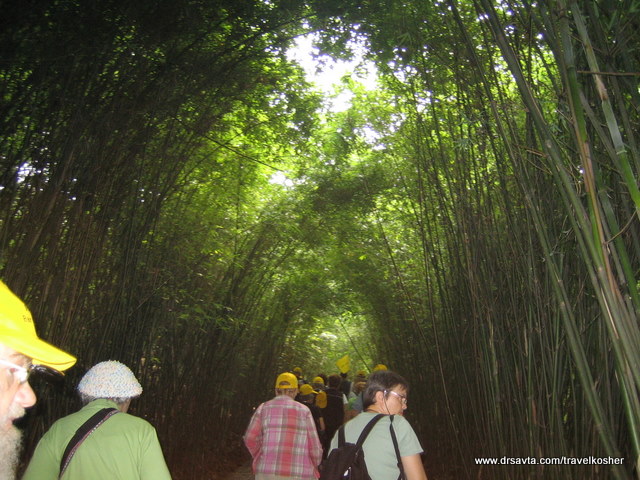
Bamboo
Pandas chiefly eat bamboo, but because the energy required to chew and digest the bamboo is roughly equal to the energy they get from it, they are not lively. At the breeding center, the pandas have been acclimated to a more varied diet that provides them with more energy. In addition, the Chinese have actually developed “panda porn.” They actually screen suggestive movies so their pandas will become inspired.

At the Chengdu panda breeding ground, many of the female pandas are artificially inseminated and all of the pandas are monitored carefully and cared for so that their offspring are healthy. Most often, the panda has one cub, but there are also frequent occurrences of twins.

The breeding program has been enormously successful and pandas soon will not be an endangered species.
Mother and baby panda on closed circuit TV
Above, the mother panda is seen from above with a little fishlike thing on her chest. That is the baby panda. They are tiny when born, but they grow very rapidly. Visitors are not allowed to approach the rooms where the mother panda and her newborn offspring are. Instead, visitors can view them on these TV monitors. To see the cubs when they are somewhere between six months and two years old, one must put on paper booties over one’s shoes and walk by the nursery cages silently so as not to disturb the pandas.

Walking through the large panda base, one could spy pandas resting (of course).
Catching some rays
This panda was one that was somewhat domesticated. For $50, one could have a picture taken with him. We graciously declined.

Pandas are also a business for the Chinese. For a million dollars a year, a foreign zoo can rent a panda for 10 years. Of course, the zoo must meet certain criteria for how they will house and care for the panda. In addition, the zoos must work toward mating the male and female pandas, usually through artificial insemination, and the panda cubs also become the property of the Chinese government. So why would a zoo do it? Pandas are a huge draw for zoos. People are fascinated by the big furry animals. Add a baby panda, and the zoo attendance soars for the first two years. It pays.

In the US, one can see pandas in the zoos in Washington DC, San Diego, Memphis, and Atlanta.

And last but not least, the pandas have friends who live with them, red pandas, also known as firefoxes. They are not of a related species, but their distinctive markings remind people of pandas. Firefoxes are able to be domesticated and are both beautiful and entertaining. I seriously wanted to bring one home!
Red Panda / Firefox

Potala Palace, Lhasa, Tibet

On our trip to western China and the province of Yunnan, we also visited Lhasa, Tibet. Lhasa, at that time (2006), was not a place that people visited so often because it is very far from other places in China, special visas are required, and the roads to Lhasa are less than perfect. [In a future post, I will talk about the roads in Yunnan Province.]

We arrived on a flight from Kunming. Lhasa is located at a very high altitude, 3650 meters or 11,975 feet above sea level. That makes it even higher than Cusco, Peru which is 3400 meters or 11,200 feet above sea level. People who visit often take close to a day to adjust to the altitude. Many people feel short of breath the whole time they are at altitudes they are not used to. We had been traveling from one place to another, each of which was at a higher altitude, so that by the time we came to Lhasa, we had very little difficulty adjusting to the altitude, although climbing steps was a lot harder because of the scarcity of oxygen in the air.

Now, for people who would like a real adventure traveling to Lhasa, there is a train that one can take from Qinghai to Lhasa. It is a very special train, built over frozen tundra at high altitude, in a way that enables the local wildlife to cross beneath its tracks and continue life as it was before the railroad.

Some of the facts about the railroad can be found here :

The train is equipped with 2 oxygen sources, 1) released throughout the cabins when reaching Golmund and heading into Tibet and 2) Personal Oxygen Canisters in case you feel light headed and only available from Tibet to Golmund or from Golmund to Tibet.

Between Xining and Golmud the tracks pass by Qinghai Lake – China’s largest. But it’s the Golmud-to-Lhasa sector which offers the most breath-taking scenery. That segment also offers the record-breakers: the world’s highest passenger railroad (at Tanggula Pass – elevation: 16,640 ft.; 5072m) and the world’s highest railroad tunnel (Fenghuoshan – elevation: 16,093 ft.; 4905m). Over 80% of the journey is at altitudes above 13,000 feet; fully half the track on this sector was laid atop permafrost.

The train ride from Beijing to Lhasa is 48 hours long. For a soft sleeper berth, the price one way is $158.

Since the railway was built, large numbers of Han Chinese have come to settle in Lhasa because now they are able to visit their families back in the center of the country more easily.

Although one may picture Lhasa as a primitive place or a place burning with tension, we found just the opposite. It was a modern, laid-back place with lots of charm and a lot of interesting places to discover.
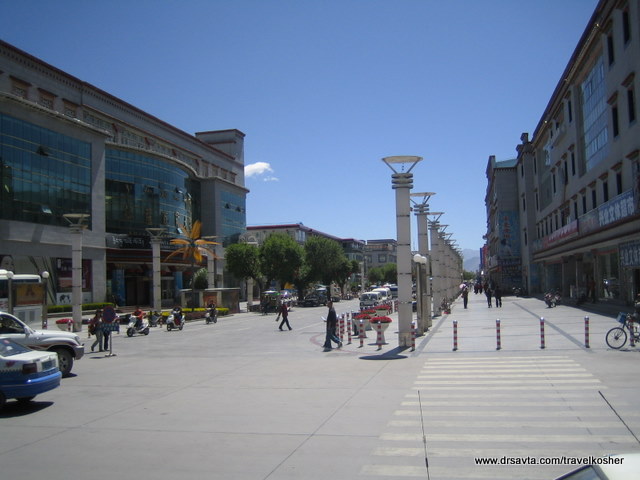
Street in Lhasa
Business street in Lhasa
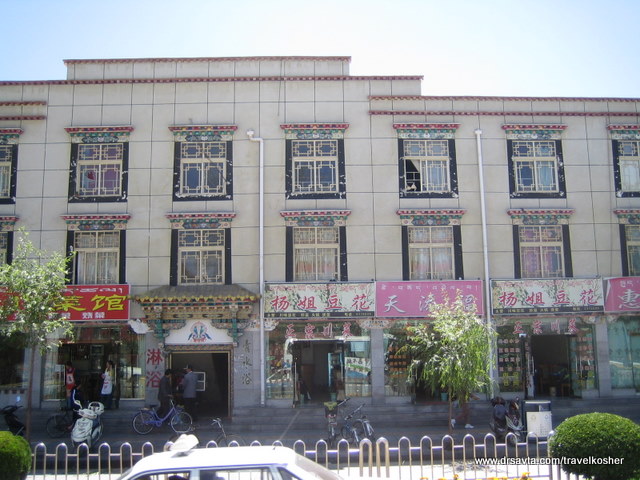
Shops in Lhasa
Shops in Lhasa

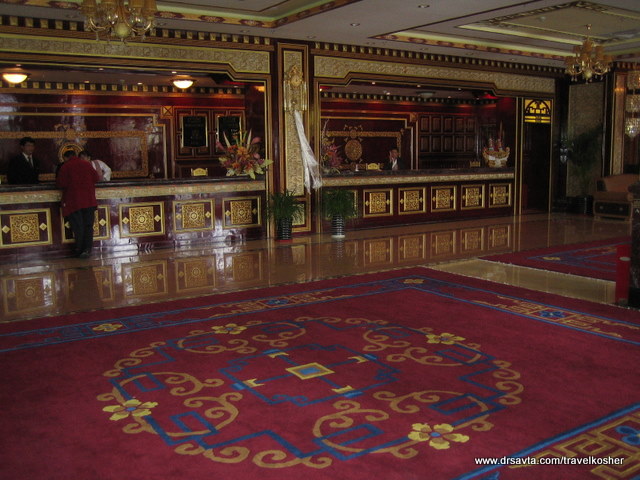
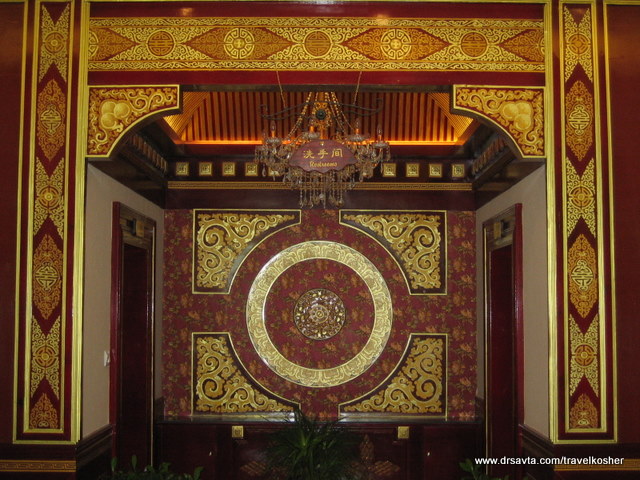
Hotel lobby
This was the lobby of the elegant hotel where we stayed

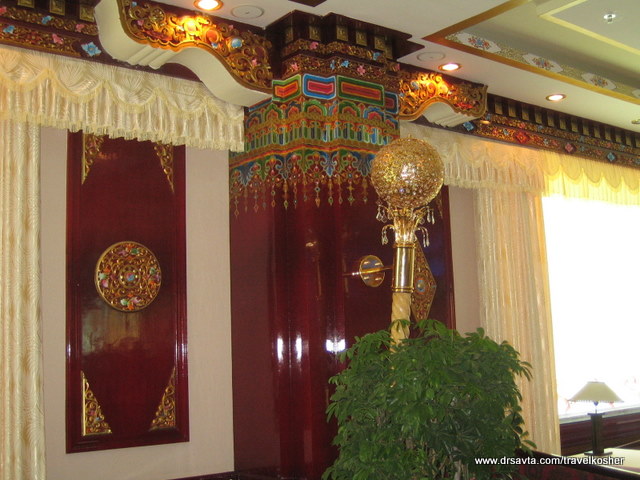
Interior of hotel
Here is some detail of the decoration
The alcove of the restrooms

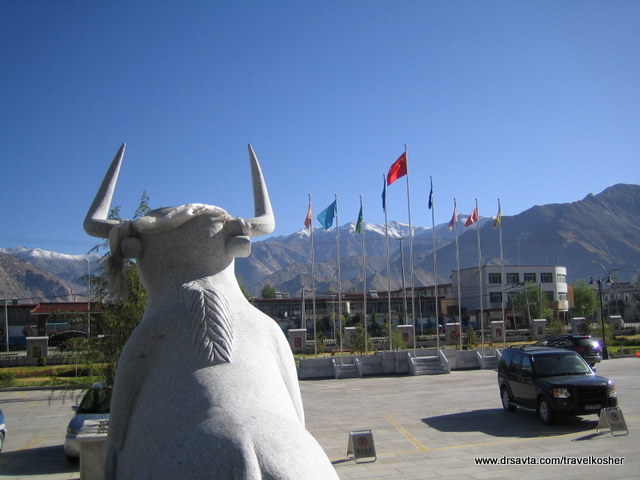
Outside the hotel, although it was already June, the first day or two we were able to see the snow-capped mountains. By the time we left, a couple of days later, all of the snow had melted.
Outside the hotel

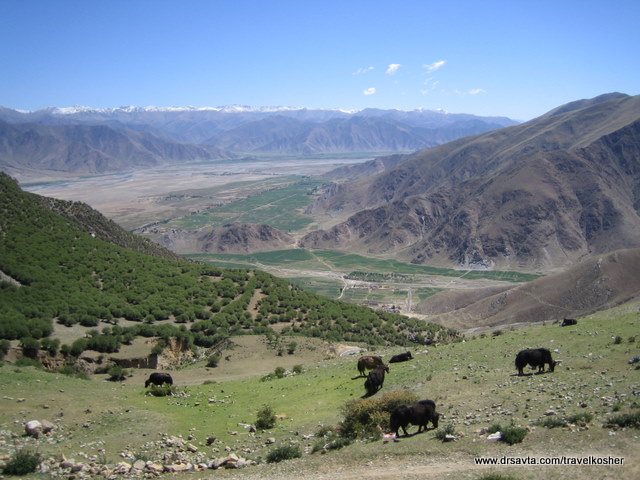
We took a ride to see a monastery on the side of a mountain and saw lovely scenery with lots of grazing yaks.

Yaks in Tibet

On our way back to Lhasa, we saw two carts.
Carts
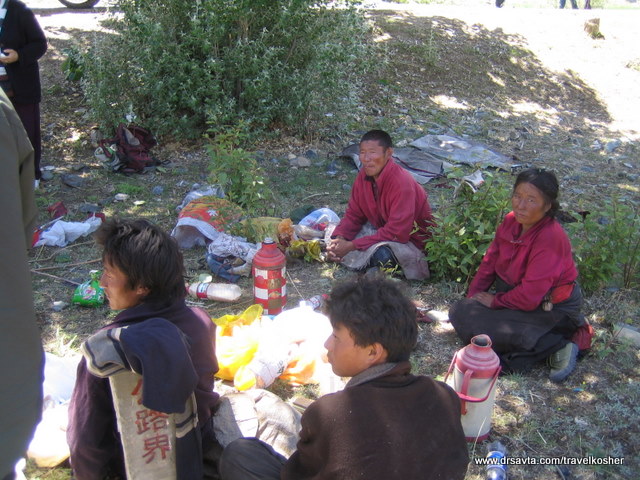
They belonged to a family of pilgrims who had been traveling on foot for almost a year from their home in Chengdu, a distance of 2415 kilometers or 1500 miles. They were nearing Lhasa and the temple they were seeking to visit. They believe that as devout Buddhists they must make this journey at least once in their lives. The father of the family had already been to Lhasa, but now he was bringing the rest of the family. Here they are:
Pilgrims

Pilgrims arriving in Lhasa will walk three steps, prostrate themselves on the ground and then get up and walk three more steps, until they reach the Jokhang temple. Then they circumambulate the temple and then finally enter.

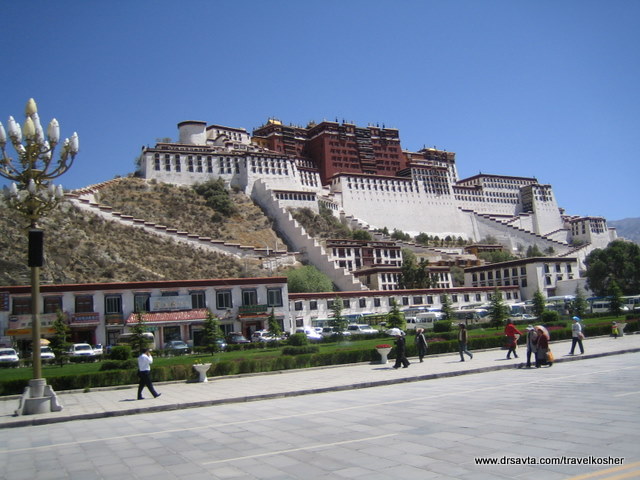
Not far from the temple is the Potala Palace, the former residence of the Dalai Lamas. It served both as a spiritual headquarters and the seat of the government. Today no business is carried out there and it is visited by tourists who must make reservations in advance, come early to go through a rigorous security check, and then climb many flights of steps to see it. It is not for the faint of heart.
The Potala Palace

We were accompanied by someone who took pictures the way a tourist would and watched our group closely. Although the palace has no real artifacts and most of the rooms we saw were empty of furnishings, it is a sensitive location for the Chinese and so they are very vigilant about who the visitors are and what they are doing while they are there.
The palace up close
This is close-up picture of the palace windows.

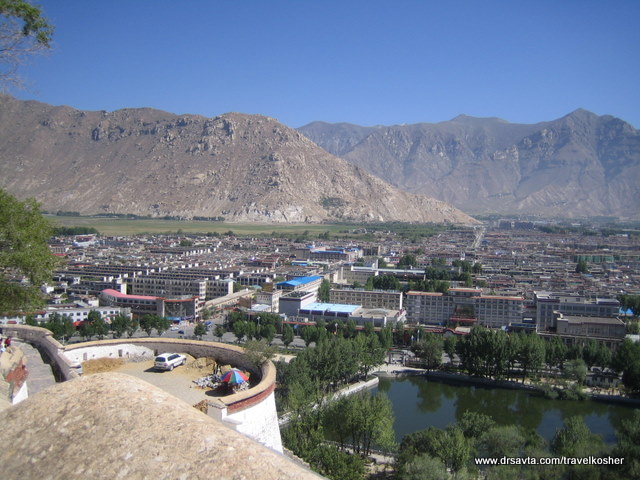
This is a view from the palace of the city of Lhasa
View of Lhasa from Potala Palace
Potala Palace

We loved our trip to Tibet. In another post, I will show you some pictures from the museum and also the summer palace of the Dalai Lama.

Where do *you* go?

Many years ago, in faraway lands (the US and Germany), I taught childbirth preparation classes. They consisted of anatomy and physiology and the basics of the birth process and becoming new parents. Most of the time was spent on giving my students techniques for reducing the pain of labor. I was eclectic in my approach and took techniques from several different theories as well as devising some of my own.

One aspect of pain reduction is relaxation and I copied from a book, perhaps Husband Coached Childbirth, an exercise that I read to the couples (yes, I had the husbands relaxing too) while they relaxed on the mats on the floor. It contained images that would help a person focus on another place and experience to distract them from some of the tension in their body.

I am long past the childbirth stage. I have, however, used many of the techniques over the years for uncomfortable medical and dental procedures. Sometimes, I use the images to simply reduce tension. Sometimes I use them just to make me happy.

So here are just some of the places I go– in no particular order:

1. A Chinese garden. Once of my favorites is the “Good Luck” Garden in Hangzhou, China. Not only is it lush and green and with some of the trees decorated with red ribbons, but it contains lovely sculptures and has beautiful Chinese music playing in the background. It’s a first class stress-reliever.

Good Luck Garden

Good Luck Garden

Liu Hai and the Golden Toad

Looking through a doorway

2. Bamboo raft ride on the Martha Brae in Jamaica. Sorry, this was in the days before digital photography! You’ll have to picture nearly still water with trees of all sorts on both banks of the river forming almost a canopy over us and lush vegetation everywhere. Except for the sounds of the birds, and the gentle poling of the gentleman taking us on this ride, there was silence. A fine mist contributed to making the experience magical.

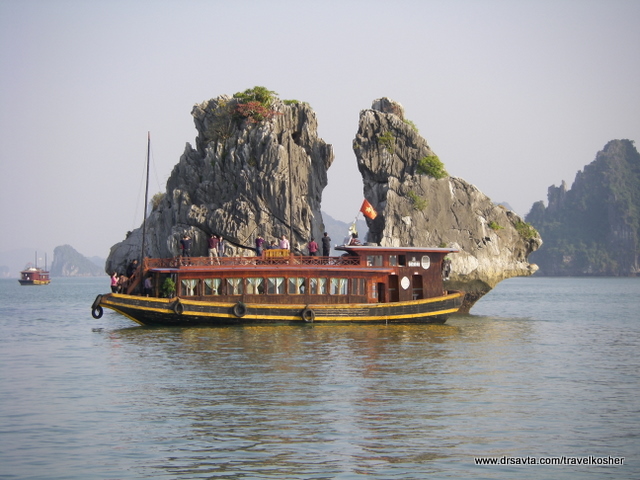
3. Halong Bay in Vietnam. It is beautiful– breathtaking, actually.

Halong Bay, Vietnam

4. The Rice Terraces at YuanYang, China. They are majestic. There’s something very clean and pure about the fresh stalks of rice, planted in rows, sculptured into the landscape.

Rice Terraces

Rice Terraces

5. Austria, just south of Salzburg. It’s just beautiful. I love the snow-capped mountains and this really isn’t a painting. It’s a picture I took myself in the month of May.

So tell me, where do you go??

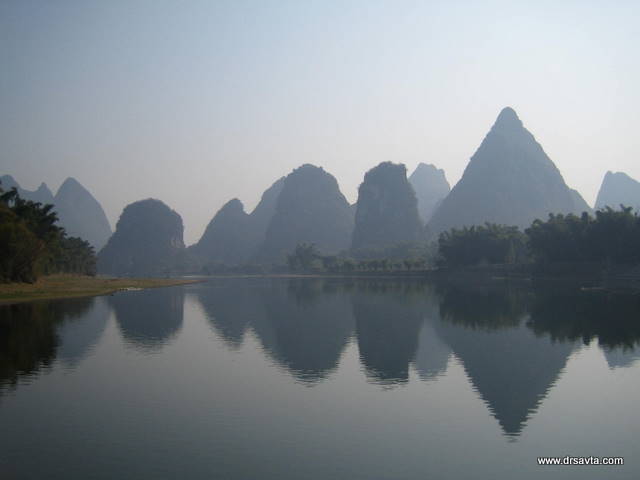
Li River, China

If you are a person who likes art, you probably have seen Chinese landscape paintings that portray very tall, pointed mountains. If you are like me, you probably have thought that it must be a stylized version of the Chinese landscape that the artist was portraying. Well, in fact, the Chinese landscape does have tall, sharp-peaked mountains. They account for some of the world’s most magnificent scenery.

The same Karst process that formed the peaks in Halong Bay, Vietnam, formed the mountains in and around Guilin, China.

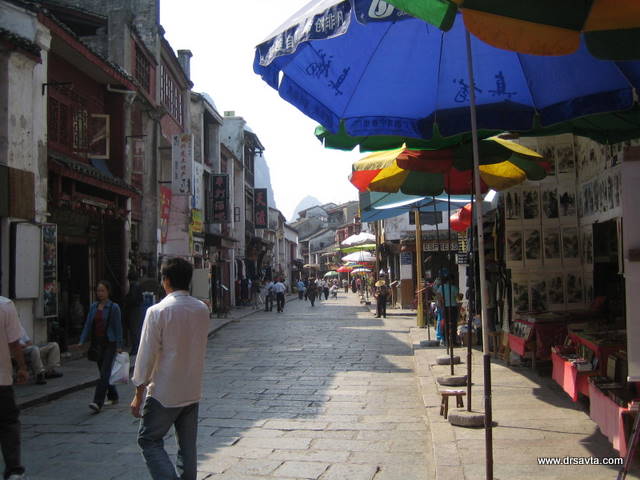
About an hour and a half from Guilin is the small city of YangShuo which also lies amid these magnificent mountains and along the Li River. Some of the best shopping in China can be done in the clean, attractive market at YangShuo that runs perpendicular to the river.

Market in YangShuo

Market in YangShuo

Once on the river, it is almost impossible not to gasp at the beauty of the landscape. Everywhere one looks there are magnificent landscapes.

Li River

Li River


Li River

Li River

While cruising down the Li River, one can see a viewing stand.

Viewing stand

Viewing stand

The viewing stand was built for viewing a production unlike anything I had ever seen before.

The Chinese director, Zhang Yimou known for films such as Raise the Red Lantern and To Live and Curse of the Golden Flower and also for his directing of the opening and closing of the Beijing Olympics, has produced a show on the river. The show is presented each night, often twice a night, and although it is not in a Chinese population center, the seats are always filled. The stand holds about five thousand!

Zhang Yimou, when asked to produce a show immediately decided that the best theater of all was the river itself and the ten mountains that surrounded the small inlet where it is staged. When the mountains were lit at the beginning of the show, it was a breathtaking experience!

The show depicts the life of the local people in their villages. It shows farming, fishing, and local customs.

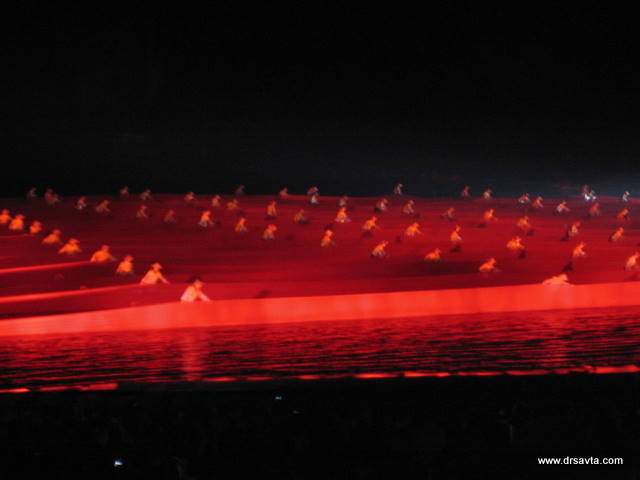
Fishermen on the water

Fishermen on the water

The fishermen, on their rafts, move from side to side and raise and lower the red fabric making a beautiful impression.

The women (below), walking on catwalks on the water are wearing dresses that light up. They switch on and off the dresses in amazing patterns.

Women lighting up the night

Women lighting up the night

It all is accompanied by beautiful music. Aside from the magnificent spectacle the show is, the wonderful part is that almost all of the 600 or so performers are local people who had lived a rather impoverished existence and who now earn a significant amount of their livelihood performing in this show. What a wonderful project! And wow! It will take your breath away.

As easy as yi, er, san

The first day I was in China on my last trip (October 5), I had a couple of things I wanted to do before my people arrived. The first was to purchase a Chinese sim card for my telephone. I had my own cell phone (unlocked and able to receive foreign sim cards) and a loaner (that I placed my Israeli sim into). That way I would have one Israeli phone and one Chinese phone to cover pretty much any situation.

On previous trips, attractive young ladies had been set up at counters at the airport to sell sim cards as people arrived. This time, there were none. I assumed it was because I arrived at 4 a.m.

So, after getting into my room, showering and changing my clothes, and checking my email, I went to the desk and asked where I could buy a sim card. I had noticed that there was a Carrefour department store adjacent to the hotel. I asked if they had them. I was told that the sim card policy in China has changed and that now there is much more regulation on them and therefore one can only purchase one at a store licensed to sell them and after filling out many forms. Fortunately, there was a China Telecom shop only a couple of blocks away.

It was a bright sunny day and everything felt wonderful. There were beautiful people, tall majestic trees with rustling leaves, and colorful shops. As I walked, I almost felt like singing. I love visiting China so much. It was like coming home to an old friend.

When finally I arrived at the telephone store I am not sure who was more perplexed– the salesgirl or me. You see, this store was not in a tourist area. It was frequented by Chinese people who unlike me, speak Chinese. How was I going to accomplish this?

I held up my phone and said “sim” hoping the word was an international one. I opened it up and showed her that one was missing. I could see a flicker of recognition. She called someone on the telephone, I assume to check how she should proceed. The person spoke to me in English. I said I wanted a sim card. I handed the phone back to the sales person. She tried to warn me, I assume because she might have assumed my phone was locked, but I pointed to it and said “OK.” “Hao, Hao.” (Hao is one of the words I know in Chinese. It means “good,”) So far, so good. She took me to another sales person, seated behind a desk. I sat down.

The new lady handed me an envelope on which were written four 8 or 9 digit numbers. She pointed to them. I remembered that in China people are very interested in the significance of numbers and they actually choose the license numbers of their cars– bidding high to get the most fortuitous ones, as for example, the number 8 being a fortuitous number, therefore, when appearing in a license, commanding a higher payment than the unlucky number 4. I chose one of the numbers at random. It was to be my telephone number.

At some point, the woman behind the desk called an English speaking colleague and after that she would hand me the telephone whenever she had a question. They asked for identification and so I handed them my passport. I had to show them which letters spelled out my name and where my birth date was. It was strange, having to stop every few seconds for questions to be asked in Chinese of the person on the phone and then the voice on the other end of the line asking them of me in English. All of us laughed at the awkwardness of the situation.

They filled out many different forms and then finally asked for a local address. Of course my local address was the hotel where I was staying as of that morning. In my jet lagged fatigue, I had forgotten the name of the hotel, but I did have the plastic card that was the room key with me. It was in a folder given to me by the hotel and had all of the relevant information.

And then, after a payment of about $20, I left with many smiles, many giggles, and my Chinese telephone.

Now wasn’t that simple? As easy as yi, er, san!*

*One, two, three

What happened next

So there we were, 6 a.m. taking off from Beijing. It’s always sad to leave China. If you haven’t been there, you have no idea of why. If you have been there, you are probably nodding your head and thinking about when you can return. China is a beautiful country filled with friendly, beautiful people. Chinese people work hard, but with a smile on their face, and greet tourists with smiles and friendship.

For example, while walking through my favorite market, one of the salespeople said to me, “I remember you!” I said, “You do? From when?” and she answered, “From now and from here.” We both smiled.

But I digress…

We were leaving China on an Aerosvit flight via Kiev, Ukraine. We had gotten to the ticket counter early, and so we were able to get bulkhead seats with lots of leg room. The flight, although 9 hours long with no films or other entertainment, was pleasant. People were quiet and I was able to sleep for a good period of time.

It still was good to land in Kiev, despite the fact that there was no time to leave the airport.

Landing in Kiev

Landing in Kiev

After proceeding through security, we were among the first to get our boarding passes for the follow-on flight to Tel Aviv. That meant that once again, we were able to get seats with decent leg room which was nice.

We had about 3 hours to wait for our next flight. The airport waiting hall is one huge room with poor acoustics and hard chairs. There were large numbers of people and since I had my suitcase and my back pack, I decided not to wander into any of the shops. I just sat and tried to read and listen to my iPod.

However, at a certain point, I started to hear the crying of a little girl. She was about 5 years old and very very cute. Her distress was over the fact that her parents would not buy her a stuffed toy dog. She was crying incessantly. Her parents came and sat down a seat or two away from me. The little girl continued crying insisting that her parents buy her the stuffed toy dog. Finally, her father began to reason with her. He said, “Look, here in your back pack are the 7 new stuffed dogs that we bought you.” He took them out one by one. Yes, there were 7 brand new, tags still affixed, stuffed toy dogs. This did not placate her. She still needed the one she had seen in the store. Her father said, “I promise you I will buy you another dog when we get back to New York.” I just listened.

The father took the girl for a walk. She thought he was going to get her another dog. I wondered whether I should talk to the mom.

She was a very pretty young woman. She was tall and slender and well dressed. I began to speak with her. She was Ukrainian and married to an American, living in New York. They had come, for the first time in three years, to visit her parents. They had visited for three weeks. Since the mother had always spoken to her daughter in Ukrainian, the child was fully able to communicate with her grandparents. They were thrilled to see her and there was nothing she wanted that they did not give her. Now, the child was leaving Ukraine, not sure when she would see her grandparents again. The mother explained that usually her daughter was easier to deal with, but they were at a loss as to what to do now.

I told her that I was a marriage and family therapist and that I understood that at times of transition, people don’t act the way they normally do and that helping their daughter to deal with leaving her grandparents and returning to her old life was a good thing to do. The mother knew that the additional stuffed dog was not going to make the child happy, but she didn’t know what to do to get her out of her ongoing demands for it.

When the father and child returned, I tried to think of something that I had that would interest the child. Fortunately, in my magic vest (the one I wear when I am traveling) I had a small laser pointer. I showed the child how to push the button to make a red dot on the floor. She was fascinated. She made the red dot travel the floor. Then it landed on her mother’s shoes. Mother played along, trying to brush it off her shoes. Then it landed on her father’s shoes. He tried to shake it off. Then it landed on my shoes, Crocs, a perfect target. With all of the holes in the top, she was able to aim the red dot at each of the holes and skip from one to the other. Soon she was giggling and happy and starting to examine her father’s throat.

While this was going on, the mother asked me what to do about a child who is stubborn. I told her that stubbornness is what enables people to study hard, work hard, and achieve. I told her she was lucky to have a child who knows what she wants and works hard to pursue it.

Soon they called my flight. I asked the child for my pointer. Unprompted, she handed it to me with a smile and said, “Thank you.”

And then I headed in the direction of home.

Home

Home

The End

Usually I like to talk about a trip starting at the beginning, but this last trip clearly had the most dramatic end (at least in the way that I experienced it…)

Our tour consisted mostly of people who flew to China from the US. Only one other person flew from Israel and we traveled together. On the night we left China, a driver from our local tour company came to the lobby of the hotel to pick us up at 3 a.m. It worried me a bit that when I came downstairs, he was sleeping. I had hoped that he would be sufficiently awake to transport us safely. However, he woke up as soon as I got within about 6 feet of him, so maybe he really wasn’t asleep, but just resting his eyes.*

Aside from the take-off motion he made with his hands when he saw me and my nod in the affirmative, we did not really communicate (his English was not as good as my Chinese– and I know fewer than 15 words).

The other traveler joined me and we went out to the car while the driver piled our luggage into the car. He got into the car and started driving toward the airport.

Our local guide, whose English was very good, had told me that we were leaving from another terminal, not the main one which was recently opened and is very beautiful, but I didn’t remember the number he told me. When we got to the terminal, it was not at all reassuring that the building was dimly lit and the sign outside it said “Domestic departures.”

I was traveling with a large suitcase (in the trunk of the car), a small carry on (on the front seat of the car) and my backpack (that contained, among other essentials, my notebook computer.)

When we got to the terminal, I said to the other traveler, “I’m not sure we’re at the right place and I don’t want to be stranded at 3:30 a.m. in a place where no one speaks English. Please wait with the driver and I will go in and see if we are in the right place.” It took me a few minutes to ascertain that we were in the right place. I walked back out to the car. Meanwhile, the driver had called our local guide and was reassured that we were in the right place and the driver and the other traveler had gotten our bags out of the car. I tipped the driver and he left.

And then, about 3 seconds later, I realized that my backpack was not on me and not with the suitcases and that the driver had left with it. I could still see the lights of the car leaving the airport.

I was certain that there was no chance I could get the backpack back. Oh no. It was gone. Forever.

But then I remembered that our guide had given me the driver’s telephone number and I even remembered where I had written it down. With my Chinese cell phone I called the number. He answered, in Chinese, of course. I said, “I left a bag.” He answered. I, of course, had no idea what he was saying, but it sounded like he didn’t understand. “My bag is with you.” Still, no sense that he had understood. “Bag in car!” Still nothing. “Come back!” Finally, it seemed as if he understood, because he seemed to had an “aha” response and then hung up. But I was not certain. I called our local guide and apologized for waking him a second time. He was very kind and said he would call the driver.

We waited. And waited. Like most modern airports, it can take several minutes to return to the drop off point at the Beijing airport as a network of roads swirls around the airport. We saw one car after another approach. Then, finally, there was the car that had brought us.

The driver stopped the car. He brought me my backpack and apologized for leaving with it. Of course, I was feeling guilty for not checking before he left, so I gave him a second tip and off we went to check in at Aerosvit for our journey home (via Kiev.)

The end.

(OK– except for my adventures in the airport in Kiev)

*My father didn’t suffer from jet lag. When we would find him sleeping, he insisted he was just resting his eyes.

China, October 2010

The words will come later. Right now, enjoy the sights with me.

Note: This was NOT produced by my daughter who does this professionally and could have done a great job. This is my first attempt to make a movie.

“>

Rona & Aaron’s Excellent Adventure, Part 4

For what happened previously go here

Having been sufficiently stunned by news of impending doom (i.e., our suitcases could be confiscated along with all we’d packed for shabbat and for other important parts of the tour), I entered the Temple of Literature compound and tried to relax. I thought of all sorts of alternatives to what we had planned and I knew that no matter what, our people were going to be well taken care of. We could bake bread, if necessary. I was pretty sure that beans and barley were available in Vietnam. We might have to buy large amounts of canned tuna to use for lunches to make up for the cheese and the peanut butter that would be confiscated, but we would be all right and our travelers would not even notice the problem.

As I walked through the gardens, relaxing became easy. It was beautiful, calm, tranquil — perfect. When I caught up with the group, they had just spied what was to be their first bride of the day.

Apparently, Vietnamese brides and grooms take full advantage of the period preceding the wedding and they go from place to place with a bevy of professional photographers being photographed in the outfits they have selected for that day. Like Chinese brides, Vietnamese brides often have more than one wedding gown– the traditional one (in China- red, in Vietnam, an Ao Dai in any color) and a white bridal gown such as those worn by brides in the West.

Here is the bride we saw at the Temple of Literature

Bride in Ao Dai

Bride in Ao Dai

We enjoyed a brief concert of Vietnamese music on traditional Vietnamese instruments and then set off for the Museum of Ethnology. There, inside the museum we saw colorful exhibits of ethnic minority customs, traditions, and dress and outside we saw models of homes and buildings of many of the ethnic minorities.

As the day wore on, the sun came out and Hanoi became very beautiful. And what did we see but more brides! Everywhere! And some of them were pretty adventurous!

After a visit to Maison Centrale, known to most Americans as “The Hanoi Hilton,” the place where captured US pilots, among them John McCain, were held, we went to Hoan Kiem Lake, a lake in the center of the city and were treated to a cyclo ride through the old city. The old city has 36 streets that were named for the crafts and trades that were located there. Although some of the streets still have some of those specialties, one cannot easily discern which street was for which trade or craft. One can, however, get the feeling of what it is like to travel at motorcycle/motorbike level in this busy city. You can see it here.

With the day quickly waning, I was getting more and more nervous about the suitcases. Even if I had figured out the solutions to my immediate problem, I really hoped that our people would have their belongings so that they could change their clothes and feel comfortable over the weekend. Since we were leaving at nine p.m. for an eight hour trip on a night train where we would sleep, our deadline for luggage delivery was all too critical.

My husband went to the restaurant to prepare dinner for the group while I went with them to the mini-hotel.

It is apparently called a mini-hotel not just because there are a small number of rooms and only one elevator, but also, I am guessing, because people use it only for a short amount of time. In fact, there were some lovely and wholesome looking young women dressed alike (black shorts, white blouses) waiting at ground level who one might imagine were in some way connected with the hotel. But I digress…

The purpose of going to the mini-hotel was to give people a chance to shower, change, and redistribute their clothing and personal items and pack only their small carry-on for our trip up north for the weekend. Taking the large suitcases onto the train was not a good idea. However, until the suitcases finally arrived, people didn’t want to shower, fearful they’d only have to put on the same clothing they’d been wearing for two days.

Our train was leaving at nine. The suitcases were not delivered until shortly after seven. Of course between suitcase delivery and the train there was distributing them to each room with only one small elevator and five stories of building and then collecting them again and then driving to the restaurant and having dinner. We were rushed.

The good news: ALL of the suitcases made it. The bad news: They had fastened a heavy plastic strip that held our largest suitcase closed and I had no implement to open it. There was no time. I decided to take all three of the large suitcases and our two small ones with us onto the train.

Our people were wonderful. Everyone was ready on time for the bus. They had left their suitcases outside their doors to be collected by the porters. We were out of the woods.

Or so we thought.

One couple said they weren’t sure where to leave their suitcase and they left it inside the room. When the time came to turn in the keys, they realized that they had locked the room with the key inside. I thought that would not be a problem, I went to the desk and asked for a duplicate key. The clerk didn’t understand me. I showed her a key and asked for another one and wrote the room number. She nodded no. I said “when you clean the room…” Of course, it was only later that I realized that most people staying there, maybe all of them, don’t leave the room and then come back. I had her call Mrs. Mai. I explained to her what had happened. Now I had two Vietnamese women who didn’t understand what I was saying, I believe. However, after the conversation, the desk clerk called someone and said, “wait one moment.” I am certain that when Vietnamese people learn English they are told that “wait one moment” means “this could take hours.”

I decided that my people needed to go and eat. I sent them on the bus to the restaurant. I assured the couple that I would not leave the hotel until their suitcase was liberated.

Finally a young man showed up on a motorbike. I assumed he had the key. I said to him, “You have the key?” and shook my head hopefully. He said, “yes, yes.” I’m guessing that when Vietnamese people learn the phrase “yes, yes” they are told it means, “I think you are a nice person and I would like you to be happy.”

The room was at the end of the corridor on the fifth floor. It was on the left. He walked down the corridor and opened the last door on the right. I said, “No, it’s this one.” He said, “yes, yes.” He went into the room and closed the door behind him. I thought, “Great! there’s an adjoining bath between them!”

He walked out of the room and said, “wait one moment.” He returned a few minutes later with an assistant and a tool box. They went into the room on the right. Then I heard loud banging– as if they were trying to break down the wall. It continued for a very long time. I waited. I sweated. I looked at my watch. I knew I had missed dinner, but how long could I stay without missing the train?

The banging continued. I sweated some more. It was 8:30. The train was at 9. I had no idea how far it was to the train station nor did I have any idea how much traffic there would be. I was cutting it very close. I called Mrs. Mai. I told her that the men were trying to break down a wall to get the suitcase, but so far, no luck. She told me that when the suitcase was finally liberated, she would have it picked up and brought to our other suitcases and that the couple would have it on Monday morning when everyone else got theirs. She called me a taxi and told him to take me to the train station.

I got into the taxi and I wanted him to know that I was in a hurry and so I wrote 9:00 on a piece of paper and apparently that was all it took to get him into Hollywood-car-chase mode. Ohmigosh! He flashed his lights, honked his horn, and drove on the wrong side of the street. As we reached the train station, I began to fear that maybe there was more than one station in Hanoi and I hoped we were at the right one. At that very moment, our big red bus pulled up and beside it I found my husband and all of our travelers.

Stay tuned to find out what happened to the suitcase, why I once again had to break down a Vietnamese door, and other exciting slip and slide adventures next time..

Continue the adventure here

Dali, Yunnan Province, China

Many of the books I read that deal with China emphasize how polluted the air is– that the skies are not blue. Actually, that has not been my experience. The most maligned city in China, Beijing, has, during the 6 times I have visited, had two or three smoggy days, but aside from them, the skies have been clear and blue.

However, everyone agrees that the western part of China, Yunnan Province, has beautiful crystal clear skies and is a most magnificent place to visit.

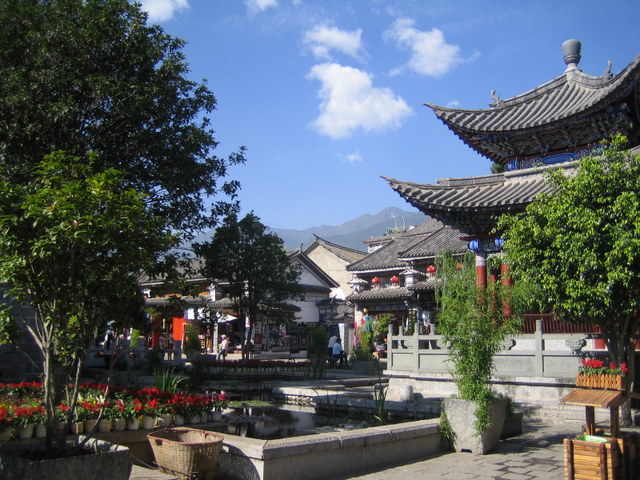
One exquisite city in Yunnan is Dali, home to two of China’s ethnic minorities, the Yi and the Bai. Bai means white and their native dress is beautifully embroidered white clothing which both the men and women wear. Dali is surrounded by mountains and is the recipient of the vast water flow that comes from the mountains. Freshly flowing water streams through conduits in the streets and between the water, the mountains, the blue sky and the meticulous cleanliness of the city, one can’t help thinking that this is one of the most idyllic places on earth.

A street in the walking area of downtown Dali

A street in the walking area of downtown Dali

Everywhere one looks there is something beautiful to see– or at least something interesting.

A town square, Dali

A town square, Dali

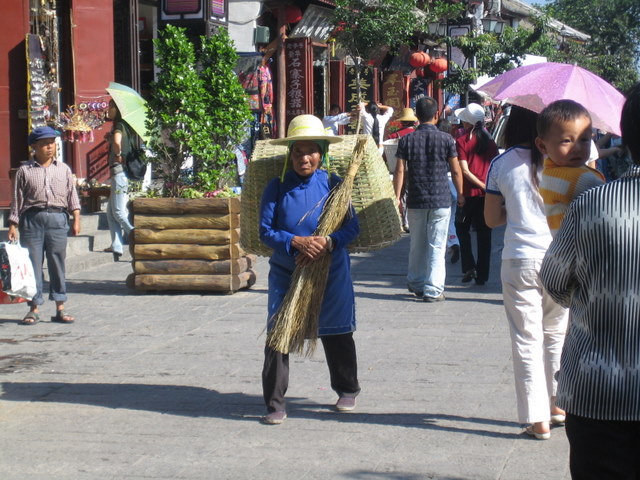
One of the things one notices when in the far east is how hard the women work. While women in the US were asking for the right to go out and work, women in the far east were doing more than their share in planting, harvesting, and even carrying heavy loads. With small families, older people work to support themselves as long as they can.

Street scene, Dali

Street scene, Dali

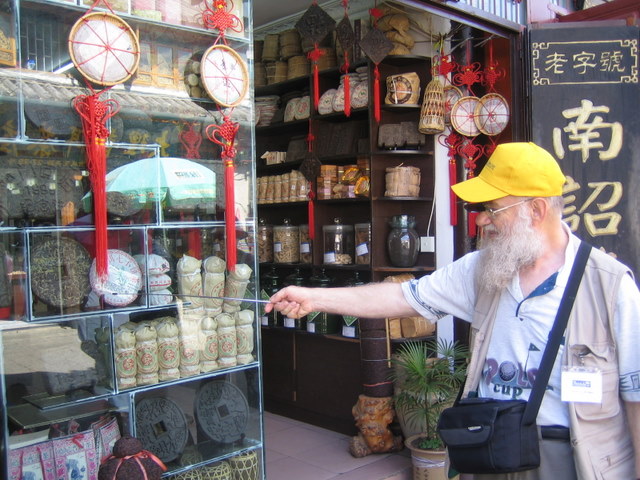
Remember that expression “for all the tea in China?” Well, that is not a small quantity. All over China tea is sold– in tins and packed into different shapes. It’s quite a culture there. No tea bags. And the teas all have special healing qualities. It’s not unusual to see a tea store such as this.

Teas in China

Teas in China

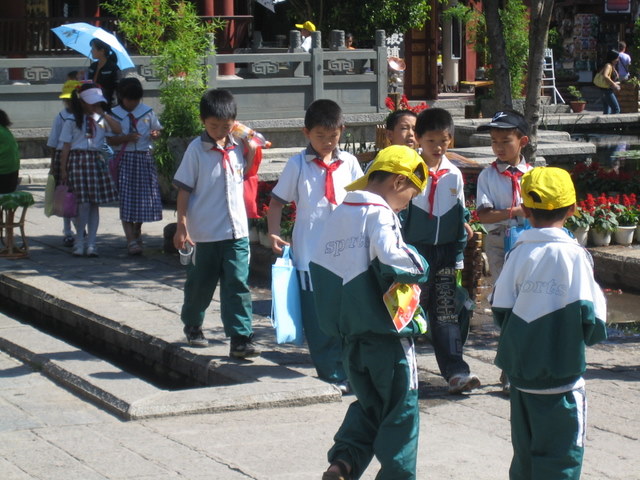
One of the very special treats of a trip to China is seeing the children. I don’t know if it is objectively true, but I think that every one of them is beautiful. Most of them are from single child families and are doted upon and it shows. The seem self confident and mature This day I caught some children returning from school. They were walking through the market, laughing and joking good naturedly. Notice how lovely they look in their school uniforms.

The boys

The boys

and the girls

and the girls

rubytuesday

Pin It on Pinterest