Yom Kippur

It seems a bit absurd to write about how Yom Kippur was for me this year, yet I cannot help but write.  As a child, I only remember this about Yom Kippur:  My parents would buy tickets for services.  In those years, the synagogue was still small and there was not enough room inside for everyone who wanted high holiday tickets, so they would erect a huge tent that seated maybe 200 people, maybe more, and my parents would attend good chunks of the service leaving us outside to our own devices.  I didn’t want to enter because I didn’t understand anything anyway and inside the tent, it was invariably boiling hot.

Late in the afternoon, my parents and I would ride about a half hour to my grandparents’ synagogue and arrive just in time for Neila, the last service of the day.  My mother would walk with us up the stairs of the synagogue into the women’s section.  The women’s section was populated with women of my grandmother’s age, all elderly (in their 50’s!) immigrant women who spoke with heavy Eastern European accents.  My grandmother was always really happy to see us when we showed up.  My cousins and their mothers too would arrive and always there was discussion as to which of the huge flower arrangements my mother and her siblings had bought for the synagogue in honor of their mother.

After the service, we would return to my grandparents’ home with the flowers.  They always consisted of  a large percentage of chrysanthemums and the smell of chrysanthemums usually reminds me of my grandmother.

I am now older than my grandmother ever was.

I am lucky enough to be living in Israel where on Yom Kippur, the entire country stops.  There are no Israeli television channels broadcasting and no radio.  Aside from one police car, I saw no cars on the roads.  In the evening, the park was filled with adults and children.  It is amazing!

This year, at services in our bursting-at-the-seams synagogue, I was privileged to have 16 of my grandchildren.  I pretty much was bursting with happiness seeing all of their beautiful faces.  The older ones, serious about their prayers, remained inside for large parts of the services and some, notably, for all of them.  The younger children, happily wandered in and out.  The youngest were held in their mothers’ or fathers’ or siblings’ arms.  The language we prayed in was the language they live.  The synagogue held familiar people.  The melodies were ones the older children had sung many times before.

And the service…  I don’t think it was my imagination.  Our congregation has been going  for about 13 years.  I think it has come of age.  The singing of large parts of the service was no less than inspiring.  Just as we repented in group fashion as one people, we sang in one voice and if the heavens were open, I can’t imagine more sincere petitions or more beautiful sounds of praise entering the holy gates.
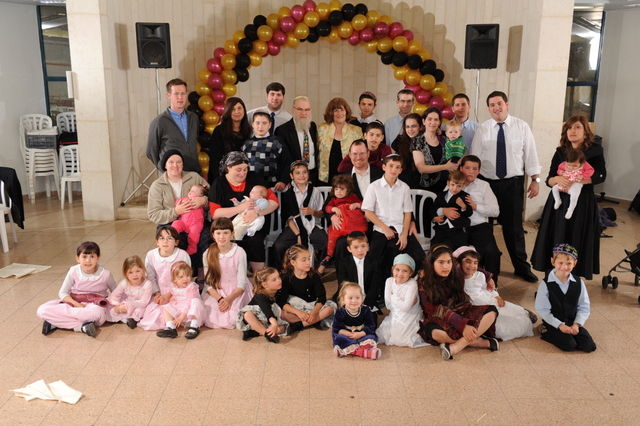
The family, unretouched, missing three children

The family, unretouched, missing three children

Missing: Amiel Michelson, Elazar Michelson, Shlomo Goodman

May all of you have a healthy, happy, prosperous New Year!

Why I am not wishing “peace” this year

Every year at Rosh Hashana, we exchange the wishes for a happy, healthy, prosperous new year. I used to put “peaceful” into that mix, but this year, I just can’t do it. I know that it is a lie. Peace is not just around the corner.

You see, the problem we have here in Israel is not that we don’t want peace. It’s not that we won’t give up the building of homes in communities in Judea and Samaria. What it is is an ideology fed to Arab children from the day they are born that has to do with eradicating the Jews from all of Israel. I believe that peace cannot come from conferences, from concessions, from cajoling, or from horse-trading. Peace will come when a responsible Arab leadership cares more about the life of their people than about the destruction of mine.

All attempts we have made have only emboldened the radical elements. If they believe that we are tired, sick to death of the terror and the pain, then they will only give us more so that we give up, capitulate, leave.

Economic success, educational success, building a society that serves the needs of its citizens is what will bring about a change in the mind set. It is what will make this senseless hatred recede as parents educate their children to achieve and to value knowledge and to love learning instead of longing for “martyrdom.”

So my prayer, it isn’t for peace. It is for the beginning of a change in the hearts and minds of the people who want to destroy me and my people. I pray that G-d will open their hearts to the knowledge that their children are precious gifts as are all of G-d’s children. I pray that by next year, the Arab parents will begin to value their children and their children’s future. I pray that responsible Arab leadership will focus on what they can do to help their people live happy meaningful lives.

More on Bulgaria– Nessebar

Nessebar is a picturesque island that has been connected to the mainland by a short land bridge. From afar, it looks a bit like a very large lollipop on the end of a very short stick.

Nessebar has a long and interesting history. It is a UNESCO World Heritage Site. It is a place that tourists love to visit because it is quaint and inviting and it is filled with small shops that feature all sorts of items, many of them local products.

Honey jars- pottery that is characteristically Bulgarian

Honey jars- pottery that is characteristically Bulgarian

The honey jars were not expensive, but they were filled with locally produced honey which made them problematic as there was no indication it was kosher.

A typical street in Nessebar

A typical street in Nessebar

Most of the homes in Nessebar are built of stone on the first level and of wood on the second. the wooden second floor is sometimes cantilevered over the street or into the yard area. Although Nessebar reminded us both of Rhodes, the architecture is more irregular and the wood gives it a more European look.

A quiet street in Nessebar

A quiet street in Nessebar

You might notice that the stones on the street are not very even. Walking there is a challenge. “Watch your step” takes on new meaning. One of the more frustrating sights we saw was someone trying to wheel a disabled person in a wheelchair on one of these streets. Impossible. She turned back despite our offers of help. The main street entering the city has a paved road and the road at the perimeter that leads to the seaport is also paved, but that’s about it. It is not a friendly place for people who have mobility problems.

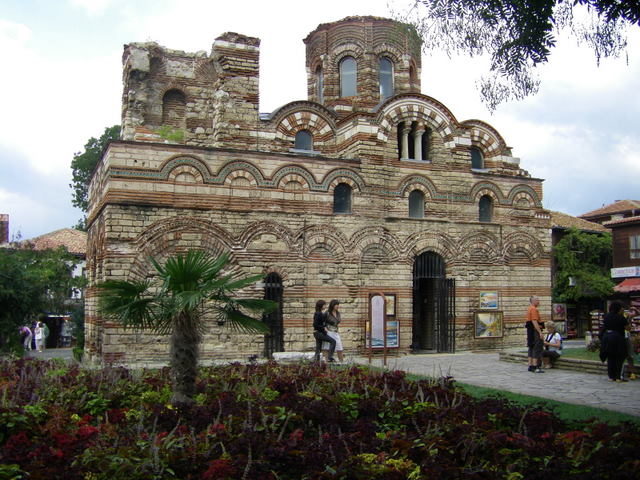
A church

A church

Our guide told us that Nessebar, this tiny island/peninsula had 40 churches. Indeed, it seemed there was one on just about every block. They all looked more or less like this one. Some are in ruins, some are used as art galleries, and some are just abandoned. There is at least one large impressive church that is still in use.

Strolling around Nessebar, we saw people from England, Russia, Poland, and of course, Romanians and Bulgarians. And what was the language we heard again and again (our little tour group consisted of just us and Brits and Poles) — Hebrew, of course!

Back from Bulgaria

We are back, tired and happy, from our vacation to Bulgaria. The purpose was a change of pace– to get away from it all, and we did. We didn’t see very much of Bulgaria and we didn’t learn very much about the people, but we did have a nice time. I couldn’t help but compare it to the type of tours we provide at Shai Bar Ilan— where we give our travelers the history, culture, folkways, legends, customs– the richness of the people we visit and we fill every minute with amazing experiences. This was not that type of trip.

Our first full day it rained. We traveled to Balchik where we visited the palace of the Romanian Queen, Marie, and the gardens that surround it. Her unpretentious home was built on a hillside by the Black Sea. It had a tower, but aside from its location on a bluff by the sea, it was not very noteworthy.

Palace of Queen Marie of Romania

Palace of Queen Marie of Romania

Romania extended into Bulgaria at the time she ruled and Marie so loved Balchik that in 1921 she decided to have her summer palace built there. She called the complex she had built Tenha Yuva, or the Quiet Nest. When she died, in accordance with her will her heart was buried there until 1940 when it was reclaimed and reburied in Romania.

Adjoining her palace are lovely gardens. She was the first monarch to declare herself of the Bahai faith and her gardens are reminiscent of the Bahai gardens in Haifa. Here are two pictures:

Garden in Balchik

Garden in Balchik

Queen Marie's Garden, Balchik

Queen Marie's Garden, Balchik

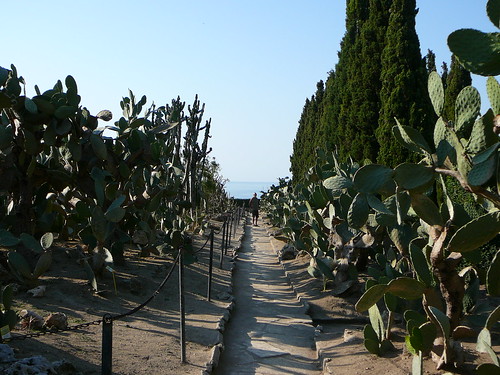
Over to the left of the garden was a garden of cacti. I wanted to photograph them too, but I was not thinking too clearly and tried to get there by walking across a cement drainage ditch. The problem wasn’t the water; it was the algae that were growing in it that were very slippery. As I lost my balance and fell hitting one- two – three parts of my body, another woman tried to help me and she too fell. Neither of us could get up because there was nothing to hold onto and I was pretty sure that I would be there until the sun came out and dried the place up in a few days or longer. Fortunately a very brave and apparently very strong man appeared out of nowhere and was able to help both of us onto our feet. We were bruised and shaken, but otherwise just wet. The pictures of the cacti? … well, I think I would have done better had I thought of this

More Bulgarian adventures next time…

Off we go…

On Wednesday we decided that we wanted to go away– somewhere. One of the big advantages to living in Israel is that aside from the notable exception of our neighboring countries which are less than welcoming to us, we are located only a short distance from a lot of interesting places and a jaunt to most of them is not very expensive.

So I searched a couple of Israeli sites on the internet for the dates we wanted to travel and looked for a place we hadn’t been before. I was able to find an inexpensive trip to… Bulgaria.

When I told my older daughter, she said, “Oh yes, we were in Varna. The center of town is very pretty.” My middle son also has been there.

But I don’t think that we are unusual for Israelis. Aside from the advantage of travel being inexpensive for us, all of us suffer from a form of “cabin fever” that one gets when one realizes that aside from the sea, every border of our country offers danger. Even our most friendly neighbors have problems accepting us. And so we are “landlocked,” unable to get into our cars and travel across the border to another country, and deep in the Israeli psyche is a need to travel.

Today I went to the supermarket and stocked up on food that we can take with us. We’ll take a variety of foods that don’t require refrigeration and supplement with fresh fruits and vegetables. We get about 20 kilos (44 pounds) each luggage allowance, so we should have some left over weight for our clothes. On Sunday we take off for our next adventure. Stay tuned.

Musings on the first day of school

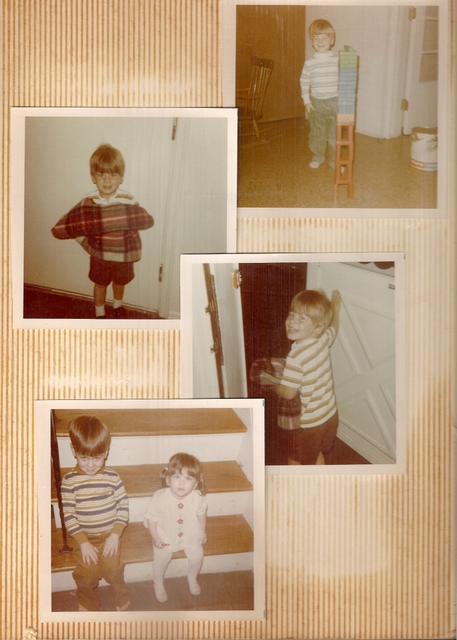
It’s the first day of school for most of the schools here in Israel. It set me to thinking about my oldest child’s first day. Here is the album page– the photos are so glued as to be destroyed if removed. The middle two pictures are from the first day of school. The upper picture is of one of his building projects. The lower picture is with his sister, Rachel.

Benjy's first day

Benjy's first day

I remember his first day of nursery school. His teacher was a gentle, kind, woman who believed in reason and calm discussion. His nursery school was located in the synagogue where my husband served as rabbi, and so it was not very worrisome to have him away since I knew his father was close by.

He was the kind of child who played his cards close to his chest. Introverted. He didn’t tell me a word about what was going on at school. I would hear from the other parents about the visits of musicians and of fantastic art projects and incredibly creative activities. He told me nothing. But it wasn’t worrisome, because I knew his father was nearby and that he was safe.

Well, kind of safe.

I remember the first time the teacher called to tell me that Benjy had run away from school. The school was the equivalent of close to a mile by car or across a number of parking lots and down the side of a steep hill from our house. This was not good news. Benjy was found within about a half hour, but I was shaking for a lot longer.

The second time he ran away from school, he was a bit smarter. He took a little girl with him and before the teacher noticed, they had already traversed the hill and the parking lots, I suppose, because she couldn’t find them. She called and asked me to go out and look for them. I was at home with three little children, ages 3, 17 months, and one month. I was not able to go and look. I was able to panic. Fortunately, the two showed up at my back door not long afterwards.

As the other children grew up and started school, the first day was a happy day for them and for me. The others were not nearly as adventurous as their big brother, (although just as mischievous, each in his/her own way).

It was only when the youngest went to nursery school for the first time that I was swept away by the feeling that I was not just relinquishing control of her, but that I was trusting the world to take good care of her. I knew too much about the world to feel confident that others would treat her the way I wanted her treated– with kindness and gentleness. As I sat in the room with her the first day and the teacher distributed the juice in tiny cups, I saw her take her cup and put it to her lips. I thought, “she is going to drink what is given to her. Please let the world serve her only good things.”

Today most of my grandchildren start school once again. A few are going to day care for the first time. I pray that the world treats all of these precious children as they deserve to be treated. I pray that they will become the kind of people who will make the world a better place.

4%

I promised myself I would wait for a while to see what happened. I know that what I say will be offensive to some of my best friends and possibly a relative or two, but I can’t keep silent any longer.

You see, today a survey was made public that said that only 4% of Israelis consider Obama to be pro-Israel. It was no surprise to me. I cringed the day after his his speech to AIPAC when he said he didn’t really mean that Jerusalem should remain Israel’s undivided capital. I knew all of those bright rosy predictions based on his “Jewish advisors” were fantasy. No one who has lived in Israel can deny that often the worst critics of Israel are members of Israel’s own suicidal left wing.

It was during the Cairo speech that I cringed once again. This time it was his implication that Israel’s legitimacy devolved from the Holocaust. This, of course, is the claim of our Arab enemies. They assert that the Jews were given Israel as recompense for damages done to the Jewish people during the Holocaust. Hence Holocaust denial. If the Holocaust never happened, then the Jews don’t have a claim on the land. In fact, our right to this land is thousands of years old. This is the land of our patriarchs- Abraham, Isaac, and Jacob, of our matriarchs, Sarah, Rebecca, Rachel, and Leah. To dismiss this legitimacy of ours to live here, to work and to love this land is to deny us our very soul.

When he tells us that Jews should not be allowed to build homes in parts of the land of Israel, it shocks me. To say that Jews cannot live somewhere because of their religion???? I seem to remember some famous people who struggled for civil rights who said something about people not being denied equal rights because of the color of their skin. Is he asking for parts of the land of Israel to be Judenrein?

And so today, it did not surprise me to see that the percentage of Israelis who think Obama is pro-Israel has fallen from 6% to 4%. Frankly, I’m surprised that there’s anyone who still thinks so.

But here’s the scoop…. despite every US president’s commitments to the state of Israel, I do not believe that the US must support Israel. No, really, I don’t. The US needs to do what is best for the US. The great tragedy of this current policy of embracing enemies and distancing friends is not good for the US. Pressure on Israel from a country seen to have been friendly in the past encourages their fantasies of our destruction.

Israel can and will take care of itself, but the world is becoming an ever more dangerous place.

Not a zero-sum game

I have been thinking lately about families and what makes them so important for the individuals in them. Of course there’s love and affection. Of course there is respect and consideration. And there also is loyalty. When I wrote a couple of days ago about competition and how it is unhealthy in the context of a family, I didn’t talk about one very important concept: the zero-sum game.

The zero-sum game, briefly is: A situation or interaction in which one participant’s gains result only from another’s equivalent losses. Source: here

Unfortunately, most of us go through life thinking it’s a zero-sum game. That’s why people are so competitive. “I can only win if the other guy loses.”

When my children were young, we had a book of cooperative games. Instead of “King of the Hill” where one person gets to the top of the hill and pushes all of the others down, the book recommended a game where as many people as possible get to the top of the hill and they cooperate to see how many they can hold up there. Games which foster cooperation also foster healthy relationships. Games like “Red Rover” where everyone is on the winning team help children understand that there doesn’t have to be a loser.

When family member achieve personal or professional expertise, other family members need to not just be happy for them, but to rejoice in it for themselves. Every strength of every member of the family only increases the others’ strength. As my children excel in areas I can’t even touch or understand, I feel personally enriched. I share in their happiness. And, fortunately, that is how they feel about each other.

Shel Silverstein said it well:

Yonatan and his little sister Naomi Elisheva

Yonatan and his little sister Naomi Elisheva

Hug O’ War

a poem by the late Shel Silverstein
[Author of A Light in the Attic]

I will not play at tug o’ war

I’d rather play at hug o’ war,

Where everyone hugs

Instead of tugs

Where everyone giggles

And rolls on the rug,

Where everyone kisses

And everyone grins

And everyone cuddles

And everyone wins.

Pomegranates 2

I had so many lovely comments about the pomegranates that I was stunned. A few people commented that they had never seen what they look like growing on a tree. Since we harvested only some of them, I have included some pictures of the fruit laden tree in our garden.

Here is a view of the garden:

A view of the garden

A view of the garden

When we bought our house, I never realized how much pleasure I would get from that garden. We have only a small patch of grass, but yesterday it served as a base for the inflatable swimming pool I bought before I moved into the house. Yesterday was the first time I used it. Kinneret, 2 years old, enjoyed playing in the pool, emptying water from cup to cup and having my husband and me and her pouring the cups of water on her back, her head, and her chest. She giggled and laughed and splashed. It was idyllic– and it took place in the shade of the pomegranate tree.

The tree arching over the path

The tree arching over the path

And here are a couple of the growing pomegranates

Still ripening

Still ripening

Your enemy is my enemy

When I wrote about competition a couple of days ago, I was really writing about human relationships, particularly those among family and friends because competition is unhealthy in the context of friendship and intimate relationships– except as modified by Virginia Satir (if you haven’t already, see Competition).

But today, in thinking about close relationships I want to talk about loyalty. Loyalty is one of the most important elements of a relationship. Loyalty means that a friend or loved one will choose to support and defend their loved one no matter what. It means that we can always count on that other person to be there for us and stand up for us. It means that if we have been hurt or wronged, that other person will understand and feel the hurt and want to help us.

Early in our marriage, my husband, a loving and kind person, made sure that any time I felt hurt or slighted, I would know that the other person really was kind and good and that I was too sensitive. I found that hurtful– more hurtful than what the stranger had done to me. I wanted him to tell me that it wasn’t right that this person was insensitive or unkind to me. I didn’t want to hear why the other person was right and I was overly sensitive. To me, that was treason. His job as my husband and my best friend was to hear me and feel my pain and to take my side. I wasn’t asking him to retaliate. I wasn’t asking him to talk to the other person. I just wanted to be understood.

Fortunately, he’s gotten a lot better (though not 100%), but it is something I taught my children as well. The world can be a cruel and unkind place. There are people who unknowingly and knowingly hurt others. The people we rely on and love need to be with us. They don’t need to be our moral compass that informs us that no one really wants to do wrong or that the other person was busy/sick/preoccupied/annoyed etc. etc. We don’t want to hear excuses for why the other person was right and we were wrong. What we want to hear is, “No one has the right to hurt you like that; I love you; you are a good and worthwhile person.”

That’s loyalty. And that’s what we need to do as family members or close friends.