Why I am not wishing “peace” this year

Every year at Rosh Hashana, we exchange the wishes for a happy, healthy, prosperous new year. I used to put “peaceful” into that mix, but this year, I just can’t do it. I know that it is a lie. Peace is not just around the corner.

You see, the problem we have here in Israel is not that we don’t want peace. It’s not that we won’t give up the building of homes in communities in Judea and Samaria. What it is is an ideology fed to Arab children from the day they are born that has to do with eradicating the Jews from all of Israel. I believe that peace cannot come from conferences, from concessions, from cajoling, or from horse-trading. Peace will come when a responsible Arab leadership cares more about the life of their people than about the destruction of mine.

All attempts we have made have only emboldened the radical elements. If they believe that we are tired, sick to death of the terror and the pain, then they will only give us more so that we give up, capitulate, leave.

Economic success, educational success, building a society that serves the needs of its citizens is what will bring about a change in the mind set. It is what will make this senseless hatred recede as parents educate their children to achieve and to value knowledge and to love learning instead of longing for “martyrdom.”

So my prayer, it isn’t for peace. It is for the beginning of a change in the hearts and minds of the people who want to destroy me and my people. I pray that G-d will open their hearts to the knowledge that their children are precious gifts as are all of G-d’s children. I pray that by next year, the Arab parents will begin to value their children and their children’s future. I pray that responsible Arab leadership will focus on what they can do to help their people live happy meaningful lives.
Musings on the first day of school

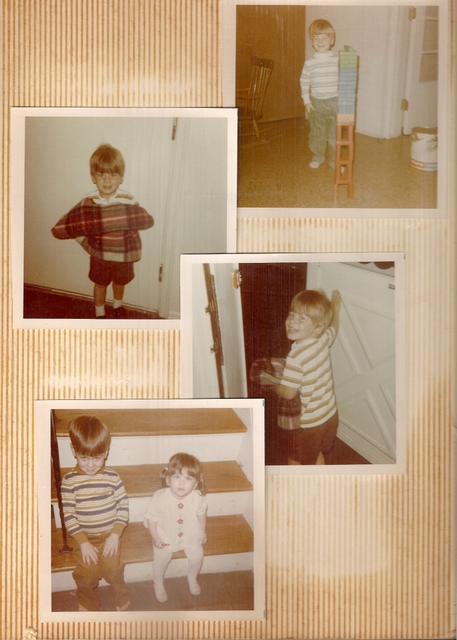
It’s the first day of school for most of the schools here in Israel. It set me to thinking about my oldest child’s first day. Here is the album page– the photos are so glued as to be destroyed if removed. The middle two pictures are from the first day of school. The upper picture is of one of his building projects. The lower picture is with his sister, Rachel.

Benjy's first day

Benjy's first day

I remember his first day of nursery school. His teacher was a gentle, kind, woman who believed in reason and calm discussion. His nursery school was located in the synagogue where my husband served as rabbi, and so it was not very worrisome to have him away since I knew his father was close by.

He was the kind of child who played his cards close to his chest. Introverted. He didn’t tell me a word about what was going on at school. I would hear from the other parents about the visits of musicians and of fantastic art projects and incredibly creative activities. He told me nothing. But it wasn’t worrisome, because I knew his father was nearby and that he was safe.

Well, kind of safe.

I remember the first time the teacher called to tell me that Benjy had run away from school. The school was the equivalent of close to a mile by car or across a number of parking lots and down the side of a steep hill from our house. This was not good news. Benjy was found within about a half hour, but I was shaking for a lot longer.

The second time he ran away from school, he was a bit smarter. He took a little girl with him and before the teacher noticed, they had already traversed the hill and the parking lots, I suppose, because she couldn’t find them. She called and asked me to go out and look for them. I was at home with three little children, ages 3, 17 months, and one month. I was not able to go and look. I was able to panic. Fortunately, the two showed up at my back door not long afterwards.

As the other children grew up and started school, the first day was a happy day for them and for me. The others were not nearly as adventurous as their big brother, (although just as mischievous, each in his/her own way).

It was only when the youngest went to nursery school for the first time that I was swept away by the feeling that I was not just relinquishing control of her, but that I was trusting the world to take good care of her. I knew too much about the world to feel confident that others would treat her the way I wanted her treated– with kindness and gentleness. As I sat in the room with her the first day and the teacher distributed the juice in tiny cups, I saw her take her cup and put it to her lips. I thought, “she is going to drink what is given to her. Please let the world serve her only good things.”

Today most of my grandchildren start school once again. A few are going to day care for the first time. I pray that the world treats all of these precious children as they deserve to be treated. I pray that they will become the kind of people who will make the world a better place.

Not a zero-sum game

I have been thinking lately about families and what makes them so important for the individuals in them. Of course there’s love and affection. Of course there is respect and consideration. And there also is loyalty. When I wrote a couple of days ago about competition and how it is unhealthy in the context of a family, I didn’t talk about one very important concept: the zero-sum game.

The zero-sum game, briefly is: A situation or interaction in which one participant’s gains result only from another’s equivalent losses. Source: here

Unfortunately, most of us go through life thinking it’s a zero-sum game. That’s why people are so competitive. “I can only win if the other guy loses.”

When my children were young, we had a book of cooperative games. Instead of “King of the Hill” where one person gets to the top of the hill and pushes all of the others down, the book recommended a game where as many people as possible get to the top of the hill and they cooperate to see how many they can hold up there. Games which foster cooperation also foster healthy relationships. Games like “Red Rover” where everyone is on the winning team help children understand that there doesn’t have to be a loser.

When family member achieve personal or professional expertise, other family members need to not just be happy for them, but to rejoice in it for themselves. Every strength of every member of the family only increases the others’ strength. As my children excel in areas I can’t even touch or understand, I feel personally enriched. I share in their happiness. And, fortunately, that is how they feel about each other.

Shel Silverstein said it well:

Yonatan and his little sister Naomi Elisheva

Yonatan and his little sister Naomi Elisheva

Hug O’ War

a poem by the late Shel Silverstein
[Author of A Light in the Attic]

I will not play at tug o’ war

I’d rather play at hug o’ war,

Where everyone hugs

Instead of tugs

Where everyone giggles

And rolls on the rug,

Where everyone kisses

And everyone grins

And everyone cuddles

And everyone wins.

Pomegranates 2

I had so many lovely comments about the pomegranates that I was stunned. A few people commented that they had never seen what they look like growing on a tree. Since we harvested only some of them, I have included some pictures of the fruit laden tree in our garden.

Here is a view of the garden:

A view of the garden

A view of the garden

When we bought our house, I never realized how much pleasure I would get from that garden. We have only a small patch of grass, but yesterday it served as a base for the inflatable swimming pool I bought before I moved into the house. Yesterday was the first time I used it. Kinneret, 2 years old, enjoyed playing in the pool, emptying water from cup to cup and having my husband and me and her pouring the cups of water on her back, her head, and her chest. She giggled and laughed and splashed. It was idyllic– and it took place in the shade of the pomegranate tree.

The tree arching over the path

The tree arching over the path

And here are a couple of the growing pomegranates

Still ripening

Still ripening

Your enemy is my enemy

When I wrote about competition a couple of days ago, I was really writing about human relationships, particularly those among family and friends because competition is unhealthy in the context of friendship and intimate relationships– except as modified by Virginia Satir (if you haven’t already, see Competition).

But today, in thinking about close relationships I want to talk about loyalty. Loyalty is one of the most important elements of a relationship. Loyalty means that a friend or loved one will choose to support and defend their loved one no matter what. It means that we can always count on that other person to be there for us and stand up for us. It means that if we have been hurt or wronged, that other person will understand and feel the hurt and want to help us.

Early in our marriage, my husband, a loving and kind person, made sure that any time I felt hurt or slighted, I would know that the other person really was kind and good and that I was too sensitive. I found that hurtful– more hurtful than what the stranger had done to me. I wanted him to tell me that it wasn’t right that this person was insensitive or unkind to me. I didn’t want to hear why the other person was right and I was overly sensitive. To me, that was treason. His job as my husband and my best friend was to hear me and feel my pain and to take my side. I wasn’t asking him to retaliate. I wasn’t asking him to talk to the other person. I just wanted to be understood.

Fortunately, he’s gotten a lot better (though not 100%), but it is something I taught my children as well. The world can be a cruel and unkind place. There are people who unknowingly and knowingly hurt others. The people we rely on and love need to be with us. They don’t need to be our moral compass that informs us that no one really wants to do wrong or that the other person was busy/sick/preoccupied/annoyed etc. etc. We don’t want to hear excuses for why the other person was right and we were wrong. What we want to hear is, “No one has the right to hurt you like that; I love you; you are a good and worthwhile person.”

That’s loyalty. And that’s what we need to do as family members or close friends.

Competition

I haven’t posted in a while on anything therapy/growth related and it’s about time. For the last two days I have been thinking of competition. Competition seems to be hard-wired in human beings. Even very little children want to be able to do something better than their sibling. They want to be thought smarter, prettier, cuter. They say things like “I can hold my breath longer than you can” or “my picture is nicer.”

It makes sense that we compare ourselves to others. There has to be some yardstick for performance, else how would we know if a performance were better or worse than average. We looked at Susan Boyle and we compared her to other women her age, other women singers, and before she began to sing, we expected that she would be laughable. Her appearance was thought to be substandard and people expected that her performance would be too. Everyone was surprised when she opened her mouth to sing and her singing was beautiful. In our minds, we compared it to the type of singing a normal person does and it was much better and then we held it up to a higher standard and she met or surpassed it. Comparisons help us make judgments.

However, competition turns out to be inappropriate and even harmful in many circumstances. In relationships with siblings and spouses, competition leads to devaluing behavior, sabotage, and ridicule. In families, we are on the same team. We need to be happy when any of our team members scores a basket! We need to help them maximize their performance just as we strive to do our own best. Saying “great job” and “wow, you did it!” when someone else has achieved something costs nothing and helps to build good will and feelings of security.

We all accept the concept of sibling rivalry as natural. Parents struggle to help each of their children to feel loved and valued, but there is always an echo of that rivalry. However, even worse is the situation when people have been programmed from early childhood to be comparing themselves to all others around them. The result is either always feeling wanting and inadequate or feeling superior (often without reason).

There are sometimes good results from striving for the kind of excellence that would lead people to see one as superior. People go to school and study for years to become the most knowledgeable, the recognized authority. People design research studies to achieve benefits for the public at large, but also because they want others to recognize their achievement and superiority.

But when competition enters family life, it is often destructive. When husband and wife each strive to be the one who is right all the time or the one who knows best, both of them suffer. When children are compared to one another in a way that lessens the value of one, that is destructive not only to the child’s ego, but to the sibling relationship– a relationship that often is the most satisfying lifelong relationship a person has.

Virginia Satir, a talented and much loved family therapist once told a couple that their competition was not a bad thing. The bad thing was what they were competing about. She suggested they compete to see who in the couple be the most loving, the most caring, the most forgiving, the most supportive, the most helpful. It’s the kind of competition that families need. It’s the kind of competition the world needs.

Some smiles

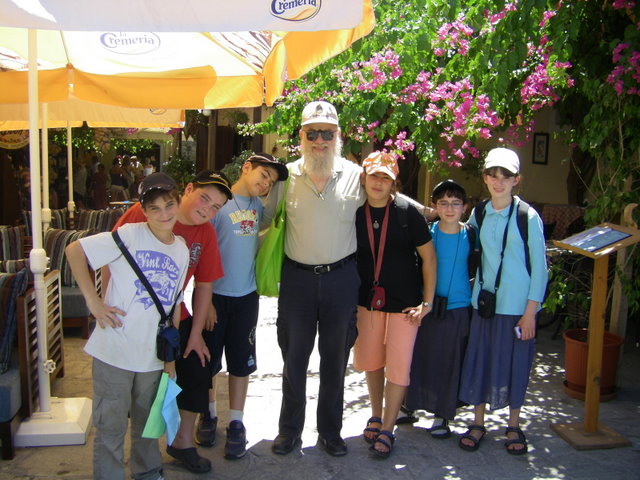
Here’s a photo of the children and their Saba on the Greek Island of Kos. It was a beautiful sunny day and the children loved walking through the colorful market area and exploring.

Six of our grandchildren and their Saba (grandfather)

Six of our grandchildren and their Saba (grandfather)

The cruise was a wonderful adventure.

The threes

The other night when I was lying in bed trying to fall asleep, I began to think about how old I am and how impossible it was for me to believe that I am not still in my thirties. And then I did a little exercise with myself that I found interesting. I imagined myself and my situation at every age that ended in 3.

3– At three years old I lived in Philadelphia with my parents. We lived in an apartment over a store space where my father fashioned items out of plastic. He made plexiglass forms that he painted and mounted on wooden platforms and wired as lamps. In a little over a year, he would be convinced that there was no future in plastics and to join my mother’s family in the floor covering business.

13– This was the year of my bat mitzvah. How happy I was! I had waited a long time and finally it was here. My parents and grandparents were excited too. I remember standing on the pulpit wearing a white robe over the totally inappropraite dress my mother had gotten me and little satin kippah with a tassel that my grandfather had made for me and taking part in the service. I remember when everyone turned around with the last verse of L’cha Dodi, my parents who were sitting in the front row and hadn’t been to shul much, didn’t know to turn around. I never mentioned it to them.

23– By now I was married and had a sweet little boy. In the just over two years my husband and I were married at that point, we had moved three times. I was now living in Somerset New Jersey on Sweetbriar Lane. The address itself seemed idyllic. The congregation he served there was not. Just before Rosh HaShana, I found out that I was pregnant and we called our parents to wish them a happy new year and to tell them that we had a wonderful surprise in store.

33 — We were now living in Germany and there were five children, the youngest born there, now 5 months old and just getting over her colic. We had done some traveling in the country, some volksmarches, and generally enjoyed living there. We had just returned from a month-long visit to Israel!

43– After living in Georgia, Massachusetts, and Oklahoma, we finally moved about an hour and a half from Philadelphia. By then, my father had already passed away and he was not able to enjoy our proximity. Our oldest son was in the Israel Army and our older daughter was also in Israel. A son who was studying in the US was away at Yeshiva in Israel for the year, another son was studying in New York and we had only our youngest at home with us. I was studying at the University of Pennsylvania for a doctorate in social work even though I had been trained, licensed, credentialed, and working as a marriage and family therapist. It felt like I was squandering the family fortune on tuition. Well, actually, I was.

53– I had moved to Israel 3 years earlier and I had moved into our current home, the 18th since we got married, about three months earlier. What a joy it was to be in Israel, close to all of my children and grandchildren (there were 9 by then) and waiting with great anticipation for the day when my husband would join me.

63 — Now there are 29 grandchildren, my home is just about the way I want it to be (OK, we could use cleaning help), and I get a special thrill out of tour guiding to China and Vietnam/Cambodia! Who knew how many turns my life would take, how much would happen over the years. Stay tuned for more updates!

On cell phones, facebook, skype and why you should book a tour to China for you and your grandchild

I have often thought of my life as somewhat unbelievable. The world has changed enormously from even the time when my children were teens. In those days the average person did not have a cell phone. Computers had text interfaces and so seeking information was possible, but photos and movies were not even considered a possibility.

I have come to know and cherish (yes, and sometimes curse) the new technologies. Cell phones have made it easier for people to meet, to decide on the basis of current conditions where and when to meet. Missing husbands can be found just by pressing the appropriate speed dial.

Facebook is a phenomenon that is amazing. I have found friends I’d lost touch with and relatives that I didn’t know existed. I can catch snippets of my friends’ and relatives’ lives without intruding. I can see their pictures the day they are taken, and all in the comfort of my home.

Blogs allow us to get to know people in an even deeper way. We can know what they are thinking, what they are doing, how they process their daily experiences, what they like to do, and what their dreams are. In fact, the internet, in some ways, is like having a big window through which you can watch the world go by.

But this morning, I felt I had entered some sort of new reality when I sat down to my computer, just before 8 a.m. and had a skype call (complete with video) from two of my grandsons who are currently visiting the other side of the family in Los Angeles. It was amazing to see them and talk to them and know that it they would soon be going to sleep while I was just starting my day. I could hear their younger siblings in the background. And best of all, it wasn’t costing anyone a penny! It’s the type of technology that my parents would have given anything to have.

It once again set me to thinking about the whole issue of how grandparents and grandchildren relate to one another. For me, having now been on vacation with a total of 7 grandchildren, it seems clear that spending leisure time together, unmediated by their parents, seems to forge the strongest and most affectionate ties. I feel now that I really know these children in a way I hadn’t known them before and we share now adventures and memories that are only ours. The better I get to know them, the more I appreciate them, and hopefully we are together creating memories that will last a lifetime. Try it, you’ll like it!

He never said goodbye

When I was a young girl, I was not very happy. Aside from all of the other issues little girls have, I also had a mother who was a perfectionist. It seemed to me that there was nothing I could do to please her. She would find something wrong with me each and every time she was near me. My dress was wrinkled, there was a stain on my skirt, a button was missing, I sat funny, I shouldn’t shake or swing my leg when I was sitting, I shouldn’t touch the fabric on the chair, my button was missing, my shoe was scuffed, I was a “klutz,” etc. etc.

Because she convinced me that I was a failure as a human being, it was a given fact that everyone knew it and therefore I had no friends because I knew the other little girls were judging me and I was found wanting.

When I entered junior high school, I sat in the auditorium where the principal explained to us that unlike elementary school, here we would have to work hard and do our homework and study. I spent much of my time in the library taking one book after another off the shelf that had books about people who had suffered. Among others, I read about Tomy Keitlin and how she lost her sight. I read “Miracle at Carville,” a book about lepers. I read, “My Left Foot” about a boy who was paralyzed. And I read “Death Be Not Proud” where the writer’s son dies. I read these books because at least these people were suffering more than I was, and somehow, it made my suffering more manageable.

But at some point something the principal had said set off a spark in me. He said that if we were having problems, there were counselors who would help us.

I didn’t know how to get the counselor to help me. No one said what to do if you were having trouble. So, I looked for a reason to see a counselor. One day, in cooking class, the twins (two girls whose names I’ve long forgotten) did something that annoyed me. I don’t remember what it was, but it seemed to me that it was a good reason to go to the counselor.

I went to see the counselor. I don’t remember anything about that meeting except that it didn’t end with his telling me that I didn’t have to go back home to my mother.

One day, a week or so later, though, my mother came and picked me up early from school. She told me that she was taking me to see someone I could talk to who would really understand me. I think at that point she was admitting that she had not a clue.

Apparently the school had called my mother and told her that I was seeking help. We went to the Philadelphia Child Guidance Clinic. There I was seen by a therapist and my mother was seen by a social worker and the plan was that they would coordinate with each other.

I was young and didn’t understand much. What I understood was that this somewhat shy and self-effacing man sat in a room with me and listened. I do remember that he told me that my mother was the way she was because of how her mother had treated her and that he hoped that we could work to stop that cycle. One thing I knew for sure: I didn’t want to be the same kind of mother to my children that my mother was to me.

My times with him were quiet and calm. I remember there being toys in the room, but he never suggested I play with them and I never quite knew what I should say.

Once (or maybe more) I felt so terrible between sessions that I wrote him a letter that I sealed in an envelope for him to read at the next session.

Once, when I told him that things at home were, if anything, getting worse, he told me that that meant that I was getting better and that my mother was unable to deal with it. I didn’t understand, but the words comforted me.

After about two years, I stopped seeing him on a regular basis and my mother would call him to consult or to see either me or my sister or her in times of crisis. My sister and I called him her “Prime Minister.”

When at 18 I became engaged, my mother sent me and my fiance to see him. He saw us and explained to us that it would be better for us not to live in the same city as my mother as she wouldn’t let us have a normal married life. She was simply too intrusive.

My fiance decided not to marry me. He thought I was going to end up being like my mother. I was devastated. I finally had plans to leave home and they were shattered.

A year later, my husband, who by my design never really got to know my mother, and I were married.

Ten years later, my former therapist (who had been in touch with my mother over this period) send me a short note and some educational materials he’d produced. By that time, I had 4 children. I was living in Wiesbaden, Germany. He wrote, “My wife was born in Wiesbaden; Good vibes!!”

Ten years later, I was presenting a workshop for family therapists at a conference in Dallas. He was presenting something in Dallas on the same weekend. I wrote him and mentioned the coincidence. He invited me to join him for breakfast on Sunday morning.

We sat and talked, this time as colleagues– about my childhood, about my husband and children, about my professional life and the work I was doing on therapeutic metaphor, and even about his interaction with my ex-fiance. He said, “I just didn’t think he was good for you.”

A couple more times over the next 20 years, we exchanged notes and once along with my sister, I met up with him in Tel Aviv, where he was living at the time.

A few days ago, I came across his obituary. He passed away at age 85. He was a gentle presence in my life. Dr. Sol Gordon will be missed. Goodbye dear friend.