A Fictional Tale

Remember all those word problems we had to figure out in school? John is twice as old as his sister Mary will be when John’s younger brother, Christopher has his bar mitzvah- how old is his mother? OK, John and Mary are not likely to have a brother who is having a a bar mitzvah, much less “Christopher” but that’s beside the point. It’s also a lot easier than the word problem I’ve been trying to solve in the last 24 hours.

Let’s say a fictional woman has 5 fictional children. Two of them live within walking distance and the others live less than an hour’s drive away. (I’m giving you irrelevant information, akin to the names above, but you have to figure out which information *is* relevant– you will be tested on this.) Now let’s say that there’s a fictional holiday coming up at the beginning of next week (end of this week for John, Mary, and Christopher). For this fictional holiday, this fictional woman has been inviting all of her fictional children and her fictional grandchildren (an ever-increasing number) for the last, let’s see, maybe 10 years. At first, they would meet in the morning to hear the (fictional) megilla. Then, after a few years (maybe 7 or so), they would meet in the evening. Bagels and lox would have been a component of this fictional adventure. OK, so now you have the fictional history up to a couple of weeks ago.

At that time the fictional woman wrote an email to all five of the children suggesting they meet in the morning since the evening was after shabbat and therefore it would of necessity start late and the grandchildren would be tired etc. No one seemed to object. Let’s call the fictional children living close by the fictional woman A, B, & C (yes, I am aware I had said two lived close by; A, B, & C are the names of all three of the two of them, but that’s another story). A,B, & C all were fine with the plan. Let’s call the three who live within an hour’s driving distance X, Y, & Z (this fictional woman was not very creative at name-giving. Poor children… imagine the looks they got in school when they introduced themselves. I’ll bet though, no teacher asked them what they were called “for short.”)

The first sign of trouble was when X said, “Remember, we must leave by 9:30 a.m.” Not that it was trouble, but combined with the next statement, it presented problems. It was when Y said “It’s unrealistic to think that we can get there before 9:30 a.m.” What to do? One is arriving when the other is leaving and the whole point is for everyone to be there at the same time. It became a problem especially since the fictional woman does not want to upset or hurt any of her fictional children and pretty much is waiting with bated breath to see all of her totally adorable fictional grandchildren in their fabulous (fictional) costumes.

The fictional woman consulted with A,B,C, & Z. There were a number of suggestions including Skyping the X family in, meeting on Monday, buying Y a new alarm clock (threw that one in to fool you– no one actually (or fictionally) said that), etc. The fictional woman tried several different tactics from “Work it out yourselves” to “Let the disinterested parties work it out and we’ll abide by their decision” to “Let’s talk about interests rather than solutions.” At one point X suggested that X & Y work it out over a steak. The fictional woman was pretty sure who would be called upon to pay for the steaks.

No fewer than 32 emails were sent and several telephone calls were made. In the end, the X family sent its chief negotiator to settle the matter, more or less to everyone’s satisfaction.

Stay tuned for the fictional pictures sometime next week.

Anger as a motivational tool

It doesn’t work.*

*Really. Believe me. Kindness works wonders. Anger, not helpful. Need I say more?

Savta, Grandma, Bubby, Nana

If new parents have a complaint “no one prepared me for parenthood” and parents of newly married children realize there is no road map to being a mother/father-in-law, there is another path that is far more uncharted. How does one be a grandparent?

You see, most people have been around new babies. They have watched friends or siblings or cousins be new parents. They observe comforting techniques, clever holds, and parent-initiated play. But being a parent-in-law and being a grandparent are far harder skills to learn.

We may have learned that in-laws were outlaws. Comedians told us that mixed feelings were what happened when you saw your mother-in-law driving off a cliff in your new Cadillac. Our own parents may have complained of in-laws’ meddling or of their disinterest. It seems that very few families hit a good balance.

But perhaps, even more problematic is how to define ourselves in the roles of grandparents. For many of us, our own grandparents seemed ancient when we were young, and seeing them as people separate from their grandparent role was so very difficult. They were obviously created only for our comfort, the real purveyors of unconditional positive regard.

At first, it’s not that hard. We coo and we smile and we hold and rock the infants. They are so lovable. I never really understood the word “delicious” until I looked at my first grandchild and now the youngest is just as delicious. But what do we do as they grow older?

Early on I decided that I was not into buying their love. First of all, Israeli homes are small. Secondly, my children buy their children everything they need and much of what they want. They lack for nothing. I didn’t want my grandchildren to look forward to my visits as a gift extravaganza. I also didn’t want to force hugs or kisses on them, as much as they were so very appealing. I remember as a child feeling smothered in my grandmother’s ample bosom. I didn’t want my grandchildren to feel that.

So how do we build healthy relationships with them? How do we let these precious young people know that we love them?

I decided that my home should have interesting things for the children to do when they come. Boxes of Legos, wooden blocks, small cars, little plastic people, and hand puppets are available. We have checkers and chess and playing cards. We have childrens’ videos and books. We sometimes show them home videos of interesting places we’ve been. We placed in the garden little figures in both ceramic and plastic of animals and gnomes that the children enjoy identifying, visiting, and often moving around from one place to another in the garden. Some of the figures are on the ground, some are hanging from trees, and one gorilla is climbing up a large pottery urn. As the seasonal fruits ripen on our trees and vines, together we pick plums, pomegranates, clementines, and lemons. We harvest grapes. We are growing kumquats and in another couple of years, when the fruit may be eaten, they will join the cycle. And we usually have an ample supply of pretzels and chocolate milk. In fact, when the children visit, often they home in on the chocolate milk as if it is a ritual. Of course the other thing we have done is the special trips that by now we have taken 7 of the grandchildren on.

We, of course, talk with them, listen to them, tell them stories about when their parents were young and tell them of our own adventures.

My maternal grandparents and their 6 oldest grandchildren

My maternal grandparents and their 6 oldest grandchildren 1955


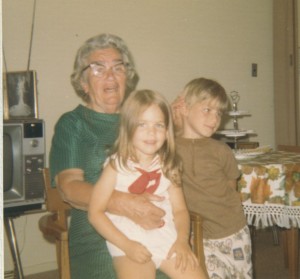
My paternal grandmother and my two oldest children (her great-grandchildren) 1973

My paternal grandmother and my two oldest children (her great-grandchildren) 1973


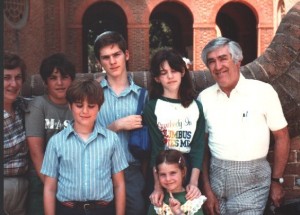
My parents with their grandchildren, 1983

My parents with their grandchildren, 1983

What do you/your parents do as grandparents to foster close relationships with your/their grandchildren?

Musings on the first day of school

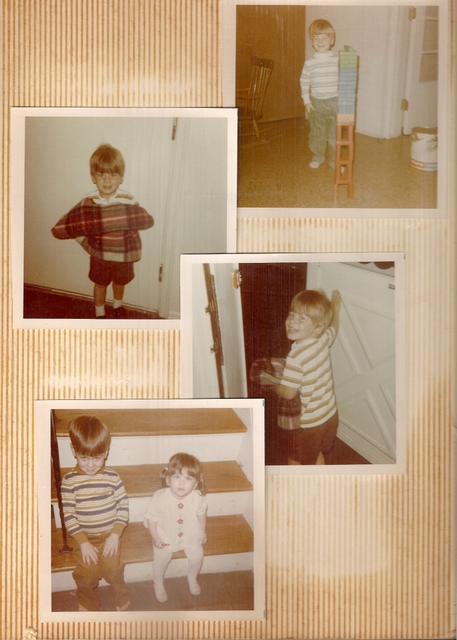
It’s the first day of school for most of the schools here in Israel. It set me to thinking about my oldest child’s first day. Here is the album page– the photos are so glued as to be destroyed if removed. The middle two pictures are from the first day of school. The upper picture is of one of his building projects. The lower picture is with his sister, Rachel.

Benjy's first day

Benjy's first day

I remember his first day of nursery school. His teacher was a gentle, kind, woman who believed in reason and calm discussion. His nursery school was located in the synagogue where my husband served as rabbi, and so it was not very worrisome to have him away since I knew his father was close by.

He was the kind of child who played his cards close to his chest. Introverted. He didn’t tell me a word about what was going on at school. I would hear from the other parents about the visits of musicians and of fantastic art projects and incredibly creative activities. He told me nothing. But it wasn’t worrisome, because I knew his father was nearby and that he was safe.

Well, kind of safe.

I remember the first time the teacher called to tell me that Benjy had run away from school. The school was the equivalent of close to a mile by car or across a number of parking lots and down the side of a steep hill from our house. This was not good news. Benjy was found within about a half hour, but I was shaking for a lot longer.

The second time he ran away from school, he was a bit smarter. He took a little girl with him and before the teacher noticed, they had already traversed the hill and the parking lots, I suppose, because she couldn’t find them. She called and asked me to go out and look for them. I was at home with three little children, ages 3, 17 months, and one month. I was not able to go and look. I was able to panic. Fortunately, the two showed up at my back door not long afterwards.

As the other children grew up and started school, the first day was a happy day for them and for me. The others were not nearly as adventurous as their big brother, (although just as mischievous, each in his/her own way).

It was only when the youngest went to nursery school for the first time that I was swept away by the feeling that I was not just relinquishing control of her, but that I was trusting the world to take good care of her. I knew too much about the world to feel confident that others would treat her the way I wanted her treated– with kindness and gentleness. As I sat in the room with her the first day and the teacher distributed the juice in tiny cups, I saw her take her cup and put it to her lips. I thought, “she is going to drink what is given to her. Please let the world serve her only good things.”

Today most of my grandchildren start school once again. A few are going to day care for the first time. I pray that the world treats all of these precious children as they deserve to be treated. I pray that they will become the kind of people who will make the world a better place.

Not a zero-sum game

I have been thinking lately about families and what makes them so important for the individuals in them. Of course there’s love and affection. Of course there is respect and consideration. And there also is loyalty. When I wrote a couple of days ago about competition and how it is unhealthy in the context of a family, I didn’t talk about one very important concept: the zero-sum game.

The zero-sum game, briefly is: A situation or interaction in which one participant’s gains result only from another’s equivalent losses. Source: here

Unfortunately, most of us go through life thinking it’s a zero-sum game. That’s why people are so competitive. “I can only win if the other guy loses.”

When my children were young, we had a book of cooperative games. Instead of “King of the Hill” where one person gets to the top of the hill and pushes all of the others down, the book recommended a game where as many people as possible get to the top of the hill and they cooperate to see how many they can hold up there. Games which foster cooperation also foster healthy relationships. Games like “Red Rover” where everyone is on the winning team help children understand that there doesn’t have to be a loser.

When family member achieve personal or professional expertise, other family members need to not just be happy for them, but to rejoice in it for themselves. Every strength of every member of the family only increases the others’ strength. As my children excel in areas I can’t even touch or understand, I feel personally enriched. I share in their happiness. And, fortunately, that is how they feel about each other.

Shel Silverstein said it well:

Yonatan and his little sister Naomi Elisheva

Yonatan and his little sister Naomi Elisheva

Hug O’ War

a poem by the late Shel Silverstein
[Author of A Light in the Attic]

I will not play at tug o’ war

I’d rather play at hug o’ war,

Where everyone hugs

Instead of tugs

Where everyone giggles

And rolls on the rug,

Where everyone kisses

And everyone grins

And everyone cuddles

And everyone wins.

Competition

I haven’t posted in a while on anything therapy/growth related and it’s about time. For the last two days I have been thinking of competition. Competition seems to be hard-wired in human beings. Even very little children want to be able to do something better than their sibling. They want to be thought smarter, prettier, cuter. They say things like “I can hold my breath longer than you can” or “my picture is nicer.”

It makes sense that we compare ourselves to others. There has to be some yardstick for performance, else how would we know if a performance were better or worse than average. We looked at Susan Boyle and we compared her to other women her age, other women singers, and before she began to sing, we expected that she would be laughable. Her appearance was thought to be substandard and people expected that her performance would be too. Everyone was surprised when she opened her mouth to sing and her singing was beautiful. In our minds, we compared it to the type of singing a normal person does and it was much better and then we held it up to a higher standard and she met or surpassed it. Comparisons help us make judgments.

However, competition turns out to be inappropriate and even harmful in many circumstances. In relationships with siblings and spouses, competition leads to devaluing behavior, sabotage, and ridicule. In families, we are on the same team. We need to be happy when any of our team members scores a basket! We need to help them maximize their performance just as we strive to do our own best. Saying “great job” and “wow, you did it!” when someone else has achieved something costs nothing and helps to build good will and feelings of security.

We all accept the concept of sibling rivalry as natural. Parents struggle to help each of their children to feel loved and valued, but there is always an echo of that rivalry. However, even worse is the situation when people have been programmed from early childhood to be comparing themselves to all others around them. The result is either always feeling wanting and inadequate or feeling superior (often without reason).

There are sometimes good results from striving for the kind of excellence that would lead people to see one as superior. People go to school and study for years to become the most knowledgeable, the recognized authority. People design research studies to achieve benefits for the public at large, but also because they want others to recognize their achievement and superiority.

But when competition enters family life, it is often destructive. When husband and wife each strive to be the one who is right all the time or the one who knows best, both of them suffer. When children are compared to one another in a way that lessens the value of one, that is destructive not only to the child’s ego, but to the sibling relationship– a relationship that often is the most satisfying lifelong relationship a person has.

Virginia Satir, a talented and much loved family therapist once told a couple that their competition was not a bad thing. The bad thing was what they were competing about. She suggested they compete to see who in the couple be the most loving, the most caring, the most forgiving, the most supportive, the most helpful. It’s the kind of competition that families need. It’s the kind of competition the world needs.

The threes

The other night when I was lying in bed trying to fall asleep, I began to think about how old I am and how impossible it was for me to believe that I am not still in my thirties. And then I did a little exercise with myself that I found interesting. I imagined myself and my situation at every age that ended in 3.

3– At three years old I lived in Philadelphia with my parents. We lived in an apartment over a store space where my father fashioned items out of plastic. He made plexiglass forms that he painted and mounted on wooden platforms and wired as lamps. In a little over a year, he would be convinced that there was no future in plastics and to join my mother’s family in the floor covering business.

13– This was the year of my bat mitzvah. How happy I was! I had waited a long time and finally it was here. My parents and grandparents were excited too. I remember standing on the pulpit wearing a white robe over the totally inappropraite dress my mother had gotten me and little satin kippah with a tassel that my grandfather had made for me and taking part in the service. I remember when everyone turned around with the last verse of L’cha Dodi, my parents who were sitting in the front row and hadn’t been to shul much, didn’t know to turn around. I never mentioned it to them.

23– By now I was married and had a sweet little boy. In the just over two years my husband and I were married at that point, we had moved three times. I was now living in Somerset New Jersey on Sweetbriar Lane. The address itself seemed idyllic. The congregation he served there was not. Just before Rosh HaShana, I found out that I was pregnant and we called our parents to wish them a happy new year and to tell them that we had a wonderful surprise in store.

33 — We were now living in Germany and there were five children, the youngest born there, now 5 months old and just getting over her colic. We had done some traveling in the country, some volksmarches, and generally enjoyed living there. We had just returned from a month-long visit to Israel!

43– After living in Georgia, Massachusetts, and Oklahoma, we finally moved about an hour and a half from Philadelphia. By then, my father had already passed away and he was not able to enjoy our proximity. Our oldest son was in the Israel Army and our older daughter was also in Israel. A son who was studying in the US was away at Yeshiva in Israel for the year, another son was studying in New York and we had only our youngest at home with us. I was studying at the University of Pennsylvania for a doctorate in social work even though I had been trained, licensed, credentialed, and working as a marriage and family therapist. It felt like I was squandering the family fortune on tuition. Well, actually, I was.

53– I had moved to Israel 3 years earlier and I had moved into our current home, the 18th since we got married, about three months earlier. What a joy it was to be in Israel, close to all of my children and grandchildren (there were 9 by then) and waiting with great anticipation for the day when my husband would join me.

63 — Now there are 29 grandchildren, my home is just about the way I want it to be (OK, we could use cleaning help), and I get a special thrill out of tour guiding to China and Vietnam/Cambodia! Who knew how many turns my life would take, how much would happen over the years. Stay tuned for more updates!

Notes I could have written today

1. Dear Hadassah,
You certainly have a lovely hospital out there on Mount Scopus, but would it hurt you to make it accessible to people with disabilities and mothers with strollers? It seems a bit unfair that the only way to avoid flights of stairs from the parking lot to the hospital is to use the very narrow sidewalk that contains one of those revolving gates into which one has to put a stroller between an adult who can push it through the bars and an adult who can pull it through on the other end.

2. And while I’m writing to you, Hadassah, may I add that the program devised for helping little children overcome fears about surgery is wonderful. It was delightful to hear the story of how an operation is carried out and to see the masks and monitoring equipment and to see the children play with modeling clay and eat breakfast together and to have a clown visit, but I am guessing that the 5.5 hours we spent there were pretty much lost on Ephraim who is 5 months old and is made to feel safe and content by drinking milk.

3. Dear Notebook Club,
Remember that computer we bought from you in November with the 22 inch monitor? Remember we were supposed to get in-home service for 3 years on the computer? Remember how suddenly when our monitor stopped working you told us you had nothing to do with it and to take it to the Dell place located in the bowels of Tel Aviv? I’ll bet you want to know what came next. Well, a week later, we picked up what they told us was a new monitor. However, it was unwrapped and had a sign on it that said, “Ready.” We brought it home. It worked for almost a week. I hope you have a creative solution for us that involves delivering a new monitor to our door or we will be looking for every opportunity to tell the world about your great service.

4. Dear President Obama,
I sure feel a lot safer today now that those outposts that were preventing peace have been dismantled. It’s amazing what destroying just a few homes can do. Wow. Peace is on its way.

5. Dear G-d,
It’s been kind of a rough time around here what with health issues and other complications. Could you not have picked a better time for the reappearance of my husband’s gout?

6. Dear World,

Would you please remember to pray for the safe recovery of my grandson, Ephraim Yehoshua ben Leah Gavriella?

Norms and deviations

Many years ago when I was studying for my doctorate, I took a course in psychological testing at the graduate school of education at the University of Pennsylvania. My professor, a singularly brilliant man, made this seemingly dry subject fascinating. He also helped us to understand tests and measurements in a new way. He gave us, for our final exam, a matching exam. On the left side of the page were 36 terms and on the right side of the page were 36 answers. We simply had to match the right one on the left side to the right one on the right side. As simple as that seems, my classmates and I puzzled over the answers for 2.5 to 3 hours. Not one person left the room before 2.5 hours were over– because for every term on the left, there were easily 2 and sometimes 3 or 4 answers on the right- and we had to find the correct one for each.

One of the terms on the left was “John’s IQ.” Strangely, that was the easiest one to answer. Because, of course, his IQ was 100. We knew that the mean score on an IQ test was 100. We knew that with a normal distribution, which IQ tests had, that within one standard deviation, 68% of the people tested would fit. We also knew that with the principle of regression to the mean, those who scored very high, would likely score lower the next time they were tested and those who scored very low, would likely score higher the next time they were tested. It was a good guess that John’s score would be 100.

I bring this up because although all of us are unique individuals, we also share a lot that makes us human. That means that none of us can fly without any apparatus on our own power. It means that all of us need to eat and to sleep. It is possible to posit certain norms.

So, when I have a family with a “problem child” who is noisy, rambunctious, demanding, and intrusive, I often will ask “How much sleep is this child getting?” Invariably, the response I get is, “He/she doesn’t require that much sleep.” The parents then go on to tell me that the child is up until midnight or later, but s/he is “wide awake” and “active” and “raring to go.” If the parents are willing to listen, the very first thing I tell them is this: “Your child does require a good night’s sleep and you need to help him/her get in the habit of getting it.” If the parents listen to me (and usually they do because they’ve invested their time, energy and money into the session) and begin to enforce reasonable sleep hours for their child, usually the second session begins like this:

“S/he’s a different child! I can’t believe it!”

And it’s true. People, all people, even your child, need adequate sleep or they become hyperactive, hypersensitive, irritable, and just plain annoying to be around. I used to tell my children, “I know it’s time for you to go to sleep because I am tired of your behavior.” I said it in a joking manner, but it was true. When children become unruly, often it is because they are tired.

Of course a side benefit of getting children into bed at a reasonable hour each evening is that the parents have a bit of time to themselves, something that is essential to keep the marriage healthy.

So, trust me, your child does require a full night’s sleep. I guarantee it!

Sleeping Abigail and friend

Sleeping Abigail and friend

Ahhhh

A sigh of relief. It’s almost done. Can’t wait to see all of the happy smiling faces. It’s worth it. All of it.