Feeling grumpy!

I am slowly recovering from my jet lag. We left Lima, Peru, at about 9 on Sunday night (Lima time), arrived in Madrid about 2 in the afternoon Monday (Madrid time) and took off again at about 11:50 pm, landing in Israel about 4:30 am on Tuesday– spending two nights on planes. So, I am a bit grumpy. And here’s what’s been really irking me:

Why is it that the woman in front of me on the last plane (the one that took off from Madrid at about midnight) who got onto the plane with her husband had to put on not only her own reading light, but the one beside her ALL NIGHT and proceed to blab with the 60 year old hippie guy with the earrings who stood in the aisle much of the trip talking to her and sounding like nothing so much as an overconfident teenager?

OK, I know there’s no good answer, but really people, isn’t it time that we grew up and started thinking about others? I mean, I understand that people want to do what they want to do, but at the expense of others? I mean I wouldn’t go and stand outside her window in the middle of the night and have a loud conversation. I wouldn’t take a flashlight and shine it in her face. Yes, I could. Yes, there’s no law against it. But is that the world you’d want to live in?

And while I’m grumping… Is it really necessary to push in front of everyone in order to get onto a plane? I seem to recall this thing called assigned seats. Best I can tell, if you have a boarding pass, chances are pretty good you’ve also got a seat. The first people onto the plane are not going to get to the destination any faster than the last ones.

And also, lines. People! Unless you’re having a health crisis, it probably isn’t going to kill you to wait your turn.

Yes, grumpy.

Catching up

If you read parts 1,2, & 3 of the adventure and wonder why I stopped writing, it’s because I have relocated the saga to the travel blog and added pictures when relevant. Chapter 5 in written and 6 is on its way. For anyone wondering about this question… It was a fantastic trip and even with all of the unscheduled adventures, our travelers had a great time, virtually untouched by tension and so did we (although not untouched by tension.) By the time I was home for 2 weeks, I was ready to go back and do it again– that’s how much fun it was… and you only can truly understand if you come along with me next time (hint, hint).

But now here we are in the little town of Modi’in (population >70K) for Hanuka and today we are anticipating the gathering of most of the clan– some members are not feeling well and some are away. Today is also an awful day in terms of air pollution and people have been urged to stay inside.

I have a lot of art supplies, a Hanuka video (“Lights”) and a few dozen latkes. Mostly, I am hoping that the little people get to spend time with their cousins and aunts and uncles.

Across from our house as you look to the right is a hill that some believe was the ancient city of Modi’in. It has artifacts from back to the Stone Age and ruins from several eras in between. At the top of the mountain is a water tower that has a series of columns that look like torches around it. For the last couple of years, they have lit the tower at holiday times with pastel lights. This year, nine of the columns have large lights on them that are lit according to the night of Hanuka. It’s quite impressive!

I wish all of you a wonderful bright Hanuka– and as a gift to yourself, a trip to China or Vietnam/Cambodia in 2010 is a pretty good idea!

Rona & Aaron’s Excellent Adventure, Part 3

Although I was of college age when the Vietnam War was taking place and people were demonstrating, some of them obsessing about every day’s battles, I was oblivious. I remained oblivious even when I got married and moved to Fort Knox, Kentucky, where my husband was serving as a chaplain in the US Army. Sure, I knew that we had guys being shipped out to ‘Nam, but I didn’t really pay much attention to the news, being somewhat self-absorbed. So, all I knew of Hanoi was that it was where the bad guys were and there was a woman who they called, “Hanoi Hannah” broadcasting nasty, morale-breaking things to our guys

Well, the Hanoi that I have come to know and, yes, love over the last couple of years is a bustling, busy city filled with interesting sights and sounds. During our day there we went to visit the mausoleum of Ho Chi Minh. It is a tasteful building into which people enter after passing through full security and leaving their cameras checked. People file in a single line, taking off their hats, walking silently into the building , ascending the stairs to the left, turning right and then right again and filing past Ho Chi Minh who is lit dimly and appears to still be alive. We walked the length of the coffin, then turning left, across the front and then turning left once again along the other side, filing out of the room, making two rights, and then going down the stairs. Something about the silence and the dim lighting with the soldiers standing at attention made the experience feel very dignified. Although he was a formidable foe, in the way he is revered in his own country, there is a sense of honor. Always depicted in photos and statuary as being with the children, he is seen as “Uncle Ho” who loved the children.

His tastes were simple. When he gained power, he was entitled to use the magnificent palatial edifice erected by the French when they were the colonial power. Instead, he lived in three sparse rooms for a period of several years until those around him explained to him that it was not an honor to the country for their leader to be so humbly housed. Then they built him a house on stilts, characteristic of Vietnamese architecture in the countryside. It also was quite humble, with just two rooms upstairs– an office and a bedroom– and eating and reception space exposed to the elements beneath it. It was fashioned of fine wood and is very attractive, but not at all the type of home one would expect for the head of a large country. Vietnam is now, by some estimates, a country of 87 million people!

On the grounds of the complex that housed his two homes and the palace, there was a pond where carp were raised. He would clap his hands and the carp would come to the surface to eat. There were also trees that bore fruit and the people of Hanoi were permitted to come and pick fruit.

Adjacent to Ho Chi Minh’s home is the One Pillar Pagoda, an interesting structure with a similarly interesting story. Around the entire area are beautifully landscaped gardens.

After leaving the Ho Chi Minh complex, we went to the Temple of Literature. It was there in the early 11th Century that Vietnam’s first university was founded. You can read more about it here. As our group walked through the front gate, the woman who heads up our operations in Vietnam and Cambodia arrived to talk to me.

The group proceeded with the local guide and my husband. I stayed behind to talk to her and to try and work out our plans. She had to have me sign permission for her people to pick up the luggage when it arrived from Hong Kong. It was due to arrive on the same flight as we had arrived on the day before. That meant that it would likely not be ready for pick up until at least 5 p.m. and with traffic, getting it in time for our people to be able to repack — getting out their winter clothing and putting it in their small luggage– in anticipation of our weekend train trip up north was problematic. I also was worried by the fact that she told me they only had paperwork on 11 of the 14 suitcases because I had not given them my baggage stickers until after they had done the paperwork– so although they had stickers for 14 suitcases, they only had paperwork for 11! I told her that it was really important to get specifically those bags because we had packed a substantial amount of food in them including our challot for shabbat and other essential food supplies that we needed to take with us up north. She said, “If there is food in your suitcase you will not get it.” I said, “I won’t get the food?” She said, “You won’t get the suitcase; they will just not send anything.”

She left with the papers. I left with the worry. But would they find the food? If so, would they send the suitcase? and also, why was it that on that Thursday, everywhere we went we saw brides? The answers to these questions (well, to a couple of them) and some pictures of the brides in the next exciting episode.

Rona & Aaron’s Excellent Adventure, Part 2

So we were airborne. Of course the luggage could not have made the flight. We had run over, under, around, and through and the baggage simply could not have been identified and transported that fast. It was all right. There would be another flight that night? the next morning? We’d be fine.

And after about two hours, we landed in Hanoi. We walked to the waiting area where we were met by our local guide. I gave the guide all of our passports, the visa application forms with photos attached, and the visa approval form we had received from the government of Vietnam. And then we waited. And waited. And waited. We could see the office where the visas were being given, see passports opened and visas affixed, but our guide was elusive. So we waited. Did I mention we waited?

After about an hour, she finally came back and we distributed the passports into which had been pasted the visas. Then everyone went through passport control and we met on the other side.

Our guide said we had to go to the lost luggage desk. Reminding her that our luggage was not lost, but tardy, she explained that unless we filed a claim for lost luggage, the luggage would not be transferred to Hanoi. I was to gather up all of the baggage claim checks which they then pasted onto a sheet of paper. Some of my people were hesitant to give up their only proof of every having had a bag, but were reassured when they were told that I would get a copy of the baggage tag page. We were missing 14 pieces of luggage. We had found only 11 baggage claim checks. No one would own up as to having additional ones. They filled out the paperwork only identifying 11 pieces of luggage. As they handed me the paperwork, I opened my ticket holder and found that I was the hold-out. There were the three baggage claim tags. I gave them to the people behind the counter and they copied the sheet for me.

Now about two hours later than we had anticipated, it was time for dinner and everyone was hungry and tired and so we decided to go directly to the restaurant where we would eat rather than to the hotel. We called and made sure that the four Swiss travelers and the one British traveler were brought to the restaurant to meet us.

Finally on the bus, we made our acquaintance with the Hanoi traffic jam– the type that puts everything at a standstill. The major bridge across the Red River was being repaired and construction materials and dug up road surface narrowed it to one lane. But we told people about Vietnam and about Hanoi and most of them were just happy to be finally out of the airport and on our way.

We arrived at the restaurant. It is the “forest” restaurant and it is beautifully decorated with objects that represent the history and folklore of Vietnam. Set in a garden, the wooden building was adorned with cloth and metal and wood wall hangings. The wait staff was dressed in native garb of one of Vietnam’s 54 ethnic minorities. It was beautiful.

What was not beautiful was the fact that our knives, cutting boards, and cooking utensils were in our baggage which was currently homeless in Hong Kong. So there we were with our Hanoi equipment (dishes, silverware, one large pot, and a wooden spatula) unable to prepare dinner.

We sent the local guide out to buy a knife. She had to take a motorcycle ride to get it and meanwhile, the chef was bristling as he wanted to kill the fish already so that he could cook them. Yes, you see when we cook in Vietnam, we need to see the fish whole and intact. So, often the fish are still alive when we meet them. These fish had something of a reprieve as we waited for the knife to appear.

In the end, we ate dinner, enjoyed getting to know each other, and although our luggage was still not with us, we all settled into our hotel that night for some much needed sleep.

Tomorrow: Hanoi as most people never imagined it and what ever happened to the luggage…

Rona and Aaron’s Excellent Adventure– Part 1

We begin our adventure at Ben Gurion Airport. Our travelers arrived so promptly that by 5 minutes after the announced gathering time having received their tickets and bags and hats and information packets, all were in line to get their boarding passes This was surely a portent of a flawless trip!

Several of the travelers asked that I show the people at the ticketing counter the letter of visa approval we had gotten from the government of Vietnam because apparently without it we could not board our flight. One woman had renewed her passport after the visa was applied for and since her passport number didn’t match the one on our approval form, there was a question as to whether she would be able to enter the country. I reassured the El Al personnel that there would not be a problem.

OK, one minor glitch… I called our office and they conveyed the new number to our representative in Hanoi.

We boarded the plane ready for our 11 hour flight to Hong Kong. Our flight to Hanoi had been scheduled for only one hour from our landing time in Hong Kong. I had asked the operations person at our office if that wasn’t much too short a time to get from one plane to another in Hong Kong. He told me that it was a code share and as such, the second flight would wait for us and the two gates would be adjacent. What he didn’t tell me was that he was leaving the company and that he wasn’t really concerned with any fallout if things didn’t go as planned. He was already gone from the company before we left for Vietnam.

As we sat down, we noticed that the TV monitors in front of our seats were registering error messages. As the doors of the plane remained open and we stayed on the ground, we began to realize that they were trying to get the system fixed before we took off. In fact, the system did get fixed and we left not more than about 25 minutes late.

Of course, we likely had lost our place in line to take off and so by the time we were in the air, we were about 40 minutes late.

Realizing this, I began to be very concerned. It was not just that there was not another Vietnam Airlines flight to Hanoi that night, it was the fact that at the same time as we were in transit, so were four people from Switzerland and one from England, all of whom were to arrive in Hanoi about an hour before we were due. They were being met at the airport and taken to the hotel, but if we did not make it to Hanoi that night, they would be left with nothing to eat until we arrived as they all kept kosher and there is no kosher food available in Hanoi. The only Chabad in Vietnam is in Ho Chi Minh City — Saigon.

I began fairly early in the flight speaking with some of the flight personnel. Some said, “Oh no; you’ll never make it.” Others said, “You’ll be fine.” Still another said that when we get close to Hong Kong, they will call Vietnam Airlines to see if they would wait for us.

And so passed the night.

About two hours from Hong Kong, our projected arrival was 10 minutes before the connecting flight’s takeoff. I was never told they would wait for us. I was, however, still under the impression that the gates were adjacent and if we could only get our people out of the plane first, we might have a chance. When I asked if they could just ask the other people on the flight to remain seated and to let us get off the plane first, I didn’t get an answer.

About 10 minutes before landing, long after the seat belt lights had been lit and the tray tables returned to the backs of the seats and all of the seats in an upright position, I was told to gather my people quickly and bring them up to the first class section. Amazingly, my people were incredibly responsive and in seconds they had gathered their carry-ons from their overhead compartments and joined me in the first class section. (Parenthetically: it’s definitely the way to fly).

When we landed, we got out first. Waiting for us was a lovely lady from Vietnam Airlines with a big sign with our names and she ran ahead of us, leading us to the check-in counter where we quickly received our boarding passes.

Then the fun began.

The Hong Kong Airport is more a city than an airport. It is huge. It is the third largest airport in the world after Dubai and Beijing with a terminal area of 570,000 square meters. Our gates were not adjacent.

Three Vietnam Airlines workers ran with us across aisles, down escalators, onto a train, up elevators, across more halls and aisles, through concourses, and finally to the gate. As we didn’t all fit on the same elevator, my husband and I ended up running separately from the other travelers. Apparently our person was a faster runner than theirs because when we got onto the plane, we realized that none of our people had made it yet. The plane was already 10 to 15 minutes beyond takeoff time. I didn’t want to sit down because I was worried our people would not make it onto the flight in time and the plane would take off without them. In a short time, however, the first of them showed up and after a few minutes we were missing only three. As I begin to make my way up the aisle, the last three boarded. In a few minutes, the captain apologized for the delay and we were airborne.

Freed from the earth, but not out of the woods…

More on Bulgaria– Nessebar

Nessebar is a picturesque island that has been connected to the mainland by a short land bridge. From afar, it looks a bit like a very large lollipop on the end of a very short stick.

Nessebar has a long and interesting history. It is a UNESCO World Heritage Site. It is a place that tourists love to visit because it is quaint and inviting and it is filled with small shops that feature all sorts of items, many of them local products.

Honey jars- pottery that is characteristically Bulgarian

Honey jars- pottery that is characteristically Bulgarian

The honey jars were not expensive, but they were filled with locally produced honey which made them problematic as there was no indication it was kosher.

A typical street in Nessebar

A typical street in Nessebar

Most of the homes in Nessebar are built of stone on the first level and of wood on the second. the wooden second floor is sometimes cantilevered over the street or into the yard area. Although Nessebar reminded us both of Rhodes, the architecture is more irregular and the wood gives it a more European look.

A quiet street in Nessebar

A quiet street in Nessebar

You might notice that the stones on the street are not very even. Walking there is a challenge. “Watch your step” takes on new meaning. One of the more frustrating sights we saw was someone trying to wheel a disabled person in a wheelchair on one of these streets. Impossible. She turned back despite our offers of help. The main street entering the city has a paved road and the road at the perimeter that leads to the seaport is also paved, but that’s about it. It is not a friendly place for people who have mobility problems.

A church

A church

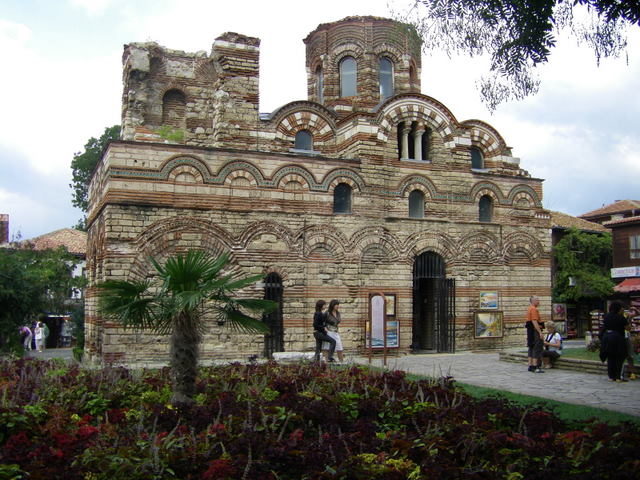
Our guide told us that Nessebar, this tiny island/peninsula had 40 churches. Indeed, it seemed there was one on just about every block. They all looked more or less like this one. Some are in ruins, some are used as art galleries, and some are just abandoned. There is at least one large impressive church that is still in use.

Strolling around Nessebar, we saw people from England, Russia, Poland, and of course, Romanians and Bulgarians. And what was the language we heard again and again (our little tour group consisted of just us and Brits and Poles) — Hebrew, of course!

Back from Bulgaria

We are back, tired and happy, from our vacation to Bulgaria. The purpose was a change of pace– to get away from it all, and we did. We didn’t see very much of Bulgaria and we didn’t learn very much about the people, but we did have a nice time. I couldn’t help but compare it to the type of tours we provide at Shai Bar Ilan— where we give our travelers the history, culture, folkways, legends, customs– the richness of the people we visit and we fill every minute with amazing experiences. This was not that type of trip.

Our first full day it rained. We traveled to Balchik where we visited the palace of the Romanian Queen, Marie, and the gardens that surround it. Her unpretentious home was built on a hillside by the Black Sea. It had a tower, but aside from its location on a bluff by the sea, it was not very noteworthy.

Palace of Queen Marie of Romania

Palace of Queen Marie of Romania

Romania extended into Bulgaria at the time she ruled and Marie so loved Balchik that in 1921 she decided to have her summer palace built there. She called the complex she had built Tenha Yuva, or the Quiet Nest. When she died, in accordance with her will her heart was buried there until 1940 when it was reclaimed and reburied in Romania.

Adjoining her palace are lovely gardens. She was the first monarch to declare herself of the Bahai faith and her gardens are reminiscent of the Bahai gardens in Haifa. Here are two pictures:

Garden in Balchik

Garden in Balchik

Queen Marie's Garden, Balchik

Queen Marie's Garden, Balchik

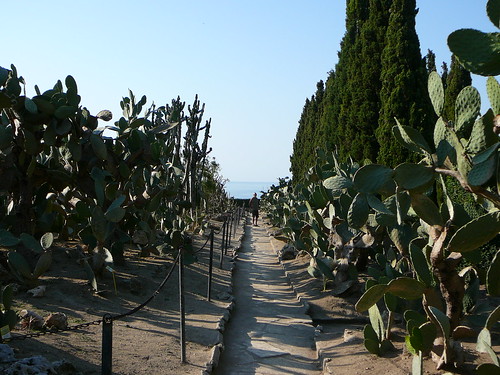
Over to the left of the garden was a garden of cacti. I wanted to photograph them too, but I was not thinking too clearly and tried to get there by walking across a cement drainage ditch. The problem wasn’t the water; it was the algae that were growing in it that were very slippery. As I lost my balance and fell hitting one- two – three parts of my body, another woman tried to help me and she too fell. Neither of us could get up because there was nothing to hold onto and I was pretty sure that I would be there until the sun came out and dried the place up in a few days or longer. Fortunately a very brave and apparently very strong man appeared out of nowhere and was able to help both of us onto our feet. We were bruised and shaken, but otherwise just wet. The pictures of the cacti? … well, I think I would have done better had I thought of this

More Bulgarian adventures next time…

Off we go…

On Wednesday we decided that we wanted to go away– somewhere. One of the big advantages to living in Israel is that aside from the notable exception of our neighboring countries which are less than welcoming to us, we are located only a short distance from a lot of interesting places and a jaunt to most of them is not very expensive.

So I searched a couple of Israeli sites on the internet for the dates we wanted to travel and looked for a place we hadn’t been before. I was able to find an inexpensive trip to… Bulgaria.

When I told my older daughter, she said, “Oh yes, we were in Varna. The center of town is very pretty.” My middle son also has been there.

But I don’t think that we are unusual for Israelis. Aside from the advantage of travel being inexpensive for us, all of us suffer from a form of “cabin fever” that one gets when one realizes that aside from the sea, every border of our country offers danger. Even our most friendly neighbors have problems accepting us. And so we are “landlocked,” unable to get into our cars and travel across the border to another country, and deep in the Israeli psyche is a need to travel.

Today I went to the supermarket and stocked up on food that we can take with us. We’ll take a variety of foods that don’t require refrigeration and supplement with fresh fruits and vegetables. We get about 20 kilos (44 pounds) each luggage allowance, so we should have some left over weight for our clothes. On Sunday we take off for our next adventure. Stay tuned.

Pomegranates

When we moved to Israel, we bought a home with a garden. But homes with gardens here come with an unbuilt area filled with dirt– not soil, but dirt. From there, you are on your own. After living in our home for a year, I contacted a gardener to come and design a garden for us, put in all of the irrigation hoses (we do drip irrigation), and plant it. He asked what I wanted in the garden. I told him that I wanted something that was easy to maintain and that did not require a lot of water since we live in a water poor area of the world. He asked me if there were any specific trees I wanted and I told him that I wanted an olive tree, a lemon tree, a palm tree, and a pomegranate tree. He planted all those and more.

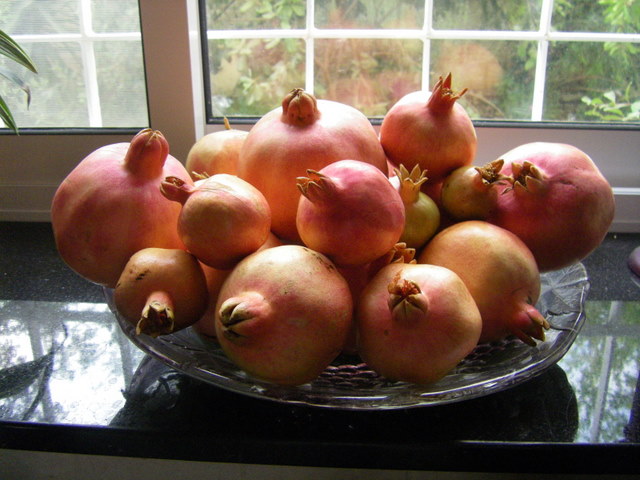
Each year we have watched our pomegranate tree bloom and then watched most of the blossoms fall to the ground. The most fruit we have ever had was 6 pomegranates. But somehow, for some unknown reason, this year, the tree is full of luscious looking pomegranates.

I have always loved the way they looked. When we were in Spain several years ago, we visited Granada whose name means pomegranate. While there, I bought a gold pendant in the shape of a pomegranate with a wedge cut out that had red stones inside. It was one of my favorite pieces of jewelry. Unfortunately, it was stolen. But I still have my tree and these beautiful round fruits to enjoy.

The first batch of pomegranates from our tree

The first batch of pomegranates from our tree

If this is Monday, it must be Oz

I am enjoying watching people post themed photos on blogs, and Mondays are “Mellow Yellow.” What could be more mellow than a trip to Oz?

Last summer we drove across the US (I blogged every day or two so you can read about it on the postings from last June and July) and one of the places we passed through was Liberal, Kansas, home of the land of Oz. In the complex there are artifacts and furnishing from the late 1800s and early 1900s as well as a house constructed to look like Dorothy’s and a large enclosed area with sets to look like Oz.

A documentary film was made about this attraction showing the young women who play Dorothy and lead people through Oz and how their aspirations to see the wider word mirror hers. I would love to see the film someday.

Here’s Dorothy telling us about her house (note her anachronistic ruby red slippers):

Dorothy at home

Dorothy at home

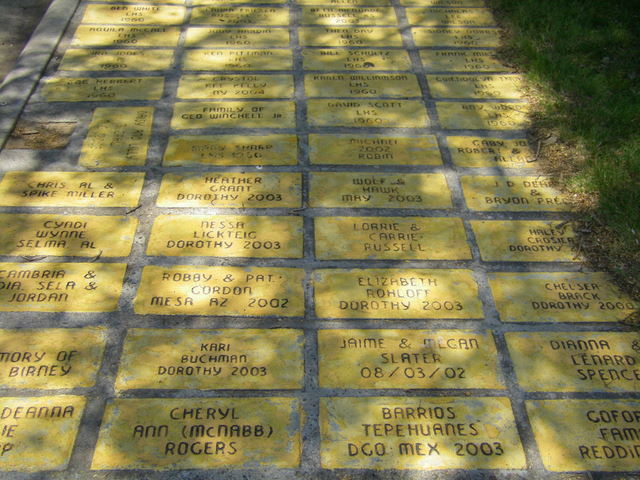
and here is the famed Yellow Brick Road (this time marked with the names of people who donated money for the building and upkeep of Oz.)

The Yellow Brick Road

The Yellow Brick Road

MellowYellowBadge