Hello People!*

There actually has been a lot going on…

I had had a little minor surgery for a bump on my nose a few weeks ago. I had shown it to my dermatologist and he had filled out a referral to the plastic surgery clinic at the hospital. When the lab results came back, they suggested I return because the biopsy contained only fragments and there could be more of the nasty cells around. Before the surgery I had read of a surgical technique called “Moh’s Surgery” that involved removing some cells, staining and freezing them, looking under a microscope, and then determining if there was anything more to be removed and then continuing the surgery at the suspicious area until they were sure everything looked clean. I had asked the surgeon and he didn’t actually know what I was talking about.

So, when I arrived to have the procedure done a second time, I had two concerns 1. that they wouldn’t get everything this time either and 2. that they would cut me more than necessary. The surgeon looked at me and said that he didn’t think he could do the surgery. He called his associate. They both agreed that because they couldn’t see anything at all that needed to be removed, they could not do the operation. They said I needed a technique called “Moh’s.”

They sent me to the dermatology clinic and they in turn gave me the name of one of the three doctors in all of Israel who is trained in the procedure. I thought I was pretty relaxed prior to my appointment with him, but at one point, on the way to his office, we sat down on a park bench and I could feel my heart beating rapidly. I took my pulse and it was at 120. I was nervous.

We waited well beyond our appointment time, but the doctor who greeted us seemed competent and was easy to talk to. He told us that the dermatologist should not have referred me to a plastic surgeon in the first place. He also told me that the first surgeon should not have operated. We made an appointment and late in June, I will have the Moh’s surgery done. Having set up the appointment for the surgery, I became much more relaxed.

Other things this week…

On Sunday we bid farewell to our shabbat guests. All three of our sons and their families (combined, that yields 19 children) came to Modi’in to take part in the bat and bar mitzvah celebration of our older daughter’s children, the oldest of our boy/girl twin grandchildren. It was a fabulous shabbat. Our daughter and her husband set up their garden to accommodate feeding the assembled masses of people and that included putting in lighting for Shabbat evening and making sure there was adequate shade for shabbat during the day. Aside from three older boys who stayed with friends of ours, we had everyone in our family who was visiting staying at our house and amazingly enough, we were able to give everyone a soft place to sleep.

The garden looked lovely, the food was good, the singing was beautiful, and having a shabbat with the whole family in a place where the noise did not reverberate was amazing. After all, when you have more than 25 children, most of them 12 and under, there is some noise.

We were very proud of both Matan and Lilach for their accomplishments and for being terrific young people. Lilach did research on how women feel about lighting shabbat candles and together with her mother, wrote a book that also contains pictures of candles and pictures of her family. It is fabulous! Matan read his haftarah beautifully. Kol HaKavod to both of them.

Sunday morning we took our car in for its annual test. Talk about nerves! The day we were at the doctor, we had the car serviced at the Toyota dealer in preparation for the test. On Sunday we took our registration (fee paid at the post office) and our compulsory insurance card (fee paid at the post office) and went off to Lod to have the car inspected. At the end of the inspection process the woman who I paid for the inspection said that there was a problem and if I wanted to know what it was I could ask the inspector. I went to ask the inspector. He said, “do you want to become a car mechanic?” I said that I only wanted to know what was wrong with the car. He said, “I can give you the name of a school that teaches you to be a car mechanic.” When I returned to my husband who was having a new back license plate made for the car (the reflective qualities had diminished over the last 11 years) the man waiting on him asked me why I was upset. I repeated what the inspector had told me. He said, “Come with me to my boss.” I didn’t go. There were two reasons. 1. I am really bad at remembering faces and can’t be sure which of the men it was who said it and 2. I didn’t think it was wise to lodge a complaint against someone who could make sure we failed the inspection again when we returned from getting the car repaired.

We decided to take the car to a nearby garage. The man there looked at the car and told us that we actually didn’t have a problem. A little oil in one place made it look as if we had a leak, but we didn’t. That cost us 100 sheqels. Then we went back to the inspection station.

We waited in the shorter line and then they began to do the inspection. The man who made us the license plate came over and told them that we were fine and so they let us go through. We paid an additional 66 sheqels for a retest, but in the end, it was done. We have a year until the next test. It will take that long for me to feel relaxed again.

And this week… I am working on the information packet on the June tour (information about the locations we will be visiting) and of course preparing for a fabulous trip to BARCELONA with my older daughter!

*to understand the reference, you will have to see an amazing act of unparalleled talent performed my members of my family.
Mount Grizim

Yesterday was Pesach sheni, one month after Passover when someone who had missed Passover could celebrate it. However, for the Samaritans, שומרונים it was Pesach!

The Samaritans believe in the Torah, but not in any of the other Biblical books, nor do they accept the Talmud or other rabbinic writings. Since modern Judaism is a product of rabbinic interpretation which they don’t accept, their religion differs in major ways from normative Judaism.

Yesterday a bus of Modi’in residents made its way to Mount Grizim to watch the Passover festivities nd to learn about the Samaritans.

All told, there are about 700 Samaritans in the world and all are living either in Holon, Israel, or on Mount Grizim which is located in Samaria (what some people call “the West Bank”). For the Passover observance, all Samaritans must come to Mount Grizim and participate. Busloads of curious Israelis and tourists arrived to watch the festivities.

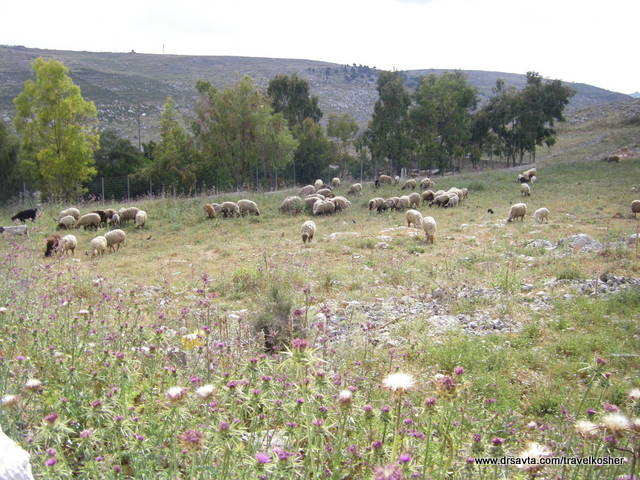
On a fairly warm day, the mountain was cold and windy. As we walked toward the location of the ceremonies, we saw some sheep grazing. They looked so peaceful and I couldn’t help but feel sad for what was to happen to them.

Sheep on Mount Grizim

Sheep on Mount Grizim

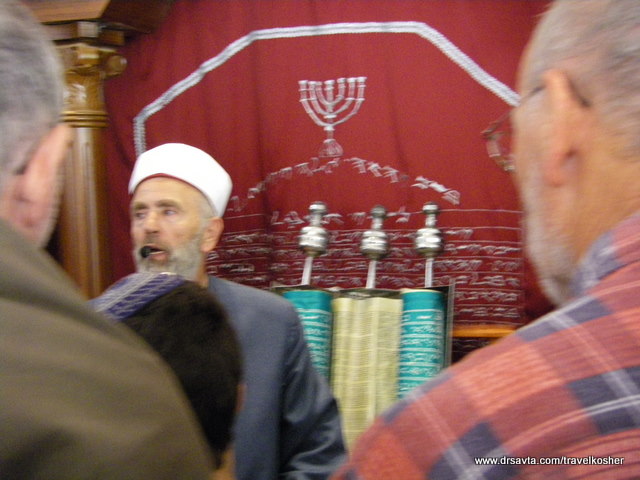
We went to the museum which was small, but well kept and we were lucky enough to have one of the Cohanim talk to us and tell us about their beliefs and observances. I found it fascinating that they take the same basic laws from the torah as we do and observe them differently. For example, on Yom Kippur, among the Samaritans, everyone fasts, even babies. The only exception is for those babies who are still nursing.

The Cohen, Yefet, with a sefer torah behind him

The Cohen, Yefet, with a sefer torah behind him

Yesterday, we were instructed not to bring with us anything that would be considered chametz, not kosher for Passover. We came to see the ritual slaughter of the paschal sacrifice, the lambs.

Lambs being brought to the ceremony

Lambs being brought to the ceremony

Passing by us on the street

Passing by us on the street

In addition to the Samaritans, there were hundreds of people who had come to watch the ceremony as well as dignitaries from the Palestinian Authority with whom they also have cordial relations. There also were almost as many professional photographers as there were sheep.

People crowded around the enclosed area where only the participants, dignitaries, photographers and some very persuasive visitors were allowed to be. We occupied a grandstand, a hillside all of the areas around the fences, and areas overlooking the site including roofs of buildings. It was very difficult to see and even more difficult to photograph as the people in front of us kept swaying and blocking our views and never thought of saying “why don’t you take a couple of pictures standing in my place and then switch back with me.” It was cold and windy and pretty frustrating to be standing on my feet for about 2 hours and not seeing much.

What we did see were many men approaching the ceremony. Most were dressed in white, however it appeared that the men of higher stature wore green robes. All of the elders some robes and each had a staff that he walked with.

Approaching the ceremony

Approaching the ceremony

Lambs in the pen, unaware

Lambs in the pen, unaware

As we stood and watched, we heard chanting. The leader would begin the chanting and then all of the men would chant. The words were not intelligible to us because they speak a different dialect. The chanting was not unpleasant, but the noise and commotion of all of the onlookers and of the non-participants made it difficult to appreciate. We saw some dignitaries, cohanim/priests, I suppose, on the podium and then there were two long lines of men. also dressed in white, many of them wearing boots, facing each other on either side of a long trench. A glimpse of two of the men showed them each holding a lamb between their legs.

At a certain point, a word was shouted and then in a couple of seconds there was cheering and shouting and people kissing each other. Although we had seen nothing, we guessed that at that point, the lambs were slaughtered. We later found out that we were right. There was such joy and elation among the participants that I found it incomprehensible.

While we were not looking the animals were skinned and gutted and later we saw a few put on huge skewers being readied to be thrown into the deep, round pits that had been burning for hours.

We were told that at that point, the people would go home and only return around midnight to claim their lamb that would be eaten with the people they were close to.

A few commments:

1. I am glad that I went. It certainly was an experience unlike any other I have had. that said, I wish they could have kept their ceremony purer– with less noise and fuss and extraneous noises and people and bustle. It didn’t have a spiritual quality that I could grasp.

2. I am still feeling very sorry for all of the lambs, and especially so when I think of the joy that slaughtering them brought to the people who did it. I never imagined that animal sacrifice could be anything but deeply solemn and deeply moving.

3. I am pretty sure that I heard our neighbor’s cat praying this morning saying “…שלא עשני כבס”

(If you don’t know Hebrew, it probably isn’t worth explaining it…)

Question

Where am I going this afternoon/tonight?

The first person who answers correctly will receive a Chinese wine bottle cover.

Clue: Look at the calendar.

More when I get back (by then, the contest is over).

How to break up a marriage

A long time ago my sister had a flirting acquaintance with law school. I was, at the time, studying family therapy. We used to joke that I would break them up and then she would get the cases.

But actually, as a therapist, I always did whatever I could to preserve marriages. No marriage is wonderful all the time. We go through difficult periods individually and as a couple that try our patience, that test our coping skills, that make us wonder why did we ever choose to marry this person. Usually, however, these times pass and some of us go along as we were beforehand and some of us grow through the experience and deepen our relationships and some of us grow further apart.

When a couple consults a family therapist, in my opinion, the therapist should never take the side of either spouse. S/he should take the side of the marriage. Particularly if there are children, the couple has a lot to lose by dissolving their marriage. Of course some marriages can’t be saved and shouldn’t be, but many can and should.

One trap therapists fall into is recommending a “trial separation.” Usually the complaining spouse pushes for it and often therapists decide that it would not be harmful. I disagree.

Imagine that you are in a contentious situation with your spouse. You feel that s/he is overly dominant and you have no breathing room. Or you feel that s/he is overly passive and you have to carry all of the weight of the marriage and family. Now imagine your spouse or you move out of the situation. Suddenly the domination stops. Suddenly it’s not your spouse opting out of the work of the family but his/her not being present. What does it feel like? It is a relief. It’s quiet. There is no contention. You sleep and wake on your own schedule. You eat if you’re hungry and don’t if you’re not. Life is a lot better.

Tell me: how is this supposed to motivate couples to get back together?

There was a period of 4 years when my husband and I lived in two different countries because of work and family obligations. I would visit him for periods adding up to 3-4 months a year and he would visit me for about one month a year. I loved the times when we were together. But the times we were apart were good times too. I liked the freedom of being able to establish my own rhythms and activity patterns. Had our relationship otherwise been problematic, the time that we were apart would have convinced me that it was a good arrangement.

Sure, family life brings strength and love and security. We enjoy the closeness and warmth of being together, working on common goals, sharing experiences together, supporting each other in difficult times. But what if all of that is missing? Then wouldn’t separation be less painful than a problematic relationship? Couples who have gotten to the point that interactions with each other are painful have difficulty picturing warm, close family family relationships.

In the over 30 years I have been a therapist, I have never known of a couple who had a trial separation who ended up working on their marriage.

If the intention is to break an abusive cycle and allow people to get the distance and perspective to realize that they really shouldn’t be together, trial separation is a good idea. Otherwise, it’s a mistake.

Families and honesty

As if I really have to tell you…

The basis of any close loving relationship is honesty. Family members should know that they can count on each other to tell the truth. Children must be able to trust their parents in order for them to feel secure. One way that parents can teach this is to let the children know that even if it means getting into trouble with mom and dad, it is always better to tell the truth. Sometimes we would explain it to our children like this: Suppose I told you that if you act nicely now I will give you ice cream after dinner and then after dinner I say I didn’t really mean it, how would you act the next time I promised a reward? How would it feel if you couldn’t trust me?

My own children were, by and large, pretty honest growing up. I am certain there were some lies and deceptions, but if so, they were not of consequence. I knew I could count on them to tell me the truth and they knew they could count on me to take them seriously.

In fact, once we had a babysitter that one of my children didn’t like. The child asked me not to have that babysitter again, but wouldn’t tell me why– and I did not call that babysitter again. Only months later did I learn the reason, and it was good that the sitter did not return. Similarly, when there was a problem at school, I always asked the child first to tell me what had happened. I always got a straight story and I always advocated for my children when appropriate.

When our oldest son left for college in Israel, we all still were living in the US. Before he left, he asked me to promise to let him know if anything happened to anyone in the family– illness or other important things he should know. I told him that I would because I knew that if I didn’t assure him that he would know, he could be in a constant state of tension- wondering if everything is OK at home. After all, back then, before mobile telephones and before the university dorms even had hall telephones in them, communications consisted of letters that took between 5 and 10 days to arrive from the US. But it was only because he knew that he could trust me that my answer was reassuring.

Some families are not honest about things like illnesses and other unpleasant information because they want to protect either themselves or others. That can create big problems.

Once we knew a family where a somewhat distant family member died suddenly at 92 years of age. Members of the family decided not to tell one of the older people to spare her feelings. However, a few weeks later there was a wedding to which both would have been invited. How to explain the absence of the deceased family member? Their solution : a trip to Europe. In our family, from then on, “going to Europe” took on a sinister connotation.

In my own family, my mother hid information about my father’s illness that was essential to my sister’s and my health. My mother hid her own illness from her friends, many of whom were like sisters to her. It robbed them of their ability to support her and it robbed her of the support they could have provided.

Bad news is hard to share, but secrets and lies separate people and doing that at a time when love and support are needed is simply a very bad choice.

Avital’s Bat Mitzvah

I have had a request to talk a little about the simcha that we celebrated a little over a week ago. Avital, the second daughter and third child of my oldest son, is a very special young lady. From the time she was a baby, it was easy to see that she would be quick and clever and have a great sense of humor. She is able to be serious and study hard and achieve and she is able to stop and enjoy life. She has a wonderful smile and in infectious giggle. Here is a formal picture of Avital.

Avital

Avital

And below is the way we usually see Avital– with her glasses on and raptly attentive to what’s going on around her.

Avital

Avital

Here she is with her siblings:

Left to right: Elihu, Tzvi, Avital, Amiel, Elisheva, Dina

Left to right: Elihu, Tzvi, Avital, Amiel, Elisheva, Dina

In addition to her siblings, she celebrated with her father and mother and both sets of grandparents and lots of lots of cousins. It was a very happy evening that we all will remember.

We all wish her a life filled with wonder. She should know great happiness, do things that are meaningful, give and receive love, and be blessed with a long, healthy life.

Mazal tov, Avital! We love you.

Pre-Pesach musings

Last time I wrote a serious post, it was about not taking what people say seriously when they are not being rational (throwing a tantrum). This time I want to talk about taking people seriously, because, in fact, most people do.

Sometimes, we take people too seriously. We allow the nasty comment of a stranger ruin our day. We allow the unfeeling statement of a friend or acquaintance to hurt us.

My mother used to say, “consider the source,” meaning that if the person said something nasty or cruel, chances are he/she wasn’t such a nice person to begin with.

On the other hand, we should pay attention to those who are kind and helpful and to people who we can trust.

Many years ago, my dear friend Susan said only a few words to me that changed (for the better, of course) my whole life. From time to time, I run into people I have had as clients and other acquaintances and they tell me that something that I had told them in the past really helped them.

In Pirke Avot, wise people are instructed to be careful with their words– and even those of us who are not wise, should be careful. Words can hurt and words can heal.

And here is the real challenge that we live with: people listen when we speak. When we say something that helps or hurts them, they remember what we’ve said far longer than we do. A word said in anger can ruin a relationship. A kind word can save a life.

So maybe when we’re thinking of cleaning for Passover, when we rid ourselves of even the tiniest crumbs of what is unfit, it’s a good time to think of the impact of what we say and to realize that even the smallest negative remark can hurt someone a very long time and the smallest expression of support can change someone’s life.

But seriously, folks

Back to the real reason I started this blog– this blog that has wandered around the world, engaged in politics, and has told you how I feel about Israel. Back to talking about family relationships…

Let me begin by saying something rather radical that will summarize what I am about to say:

Don’t take people who are upset seriously.
That’s it. Don’t.

OK, Let me go back and talk about it and then you will understand, I hope.

When we are little and non-verbal, our tantrums usually consist of non-stop crying, flailing, and throwing things. As we get a little older, our parents encourage us to express our displeasure in more socially acceptable ways, i.e., talking about it. So, by the age of twenty or so, we (most of us) stop screaming, yelling and throwing things and instead use words to express our displeasure.

So far, so good.

However, it sometimes happens that we use words in the same way as we used our stuffed toy animals and blocks and little train cars–we take them and throw them at others like weapons.

In response, those who love us are hurt, surprised, and often themselves become angry and hurtful.

So here we are. Mature, adult two year olds having a simultaneous tantrum.

Now what happens in tantrum state?

The person who is having the tantrum has two major objectives
1. To get his/her point across.
2. To let the other person/people know how upset he/she is.

In accomplishing the second, often the message of the first is lost. Not only that, but the listeners may actually be less motivated to hear the message as they move to defend themselves and pay back in kind. Which is why most arguments do not end well.

Few people realize, however, that when someone is in tantrum state he/she often loses control of his/her ability to think clearly and may say lots of things that he/she doesn’t mean. Some of those things may have dire consequences.

Take my uncle.

When my cousin was a freshman in college my cousin decided to grow a beard. My uncle did not like the idea of his son having a beard. He tried to cajole him and finally, in a tantrum state, threatened him- telling him that if he didn’t remove the beard, he couldn’t come home.

Do I have to tell you the rest of the story?

It was not a happy story.

Did my uncle mean to lose his son for a long period of time? I strongly doubt it. He just got carried away.

What could have happened instead:
My cousin could have listened to the tantrum. He could have responded calmly or not at all, he could have gotten up and walked away. Chances are pretty good that once my uncle got back in control of himself, he would have still not liked the beard, but might have realized that it wasn’t worth losing his son over it.

Example two:

When I began studying for my doctorate at the University of Pennsylvania at age 42– after having been in clinical practice as a family therapist, I was ambivalent. On the one hand, the idea of getting a doctorate was very exciting. On the other hand, I felt the level of instruction in certain areas was naive and simplistic and since the tuition was high, I wasn’t sure I wanted to make the investment of our family’s resources.

I don’t remember what specifically set me off, but one morning, early in November, before we had received any tuition bills, I got really angry and told my husband that I was dropping out and didn’t want any more part of the nonsense going on at the school and that I could think of a lot of things to do with my time and our money that would be more productive etc. I went on and on. He didn’t answer. I’m pretty sure it was because he didn’t know what to say. But after a while, it just ran down. I was finished and I picked up my books and left for school.

Could it have ended otherwise? Surely. Had he gotten sucked into the tantrum, he would have urged me to continue and I would have dropped out just to show him that he couldn’t control me.

Tantrums do bad things to people.

When I was seeing couples in marital therapy, often what the spouses would complain about was what the other one had said at the height of a tantrum. Usually, the spouse either didn’t remember having said it or regretted saying it. In fact, it was not the spouse speaking from his/her rational mind. It was that reptilian brain that all of us have inside of us. It is that primitive fight or flight mechanism that that springs into action when we begin to feel any sort of threat.

So what should we do when someone we care about starts having a tantrum? Don’t respond in kind. Listen, to the message but don’t take everything he/she says seriously. Really. He/she doesn’t mean half of what he/she is saying. There’s no need for there to be more than one two year old in the room. Not feeding the flames helps extinguish them. And once the person is rational again, maybe the problem can even be solved!

Condemned

I don’t like putting up political posts. Sometimes they threaten friendships, and I really don’t want to lose any friends. But what’s been happening lately is so troubling that I can’t remain let it pass. Here’s one article about it.

Funniest Experiences

Funniest experiences

Rules: Fill in the following. Tag 4 friends to do the same.

  • My funniest dream
    I try really hard not to remember my dreams because in them frequently I find myself in public places having forgotten to put on my clothes.
  • My funniest experience with a pet
    At the time I didn’t think it was funny, but my daughter thought that heating up a piece of chicken for the dog was a bit over the top. I like it warm… I thought he would too.
  • My funniest experience at a job interview
    I applied for a job working with a population that I really didn’t know and the interviewer wanted so badly to hire me that she supplied the answers to the questions she asked me.
  • My funniest purchase
    I’m sure there are funnier ones, but recently on a rainy day I purchased a meter of plastic tablecloth material to cover my shopping cart that was full of purchases and likely to drown in the downpour we were having.
  • My funniest experience in high school
    High school was not funny.
  • My funniest cooking experience
    The first year I was married I made bread pudding with rye bread. Not recommended.
  • The funniest thing I ever said to anyone
    “When you’re a daddy, you get to eat all the ice cream” It wasn’t funny then, but the story evolved.
Everyone tagged

My family and friends are invited to add in the comments any answers that they think I should have given.
fill in this meme

Sleeqo