Truths my father told me

Tonight and tomorrow mark the yahrtzeit of my father, Harry Mager. He passed away long before his time in October of 1985. Yet, the conversations he had with me feel as if they happened only yesterday. He taught me by word and example many things that have enriched my life. Today, in a sense, I am allowing him to write a guest posting through me. Here are some things I learned from him.

1. No matter what your situation, you have the ability to influence it for the better.
My father was in high school when the Depression began. His family was not doing well financially. He quit school and went to work. He worked hard and learned skills that served him later in his life. He harbored no bitterness; he did what he needed to do.

2. It’s possible to be optimistic even when times are rough.
Fortunately, my father’s life was not a difficult one. His greatest challenge was dealing with my mother, and although she was a formidable challenge, it was not as if he were fighting illness or poverty. However, as with all people, there were times that were less than perfect. Yet, he always had a positive attitude. He looked at each day as a gift.

3. Enjoy the world around you.
My father could have been a great artist. He didn’t have the opportunity to develop his art to the degree that it became commercial, but there was nothing he built, drew, sewed, designed, or sculpted that wasn’t superb. His photography was beautiful. He loved nature. He loved the seasons. When there was a huge snowfall one year and he was unable to go to work, I remember him telling me to get ready so that we could take a long walk in the snow. He loved it. So did I. He loved trees and flowers. He loved beautiful sunsets. The year he became ill, I was saddened to think that he might not see another spring. The day he was buried, the trees were clad in their autumn reds and yellows and oranges and browns, and I thought he would have loved to have seen them.

4. Be kind.
My father was a kind man. He was respectful and courteous, and gentle.

5. Treasure the time you have.
One of my earliest memories is of riding in the back of my parents’ car and hearing my father say to my mother, “Life is too short.” I think he had that awareness at all times and that he tried to fill every moment with something significant. In his store, he had not customers, but friends. People would meet him once and feel as if they had been his friend for years. His leisure time he filled with reading books that helped him self-educate. He became a big fan of Mark Twain. He read Shakespeare for pleasure. He bought and listened to classical music. All of the education he hadn’t been able to acquire as a young man, he reached for as an adult.

6. Love Learning
In addition to his reading, my father was interested in learning any way he could. He took adult education courses, he watched documentaries, and he loved to listen to other people tell their stories.

7. Love your family
One of the sweetest memories of my father is of his standard way of saying goodbye as I would be leaving their house after a visit. He would say, “Drive carefully; you have precious cargo.” He told me that I was a millionaire and told me more than once that I had five million dollars– referring to the five children. I don’t really know the story but my mother had a gold bracelet that had five diamonds on it. I like to think that that my father bought it for her as another way of acknowledging their good fortune at having five precious gems as grandchildren. I know that he adored them and I remember thinking that the day the children and I spent at Busch Gardens with him, he was the happiest I had ever seen him.

My father is not with us physically, but his influence on my life is profound, and I hope that his grandchildren and great-grandchildren will feel his influence for years to come.
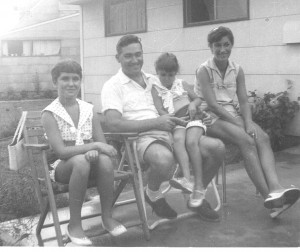
Our family, September 1956

Our family, September 1956

Sisters 2

I wrote about sisters once before– here. I actually enjoyed rereading the post and hope you will too. But today I want to write about a specific issue in the relationship between sisters.

As anyone who is a sister or who has two daughters knows, despite coming from the same genetic pool, sisters can be very different from each other. They can look different.

Ayala (left) and Tamar (right)

Ayala (left) and Tamar (right)

Matan with Lilach (his twin) and Hadas (his older sister)

Matan with Lilach (his twin) and Hadas (his older sister)


And just as they can look very different, they can have different preferences, interests, levels of extraversion, talents, etc. But, just the same, they share so very much that they have the potential of being each others’ best friends through life.

Here’s how.
1. Understand that your sister really is different from you.
2. Understand, though, that there is such a richness in shared ties and experience that your sister can offer you a friendship unparalleled by anyone else.
3. When you have disagreements think about what is at stake.
a. Your pride (you can get over it)
b. Your health and welfare (talk to her about it)
c. Her health and welfare (talk to her about it)
4. Don’t trash your sister to others, whether inside or outside the family. (There are no secrets and this one will come back to bite both of you)
5. And most important: Forgive. Nothing is sadder for a family than being split by the hostility of two of its members.

My sister lives thousands of miles away. I don’t see her nearly as much as I would like. Anyone who met us would tell you that aside from the voices, we have almost none of the same traits. Yet we share a bond that is strong and healthy. It’s one I cherish. Here’s our song.

Savta, Grandma, Bubby, Nana

If new parents have a complaint “no one prepared me for parenthood” and parents of newly married children realize there is no road map to being a mother/father-in-law, there is another path that is far more uncharted. How does one be a grandparent?

You see, most people have been around new babies. They have watched friends or siblings or cousins be new parents. They observe comforting techniques, clever holds, and parent-initiated play. But being a parent-in-law and being a grandparent are far harder skills to learn.

We may have learned that in-laws were outlaws. Comedians told us that mixed feelings were what happened when you saw your mother-in-law driving off a cliff in your new Cadillac. Our own parents may have complained of in-laws’ meddling or of their disinterest. It seems that very few families hit a good balance.

But perhaps, even more problematic is how to define ourselves in the roles of grandparents. For many of us, our own grandparents seemed ancient when we were young, and seeing them as people separate from their grandparent role was so very difficult. They were obviously created only for our comfort, the real purveyors of unconditional positive regard.

At first, it’s not that hard. We coo and we smile and we hold and rock the infants. They are so lovable. I never really understood the word “delicious” until I looked at my first grandchild and now the youngest is just as delicious. But what do we do as they grow older?

Early on I decided that I was not into buying their love. First of all, Israeli homes are small. Secondly, my children buy their children everything they need and much of what they want. They lack for nothing. I didn’t want my grandchildren to look forward to my visits as a gift extravaganza. I also didn’t want to force hugs or kisses on them, as much as they were so very appealing. I remember as a child feeling smothered in my grandmother’s ample bosom. I didn’t want my grandchildren to feel that.

So how do we build healthy relationships with them? How do we let these precious young people know that we love them?

I decided that my home should have interesting things for the children to do when they come. Boxes of Legos, wooden blocks, small cars, little plastic people, and hand puppets are available. We have checkers and chess and playing cards. We have childrens’ videos and books. We sometimes show them home videos of interesting places we’ve been. We placed in the garden little figures in both ceramic and plastic of animals and gnomes that the children enjoy identifying, visiting, and often moving around from one place to another in the garden. Some of the figures are on the ground, some are hanging from trees, and one gorilla is climbing up a large pottery urn. As the seasonal fruits ripen on our trees and vines, together we pick plums, pomegranates, clementines, and lemons. We harvest grapes. We are growing kumquats and in another couple of years, when the fruit may be eaten, they will join the cycle. And we usually have an ample supply of pretzels and chocolate milk. In fact, when the children visit, often they home in on the chocolate milk as if it is a ritual. Of course the other thing we have done is the special trips that by now we have taken 7 of the grandchildren on.

We, of course, talk with them, listen to them, tell them stories about when their parents were young and tell them of our own adventures.

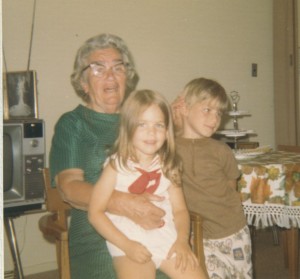
My maternal grandparents and their 6 oldest grandchildren

My maternal grandparents and their 6 oldest grandchildren 1955


My paternal grandmother and my two oldest children (her great-grandchildren) 1973

My paternal grandmother and my two oldest children (her great-grandchildren) 1973


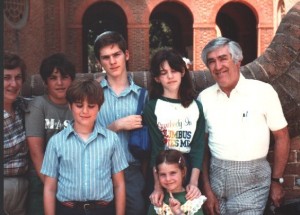
My parents with their grandchildren, 1983

My parents with their grandchildren, 1983

What do you/your parents do as grandparents to foster close relationships with your/their grandchildren?

Not a zero-sum game

I have been thinking lately about families and what makes them so important for the individuals in them. Of course there’s love and affection. Of course there is respect and consideration. And there also is loyalty. When I wrote a couple of days ago about competition and how it is unhealthy in the context of a family, I didn’t talk about one very important concept: the zero-sum game.

The zero-sum game, briefly is: A situation or interaction in which one participant’s gains result only from another’s equivalent losses. Source: here

Unfortunately, most of us go through life thinking it’s a zero-sum game. That’s why people are so competitive. “I can only win if the other guy loses.”

When my children were young, we had a book of cooperative games. Instead of “King of the Hill” where one person gets to the top of the hill and pushes all of the others down, the book recommended a game where as many people as possible get to the top of the hill and they cooperate to see how many they can hold up there. Games which foster cooperation also foster healthy relationships. Games like “Red Rover” where everyone is on the winning team help children understand that there doesn’t have to be a loser.

When family member achieve personal or professional expertise, other family members need to not just be happy for them, but to rejoice in it for themselves. Every strength of every member of the family only increases the others’ strength. As my children excel in areas I can’t even touch or understand, I feel personally enriched. I share in their happiness. And, fortunately, that is how they feel about each other.

Shel Silverstein said it well:

Yonatan and his little sister Naomi Elisheva

Yonatan and his little sister Naomi Elisheva

Hug O’ War

a poem by the late Shel Silverstein
[Author of A Light in the Attic]

I will not play at tug o’ war

I’d rather play at hug o’ war,

Where everyone hugs

Instead of tugs

Where everyone giggles

And rolls on the rug,

Where everyone kisses

And everyone grins

And everyone cuddles

And everyone wins.

Your enemy is my enemy

When I wrote about competition a couple of days ago, I was really writing about human relationships, particularly those among family and friends because competition is unhealthy in the context of friendship and intimate relationships– except as modified by Virginia Satir (if you haven’t already, see Competition).

But today, in thinking about close relationships I want to talk about loyalty. Loyalty is one of the most important elements of a relationship. Loyalty means that a friend or loved one will choose to support and defend their loved one no matter what. It means that we can always count on that other person to be there for us and stand up for us. It means that if we have been hurt or wronged, that other person will understand and feel the hurt and want to help us.

Early in our marriage, my husband, a loving and kind person, made sure that any time I felt hurt or slighted, I would know that the other person really was kind and good and that I was too sensitive. I found that hurtful– more hurtful than what the stranger had done to me. I wanted him to tell me that it wasn’t right that this person was insensitive or unkind to me. I didn’t want to hear why the other person was right and I was overly sensitive. To me, that was treason. His job as my husband and my best friend was to hear me and feel my pain and to take my side. I wasn’t asking him to retaliate. I wasn’t asking him to talk to the other person. I just wanted to be understood.

Fortunately, he’s gotten a lot better (though not 100%), but it is something I taught my children as well. The world can be a cruel and unkind place. There are people who unknowingly and knowingly hurt others. The people we rely on and love need to be with us. They don’t need to be our moral compass that informs us that no one really wants to do wrong or that the other person was busy/sick/preoccupied/annoyed etc. etc. We don’t want to hear excuses for why the other person was right and we were wrong. What we want to hear is, “No one has the right to hurt you like that; I love you; you are a good and worthwhile person.”

That’s loyalty. And that’s what we need to do as family members or close friends.

Competition

I haven’t posted in a while on anything therapy/growth related and it’s about time. For the last two days I have been thinking of competition. Competition seems to be hard-wired in human beings. Even very little children want to be able to do something better than their sibling. They want to be thought smarter, prettier, cuter. They say things like “I can hold my breath longer than you can” or “my picture is nicer.”

It makes sense that we compare ourselves to others. There has to be some yardstick for performance, else how would we know if a performance were better or worse than average. We looked at Susan Boyle and we compared her to other women her age, other women singers, and before she began to sing, we expected that she would be laughable. Her appearance was thought to be substandard and people expected that her performance would be too. Everyone was surprised when she opened her mouth to sing and her singing was beautiful. In our minds, we compared it to the type of singing a normal person does and it was much better and then we held it up to a higher standard and she met or surpassed it. Comparisons help us make judgments.

However, competition turns out to be inappropriate and even harmful in many circumstances. In relationships with siblings and spouses, competition leads to devaluing behavior, sabotage, and ridicule. In families, we are on the same team. We need to be happy when any of our team members scores a basket! We need to help them maximize their performance just as we strive to do our own best. Saying “great job” and “wow, you did it!” when someone else has achieved something costs nothing and helps to build good will and feelings of security.

We all accept the concept of sibling rivalry as natural. Parents struggle to help each of their children to feel loved and valued, but there is always an echo of that rivalry. However, even worse is the situation when people have been programmed from early childhood to be comparing themselves to all others around them. The result is either always feeling wanting and inadequate or feeling superior (often without reason).

There are sometimes good results from striving for the kind of excellence that would lead people to see one as superior. People go to school and study for years to become the most knowledgeable, the recognized authority. People design research studies to achieve benefits for the public at large, but also because they want others to recognize their achievement and superiority.

But when competition enters family life, it is often destructive. When husband and wife each strive to be the one who is right all the time or the one who knows best, both of them suffer. When children are compared to one another in a way that lessens the value of one, that is destructive not only to the child’s ego, but to the sibling relationship– a relationship that often is the most satisfying lifelong relationship a person has.

Virginia Satir, a talented and much loved family therapist once told a couple that their competition was not a bad thing. The bad thing was what they were competing about. She suggested they compete to see who in the couple be the most loving, the most caring, the most forgiving, the most supportive, the most helpful. It’s the kind of competition that families need. It’s the kind of competition the world needs.

He never said goodbye

When I was a young girl, I was not very happy. Aside from all of the other issues little girls have, I also had a mother who was a perfectionist. It seemed to me that there was nothing I could do to please her. She would find something wrong with me each and every time she was near me. My dress was wrinkled, there was a stain on my skirt, a button was missing, I sat funny, I shouldn’t shake or swing my leg when I was sitting, I shouldn’t touch the fabric on the chair, my button was missing, my shoe was scuffed, I was a “klutz,” etc. etc.

Because she convinced me that I was a failure as a human being, it was a given fact that everyone knew it and therefore I had no friends because I knew the other little girls were judging me and I was found wanting.

When I entered junior high school, I sat in the auditorium where the principal explained to us that unlike elementary school, here we would have to work hard and do our homework and study. I spent much of my time in the library taking one book after another off the shelf that had books about people who had suffered. Among others, I read about Tomy Keitlin and how she lost her sight. I read “Miracle at Carville,” a book about lepers. I read, “My Left Foot” about a boy who was paralyzed. And I read “Death Be Not Proud” where the writer’s son dies. I read these books because at least these people were suffering more than I was, and somehow, it made my suffering more manageable.

But at some point something the principal had said set off a spark in me. He said that if we were having problems, there were counselors who would help us.

I didn’t know how to get the counselor to help me. No one said what to do if you were having trouble. So, I looked for a reason to see a counselor. One day, in cooking class, the twins (two girls whose names I’ve long forgotten) did something that annoyed me. I don’t remember what it was, but it seemed to me that it was a good reason to go to the counselor.

I went to see the counselor. I don’t remember anything about that meeting except that it didn’t end with his telling me that I didn’t have to go back home to my mother.

One day, a week or so later, though, my mother came and picked me up early from school. She told me that she was taking me to see someone I could talk to who would really understand me. I think at that point she was admitting that she had not a clue.

Apparently the school had called my mother and told her that I was seeking help. We went to the Philadelphia Child Guidance Clinic. There I was seen by a therapist and my mother was seen by a social worker and the plan was that they would coordinate with each other.

I was young and didn’t understand much. What I understood was that this somewhat shy and self-effacing man sat in a room with me and listened. I do remember that he told me that my mother was the way she was because of how her mother had treated her and that he hoped that we could work to stop that cycle. One thing I knew for sure: I didn’t want to be the same kind of mother to my children that my mother was to me.

My times with him were quiet and calm. I remember there being toys in the room, but he never suggested I play with them and I never quite knew what I should say.

Once (or maybe more) I felt so terrible between sessions that I wrote him a letter that I sealed in an envelope for him to read at the next session.

Once, when I told him that things at home were, if anything, getting worse, he told me that that meant that I was getting better and that my mother was unable to deal with it. I didn’t understand, but the words comforted me.

After about two years, I stopped seeing him on a regular basis and my mother would call him to consult or to see either me or my sister or her in times of crisis. My sister and I called him her “Prime Minister.”

When at 18 I became engaged, my mother sent me and my fiance to see him. He saw us and explained to us that it would be better for us not to live in the same city as my mother as she wouldn’t let us have a normal married life. She was simply too intrusive.

My fiance decided not to marry me. He thought I was going to end up being like my mother. I was devastated. I finally had plans to leave home and they were shattered.

A year later, my husband, who by my design never really got to know my mother, and I were married.

Ten years later, my former therapist (who had been in touch with my mother over this period) send me a short note and some educational materials he’d produced. By that time, I had 4 children. I was living in Wiesbaden, Germany. He wrote, “My wife was born in Wiesbaden; Good vibes!!”

Ten years later, I was presenting a workshop for family therapists at a conference in Dallas. He was presenting something in Dallas on the same weekend. I wrote him and mentioned the coincidence. He invited me to join him for breakfast on Sunday morning.

We sat and talked, this time as colleagues– about my childhood, about my husband and children, about my professional life and the work I was doing on therapeutic metaphor, and even about his interaction with my ex-fiance. He said, “I just didn’t think he was good for you.”

A couple more times over the next 20 years, we exchanged notes and once along with my sister, I met up with him in Tel Aviv, where he was living at the time.

A few days ago, I came across his obituary. He passed away at age 85. He was a gentle presence in my life. Dr. Sol Gordon will be missed. Goodbye dear friend.

Pesach Cleaning

So what else is new? I am happy to report that I am not afflicted with PPCD this year. I actually am pretty calm and relaxed. I may have perfected denial to a new level. However, for those of you suffering, I would like to re-publish this diagnostic material that I wrote about 10 years ago, but somehow remains relevant. The prognosis is good.

***************************************************************
Alert:
New diagnostic category added to DSM-IV-R
PPCD: Pre-Pesach Cleaning Disorder

This is a recently discovered disorder, recognized as a seasonal disorder, usually coming in early spring. It is characterized by obsessive thinking about cleanliness, far out of normal proportions. It is distinguished from Obsessive Compulsive Disorder 300.3 by several symptoms.

1. Obsessive focusing on small particles of food throughout the house to the extent of climbing onto bookshelves and behind toilets to ferret out particles smaller than the eye can see.

2. Compulsive washing of objects that are ostensibly clean (e.g., one patient was found putting her children’s Legos into a sock bag and washing them. This was discovered by a disturbed neighbor who couldn’t figure out what could possibly be banging so loudly and incessantly in the dryer. The patient, when confronted said, “Well, what did you expect– for me to put them in the toy box wet!”)

3. Incessant moving of common objects from their normal places (e.g., dishes, silverware, etc. are wrapped up and/or banished from their normal shelves and drawers.)

4. Talking with friends and acquaintances about topics formerly of no interest (e.g., effectiveness of different oven cleaners, location of most pungent horseradish.)

This disorder seems to occur in a social context. Frequently groups of women become pre-occupied with cleaning simultaneously.

Presumptive symptoms:
1. Spring time frame.
2. Patient is a woman.
3. Patient reports insomnia.
4. Patient has red hands.
5. Patient has a heavy odor of cleaning substances.
6. Patient does not have time to talk about it.

Treatment:
This disorder has a guarded prognosis. Although patients uniformly recover within several weeks, they tend to relapse around the same time each year.

There are reports of cessation of symptoms if they are taken away for a week to a hotel each year.

Nothing to say

This week has been a difficult one. My daughter and her husband are faced with a difficult decision. A child in our city was killed in a traffic accident. People I know have lost loved ones. And I feel impotent- unable to provide the right answer, the right words. And who should know what to say? Surely a family therapist, an “expert” in human interactions, a person who should know how to phrase things properly, how to say exactly the right thing, surely I should be able to respond in a meaningful, thoughtful, helpful way.

But I can’t.

Because, there is nothing to say. There is nothing that makes a difficult decision easier other than expressing one’s confidence that whatever people choose to do will be the right choice for them. There is nothing to say that removes grief. No one else can feel the pain of the bereft. No one can know what that family member meant to them. No one can know what words might heal and what words might hurt.

A long time ago I worked in the intensive care unit at a hospital. My supervisor, a chaplain, had talked to us about “a ministry of presence.” He told us that just being there and being with was in itself, a ministry. There was one very old woman (I think she was 92) who was in a coma. Each day I went and stood by her bed. I would take her hand. I would sometimes talk to her, although I knew she most likely wouldn’t hear me. I would stay there for 5 or 10 minutes and then I would wish her well and leave. One day I came to the unit and she was gone. I thought she had died. I was about to leave the unit after visiting some other people when one of the nurses came to me and told me that the woman had awakened. She told me that the family had asked her to thank me for being with their mother and for having been so kind. I never thought to ask how they knew. Did she hear me? feel me? Had the nurses told them? I don’t know.

But after that I understood that sometimes, when there is nothing to say, being there, being with is the best thing we can do.

Predictability

It’s interesting what we humans do. We are born into a world that has some degree of predictability– the sun will rise in the morning and set at night, but a very large degree of randomness. If we look at our lives, we realize that very little is in our control. We cannot control the other driver- who may be talking on his cell phone or just not paying attention. We cannot control the illnesses that we are subject to. Oh yes, researchers work on treatments and cures, but aside from taking precautions not to do things that are dangerous to our health (smoking, excessive use of alcohol, tanning, eating large quantities of artery-clogging foods), we have very little control.

But we long for control. We long for predictability. We try to find reasons why others have hardships and heartaches and disabilities in order to protect ourselves from the realization that all of us are vulnerable. But when we are being rational, we know that the terror victim happened to be in the wrong place at the wrong time. We understand that cancer began to grow in someone as a random occurrence. We comprehend that we are vulnerable.

We teach our children that this is an ordered universe- that if they behave nicely, good things will happen to them. And, we hope, we pray, this is true. We want so much to create for them a world without pain. And then the randomness of the universe once again shows itself.

Where is G-d in all of this? I wish I had an answer. I know that I cannot understand. I am not sure that humans are meant to understand. I have read more than once of life on earth as a tapestry. Just as a magnificent tapestry may have areas that are dark or bent or frayed, but when seen in the full context, they only add to the beauty, so we may see our lives. It’s a beautiful metaphor, but it doesn’t answer the question. Why can’t all of the people I love be part of the bright and beautiful part of the tapestry?

I think the answer to the lack of control is to take control of the part that we can. We CAN be kind to each other. We CAN help each other. We CAN value each other. We CAN provide the listening ear, the gentle touch, the warm embrace. We may not be able to control the world, but we can control how we act in it. And we have the ability to make it a better place.