My husband always…

Hmmm… are you interested in the rest of the sentence? Thought so. I became a family therapist because statements like this intrigued me.

Well, if you must know… the full sentence is “my husband always tells me that he loves me.” Yes, really.

But how many people start that sentence (and yes, it can be “husband” or “wife”) and end it with something not quite so nice?

And we hear things about their spouse that are not complimentary. Sometimes it’s a one time thing, and sometimes people complain repeatedly.

Here’s the problem:

1. The listener is in no position to solve the problem

2. The speaker may be upset temporarily, but the listener may take the complaining to mean that there is real trouble in the relationship.

3. The listener may draw negative and lasting conclusions about the speaker or the spouse.

4. The listener may take the disclosure as permission to complain about his/her own spouse.

Can you see where this is going? It’s not going anywhere good.

When couples have issues with one another, they should be worked out between them. If they find it difficult, there are any number of self-help books, seminars, and yes, therapists to help them.

But please– if you’re angry with your spouse, don’t broadcast it. I can guarantee that it will come back to bite you.
Catching up

If you read parts 1,2, & 3 of the adventure and wonder why I stopped writing, it’s because I have relocated the saga to the travel blog and added pictures when relevant. Chapter 5 in written and 6 is on its way. For anyone wondering about this question… It was a fantastic trip and even with all of the unscheduled adventures, our travelers had a great time, virtually untouched by tension and so did we (although not untouched by tension.) By the time I was home for 2 weeks, I was ready to go back and do it again– that’s how much fun it was… and you only can truly understand if you come along with me next time (hint, hint).

But now here we are in the little town of Modi’in (population >70K) for Hanuka and today we are anticipating the gathering of most of the clan– some members are not feeling well and some are away. Today is also an awful day in terms of air pollution and people have been urged to stay inside.

I have a lot of art supplies, a Hanuka video (“Lights”) and a few dozen latkes. Mostly, I am hoping that the little people get to spend time with their cousins and aunts and uncles.

Across from our house as you look to the right is a hill that some believe was the ancient city of Modi’in. It has artifacts from back to the Stone Age and ruins from several eras in between. At the top of the mountain is a water tower that has a series of columns that look like torches around it. For the last couple of years, they have lit the tower at holiday times with pastel lights. This year, nine of the columns have large lights on them that are lit according to the night of Hanuka. It’s quite impressive!

I wish all of you a wonderful bright Hanuka– and as a gift to yourself, a trip to China or Vietnam/Cambodia in 2010 is a pretty good idea!

Truths my father told me

Tonight and tomorrow mark the yahrtzeit of my father, Harry Mager. He passed away long before his time in October of 1985. Yet, the conversations he had with me feel as if they happened only yesterday. He taught me by word and example many things that have enriched my life. Today, in a sense, I am allowing him to write a guest posting through me. Here are some things I learned from him.

1. No matter what your situation, you have the ability to influence it for the better.
My father was in high school when the Depression began. His family was not doing well financially. He quit school and went to work. He worked hard and learned skills that served him later in his life. He harbored no bitterness; he did what he needed to do.

2. It’s possible to be optimistic even when times are rough.
Fortunately, my father’s life was not a difficult one. His greatest challenge was dealing with my mother, and although she was a formidable challenge, it was not as if he were fighting illness or poverty. However, as with all people, there were times that were less than perfect. Yet, he always had a positive attitude. He looked at each day as a gift.

3. Enjoy the world around you.
My father could have been a great artist. He didn’t have the opportunity to develop his art to the degree that it became commercial, but there was nothing he built, drew, sewed, designed, or sculpted that wasn’t superb. His photography was beautiful. He loved nature. He loved the seasons. When there was a huge snowfall one year and he was unable to go to work, I remember him telling me to get ready so that we could take a long walk in the snow. He loved it. So did I. He loved trees and flowers. He loved beautiful sunsets. The year he became ill, I was saddened to think that he might not see another spring. The day he was buried, the trees were clad in their autumn reds and yellows and oranges and browns, and I thought he would have loved to have seen them.

4. Be kind.
My father was a kind man. He was respectful and courteous, and gentle.

5. Treasure the time you have.
One of my earliest memories is of riding in the back of my parents’ car and hearing my father say to my mother, “Life is too short.” I think he had that awareness at all times and that he tried to fill every moment with something significant. In his store, he had not customers, but friends. People would meet him once and feel as if they had been his friend for years. His leisure time he filled with reading books that helped him self-educate. He became a big fan of Mark Twain. He read Shakespeare for pleasure. He bought and listened to classical music. All of the education he hadn’t been able to acquire as a young man, he reached for as an adult.

6. Love Learning
In addition to his reading, my father was interested in learning any way he could. He took adult education courses, he watched documentaries, and he loved to listen to other people tell their stories.

7. Love your family
One of the sweetest memories of my father is of his standard way of saying goodbye as I would be leaving their house after a visit. He would say, “Drive carefully; you have precious cargo.” He told me that I was a millionaire and told me more than once that I had five million dollars– referring to the five children. I don’t really know the story but my mother had a gold bracelet that had five diamonds on it. I like to think that that my father bought it for her as another way of acknowledging their good fortune at having five precious gems as grandchildren. I know that he adored them and I remember thinking that the day the children and I spent at Busch Gardens with him, he was the happiest I had ever seen him.

My father is not with us physically, but his influence on my life is profound, and I hope that his grandchildren and great-grandchildren will feel his influence for years to come.

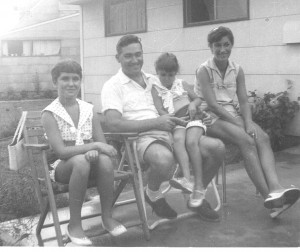
Our family, September 1956

Our family, September 1956

Sisters 2

I wrote about sisters once before– here. I actually enjoyed rereading the post and hope you will too. But today I want to write about a specific issue in the relationship between sisters.

As anyone who is a sister or who has two daughters knows, despite coming from the same genetic pool, sisters can be very different from each other. They can look different.

Ayala (left) and Tamar (right)

Ayala (left) and Tamar (right)

Matan with Lilach (his twin) and Hadas (his older sister)

Matan with Lilach (his twin) and Hadas (his older sister)


And just as they can look very different, they can have different preferences, interests, levels of extraversion, talents, etc. But, just the same, they share so very much that they have the potential of being each others’ best friends through life.

Here’s how.
1. Understand that your sister really is different from you.
2. Understand, though, that there is such a richness in shared ties and experience that your sister can offer you a friendship unparalleled by anyone else.
3. When you have disagreements think about what is at stake.
a. Your pride (you can get over it)
b. Your health and welfare (talk to her about it)
c. Her health and welfare (talk to her about it)
4. Don’t trash your sister to others, whether inside or outside the family. (There are no secrets and this one will come back to bite both of you)
5. And most important: Forgive. Nothing is sadder for a family than being split by the hostility of two of its members.

My sister lives thousands of miles away. I don’t see her nearly as much as I would like. Anyone who met us would tell you that aside from the voices, we have almost none of the same traits. Yet we share a bond that is strong and healthy. It’s one I cherish. Here’s our song.

Savta, Grandma, Bubby, Nana

If new parents have a complaint “no one prepared me for parenthood” and parents of newly married children realize there is no road map to being a mother/father-in-law, there is another path that is far more uncharted. How does one be a grandparent?

You see, most people have been around new babies. They have watched friends or siblings or cousins be new parents. They observe comforting techniques, clever holds, and parent-initiated play. But being a parent-in-law and being a grandparent are far harder skills to learn.

We may have learned that in-laws were outlaws. Comedians told us that mixed feelings were what happened when you saw your mother-in-law driving off a cliff in your new Cadillac. Our own parents may have complained of in-laws’ meddling or of their disinterest. It seems that very few families hit a good balance.

But perhaps, even more problematic is how to define ourselves in the roles of grandparents. For many of us, our own grandparents seemed ancient when we were young, and seeing them as people separate from their grandparent role was so very difficult. They were obviously created only for our comfort, the real purveyors of unconditional positive regard.

At first, it’s not that hard. We coo and we smile and we hold and rock the infants. They are so lovable. I never really understood the word “delicious” until I looked at my first grandchild and now the youngest is just as delicious. But what do we do as they grow older?

Early on I decided that I was not into buying their love. First of all, Israeli homes are small. Secondly, my children buy their children everything they need and much of what they want. They lack for nothing. I didn’t want my grandchildren to look forward to my visits as a gift extravaganza. I also didn’t want to force hugs or kisses on them, as much as they were so very appealing. I remember as a child feeling smothered in my grandmother’s ample bosom. I didn’t want my grandchildren to feel that.

So how do we build healthy relationships with them? How do we let these precious young people know that we love them?

I decided that my home should have interesting things for the children to do when they come. Boxes of Legos, wooden blocks, small cars, little plastic people, and hand puppets are available. We have checkers and chess and playing cards. We have childrens’ videos and books. We sometimes show them home videos of interesting places we’ve been. We placed in the garden little figures in both ceramic and plastic of animals and gnomes that the children enjoy identifying, visiting, and often moving around from one place to another in the garden. Some of the figures are on the ground, some are hanging from trees, and one gorilla is climbing up a large pottery urn. As the seasonal fruits ripen on our trees and vines, together we pick plums, pomegranates, clementines, and lemons. We harvest grapes. We are growing kumquats and in another couple of years, when the fruit may be eaten, they will join the cycle. And we usually have an ample supply of pretzels and chocolate milk. In fact, when the children visit, often they home in on the chocolate milk as if it is a ritual. Of course the other thing we have done is the special trips that by now we have taken 7 of the grandchildren on.

We, of course, talk with them, listen to them, tell them stories about when their parents were young and tell them of our own adventures.

My maternal grandparents and their 6 oldest grandchildren

My maternal grandparents and their 6 oldest grandchildren 1955


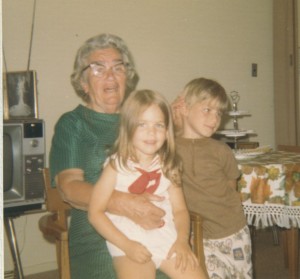
My paternal grandmother and my two oldest children (her great-grandchildren) 1973

My paternal grandmother and my two oldest children (her great-grandchildren) 1973


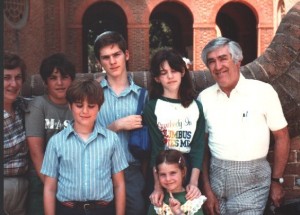
My parents with their grandchildren, 1983

My parents with their grandchildren, 1983

What do you/your parents do as grandparents to foster close relationships with your/their grandchildren?

Yom Kippur

It seems a bit absurd to write about how Yom Kippur was for me this year, yet I cannot help but write.  As a child, I only remember this about Yom Kippur:  My parents would buy tickets for services.  In those years, the synagogue was still small and there was not enough room inside for everyone who wanted high holiday tickets, so they would erect a huge tent that seated maybe 200 people, maybe more, and my parents would attend good chunks of the service leaving us outside to our own devices.  I didn’t want to enter because I didn’t understand anything anyway and inside the tent, it was invariably boiling hot.

Late in the afternoon, my parents and I would ride about a half hour to my grandparents’ synagogue and arrive just in time for Neila, the last service of the day.  My mother would walk with us up the stairs of the synagogue into the women’s section.  The women’s section was populated with women of my grandmother’s age, all elderly (in their 50’s!) immigrant women who spoke with heavy Eastern European accents.  My grandmother was always really happy to see us when we showed up.  My cousins and their mothers too would arrive and always there was discussion as to which of the huge flower arrangements my mother and her siblings had bought for the synagogue in honor of their mother.

After the service, we would return to my grandparents’ home with the flowers.  They always consisted of  a large percentage of chrysanthemums and the smell of chrysanthemums usually reminds me of my grandmother.

I am now older than my grandmother ever was.

I am lucky enough to be living in Israel where on Yom Kippur, the entire country stops.  There are no Israeli television channels broadcasting and no radio.  Aside from one police car, I saw no cars on the roads.  In the evening, the park was filled with adults and children.  It is amazing!

This year, at services in our bursting-at-the-seams synagogue, I was privileged to have 16 of my grandchildren.  I pretty much was bursting with happiness seeing all of their beautiful faces.  The older ones, serious about their prayers, remained inside for large parts of the services and some, notably, for all of them.  The younger children, happily wandered in and out.  The youngest were held in their mothers’ or fathers’ or siblings’ arms.  The language we prayed in was the language they live.  The synagogue held familiar people.  The melodies were ones the older children had sung many times before.

And the service…  I don’t think it was my imagination.  Our congregation has been going  for about 13 years.  I think it has come of age.  The singing of large parts of the service was no less than inspiring.  Just as we repented in group fashion as one people, we sang in one voice and if the heavens were open, I can’t imagine more sincere petitions or more beautiful sounds of praise entering the holy gates.

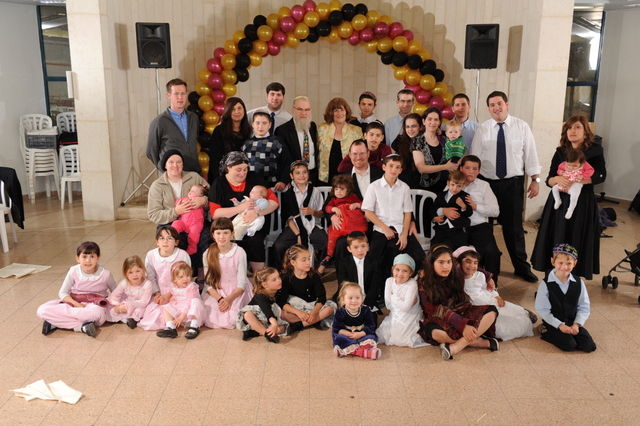
The family, unretouched, missing three children

The family, unretouched, missing three children

Missing: Amiel Michelson, Elazar Michelson, Shlomo Goodman

May all of you have a healthy, happy, prosperous New Year!

Why I am not wishing “peace” this year

Every year at Rosh Hashana, we exchange the wishes for a happy, healthy, prosperous new year. I used to put “peaceful” into that mix, but this year, I just can’t do it. I know that it is a lie. Peace is not just around the corner.

You see, the problem we have here in Israel is not that we don’t want peace. It’s not that we won’t give up the building of homes in communities in Judea and Samaria. What it is is an ideology fed to Arab children from the day they are born that has to do with eradicating the Jews from all of Israel. I believe that peace cannot come from conferences, from concessions, from cajoling, or from horse-trading. Peace will come when a responsible Arab leadership cares more about the life of their people than about the destruction of mine.

All attempts we have made have only emboldened the radical elements. If they believe that we are tired, sick to death of the terror and the pain, then they will only give us more so that we give up, capitulate, leave.

Economic success, educational success, building a society that serves the needs of its citizens is what will bring about a change in the mind set. It is what will make this senseless hatred recede as parents educate their children to achieve and to value knowledge and to love learning instead of longing for “martyrdom.”

So my prayer, it isn’t for peace. It is for the beginning of a change in the hearts and minds of the people who want to destroy me and my people. I pray that G-d will open their hearts to the knowledge that their children are precious gifts as are all of G-d’s children. I pray that by next year, the Arab parents will begin to value their children and their children’s future. I pray that responsible Arab leadership will focus on what they can do to help their people live happy meaningful lives.

Musings on the first day of school

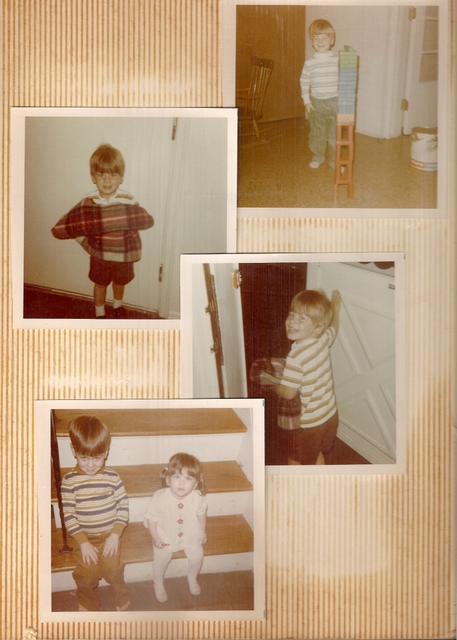
It’s the first day of school for most of the schools here in Israel. It set me to thinking about my oldest child’s first day. Here is the album page– the photos are so glued as to be destroyed if removed. The middle two pictures are from the first day of school. The upper picture is of one of his building projects. The lower picture is with his sister, Rachel.

Benjy's first day

Benjy's first day

I remember his first day of nursery school. His teacher was a gentle, kind, woman who believed in reason and calm discussion. His nursery school was located in the synagogue where my husband served as rabbi, and so it was not very worrisome to have him away since I knew his father was close by.

He was the kind of child who played his cards close to his chest. Introverted. He didn’t tell me a word about what was going on at school. I would hear from the other parents about the visits of musicians and of fantastic art projects and incredibly creative activities. He told me nothing. But it wasn’t worrisome, because I knew his father was nearby and that he was safe.

Well, kind of safe.

I remember the first time the teacher called to tell me that Benjy had run away from school. The school was the equivalent of close to a mile by car or across a number of parking lots and down the side of a steep hill from our house. This was not good news. Benjy was found within about a half hour, but I was shaking for a lot longer.

The second time he ran away from school, he was a bit smarter. He took a little girl with him and before the teacher noticed, they had already traversed the hill and the parking lots, I suppose, because she couldn’t find them. She called and asked me to go out and look for them. I was at home with three little children, ages 3, 17 months, and one month. I was not able to go and look. I was able to panic. Fortunately, the two showed up at my back door not long afterwards.

As the other children grew up and started school, the first day was a happy day for them and for me. The others were not nearly as adventurous as their big brother, (although just as mischievous, each in his/her own way).

It was only when the youngest went to nursery school for the first time that I was swept away by the feeling that I was not just relinquishing control of her, but that I was trusting the world to take good care of her. I knew too much about the world to feel confident that others would treat her the way I wanted her treated– with kindness and gentleness. As I sat in the room with her the first day and the teacher distributed the juice in tiny cups, I saw her take her cup and put it to her lips. I thought, “she is going to drink what is given to her. Please let the world serve her only good things.”

Today most of my grandchildren start school once again. A few are going to day care for the first time. I pray that the world treats all of these precious children as they deserve to be treated. I pray that they will become the kind of people who will make the world a better place.

Not a zero-sum game

I have been thinking lately about families and what makes them so important for the individuals in them. Of course there’s love and affection. Of course there is respect and consideration. And there also is loyalty. When I wrote a couple of days ago about competition and how it is unhealthy in the context of a family, I didn’t talk about one very important concept: the zero-sum game.

The zero-sum game, briefly is: A situation or interaction in which one participant’s gains result only from another’s equivalent losses. Source: here

Unfortunately, most of us go through life thinking it’s a zero-sum game. That’s why people are so competitive. “I can only win if the other guy loses.”

When my children were young, we had a book of cooperative games. Instead of “King of the Hill” where one person gets to the top of the hill and pushes all of the others down, the book recommended a game where as many people as possible get to the top of the hill and they cooperate to see how many they can hold up there. Games which foster cooperation also foster healthy relationships. Games like “Red Rover” where everyone is on the winning team help children understand that there doesn’t have to be a loser.

When family member achieve personal or professional expertise, other family members need to not just be happy for them, but to rejoice in it for themselves. Every strength of every member of the family only increases the others’ strength. As my children excel in areas I can’t even touch or understand, I feel personally enriched. I share in their happiness. And, fortunately, that is how they feel about each other.

Shel Silverstein said it well:

Yonatan and his little sister Naomi Elisheva

Yonatan and his little sister Naomi Elisheva

Hug O’ War

a poem by the late Shel Silverstein
[Author of A Light in the Attic]

I will not play at tug o’ war

I’d rather play at hug o’ war,

Where everyone hugs

Instead of tugs

Where everyone giggles

And rolls on the rug,

Where everyone kisses

And everyone grins

And everyone cuddles

And everyone wins.

Pomegranates 2

I had so many lovely comments about the pomegranates that I was stunned. A few people commented that they had never seen what they look like growing on a tree. Since we harvested only some of them, I have included some pictures of the fruit laden tree in our garden.

Here is a view of the garden:

A view of the garden

A view of the garden

When we bought our house, I never realized how much pleasure I would get from that garden. We have only a small patch of grass, but yesterday it served as a base for the inflatable swimming pool I bought before I moved into the house. Yesterday was the first time I used it. Kinneret, 2 years old, enjoyed playing in the pool, emptying water from cup to cup and having my husband and me and her pouring the cups of water on her back, her head, and her chest. She giggled and laughed and splashed. It was idyllic– and it took place in the shade of the pomegranate tree.

The tree arching over the path

The tree arching over the path

And here are a couple of the growing pomegranates

Still ripening

Still ripening