Mazal tov, Matan!

It’s hard to believe, but we are in the full swing of Bar/Bat Mitzvah season… I expect it to last for many years even as wedding season will begin to overlap.

By now there are 3 Bat Mitzvah girls and 2 Bar Mitzvah boys and today, the third put on his tfillin for the first time. All of us went out to celebrate together. OK, not ALL of us, but all of my children and some of the grandchildren.

It says so much about the future- not just the future of our family, but the future of the Jewish people, as I see these young people take their place as contributing members of the community with dedication. Their bright beautiful faces give me hope.

Read what my daughter Rachel said about this special day in her son’s life. here
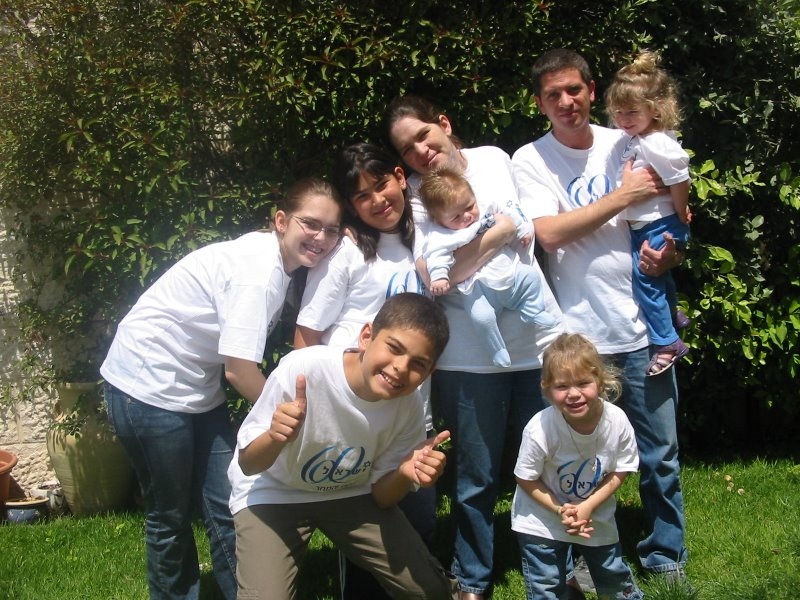
My father and my grandchildren

My father died too young.

He was a good man. He was kind and gentle and he loved his family. He loved nature and he loved beauty. He had a pleasant demeanor and everyone he met liked him. He had artistic gifts and was able to draw, paint, sculpt, build furniture, and take amazing photographs. Above all, he was my father.

He lived to see all 5 of his grandchildren. He got a tremendous amount of pleasure from spending time with them and learning of their achievements. I remember the day my oldest son went with him to a Radio Shack and he showed my father what he could make the TRS80 do. My father was completely stunned and amazed. Whenever we visited, he would tell me the same thing as I left: “Drive carefully; you have precious cargo.” He would tell me, “You are rich; you have 5 million dollars.”

As we all do, when happy times come, I think about my father and how I would have wanted him to be with us. Sometimes, though, I get a very clear picture of how it would be. For example, on Yom HaAtzmaut.

He would see and talk to each of my grandchildren. I can see his face beaming as one after the other was a delight for him to meet and get to know. I can see him laughing and joking with them. I can see him looking up in the trees at my little monkeys who have climbed them and shaking his finger and saying “Get down now, boys!” with a big smile on his face. I see him watching the little girls walking to and fro and enjoying the babies and then I see him talking to the children and telling them he wanted to take them up to Titora Hill to take some pictures of them, knowing all along that he would be pointing out the birds and the flowers along the way. I hear him calling them, “Come along, kinderlach!” and I see them happily skipping away after him.

Update

It’s been a very busy week, what with the launch of my new web log and learning how to arrange text and pictures and making tons of mistakes and uploading the same pictures 3 and 4 times without understanding that once they are there, they are there…

But it’s an adventure and what’s making it all the more pleasant is the prospect of actually being able to let people see why these tours I do are so incredibly fascinating.

But that’s for the other site..

After all of the excitement of greeting the new Olim who are living in our upstairs apartment and helping them get settled in, preparing for Pesach, having guests from outside of the country, and the Bar Mitzvah or our grandson Daniel, I was under the impression that things would settle down. But no. This week we have Israel’s Memorial Day and following that, Independence Day. That means that two and a half days (remember, Memorial Day starts the evening before) this week will be taken up with these commemorations. And it’s not like the US where you can ignore these days. The stores close. And EVERYONE is involved in one way or another.

Of course the traditional way of celebrating Independence Day here is by having a barbeque. And the truth is that most people do that. Our family, instead, will be meeting for a picnic brunch so that the children can play soccer and generally run around and have fun. Later in the day, I suspect that most of them will be at traditional barbeques while I recover.

Rachel and family, Independence Day, 2008

Rachel and family, Independence Day, 2008

I always wondered how I would deal with the boredom once all of my children were out of the house. I still haven’t gotten to the boredom part. I am indeed blessed!

Giving birth

Can you believe it? At my age? But it’s true. My incredibly talented doula has enabled me to give life to a new blog that is devoted to information and experiences related to travel to China, Vietnam, and Cambodia. It can be found here. This is not a replacement for this blog. It is an additional blog. Here at drsavta.com, I will continue to talk about life in Israel, parenting, spirituality, emotional health, and family life.

Meanwhile, here is a picture of last week’s Bar Mitzvah boy, my grandson, Daniel Michelson, juggling torches for the first time– at his Bar Mitzvah party.

Daniel juggling torches

Daniel juggling torches

TWTSTW*

This is a post that will need to write itself since I want to write about the seder, but have no idea of where to start. First of all, the logistics: Israeli homes are on average, the size of US elevators so our seder configuration was roughly equivalent to an elevator at Macy’s on the day after Thanksgiving, except that the average age was about 15 months. OK. I exaggerate. The children’s ages: 15, 15, 12,12,12,11,9,7,4,4,3,1.5,1,7 months, 3 months. The fact that the youngest 5 were 3 and under led to a substantial amount of motion and noise. The truth is that all of them were super-adorable. But imagine 5 super-adorable puppies… you get the point. This entailed less barking and a bit less biting, but just as much action.

But all that aside, the family was beautiful. Each and every one of them looked wonderful. We enjoyed reading and chanting and singing together, even when one or more of us were off-key and/or making up our own melody that was similar to but not identical to the ones we are accustomed to singing. There was a feeling of happiness and a real sense of tradition. It all really was worth it. I only pray to enjoy many many more with the ones I love!

*That was the seder that was

Ahhhh

A sigh of relief. It’s almost done. Can’t wait to see all of the happy smiling faces. It’s worth it. All of it.

Training parents– Part 1

Well, since you asked….

Many people have the same concern: Why can’t my/my spouse’s parents understand that we are adults who are caring for our own children? Why do they think we can’t make healthy decisions on our own? Why do they think they have to tell us what to do?

The simple answer is that for some reason, these grandparents/ parents of adults forgot that their children grew up. They don’t know how to offer support without imposing control. The tighter they attempt to hold on to control, the stronger the adult child’s need to put some distance between him/herself and the parent.

Often, this creates friction in the younger couple. In general, people want to be kind and loving toward their parents, but the parents’ actions can make that difficult.

Let’s take David and Donna, two fictional people who we are meeting for the first time today. David’s parents live at a great distance from them, but they maintain telephone contact and most of the time the interactions with them are pleasant, if not extremely close. Donna, on the other hand, lives only a few blocks away from her parents. Donna’s mother calls her several times a day. She asks her what she is feeding her children for each meal, what clothing size the baby is, how much weight Donna has lost since the baby’s birth. In addition, Donna’s father needs to know how much money Donna and David are putting into savings each month and whether David has found a good financial analyst. He also asks Donna questions about David’s work that even she doesn’t know the answers to. On their frequent, unplanned visits, Donna’s mother checks out the amount of dust under the sofa and comments on the dirty dishes in the sink. Donna’s father suggests that the houseplants need to be fertilized and they are being under-watered.

Is it any wonder that David blows his top after every interaction with Donna’s parents? He resents not only their interference in his life, but also their interference in Donna’s. Donna too resents her parents badgering, but she feels angry when David points it out. She even sometimes says things like, “Oh, so your parents are so perfect– like if we all died they wouldn’t know until a week from Tuesday when they get around to calling again.” David, of course, then responds with something like, “Well at least they aren’t always in my face; your parents are suffocating me!” Donna, feeling defensive then responds with something like, “Well, at least they care!”

And so on.

The truth is that the problem is not with David and Donna. It is that Donna’s parents have not yet figured out that she grew up. She no longer asks them for money and she has made good decisions. But somehow, they haven’t gotten it that she grew up! Perhaps they are so used to being in control that they don’t know how to give it up. Perhaps they don’t know another way to be close to their adult daughter. And perhaps their life lacks other sources of connection and satisfaction.

Think of it… It take a lot of energy to be controlling. When would one have time to have fun?

Clearly, Donna’s parents are not going to change on their own. The change in the relationship has to come from both David and Donna. They need to redefine the problem as inappropriate boundaries. Simply put, Donna’s parents have been breaching the marital fence that David and Donna have constructed. Somehow or other, the “no trespassing” signs have not been seen or taken seriously. David and Donna need to strengthen that fence. Depending on the types of intrusion, there are several strategies.

Today let’s start with time boundaries

Telephone:

There should be clear “call” and “no call” hours. Donna’s parents should be informed that because of their family activities and Donna’s need for things like sleep and a shower and feeding the baby and cleaning and straightening and cooking, it is not a good idea to call before x hour in the morning or after x hour at night. If a phone call does come in at those hours, then David or Donna needs to politely say, “I’m sorry, this isn’t a good time; can you call me at [and supply a time within the call hours]?” If they persist, say, “I really do want to hear what you have to say, but I need to put down the phone now. ‘Talk to you later. Goodbye.”

I know it sounds harsh, but it is necessary to be clear and consistent. Hints won’t make it! They need to know that there is no talking or listening outside of normal talk/listening hours.

Next time: Visiting time boundaries

Dreams

One of the most amazing things about fulfilling a dream is that once fulfilled, one is again and again reminded of how it looked from far off and once again one can feel the joy of its having been accomplished.

One way in which I experience this is in my feelings for living in Israel. My first consciousness of Eretz Yisrael came when as a child I heard my maternal grandmother at the end of the seder tell the family that it was her intention to take the whole family to Israel next Pesach. I believed then and still believe today that that is what she truly wanted to do and probably would have, had she lived long enough.

In Sunday School and Hebrew School, we talked about Israel, but it wasn’t until I saw the movie Exodus that my longing to visit Israel began. It was only after a broken engagement that I got to see the land for the first time in 1965, and only after twelve years of marriage and five children that I returned in 1978. The real longing to live in Israel started then and intensified when our oldest son left the US to study at Hebrew University in 1984 and finally, after each child had come to live in Israel on his or her own, I joined them. My father-in-law and husband were the last of the family to arrive.

And you would think that after ten years in Israel, seven of them living in our own home, I would just take living here for granted. But you would be wrong.

Every morning waking up to the sweet smells of our garden, I am reminded of the beautiful place that I live. Each trip to Jerusalem makes me love her ancient stones more intensely. Our trip to Sde Boker and Ein Avdat brought me the awe of desert landscapes with colored sands and rich wadis and waterfalls. And last weekend, our shabbat at Karei Deshe allowed me to hear the gentle lapping of the waters of the Kinneret (Sea of Galilee) at night and to watch the sun shimmering in its waters in the day.

These places are not just places. They are spiritual landmarks, places where I meet God’s works face to face and experience a closeness to Him and a feeling of serenity and completeness.

And I think about what I hoped I would find when I got here, and I am awed that I have found so infinitely more.

Pre-Pesach Cleaning Disorder (PPCD)

Alert:
New diagnostic category added to DSM-IV-R
PPCD: Pre-Pesach Cleaning Disorder

This is a recently discovered disorder, recognized as a seasonal disorder, usually coming in early spring. It is characterized by obsessive thinking about cleanliness, far out of normal proportions. It is distinguished from Obsessive Compulsive Disorder 300.3 by several symptoms.

1. Obsessive focusing on small particles of food throughout the house to the extent of climbing onto bookshelves and behind toilets to ferret out particles smaller than the eye can see.

2. Compulsive washing of objects that are ostensibly clean (e.g., one patient was found putting her children’s Legos into a sock bag and washing them. This was discovered by a disturbed neighbor who couldn’t figure out what could possibly be banging so loudly and incessantly in the dryer. The patient, when confronted said, “Well, what did you expect– for me to put them in the toy box wet!”)

3. Incessant moving of common objects from their normal places (e.g., dishes, silverware, etc. are wrapped up and/or banished from their normal shelves and drawers.)

4. Talking with friends and acquaintances about topics formerly of no interest (e.g., effectiveness of different oven cleaners, location of most pungent horseradish.)

This disorder seems to occur in a social context. Frequently groups of women become pre-occupied with cleaning simultaneously.

Presumptive symptoms:
1. Spring time frame.
2. Patient is a woman.
3. Patient reports insomnia.
4. Patient has red hands.
5. Patient has a heavy odor of cleaning substances.
6. Patient does not have time to talk about it.

Treatment:
This disorder has a guarded prognosis. Although patients uniformly recover within several weeks, they tend to relapse around the same time each year.

There are reports of cessation of symptoms if they are taken away for a week to a hotel each year.

Okey Dokey

I had the good fortune to have known all of my grandparents. Each one of them occupies a special place in my heart. Just thinking of each of them opens a medley of images. I remember things they used to say to me. Those phrases told me what they thought of the world, how they saw life, what their aspirations were.

Being a grandmother myself, sometimes I wonder what it is that my grandchildren will remember of me. Because of my intense curiosity about my grandparents, I have been writing an autobiography for those of my grandchildren, if any, who might want to know something about my life. However, I am fairly certain that most of them will never look at it and so they will be left only with the memories we make together.

A while back we were with one of our granddaughters and she started laughing after I said something. I asked her what she was laughing about and she said, “You always say ‘okey dokey.’” Within the next week or two I heard a grandson from another family saying, “Like you say, Savta—okey dokey.” For a few months after that we heard echoes of “Savta says ‘okey dokey.’”

Well, it’s true. I do say “okey dokey.” To me, it means that things are not just OK, but really OK—fine, fun, happy. If that’s what they remember about me, well, that’s okey dokey!